

Search Engine Marketing, or SEM, is a game-changer for attorneys. It’s a powerful one-two punch that combines paid ads (PPC) with organic search optimization (SEO) to put your firm in front of clients the exact moment they’re searching for legal help. When done right, it drives high-intent traffic—people who need a lawyer now—straight to your door.
Why SEM Is A Cornerstone For Modern Law Firms
In today's world, if your law firm isn't on the first page of Google, you might as well have an office with no sign. Attorney search engine marketing is that sign. It’s the direct line connecting you to people actively looking for legal counsel.
This isn't like running a billboard and hoping for the best. We're talking about precision targeting. When someone types "personal injury lawyer near me" into Google, they aren’t just browsing. They have an immediate, pressing need. SEM puts your firm right there at that critical point of decision. To get started on the right foot, it's essential to understand the core Search Engine Marketing best practices.
The Power Of Organic Search
The data doesn't lie: organic search is king in the legal space. A staggering 52.6% of all traffic to law firm websites comes from organic search results, while paid ads bring in around 15%. Considering that 96% of potential clients use a search engine when looking for an attorney, showing up organically isn't just a good idea—it's absolutely critical for sustainable growth.
This infographic breaks down exactly how potential clients are finding law firms online.
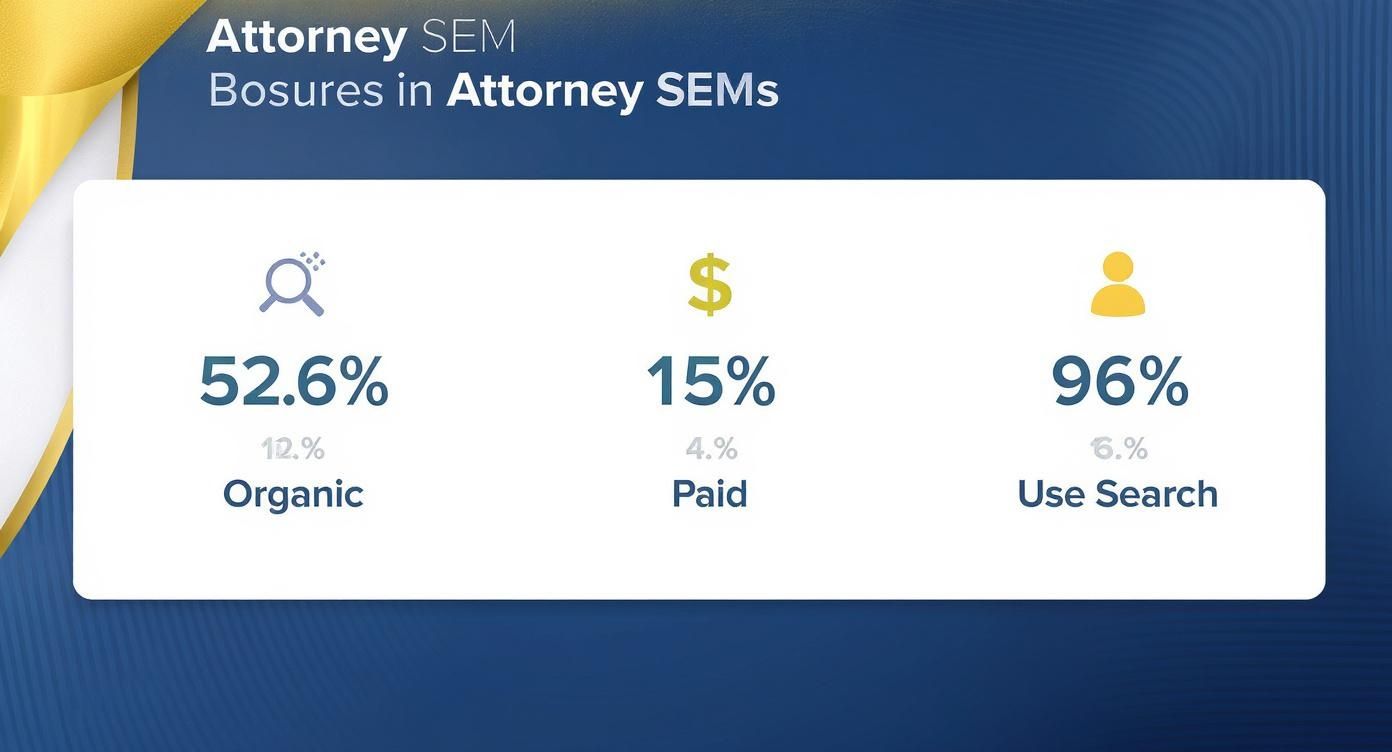
As you can see, an organic-first approach is non-negotiable if you want to capture the largest share of potential clients.
SEM isn't a single tactic but a complete system. It integrates the immediate visibility of paid ads with the long-term authority and trust built through SEO, creating a reliable client acquisition engine.
To help illustrate the distinct roles of paid and organic search, let's look at how they compare side-by-side.
Organic vs Paid Traffic Comparison
| Channel | Traffic Share | Average ROI | Conversion Rate |
|---|---|---|---|
| Organic Search (SEO) | ~53% | High (long-term) | Strong (trust-based) |
| Paid Search (PPC) | ~15% | Moderate (short-term) | High (intent-driven) |
While paid search delivers immediate, high-intent leads, organic search builds the foundation for long-term trust, authority, and a steady stream of cases at a lower cost-per-acquisition over time.
By combining both, your firm gets the best of both worlds—short-term wins from ads and long-term stability from top organic rankings. You can learn more about crafting this kind of holistic plan in our complete guide to digital marketing for legal firms. This blended approach ensures you capture attention from every possible angle.
Digging for Gold: Market and Keyword Research

Before you spend a single dollar on an ad, you need to get inside the head of a potential client. A winning SEM campaign is built on a deep understanding of the exact words and phrases people type into Google when they’re in trouble and need a lawyer.
This is the bedrock. Get this wrong, and you're just throwing money away.
Think about it from a client's perspective. An employment lawyer might assume everyone is searching for "wrongful termination lawyer." That's a good term, for sure. But what if there's a huge, untapped pool of potential clients searching for things like "is my boss allowed to cut my hours" or "hostile work environment lawsuit"?
Solid keyword research uncovers these hidden opportunities. It's not just about finding keywords; it's about understanding the intent behind them. Someone looking for "what is a misdemeanor" is just gathering information. But someone searching for a "criminal defense attorney in Los Angeles" is ready to make a call. Your campaign has to account for both.
Building Your Digital Toolkit
To do this right, you need the proper tools. Think of them as your investigative team, gathering intelligence on what your market is actually searching for.
-
Google Keyword Planner: This is your starting point. It's Google's own tool, giving you a direct line into search volume data and estimated costs. It’s essential for building a realistic budget.
-
Ahrefs or SEMrush: These are the heavy hitters. They let you spy on your competitors, see what keywords they're bidding on, and uncover long-tail phrases that the basic tools might miss.
With these tools, a family law firm might discover that while "divorce lawyer" is a high-volume (and high-cost) keyword, a term like "child custody mediation services" has a lower cost-per-click and attracts a client who is a much better fit for their practice. That's the kind of insight that turns an average campaign into a profitable one.
The most successful keyword strategies are a mix. They blend the big, high-volume terms with hyper-specific, long-tail phrases. This approach lets you catch potential clients at every single stage of their journey, from early research to "I need to hire someone now."
Finding Gaps in the Market
Your competitors are a goldmine of data. By analyzing their paid search campaigns, you can see what’s working for them and, even better, what they’re completely missing.
Maybe you're a criminal defense firm and you see your main rival is spending big on state-level keywords. But you also notice they're completely ignoring valuable, city-specific terms like "DUI lawyer Santa Monica."
That gap is your opening.
By targeting these hyper-local keywords, you can intercept highly motivated clients right in your backyard. This is where a keyword matrix comes in handy—it’s just a simple way to keep everything organized.
Here’s what a basic matrix might look for a personal injury firm:
| Keyword Theme | Primary Keyword | Local Modifier | Long-Tail Variation |
|---|---|---|---|
| Car Accidents | car accident lawyer | near me | what to do after a fender bender |
| Slip & Fall | slip and fall attorney | in Los Angeles | grocery store slip and fall settlement |
| Medical Malpractice | medical malpractice lawyer | California | surgical error lawsuit statute of limitations |
This organized approach ensures your attorney search engine marketing is strategic, not scattershot. It also forces you to align your paid search strategy with your website's content and SEO—a crucial connection for long-term success. To learn more about how this all fits together, check out our guide on understanding the fundamentals of SEO for law firms.
By weaving together broad practice area terms with local modifiers and long-tail questions, you build a powerful digital net capable of catching clients no matter how they search.
Building Your Campaign Structure and Ad Creative
With your keyword map in hand, it's time to build the architecture of your campaign. A disorganized Google Ads account is a money pit, plain and simple. It's like trying to run a law office with client files scattered everywhere—you can't find what you need, and you waste precious time and resources. Getting the structure right from the start is absolutely essential for controlling costs and pulling in high-quality leads.
Think about it this way: a real estate litigation practice shouldn't just dump all its keywords into one bucket. Someone searching for a "foreclosure defense attorney" is in a completely different—and often more desperate—situation than someone looking for a "tenant rights lawyer." A well-built campaign isolates these into distinct, tightly-themed ad groups. This ensures your ad copy and landing page for "foreclosure defense" speak directly to that specific, urgent problem.
This meticulous separation is the secret to a high Quality Score, which is Google's way of grading the relevance of your ads, keywords, and landing pages. A better score means you pay less for clicks and get better ad positions.
Mastering Keyword Match Types
You absolutely have to control who sees your ads. Paying for clicks from people searching for something totally irrelevant to your services is the fastest way to burn through your budget. This is exactly what keyword match types are for.
- Broad Match: This is the widest net you can cast. It shows your ad for searches related to your keyword, including synonyms and concepts you might not have even thought of. Use this one with extreme caution—it’s notorious for attracting unqualified traffic.
- Phrase Match: This is the sweet spot for many firms. Your ad can appear for searches that include the meaning of your keyword. So, for the phrase match "personal injury lawyer," your ad might show up for "find a personal injury lawyer near me." It strikes a great balance between reach and control.
- Exact Match: This is the most restrictive and gives you the most control. For "[car accident attorney]," your ad will only show for that exact search or incredibly close variations. You know the intent is spot-on.
I almost always recommend that law firms start with a strategic mix of phrase and exact match keywords. This combination gives you the best control over your spend while making sure you're still reaching the right audience.
Crafting Ad Copy That Actually Converts
Your ad headline is your first impression in a sea of competitors. It has to be compelling, trustworthy, and incredibly clear. Ditch the generic fluff like "Best Law Firm" and get straight to the point about why you're the right choice for their specific legal crisis.
Highlighting credentials or proven results works wonders.
- Headline 1: Certified Family Law Specialist
- Headline 2: Over 200 Cases Won – Free Consult
- Description: Facing a tough custody battle? Our team has the experience to protect your rights. Call now for a confidential review of your case.
This ad works because it instantly establishes credibility ("Certified"), provides social proof ("200 Cases Won"), and gives them a clear, no-risk next step ("Free Consult"). When you're trying to nail down the perfect messaging for ads and landing pages, smart tools can make a huge difference. You might even consider using advanced AI content creation tools to help brainstorm and test different angles more efficiently.
The most effective ad copy in attorney search engine marketing isn't about being clever; it's about being clear. A potential client is often in a stressful situation—your ad should offer a straightforward solution and a reason to trust you.
Leveraging Ad Extensions To Stand Out
Think of ad extensions as free real estate. They're extra snippets of information that make your ad bigger, more informative, and more likely to get clicked. They push your competitors further down the page and don't cost you a penny extra to use. It's a no-brainer.
- Sitelink Extensions: Add direct links to important pages on your site, like "Case Results," "Attorney Profiles," or "Contact Us."
- Call Extensions: Put your phone number right in the ad. For mobile users, this means they can call your firm with a single tap.
- Structured Snippets: Quickly highlight key aspects of what you do, like "Practice Areas: DUI Defense, Drug Offenses, Assault."
Setting these up gives potential clients more context and builds a foundation of trust before they even click. For a deep dive on how to implement these, check out our comprehensive guide to Google Ads for lawyers. By using every tool at your disposal, you don’t just get more clicks—you get the right ones.
Aligning Landing Pages With SEO Best Practices
You might have the sharpest ad in your toolbox, but if the landing page falls flat, every dollar you spend evaporates. Effective ads set clear expectations—and your page must deliver on that promise from the moment someone clicks. A seamless transition reinforces trust and keeps prospects on your side.
When ad copy and landing page messaging don’t align, that disconnect jars visitors and drags down campaign performance. Google calls this consistency ad scent, and it’s rewarded with higher Quality Scores, which drive down your cost per click. If your ad touts a “free consultation for car accident victims,” that exact phrase needs to greet every visitor on the page.
In one real-world case, a personal injury practice watched its lead costs skyrocket. Their misstep? Sending all their ads to a generic homepage. After building hyper-targeted landing pages—one for truck accidents, another for slip-and-falls—and trimming the contact form to just three essential fields, they saw a 35% spike in qualified leads in a single quarter.
Weaving SEO Into Your Landing Pages
Even if your pages start life as paid campaign destinations, they shouldn’t ignore SEO. Laying in solid on-page fundamentals makes each page work overtime—bringing in both paid clicks and organic visitors over time.
- Title Tag & Meta Description: Use your primary keyword clearly to guide both users and search engines.
- H1 Matches Intent: Make sure your main headline mirrors the promise in your ad.
- Subheadings (H2, H3): Break up content and weave in related keywords naturally.
- Image Alt Text: Describe each image for accessibility and SEO. For example, “Smith & Jones law office in downtown Los Angeles.”
- Internal Linking: Connect to relevant service pages or blog posts to spread authority and guide users.
- Mobile-First Design: With more legal searches happening on smartphones, buttons need to be easy to tap and forms quick to complete.
Designing For Trust And Action
A law firm landing page has two clear missions: establish immediate trust and make the next step obvious. Every element on the page needs to serve one of those goals.
Think of your landing page as a digital handshake: it needs to radiate competence, empathy, and clarity within seconds. Any clutter or slow loading time will send prospects clicking away.
| Element | Purpose | Example |
|---|---|---|
| Clear Headline | Immediately confirms the page’s relevance. | "Aggressive DUI Defense in Orange County" |
| Trust Signals | Builds credibility and reduces hesitation. | "Super Lawyers" badges, bar association logos. |
| Client Testimonials | Provides social proof from real people. | A short quote or video from a satisfied client. |
| Simple Form | Removes friction from the conversion process. | Name, Email, Phone Number. That’s it. |
| Click-to-Call Button | Caters to mobile users needing immediate help. | A large, prominent button with your phone number. |
By focusing on these core components, you create a visitor journey that naturally leads to contact. For more strategies on building high-performing legal websites, check out our guide on website optimization for law firms.
Tracking Analytics And Optimizing Performance

Launching an SEM campaign without solid tracking is like walking into a deposition unprepared. You might stumble through it, but you’re burning through time and money with no clear strategy. Smart attorney search engine marketing isn't a "set it and forget it" game; it's a constant cycle of measuring what's happening, figuring out why, and making calculated adjustments based on cold, hard data.
Stop guessing. Every click, call, and form submission is a clue, a piece of evidence telling you exactly what your potential clients need. By setting up the right analytics from the very beginning, you transform a spreadsheet full of numbers into a strategic roadmap, driving down your cost per signed case.
Establishing Your Conversion Tracking
First things first: you have to define what a "win" actually looks like for your firm. A conversion isn't just a click—it's a valuable, specific action taken by a potential new client. These are the metrics that actually matter.
- Form Submissions: Someone fills out your "Free Case Evaluation" or "Contact Us" form.
- Phone Calls: A user clicks the phone number in your ad or on your landing page to call your office.
- Live Chat Engagements: A visitor starts a real-time conversation with your team or chat service.
Getting these conversion events properly configured in both Google Ads and Google Analytics is absolutely non-negotiable. This is what allows you to see precisely which keywords, ads, and campaigns are generating real leads, not just website traffic. Without this foundation, you’re flying blind.
The entire goal is to move past vanity metrics like impressions and clicks. A high click-through rate means nothing if none of those visitors ever pick up the phone. You have to focus exclusively on the actions that lead to new clients.
The Art Of A/B Testing
Once your tracking is solid, the real work of optimization begins. This is where A/B testing, or split testing, comes into play. It’s a simple concept: you run two slightly different versions of an ad or landing page at the same time to see which one performs better.
The key is to test one thing at a time. If you change the headline, the button color, and the main image all at once, you’ll never know what actually made the difference. Isolate single variables for clean, unambiguous results.
Try testing things like:
- Ad Copy: Pit a headline focused on "No Win, No Fee" against one that highlights your "20+ Years of Experience."
- Landing Page Headline: See if "Expert Car Accident Lawyers in Miami" pulls better than "Injured in a Miami Car Crash? Get a Free Consultation."
- Call-to-Action (CTA): Test the performance of a contact form at the top of the page versus one at the bottom.
By methodically testing and implementing the winning versions, you'll see small, incremental gains that really compound over time, dramatically improving your campaign's return on investment. For a deeper dive on this, check out our guide on measuring advertising effectiveness.
Interpreting Key Performance Indicators
Your campaign dashboard is overflowing with data, but you need to know which numbers actually matter. Metrics like Quality Score are critical because they directly influence your ad rank and how much you pay per click. Improving this score should always be a priority.
It's also worth noting how paid and organic search work together. Recent data shows that the average visitor-to-lead conversion rate for organic SEO traffic is 7.4%, which is significantly higher than the 4.3% for paid search. This just underscores the need to align your SEM campaigns with a strong SEO foundation to attract those high-intent leads who are ready to talk.
To keep your campaigns lean and effective, constantly watch the performance data and adjust your bids accordingly. Think about setting up automated bid rules that push your ads harder during the peak hours when potential clients are most likely searching. This data-driven approach means you can cut failing ads loose quickly and funnel that budget into the campaigns that are actually delivering for your firm.
Managing Your Budget and Deciding: Agency vs. In-House

One of the toughest conversations we have with firms revolves around this very topic. Do you build your own marketing engine from the ground up, or do you bring in a specialized agency to run it for you? This is the classic "build vs. buy" dilemma, and it's a decision that really depends on your firm's budget, ambitions, and existing resources.
There’s no single right answer here. An in-house approach gives you ultimate control and deep, focused knowledge of your firm's specific needs. On the other hand, partnering with an agency grants you immediate access to a team of battle-tested experts. Let's dig into how to make the right call.
Forecasting Your SEM Budget
Before you can figure out who will run your campaigns, you have to know what you’re willing to spend. A midsize firm might earmark $100,000 for their annual SEM budget, but how that money gets split between long-term SEO and immediate-impact PPC can look wildly different depending on your practice area.
A business law firm, for instance, might dedicate 60% of that budget to building organic authority through SEO. But a personal injury firm in a hyper-competitive city might have to push 40% or more into PPC just to get a seat at the table.
Budgets for attorney search engine marketing have ballooned for a reason: it works. By 2025, it’s not uncommon for a law firm to spend $120,000 to $150,000 a year on SEO alone. That sounds like a lot until you see the returns. Firms consistently report an average 526% ROI from their SEO efforts over a three-year period. You can see more data behind these numbers in these legal marketing statistics and insights.
The question isn't "How much will this cost me?" It's "What is one new, qualified client worth to my practice?" Once you have that number, building a budget that aligns with your revenue goals becomes much clearer.
As you map out your spending, keep these variables in mind:
- Practice Area: Personal injury and mass torts have some of the highest keyword costs, demanding a hefty PPC budget.
- Geographic Market: Trying to rank in Los Angeles is a completely different financial ballgame than targeting a smaller city.
- Growth Stage: Are you a new firm trying to make a splash? You’ll likely need a more aggressive upfront investment to gain traction.
We've seen how these factors play out across different legal specialties. Here's a look at how annual spending and ROI can vary.
SEM Budget Allocation by Practice Area
The table below provides a snapshot of typical annual SEM budgets, how they're often allocated between PPC and SEO, and the expected returns over a three-year period for various practice areas. This illustrates just how much the competitive landscape can influence your spending strategy.
| Practice Area | Annual SEO Spend | PPC Allocation | ROI Over Three Years |
|---|---|---|---|
| Personal Injury Law | $150,000 | 40% | 450% |
| Family Law | $90,000 | 30% | 550% |
| Corporate Law | $120,000 | 25% | 600% |
| Criminal Defense | $110,000 | 35% | 500% |
| Estate Planning | $75,000 | 20% | 650% |
Notice how more competitive, high-value case areas like personal injury require a larger slice of the pie for PPC, while practice areas with a longer client consideration cycle, like estate planning, can lean more heavily on long-term SEO.
The In-House vs. Agency Dilemma
Now for the big decision. Bringing marketing in-house means hiring a specialist (or a team), while outsourcing to an agency involves a trade-off. You’re balancing cost, control, and access to a broad range of expertise.
Let's put them head-to-head.
| Factor | In-House Team | Marketing Agency |
|---|---|---|
| Cost | High fixed costs (salary, benefits, tools). Potentially lower long-term spend. | Variable costs (retainer, ad spend percentage). No overhead for staff. |
| Expertise | Dependent on the individual hired. Can build deep firm-specific knowledge. | Access to a team of specialists across SEO, PPC, and analytics. |
| Control | Full control over strategy and day-to-day execution. | Less direct control; reliant on agency communication and reporting. |
| Scalability | Scaling requires hiring and training new team members, which can be slow. | Can scale campaigns up or down quickly based on budget and market needs. |
Making The Right Choice For Your Firm
If your firm is large enough to absorb a full-time marketing salary—plus benefits, software subscriptions, and training—an in-house pro can be a game-changer. They live and breathe your firm’s culture and can pivot on a dime. This path is ideal for firms that crave granular control and have a well-defined, long-term digital roadmap.
For most small to midsize firms, however, an agency is the more practical and cost-effective route. You get the brainpower of an entire team of experts for less than the price of one senior-level employee. A good agency has seen what works (and what doesn't) across dozens of law firms and can apply those winning strategies to your campaigns from day one.
When you start talking to agencies, demand total transparency. Ask for detailed case studies. Insist on speaking with their current clients in your practice area. Make sure their reporting isn't just a bunch of vanity metrics but is tied directly to what you care about: leads, calls, and signed cases. A great agency partner is more than a vendor; they're an extension of your team, guiding you through the complexities of attorney search engine marketing to deliver a real return on your investment.
Your Top SEM Questions, Answered
Jumping into search engine marketing can feel like a big step, especially when you hear so much conflicting advice. Most law firms I talk to have the same handful of questions right before they decide to pull the trigger. Let's tackle them head-on.
How Much Should a Law Firm Budget for SEM?
This is the big one, and the honest answer is: it depends. There's no magic number. A personal injury firm trying to compete in a hyper-competitive market like Los Angeles is going to need a much healthier budget than an estate planning attorney in a smaller, less saturated town.
The best way to get a real answer is to work backward. Start by figuring out the lifetime value of a single new client. Once you have that number, you can determine what you're willing to pay to acquire that case, which gives you a realistic cost-per-acquisition goal to build your budget around.
What’s More Important, SEO or PPC?
This question sets up a false choice. It's not about picking one over the other. The most successful attorney search engine marketing strategies are the ones that make them work together. Think of it this way: PPC is your immediate source of visibility and leads, perfect for driving growth right now.
SEO, on the other hand, is the long game. It’s about building your firm's digital foundation and authority so you can generate cases sustainably for years to come. The numbers don't lie: organic search is responsible for a whopping 53% of website traffic for law firms, with paid search trailing at just 15%. You need both to win.
I always tell clients to think of it like this: PPC is your sprinter, bringing in leads today. SEO is your marathon runner, building the foundation for consistent, cost-effective growth for years.
How Long Until I Actually See Results?
Here’s where the two channels really differ. With a well-structured PPC campaign, you can start seeing the phone ring and contact forms hit your inbox within a few days of launch. It's built for speed.
SEO requires patience. You’re building trust and authority with search engines, and that doesn't happen overnight. It typically takes a good 4-6 months to see meaningful, upward movement in the search rankings for valuable legal keywords.
At Case Quota, we specialize in creating comprehensive marketing strategies that blend immediate PPC wins with sustainable SEO growth. Discover how our targeted approach can build a predictable pipeline of high-value cases for your firm. Visit us at https://casequota.com to learn more.