

Attorney Facebook ads are a game-changer for law firms ready to get proactive. Instead of just waiting for the phone to ring, you can use Meta’s powerful targeting tools to connect with people based on life events, behaviors, and interests that signal a real need for legal help. It’s how you turn a social media platform into a reliable system for generating new cases.
Why Facebook Is a Goldmine for Modern Law Firms
Most attorneys are used to a reactive marketing model. Someone has a problem, they go to Google, they find your website, and they call. It works, but it completely ignores the massive opportunity to connect with potential clients before they even start searching.
This is where Facebook ads flip the script. You’re no longer just being found; you're actively finding your next high-value case.
Think about it. Legal issues don't just appear out of thin air; they’re often triggered by major life events. A sudden injury, a messy business breakup, or a change in the family—these moments are all over Facebook. The platform gives you an incredible window into these events, letting you put your firm's message in front of the right people at exactly the right time.
Going Beyond Search Intent
Search engine marketing is all about capturing existing demand. You’re there when someone types "personal injury lawyer near me." Facebook advertising, on the other hand, creates demand.
You’re not waiting for that search query. You’re reaching people whose recent online activity, demographics, or declared interests strongly suggest they might be facing a legal challenge. This proactive approach gives you a massive head start on the competition.
Of course, to win new clients online, you need to understand the full toolkit available. Facebook is a central pillar, but it's one part of a larger strategy. For a deeper dive, check out this a comprehensive guide to lead generation for attorneys.
The Data-Backed Advantage
The numbers speak for themselves. While your competitors are stuck in bidding wars for Google keywords—sometimes paying over $250 per click for a term like 'car accident lawyer'—Facebook offers a much smarter path to client acquisition.
Did you know around 30% of law firms are already using Facebook for marketing? There's a good reason. The platform delivers a strong average click-through rate of 2.11% and a lead conversion rate of 10.53% for legal services. Best of all, the cost-per-lead is often 20-50% lower than what you'd pay on Google Ads.
The real magic of Facebook isn't just its massive audience; it's the ability to layer targeting criteria. You can create an audience of people who recently visited an emergency room, have shown an interest in motorcycles, and live within a 15-mile radius of your office. That level of precision is simply impossible with traditional advertising.
This is about much more than just posting updates to your firm's page. A well-built Facebook ad campaign is a sophisticated client acquisition machine. It becomes your engine for:
- Building Brand Awareness: Staying top-of-mind with potential clients in your specific geographic area and practice niche.
- Generating Qualified Leads: Using lead forms and targeted landing pages to capture contact information from genuinely interested prospects.
- Nurturing Prospects: Retargeting website visitors and video viewers to build trust and move them closer to booking a consultation.
By moving beyond a purely search-based strategy, you open up a new, highly profitable channel for cases. Our complete guide on social media marketing for attorneys offers more ways to build your firm's presence online. When done right, Facebook ads aren't just another marketing expense; they are a direct investment in a predictable pipeline of clients.
Building a Compliant and High-Performing Ad Foundation
Before you even think about launching your first Facebook ad, you have to get the technical infrastructure right. I’ve seen firms jump the gun on this, and it never ends well. Skipping these steps is like building a house on a shaky foundation—it might look fine for a week, but it will eventually crumble, wasting your ad spend and leaving you with junk data.
Getting this setup dialed in from the start ensures every dollar is tracked and every lead is properly attributed.
Your command center for everything is the Facebook Business Manager (now called Meta Business Suite). This is a non-negotiable first step. It separates your personal Facebook profile from your law firm's professional assets, which is crucial for both security and organization. Think of it as the digital headquarters for your firm's ad accounts, pages, and tracking pixels.
Setting it up correctly from day one prevents a world of headaches down the road, especially when it comes to asset ownership and giving team members the right level of access.
Once the foundation is solid, you can implement a simple, effective system to proactively acquire new clients. The goal is to move people from seeing your ad to becoming a qualified lead for your firm.
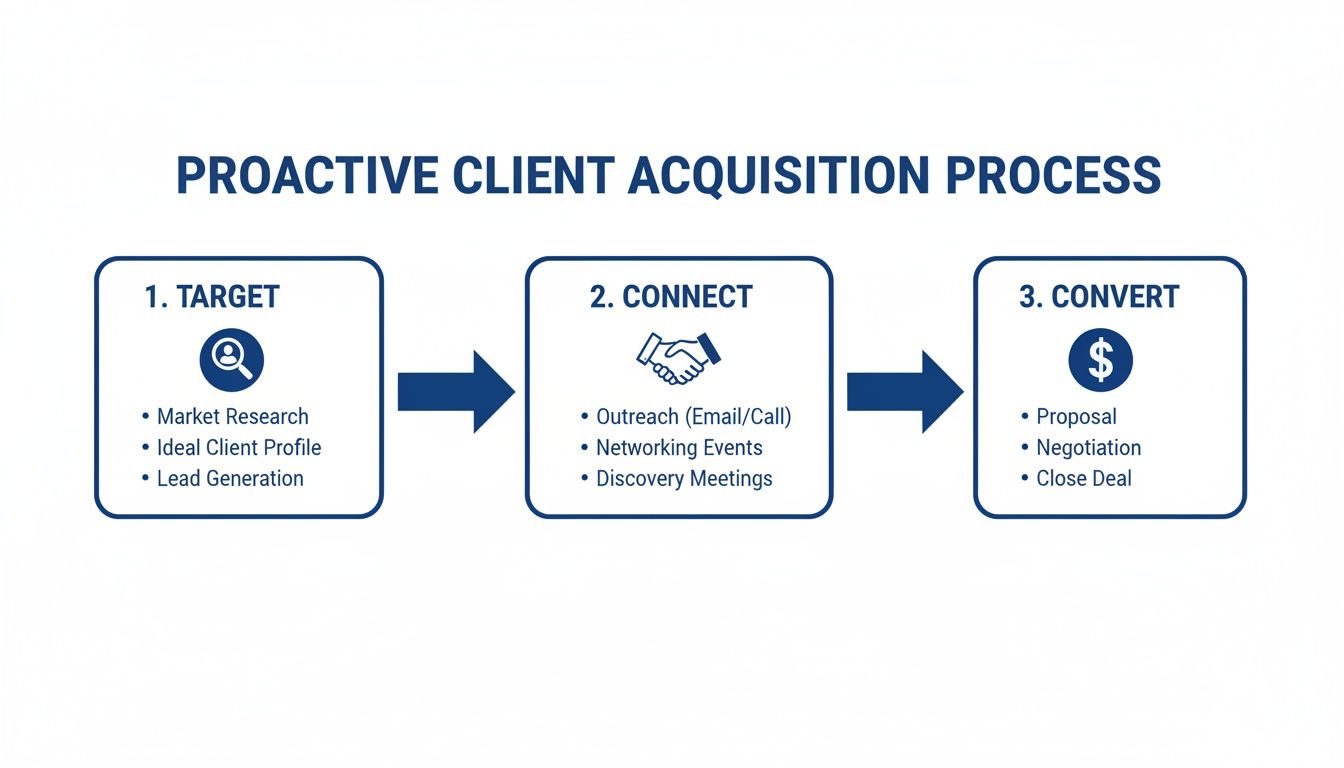
This process shows how a well-built technical setup enables you to systematically find, engage, and convert your ideal clients.
Installing Your Data Collection Tools
With your Business Manager active, the next job is setting up your data tracking. This is where two key pieces of technology work together: the Meta Pixel and the Conversions API (CAPI).
The Meta Pixel is a small snippet of code you install on your law firm's website. It’s been the standard for years, tracking actions like when someone visits a practice area page, fills out a contact form, or clicks your phone number. This data is what fuels retargeting and helps teach Facebook's algorithm who your ideal clients are.
But the Pixel alone isn't enough anymore. Thanks to privacy updates from Apple (iOS 14+) and new browser restrictions, its tracking ability has been significantly weakened. This is where the Conversions API comes in to save the day.
CAPI creates a direct, server-to-server connection between your website and Meta. This is a big deal because it bypasses the browser-side tracking limitations that hobble the Pixel. For law firms trying to measure actual ROI, this isn't a "nice-to-have"—it's an absolute necessity for getting accurate performance data.
By implementing both, you create a much more durable tracking system that captures far more conversion data. The result? Better ad optimization and a much clearer picture of your return on ad spend.
Ensuring Compliance and Prioritizing Events
Now that your tracking tools are ready, you have to verify your website's domain within Business Manager. This is a simple but critical step that proves you own the domain and gives you control over which conversion events can be used for your ads.
After verification, you'll configure Aggregated Event Measurement. This feature lets you prioritize up to eight key conversion events in order of importance. For a law firm, your list will likely look something like this:
- Lead: The most important one. This fires when someone successfully submits a case evaluation or contact form.
- Schedule: A prospect books a consultation directly on your site.
- Contact: A user clicks to call your office or sends you a direct message.
- ViewContent: Someone views a critical page, like a specific practice area page or an attorney bio.
Prioritizing these events tells Meta what you value most, which allows the algorithm to go find more people likely to take those high-value actions.
Following these technical rules is just as important as adhering to the ethical guidelines in your ad copy. For attorneys, this is paramount, especially in states with notoriously strict rules. To get a better handle on the advertising rules of engagement, you can explore our detailed guide to ethical attorney advertising in California, which offers valuable insights no matter where you practice.
Once all this is done, you’ll be ready to dive into the Meta Ads Manager, the platform's central dashboard where you'll create, manage, and analyze your campaigns. This is where the real work begins, so get comfortable with the interface—it’s where you’ll be spending your time turning ad spend into signed cases.
Designing Ad Campaigns That Connect and Convert
With the technical foundation set, we get to the fun part: actually building the campaigns that will bring potential clients to your digital doorstep. This is where strategic thinking meets creative execution.
A winning Facebook ad campaign for a law firm doesn't just find people; it has to connect with them on an emotional level, all while upholding the highest ethical standards of our profession.
Your first move inside Ads Manager is to pick a campaign objective. You’ll see a bunch of options like "Awareness" and "Traffic," and while they have their uses, our primary goal is clear: generate new cases.
For that reason, the 'Leads' objective is almost always the right choice for law firms. Choosing this tells Meta's powerful algorithm to hunt for users who are most likely to fill out your form or call your office, putting your ad spend to work on tangible results.
Writing Compliant Ad Copy That Resonates
Crafting ad copy for lawyers is a delicate dance. You need to show empathy and speak directly to a person's pain point, but you can never, ever cross ethical lines.
Making guarantees, promising specific outcomes, or using overly aggressive language is a one-way ticket to ad disapprovals and, far worse, potential state bar violations.
The secret is to adopt a problem-aware, solution-oriented tone. You aren't selling a product; you're offering a clear path forward during what is likely one of the most difficult times in a person's life. Your copy needs to validate their feelings and position your firm as an experienced guide, not a miracle worker.
Let's look at how this plays out across different practice areas. The table below breaks down how to frame your messaging in a way that’s both effective and compliant.
Ad Copy Angles by Practice Area
| Practice Area | Problem-Aware Headline | Empathetic Body Copy Hook | Compliant Call-to-Action |
|---|---|---|---|
| Family Law | Facing a Difficult Family Transition? | The uncertainty of a divorce can be overwhelming. We believe in providing clear guidance and compassionate support. | Learn more about your options in a confidential consultation. |
| Estate Planning | Secure Your Family’s Future Today | Planning for the future is an act of love for your family. We help you create a clear, comprehensive plan. | Get our free estate planning checklist to start the conversation. |
| Personal Injury | Injured in an Accident? Know Your Rights. | Medical bills and lost wages can be stressful. Our team is here to help you understand the next steps. | Click here for a free, no-obligation case review. |
Notice the pattern? Each example focuses on the client's immediate problem and offers a low-commitment, high-value next step. This is how you build trust and encourage someone to reach out without making over-the-top claims.
The Power of Visuals and Avoiding Ad Disapprovals
Your ad creative—the image or video you use—is what ultimately stops the scroll. A generic stock photo of a gavel or courthouse steps just won't cut it anymore. Your visuals have to feel authentic and human to forge an immediate connection.
Here are a few visual strategies that consistently work for law firms:
- Professional Headshots: A warm, approachable photo of you or your team builds instant trust. People want to see the attorney they might be working with.
- Authentic Video: A short, 15-30 second video can be a game-changer. Introduce yourself, debunk a common legal myth, or share a client success story (with their explicit permission, of course). These assets are invaluable; learn more about creating compelling attorney marketing videos to see how they can transform your campaigns.
- Custom Graphics: Simple, cleanly branded graphics that highlight a key statistic or client benefit can look sharp and professional.
Critical Tip: Stay far away from "before and after" images, sensationalized photos of accidents, or anything that could be interpreted as a guarantee of results. Facebook’s ad policies are notoriously strict about these, and they are the most common reasons ads from law firms get disapproved.
Putting the right objective, empathetic copy, and authentic visuals together creates a powerful ad. But it's the system behind the ad that truly drives results. In a recent session with over 300 law firm owners, we saw campaigns generating over $180,000 in revenue with ROIs exceeding 2,000%. They achieved this because of a rock-solid system, not just a massive budget.
This is more critical than ever, as AI Overviews are expected to slash Google clicks by 20-40%, making channels like Facebook—where 68% of American adults are active daily—absolutely essential. It’s also no secret that practice areas with emotional urgency, like mass torts and personal injury, thrive on the platform, while more transactional areas like patent law can struggle to find their audience.
This strategic, system-based approach is how you turn ad spend into a predictable pipeline of high-value cases.
Targeting Strategies to Attract Your Ideal Clients
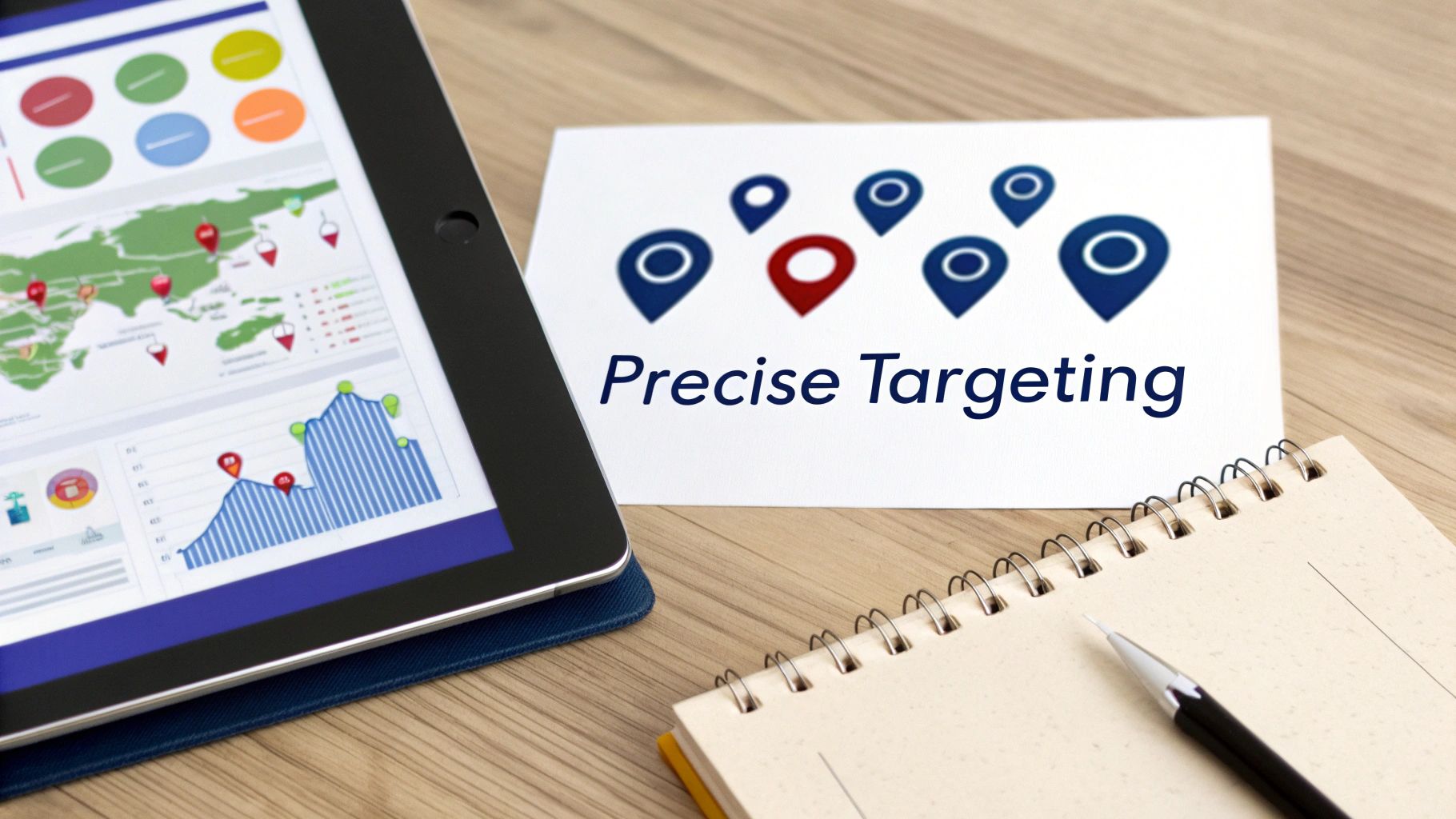
A perfectly crafted ad shown to the wrong person is a wasted dollar. It’s that simple. Targeting is the lever that multiplies the effectiveness of every penny you spend, turning your ad budget from a shot in the dark into a precision system for attracting high-value cases.
The real power of attorney Facebook ads isn't just about age and location—that's beginner stuff. The platform's magic lies in its ability to build audiences based on behaviors, life events, and interests that strongly signal a need for legal help. Before you even touch the ad settings, you absolutely must how to identify a target audience so your message lands with the right people.
Layering Interests and Behaviors for Precision
Let's get practical. Just targeting "men, ages 30-55" for a personal injury campaign is way too broad. You’ll burn through your budget in days with nothing to show for it. Instead, you need to layer criteria to create a hyper-relevant audience.
Imagine you're running ads for a personal injury practice that handles a lot of motorcycle accident cases. A smart targeting strategy would look something like this:
- Location: A 25-mile radius around your office.
- Age: 25-65.
- Interests (Layer 1): Must match one of Harley-Davidson, Motorcycle racing, or Indian Motorcycle.
- Behaviors (Layer 2): And must also match "Recently visited an emergency room" (a partner-provided data point).
See the difference? This multi-layered approach filters out the weekend enthusiasts and hones in on individuals whose recent offline behavior screams that they might have been in an accident. That level of detail is what transforms Facebook ads into a legitimate lead generation machine.
Targeting Recipes for Common Practice Areas
Guesswork has no place in a successful ad campaign. To get you off the ground, here are a few proven targeting "recipes" you can adapt for your own firm.
Family Law (Divorce Services)
- Location: Your primary service area.
- Demographics: Recently changed relationship status to "Separated" or "Divorced."
- Interests: Exclude users interested in "Wedding planning" or "Getting engaged" to sharpen your audience even further.
Estate Planning
- Location: Affluent zip codes in your county.
- Age: 45+.
- Demographics & Behaviors: "Parents with adult children," "Small business owners," or users showing interest in investment or retirement planning.
Personal Injury (Car Accidents)
- Location: A 15-mile radius around your office.
- Behaviors: Users who have recently interacted with auto body shops or insurance companies (using partner data).
- Interests: You can actually leave this broad. The behavior is the key signal here, so you want to capture a wider net of people exhibiting that specific activity.
These are just starting points. The real key is to test different combinations relentlessly and let the data tell you which audiences are delivering the most cost-effective leads for your firm.
Harnessing Your Own Data with Custom Audiences
While interest and behavior targeting is fantastic for finding new clients, your firm’s most valuable data is the data you already own. Facebook's Custom Audiences feature lets you use your existing assets to create incredibly effective ad campaigns.
There are two primary types of Custom Audiences that every single law firm should be using:
- Customer List Audience: You can securely upload a list of your past and current clients. Facebook will match these individuals to their profiles, allowing you to either exclude them from new client campaigns (saving money) or create a powerhouse Lookalike Audience.
- Website Visitor Audience: Using the data flowing from your Meta Pixel, you can create an audience of everyone who has visited your website—or even specific pages—within a set timeframe, like the last 90 days. This is the engine that powers all your retargeting efforts.
Once you have a high-quality Custom Audience from your client list (you'll want at least 1,000 matched users to make it work well), you can create a Lookalike Audience. This is where Facebook analyzes the common traits of your best clients and builds a new, much larger audience of users who share similar characteristics.
A 1% Lookalike Audience is the most precise and almost always yields the best results for legal lead generation for lawyers.
With 79% of law firms on social media and 82% of them on Facebook, the competition is real. Yet, attorneys are still seeing a strong 10.53% conversion rate on lead campaigns, with lead costs often 20-50% less than on Google Ads. And since 57% of potential clients start looking for a lawyer online, using these precise targeting methods to get in front of them early is no longer optional—it's crucial.
Optimizing Budgets and Measuring True ROI
Getting your Facebook ads live is a huge step, but let’s be clear: it’s just the starting line. The real money is made in the weeks and months that follow, through disciplined budget management and a ruthless focus on the numbers that actually matter.
It's far too easy to get lost in a sea of data. A successful campaign, however, boils down to one simple question: are we turning ad spend into signed cases?
How to Fuel Your Ad Campaigns Without Burning Cash
Think of your budget as the fuel for your advertising engine. If you put in too little, the algorithm never gets enough data to learn who your best clients are. If you throw too much money at it without a clear strategy, you're just setting cash on fire.
For most local law firms, a good starting point is somewhere between $1,500 and $5,000 per month. This gives you enough runway to run meaningful tests and let the platform find its groove.
You've got two primary ways to manage that budget within Facebook:
- Campaign Budget Optimization (CBO): You set one budget for the entire campaign, and Facebook's algorithm automatically shifts money to the ad sets and audiences that are performing best. It’s a hands-off approach that lets the machine find you the cheapest leads.
- Ad Set Budgets: This is the manual approach. You assign a specific daily or lifetime budget to each individual ad set. This gives you more control, which can be useful if you have a high-priority audience (like a "hot" retargeting list) that you want to guarantee gets a certain amount of spend.
For firms just starting out, CBO is almost always the smarter choice. It lets Meta's powerful machine learning do the heavy lifting, ensuring your dollars are constantly flowing toward the audiences most likely to convert.
Moving Beyond Feel-Good Numbers
It's tempting to get excited about high "Reach" or "Impression" counts, but these are pure vanity metrics. They tell you how many people saw your ad, not how many potential clients actually picked up the phone.
To measure real success, you have to track the key performance indicators (KPIs) that connect directly to your firm's revenue. True performance is measured in qualified leads and signed cases, not just clicks. This is how you reframe advertising from an expense into a powerful investment.
The most common mistake I see firms make is obsessing over Cost per Click (CPC). A low CPC is meaningless if those clicks don't become qualified leads. I'd much rather pay $20 for a click that turns into a high-value case than $2 for a click from someone who was never a real prospect to begin with.
Your focus has to be on the metrics that tell a financial story. It's the only way to prove your marketing is a profit center for the firm.
The KPIs That Actually Drive Firm Growth
To truly understand your Return on Investment, you need to be tracking a handful of critical numbers. This data-driven view will give you a crystal-clear picture of your campaign's health and profitability.
At Case Quota, we’ve found that focusing on a specific set of KPIs is the fastest way to understand campaign performance and make smart decisions. The table below outlines the most important metrics, what they mean, and what a good benchmark looks like for law firms.
Key Performance Indicators for Attorney Facebook Ads
| Metric | What It Measures | Industry Benchmark (Legal) | Optimization Goal |
|---|---|---|---|
| Cost per Lead (CPL) | The average cost to acquire one potential client's contact information. | $75 – $300+ | Decrease CPL without sacrificing lead quality. |
| Lead-to-Client Rate | The percentage of leads that sign a retainer and become clients. | 5% – 20% | Increase by improving intake process and lead quality. |
| Cost per Acquisition (CPA) | The total ad spend required to sign one new client. | Varies by case value | Decrease CPA to improve overall profitability. |
| Return on Ad Spend (ROAS) | The total revenue generated for every dollar spent on ads. | 3:1 to 10:1+ | Maximize ROAS to ensure campaigns are a profit center. |
Tracking these numbers is non-negotiable. The Lead-to-Client Conversion Rate, for example, happens offline during your intake process, but it's the most critical piece of the puzzle for understanding lead quality.
Ultimately, it all comes down to Return on Ad Spend (ROAS). This is the final verdict on your campaign's success. It answers the simple, all-important question: "For every dollar I put into these ads, how many dollars in revenue did I get back?"
For a more comprehensive look at this, our guide on measuring advertising effectiveness offers a deeper framework specifically for legal marketers.
By diligently tracking these KPIs, you stop guessing and start knowing. You can make intelligent decisions about where to scale your budget and which campaigns to cut, building a predictable client acquisition machine for your firm.
Got Questions About Facebook Ads for Your Firm? We've Got Answers.
Diving into the world of Facebook advertising often brings up some serious and valid questions for attorneys. It's totally understandable. You're worried about compliance, throwing money away, or just how the whole thing actually works.
Let's cut through the noise and tackle the most common concerns head-on. My goal is to give you the straightforward answers you need to start with confidence.
Are Facebook Ads Even Compliant with Legal Advertising Rules?
Yes, they absolutely are—but you have to do it right. This is where many firms get tripped up. The key isn't just what you say, but what you don't say.
State bar associations have strict rules, and the fastest way to get in trouble is by making promises you can't keep.
You need to steer clear of:
- Guaranteeing outcomes: Anything like "We'll win your case" or "Get the maximum settlement" is a huge no-go.
- Using misleading or sensational language: Your ads should be professional and informative, not dramatic. Avoid creating unjustified expectations.
Instead, shift your focus. Use your ads to offer genuine value. Talk about your firm's specific experience, offer a free guide, or invite them to a "no-obligation case review." And, of course, always include the necessary disclaimers your state bar requires.
What Should a Law Firm Realistically Budget for Facebook Ads?
This is the big one, isn't it? A practical starting point for most local law firms is somewhere between $1,500 and $5,000 per month.
That number isn't pulled out of thin air. It’s the sweet spot that gives the Meta algorithm enough fuel to do its job—to gather data, get out of its initial "learning phase," and start finding the right people for you.
Don't just pick a number that feels right. Work backward. Figure out the average value of a new client for a specific practice area. Then, determine what you're willing to pay to get that client. This turns your ad budget from a blind expense into a predictable, data-driven investment.
How Long Does It Take to Actually See Results?
You'll likely see leads coming in within the first few days of launching a campaign, which is great for immediate feedback.
However, you absolutely must treat the first 30 to 60 days as a testing and data-gathering phase. This is when the algorithm is learning what works—which audiences respond, what copy connects, and which images stop the scroll.
While the initial activity is encouraging, your real performance metrics, like cost per lead and the quality of those leads, will sharpen and improve significantly after this initial period. It’s a huge advantage over something like SEO, which can take many, many months to gain traction. Paid ads give you speed and immediate feedback.
The Million-Dollar Question: Is the Ad Image or the Copy More Important?
Honestly, it’s a trick question. They are equally vital and completely dependent on each other.
Think of it this way: your ad creative (the image or video) is what stops someone's thumb from scrolling on their phone. In a crowded, fast-moving newsfeed, a boring or generic visual is a death sentence. It has one job: to grab attention.
But once you have that attention, the ad copy has to do the heavy lifting. It needs to connect with their problem, show them you understand, and convince them to take the next step.
A fantastic image paired with weak, uninspired copy goes nowhere. And the most brilliantly written copy in the world won't even get read if it's attached to a terrible stock photo. The best attorney Facebook ads win because they nail both—a powerful visual that grabs attention and empathetic copy that drives action.
At Case Quota, we specialize in building compliant, high-performance ad campaigns that turn your budget into a predictable pipeline of high-value cases. If you're ready to move beyond guesswork and implement a proven system for client acquisition, learn more at https://casequota.com.