

Trying to win clients by matching the reach of mega-firms often feels like a losing battle for many small and mid-sized Southern California law firms. Competing on price or broad service offerings stretches resources thin without much reward. By focusing your client acquisition on niche marketing for law firms, you shift the game toward expertise and relevance, making your firm the obvious choice for a well-defined segment. This approach helps you attract ideal clients and stand out in a crowded legal market.
Table of Contents
- Defining Niche Marketing for Law Firms
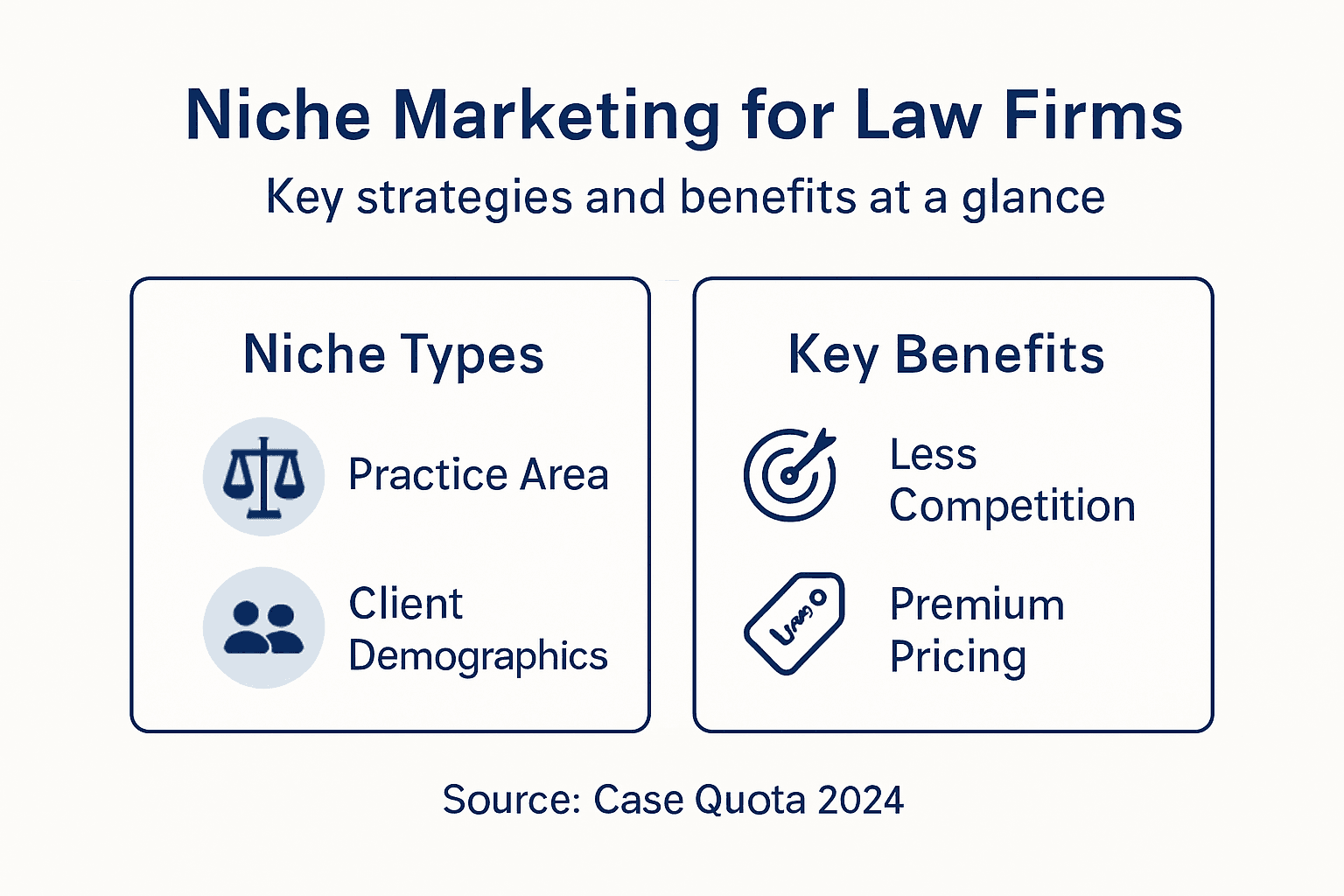
- Key Benefits of Legal Niche Focus
- Types of Niche Marketing Strategies
- Practical Steps to Implement a Niche
- Risks and Common Mistakes to Avoid
Key Takeaways
| Point | Details |
|---|---|
| Focus on a Niche | Specializing in a specific area allows law firms to target clients effectively and stand out in a crowded market. |
| Enhance Client Loyalty | Clients tend to stay longer and refer others when they perceive a firm as an expert in a specific legal need. |
| Adjust Marketing Strategies | Tailoring marketing messages directly to ideal clients improves engagement and maximizes marketing budgets. |
| Be Flexible and Informed | Continuously assess market conditions to avoid pitfalls of over-specialization and to adapt to changing client needs. |
Defining Niche Marketing for Law Firms
Niche marketing for law firms means focusing your practice on a specific slice of the legal market rather than trying to be everything to everyone. Instead of casting a wide net, you target clients with particular needs, characteristics, or situations. This focused approach lets you concentrate your resources, expertise, and marketing efforts where they matter most.
A niche law practice targets specific market segments defined by practice area or demographic factors. You might specialize in immigration law for small business owners, estate planning for high-net-worth individuals, or workplace discrimination cases for tech employees. The specificity is what makes niche marketing work.
Think of it this way: a general practitioner competes on price and availability. A specialist competes on expertise and relevance. When someone in Southern California needs a trademark attorney for their e-commerce startup, they’re not comparing you to every lawyer in the phone book. They’re looking for someone who understands their exact situation.
Niche marketing involves targeting highly specific consumer groups who share unique characteristics like demographics, income level, industry, or business stage. In practical terms, this means your marketing messages speak directly to your ideal client. Your website content, case studies, and advertising all reflect their specific pain points and goals.
This distinction matters for Southern California firms competing against larger competitors with bigger budgets. You can’t outspend the mega-firms, but you can out-focus them. By owning a specific niche, you become the obvious choice for clients within that space. You know their problems better. Your solutions feel tailor-made. Your pricing makes sense for their situation.
The power lies in clarity. When potential clients understand exactly what you do and who you serve, decision-making becomes simple. You stop wasting time on prospects who don’t fit your practice. You attract clients who value specialization and are willing to pay for expertise rather than haggling over rates.
Here’s a comparison of how a generalist practice contrasts with a niche legal practice:
| Aspect | Generalist Law Firm | Niche Law Firm |
|---|---|---|
| Client Base | Broad, varied | Targeted, specific |
| Competition | High, many rivals | Lower, few experts |
| Pricing Power | Competes on cost | Can charge premium |
| Marketing Focus | Wide, less defined | Tailored, precise |
| Client Loyalty | Often limited | Builds strong loyalty |
Pro tip: Map out three potential niches for your firm by listing your best past clients, their industries, their problems, and what made those cases successful—your ideal future client profile lives in that intersection.
Key Benefits of Legal Niche Focus
When you commit to a niche, you stop competing on price and start competing on expertise. That shift changes everything about how prospects perceive your firm and how much they’re willing to pay for your services. For small to mid-sized firms in Southern California, this advantage is massive.

One of the clearest wins is reduced competition within your niche. Instead of battling the big firms on general practice, you own a specific corner of the market. When a business owner in Orange County needs employment law counsel for a startup, they find you first because you dominate that space, not the mega-firm across town.
Specialization builds unshakeable client loyalty. You become the go-to expert for a specific legal need, which means clients stick around longer and refer others like them. Repeat business and referrals cost nothing to acquire but generate consistent revenue. That’s how smaller firms outpace larger competitors despite smaller marketing budgets.
Niche practices can charge premium pricing because specialization justifies higher fees. Clients recognize that your deep expertise in their specific problem is worth more than a generalist’s discounted rate. They pay for solutions tailored to their exact situation, not cookie-cutter advice.
You also enjoy clearer marketing strategies. Instead of creating content for everyone, you speak directly to your ideal client. Your website, case studies, blog posts, and ads all resonate with people who recognize themselves in your messaging. This focus means your marketing dollar stretches further because you’re not wasting effort on prospects who don’t fit.
There’s a personal benefit too. Working within your niche means handling cases you actually find fulfilling. You develop genuine expertise that makes the work rewarding. You’re not exhausted by jumping between unrelated practice areas. You know your cases inside out, handle them efficiently, and build a stronger reputation.
Pro tip: Audit your current client base to identify patterns in which cases you win fastest and most profitably—that intersection reveals your natural niche where digital marketing for legal firms can then amplify your message.
Types of Niche Marketing Strategies
Niche marketing strategies aren’t one-size-fits-all. You choose your approach based on what makes sense for your firm, your strengths, and the market opportunities you see. The key is being intentional rather than drifting into a niche by accident.
The most straightforward approach is practice area specialization. You pick a specific legal field like employment law, intellectual property, family law, or real estate litigation and become the expert. This works well because the niche is immediately clear to prospects searching for that type of help.
Another powerful strategy focuses on client demographics or characteristics. Rather than serving all bankruptcy clients equally, you specialize in small business bankruptcies. Rather than general estate planning, you focus on high-net-worth individuals or business owners. You might target recent immigrants for immigration services or serve female entrepreneurs navigating business formation. The specificity here creates a competitive moat.
You can also combine approaches. Niche segmentation strategies use demographics, psychographics, and firmographics together to create a more precise target. This means blending practice area plus client type plus their industry or situation. A firm might specialize in employment law for technology startups, combining the practice area, client industry, and business stage.
Many Southern California firms find success with industry-focused niches. You become the go-to attorney for real estate developers, healthcare practices, restaurants, or construction companies. You understand their specific compliance needs, deal structures, and operational challenges in ways a generalist cannot.
Emerging practice areas also deserve attention. Growing sectors like cybersecurity law and cannabis law attract less competition because fewer firms have invested in expertise yet. If you move early, you own that space before it becomes crowded.
The strategy that works best aligns with three factors: genuine market demand, manageable competition, and your team’s actual interest and skills. A niche nobody needs isn’t a niche. Neither is one where five mega-firms already dominate completely.
Pro tip: Research which client types or industries generate your highest case values and shortest case cycles, then build your niche marketing messaging around solving those exact problems most firms overlook.
Practical Steps to Implement a Niche
Implementing a niche isn’t something you do overnight, but it doesn’t require years either. Start by looking inward. What practice areas energize you? Which clients do you actually enjoy working with? Your best niche aligns with genuine interest because you’ll be spending considerable time building expertise in it.
Next, assess the market reality. Does demand exist for your potential niche? Are clients actively searching for this type of help? You can research this through keyword analysis, local competitor evaluation, and conversations with your existing clients. A niche nobody needs is a niche that fails.
Implementing a niche practice begins with identifying areas aligned with your strengths and interests, followed by thorough market assessment. Look for gaps where competition is manageable but demand is genuine. Southern California’s market is large enough that multiple profitable niches exist simultaneously.
Once you’ve chosen your direction, focus your marketing ruthlessly. Stop trying to appeal to everyone. Rewrite your website copy to speak directly to your ideal client. Update your case studies to showcase relevant wins. Create blog content addressing their specific problems. Adjust your Google Local Services Ads and paid search campaigns to target this audience.
Build expertise deliberately. Attend niche-specific conferences. Join relevant bar associations and professional groups. Read the latest developments in your chosen area. This credibility matters because prospects in your niche will research you, and they’ll notice whether you’re genuinely specialized or just making claims.
Refinement happens over time. Continual refinement based on client engagement and competitive analysis maintains relevance and solidifies your market position. Track which marketing channels bring your best clients. Listen to what prospects tell you about their biggest pain points. Adjust your messaging accordingly.
Start small if you’re nervous. You don’t have to abandon all other work immediately. Test your niche messaging. Track conversion rates. Build momentum gradually. Many successful Southern California firms transitioned into their niche over 12 to 24 months while maintaining their general practice revenue.
Pro tip: Identify your three best clients from the past two years, document what they had in common, then build your entire niche marketing strategy around attracting more clients exactly like them.
Risks and Common Mistakes to Avoid
Niche marketing isn’t risk-free. The same focus that creates your competitive advantage can backfire if you choose poorly or execute carelessly. Understanding these pitfalls helps you avoid costly mistakes.
The biggest mistake is choosing a niche that’s too small. You pick a practice area so narrow that it can’t generate enough cases to sustain your firm’s revenue. Estate planning for divorced female entrepreneurs in Pasadena sounds specific, but it might only yield a handful of cases per year. Common risks include selecting a niche that is too small to sustain adequate business, limiting your growth potential significantly. Do the math first. How many potential clients actually exist in your niche? How many could realistically become your clients?
Another critical error is failing to distinguish yourself within your chosen niche. You specialize in employment law for startups, but so do ten other firms in Orange County. Specialization alone doesn’t guarantee success. You need a genuine competitive advantage. Maybe you offer flat-fee agreements. Maybe you focus exclusively on pre-litigation strategy. Maybe your track record is exceptional. Something must make you the obvious choice within your niche.
Neglecting ongoing market research creates a slow death. Client needs change. Economic conditions shift. New competitors enter. What worked three years ago might not work today. Underestimating the importance of marketing within the niche and not investing in building authority reduces your effectiveness significantly. You can’t just set your niche marketing strategy and forget about it.
Over-specialization also carries hidden risk. If you commit entirely to a practice area and that market contracts unexpectedly, you have no backup. Consider building your niche as your primary focus while maintaining some capacity in adjacent areas. This flexibility protects your firm during market downturns.
Finally, avoid rigid thinking about your niche. Business conditions change. What seemed like a perfect niche six months ago might prove less profitable than expected. Stay willing to adjust based on actual results rather than assumptions.
Below is a summary of major risks with strategies to avoid them when implementing a legal niche:
| Risk | Example | Avoidance Strategy |
|---|---|---|
| Niche too narrow | Too few potential clients | Research client pool size |
| Lack of distinction | Many similar local firms | Offer unique services |
| Ignoring market shifts | Changing client needs | Conduct regular analysis |
| Over-specialization | Market shrinks unexpectedly | Maintain related practice areas |
| Inflexibility | Not adapting to results | Adjust niche as needed |
Pro tip: Before fully committing to a niche, test your messaging with five to ten prospects in that market and track their response rates and conversion patterns to validate demand exists.
Unlock Your Law Firm’s Potential with Targeted Niche Marketing
Niche marketing is about focusing your expertise and marketing efforts on the clients who need you most. The challenge many Southern California law firms face is standing out against larger competitors with bigger budgets. You know that specializing in a practice area or client demographic lets you compete on expertise rather than price, but executing this strategy requires precise, performance-driven marketing that speaks directly to your ideal clients. At Case Quota, we understand these challenges and help firms like yours dominate their niche through tailored digital marketing solutions.
From SEO-optimized web design to AI-powered pay-per-click advertising plus Google Local Services Ads, our strategies are designed for law firms ready to grow their client base efficiently and effectively. Our six years of dedicated California legal marketing experience means we know exactly how to highlight your unique value and reach the clients who appreciate your specialization. Don’t waste time on generic marketing. Focus on results with experts who get legal niche marketing.

Ready to own your niche and attract clients who truly value your expertise Visit Case Quota now to learn how our tailored marketing strategies can empower your firm to compete and win in the Southern California legal market. Act today to transform your practice and build lasting client loyalty with focused digital marketing from trusted specialists.
Frequently Asked Questions
What is niche marketing for law firms?
Niche marketing for law firms is the practice of focusing on a specific segment of the legal market rather than serving a broad client base. This approach allows firms to target clients with particular needs or situations, enhancing their expertise and marketing effectiveness.
What are the benefits of niche marketing for legal practices?
The benefits of niche marketing include reduced competition, the ability to charge premium prices due to specialized expertise, stronger client loyalty, and more effective marketing strategies that resonate directly with ideal clients.
How can I identify the right niche for my law firm?
To identify a suitable niche, assess your interests and strengths, analyze market demand through keyword research and competitor analysis, and look for gaps where your unique expertise can meet client needs effectively.
What common mistakes should law firms avoid when implementing niche marketing?
Common mistakes include choosing a niche that is too small, failing to distinguish your firm from competitors, neglecting ongoing market research, over-specializing without backup options, and being inflexible in adapting to changing market conditions.
Recommended
- Digital Marketing Agency for Attorneys: Complete Guide to Growing Your Law Practice Online – Case Quota
- Complete Guide to Multichannel Marketing for Law Firms – Case Quota
- A Modern Law Firm Marketing Strategy That Wins Clients
- Legal Marketing for Small Firms A Complete Guide
- BAA POSTICA TURUTA ATTORNEYS – Legal Services