

Before you even think about ordering business cards or scouting office space, the real work of building a successful law firm begins. This is the blueprint phase—the strategic thinking that separates thriving practices from those that fizzle out in the first year.
Get these foundational pieces right, and you'll have a clear roadmap for everything that comes next.
Nailing Down Your Firm's Blueprint
Trying to launch a law firm without a solid plan is like walking into a courtroom without having read the case file. You might get by on adrenaline for a bit, but you're setting yourself up for failure. The decisions you make right now—about your niche, your business structure, and your financial plan—will echo for years to come.
These three elements aren't just checkboxes on a to-do list; they're the bedrock of your entire enterprise.
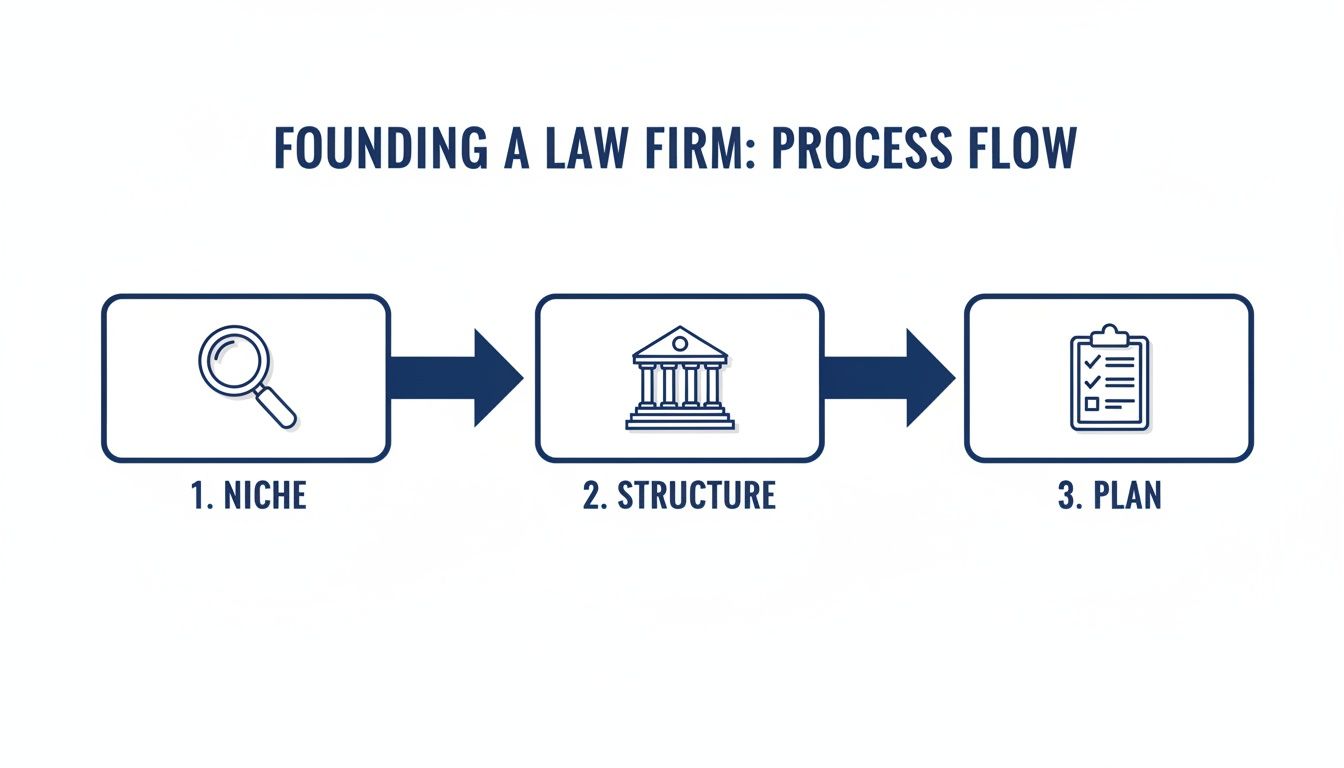
Think of it this way: you can't pick a business structure until you know what kind of law you'll practice, and you can't build a realistic business plan without knowing your niche and structure. They flow into one another.
Pinpoint a Profitable Niche
Look, the days of the successful general practitioner are mostly behind us, especially in a shark tank like Southern California. The key to not just surviving but thriving is to specialize. When you have a focused niche, you stop being a jack-of-all-trades and become the go-to expert. That’s when you can attract better clients and charge what you're worth.
Don't just say "I do family law." That's not a niche; it's a giant, crowded category. Get specific.
- High-Asset Divorce in Orange County: Now you're talking. This targets a particular client with very specific, complex needs.
- Startup IP for Silicon Beach Tech Companies: You've instantly tied your practice to a booming local industry.
- DUI Defense for Commercial Drivers: This is a hyper-specific slice of criminal defense where the stakes are incredibly high for the client.
A tight focus makes your marketing a hundred times easier. You know exactly who you're talking to and what problems you solve for them.
The single biggest mistake I see new firm owners make is casting too wide a net. They're afraid of "limiting" their opportunities. The reality is that a narrow niche concentrates your power and builds your authority, which is always more profitable.
Select the Right Business Structure
This is a monumental decision. The legal structure you choose will directly impact your personal liability, how you're taxed, and the amount of administrative headaches you'll face down the road. This isn't just paperwork; it’s about protecting your personal assets.
Let's quickly run through the most common options:
- Sole Proprietorship: Simple, yes. But it offers zero liability protection. If the firm gets sued or goes into debt, your house, car, and personal savings are on the line. It's a risk few lawyers should ever be willing to take.
- Limited Liability Partnership (LLP): A solid choice if you're launching with partners. The big benefit here is that you're shielded from the malpractice of your partners, though you're still on the hook for your own.
- S-Corporation (S-Corp): Often the sweet spot for solo and small firms. It creates a strong wall between your business and personal assets. It can also offer significant tax advantages by letting you pay yourself a "reasonable salary" and take the rest of the profits as distributions, which aren't hit with self-employment taxes.
As you weigh your options, it's smart to get educated. Reading up on topics like understanding professional corporations can give you a much clearer picture of the liability and tax implications you'll be dealing with.
Build a Real-World Business Plan
Your business plan isn't just a document you create to get a bank loan and then stuff in a drawer. It's your living, breathing operational playbook. It's where you force yourself to answer the tough questions about money, marketing, and growth.
A truly useful business plan has to include:
- Executive Summary: A one-page snapshot of your firm. What's your mission? Who do you serve?
- Company Description: Get into the specifics of your niche, your target client, and what makes you the obvious choice for them.
- Market Analysis: An honest assessment of your competitors and a detailed profile of your ideal client in Southern California.
- Financial Projections: This is where the rubber meets the road. Map out your startup costs, ongoing monthly overhead, and realistic revenue goals for years one, two, and three.
This plan is your North Star. When you're overwhelmed with decisions, you come back to this document. If you want to dive deeper into the client acquisition side of things, this law firm marketing plan template is an excellent resource.
Alright, you've got the big-picture strategy down. Now comes the part that can feel like a grind: turning that vision into a real, functioning, and—most importantly—legally compliant law firm. This is where you get into the weeds of California's rules and operational setup.
It’s easy to see these steps as just a bunch of administrative hoops to jump through. But trust me, getting this stuff right from the very beginning is what protects you, your clients, and the future of your practice. Think of it as building the firm's engine and making sure it passes California's notoriously tough inspection.

Locking Down Your Firm's Legal and Financial Identity
Before you can even think about taking on a client, you have to exist as a legitimate business. That means getting your name registered and securing the right tax IDs.
First, your firm's name. If you're setting up an LLP or a professional corporation, you'll need to register it with the California Secretary of State. Going the solo proprietor route? You can either use your own name or file a Fictitious Business Name Statement with your county.
Next up is your Employer Identification Number (EIN) from the IRS. You absolutely need this. It’s essential for tax filings, opening your business bank accounts, and bringing on any staff down the line.
And don't get tripped up by local rules. Cities across Southern California—from Los Angeles to San Diego—have their own business license and tax registration requirements. Forgetting this step can lead to some nasty fines later.
Nailing California State Bar Compliance
This one is non-negotiable. Your relationship with the State Bar of California has to be perfect from day one, and that starts with your client trust account.
One of your first and most critical tasks is setting up your Interest on Lawyers' Trust Account (IOLTA). This isn't just any bank account; it's a special, interest-bearing account required for holding all client funds, whether it's a retainer, a settlement, or a filing fee.
That interest it generates? It doesn't go to you or your client. It gets sent to the State Bar to fund legal aid for those who can't afford it. Mishandling client funds is one of the quickest tickets to disciplinary action, so you need to be meticulous with your record-keeping from the second you open the account.
Understanding your ethical duties isn't a one-time checklist—it's an ongoing commitment. From how you advertise to how you communicate with clients, you have to stay sharp. Pleading ignorance of the Rules of Professional Conduct will get you nowhere.
These ethical duties bleed into every part of your business, especially marketing. You have to know the state’s specific rules on advertising inside and out. To stay on the right side of the Bar, you should carefully review a guide to ethical attorney advertising in California to make sure your client acquisition plan is fully compliant.
Deciding Where You'll Work
For any lawyer in Southern California, the "where" is a huge decision, mostly because commercial real estate costs are astronomical. This choice will have a massive impact on your startup budget.
- The Traditional Office: A physical office definitely lends a certain credibility and gives you a professional spot for client meetings. But the overhead in a place like Orange County or West LA is no joke—we're talking high rent, utilities, furniture, and more.
- The Virtual Firm: Going fully remote slashes your overhead costs. It gives you incredible flexibility but demands serious self-discipline and the right tech stack to keep everything professional and secure.
- The Hybrid Approach: This is a popular route for new firms. You use a co-working space or a virtual office service that provides a professional business address and lets you book conference rooms when you need them. It's the best of both worlds.
Protecting Your Practice with the Right Insurance
Last but not least, you need to shield your new firm from risk. Operating without the right insurance coverage is a gamble you just can't afford to take, especially when you're just starting out.
Here’s the essential coverage you should have in place:
- Professional Liability (Malpractice) Insurance: This is your number one priority. It covers you if a client makes a claim of negligence or alleges you made an error in your legal work.
- General Liability Insurance: This is for the "slip-and-fall" scenarios. It covers claims of bodily injury or property damage that might happen at your office.
- Cybersecurity Insurance: In today's world, this is no longer optional. A data breach can be catastrophic. This policy helps cover the massive costs that come with it, from notifying clients to restoring your systems.
Building Your Modern Law Firm Tech Stack
In today's legal market, technology is the great equalizer. It’s what allows a solo attorney in Southern California to punch well above their weight, operating with the same polish and efficiency as a much larger firm. When you're just starting out, your tech stack isn't a "nice-to-have"—it's the operational engine that handles the grunt work, freeing you up for the high-value, billable tasks that actually grow your practice.
Forget about patching together a dozen different apps that don't talk to each other. That's a recipe for disaster and wasted hours. The goal here is to build a single, integrated system where your software communicates, saving you from the soul-crushing drudgery of entering the same client information over and over again. This is about creating a smooth, unbroken line from the moment a potential client finds your website to the day their final invoice is paid.
This isn't just about convenience; it's a strategic investment. The entire legal industry has seen a 9.7% surge in tech spending, a clear signal that firms are leaning on technology to drive a 13% growth in profits. For a new firm in a cutthroat market like Los Angeles, getting this right from day one is non-negotiable. Just look at AI adoption—it exploded from 19% in 2023 to a staggering 79% in 2024, with 77% of firms using it for tasks like document review.
Core Components of a Lean Law Firm Tech Stack
Building out your firm's tech infrastructure means making smart, deliberate choices about tools that play well together. One of the very first decisions you'll face is choosing the right CRM for your firm, a critical piece for managing your client pipeline from the very beginning.
To keep it simple, your essential tech stack needs to cover these four key bases:
- Practice Management Software (PMS): This is the central nervous system of your firm. A solid cloud-based PMS like Clio, MyCase, or PracticePanther will manage your case files, client communication, calendar, and tasks in one secure hub.
- Client Intake and CRM: Before they’re clients, they’re leads. You can’t afford to let them slip through the cracks. Software like Lawmatics or even a well-configured PMS can automate your intake process and should plug directly into your website's contact forms.
- Billing and Accounting Software: Chasing down payments is a terrible use of your time. Get a system in place from the start. Tools like LawPay handle secure online payments, and it integrates cleanly with business-focused accounting software like QuickBooks Online.
- Document Management and E-Signatures: A modern, mobile practice demands secure, cloud-based storage. Solutions like NetDocuments or the built-in features of your PMS, paired with an e-signature platform like DocuSign, will streamline your entire document workflow.
Don't get paralyzed by the endless options out there. Start with these core four: a great PMS, an automated intake system, a reliable billing solution, and secure document management. You can always bolt on more specialized tools later as your firm grows.
Integrating AI and Automation Smartly
Artificial intelligence isn't just a buzzword for Big Law anymore. AI-powered tools are now accessible and affordable, giving small firms a massive competitive edge. Think about the hours you could save on legal research and document review alone.
Platforms like Casetext are completely changing the game, allowing attorneys to analyze huge volumes of legal documents in minutes instead of days. That kind of efficiency translates directly to a healthier bottom line and lets you offer more competitive pricing to your clients.
And remember, your entire tech stack really begins with your most important marketing asset: your website. A high-performing site is the engine that feeds your entire client intake system. For a deep dive into getting this foundational piece right, our guide on web design for attorneys walks through exactly how to build a site that doesn't just look professional but is engineered to turn visitors into leads.
5. Engineer a Reliable Client Acquisition System
Let's be blunt: a steady stream of new clients is the oxygen your law firm needs to breathe. Without it, you're not growing; you're just surviving. Building a modern, sustainable client acquisition engine isn't optional—it's the most critical activity you'll undertake.
And it all starts with your most important marketing asset: your website.
Your site can't just be a pretty digital brochure. It has to be a lead-generation machine, built from day one to attract, engage, and convert your ideal clients. That means it needs to be lightning-fast, work flawlessly on a phone, show up on Google, and be accessible to everyone.

This isn't just theory. Hard data shows that 65% of law firms get their highest marketing ROI directly from their website. It's the one place new firms absolutely cannot afford to cut corners. With the right strategy, legal marketing can deliver an average ROI of 526% over three years.
Your Website: The Foundation of Your Marketing
Think of your website as your firm's digital headquarters. It’s the first impression you’ll make on most potential clients, and it’s where every other marketing effort—from Google Ads to social media—will eventually lead people.
For your website to actually work, it needs a few key things firing on all cylinders:
- Search Engine Optimization (SEO): This is the art and science of structuring your site and its content so Google understands what you do and ranks you high when people search for your services.
- ADA Compliance: Your site has to be accessible to people with disabilities. It's the right thing to do, it protects you from lawsuits, and it opens your doors to more clients.
- Mobile-First Design: Let's face it, most of your potential clients are looking you up on their smartphone. If your site is a mess to navigate on a small screen, they're gone in a flash.
- Clear Calls-to-Action (CTAs): Don't make people hunt for what to do next. Every single page needs an obvious button or link telling them to "Call Now" or "Schedule a Consultation."
Your website is not a cost; it's an investment. Skimping here is like building your physical office on a faulty foundation. It's only a matter of time before everything comes crashing down.
Dominate Local Search Results
For almost any Southern California law firm, your clients are local. This makes Local SEO one of the most potent weapons in your marketing arsenal. The goal is dead simple: when someone in your city searches "family lawyer near me" or "San Diego criminal defense attorney," you need to be right there in Google's "Map Pack."
The key to this is a perfectly optimized Google Business Profile (GBP). Your GBP is a free listing that's like a mini-website inside Google's search results, showing your firm's name, address, phone number, and—most importantly—your reviews. Consistent, positive client reviews are the rocket fuel for a high-ranking GBP.
Build Authority with Content That Actually Helps
Content marketing isn't about bragging. It's about creating genuinely valuable articles, blog posts, and videos that solve problems for your ideal clients, establishing you as the go-to expert in your niche.
Forget generic blog posts. Instead of "What to Do After a Car Accident," a personal injury lawyer in Los Angeles should write something like, "Navigating the 405 Freeway After a Collision: A Step-by-Step Guide." See the difference? That specific, localized content is immensely more valuable and instantly positions you as an authority.
By consistently answering the real questions your clients are asking, you build trust and stay top-of-mind. You can dig deeper into a successful attorney lead generation strategy that puts content at its core.
Capture High-Intent Leads with Google Ads
SEO and content are long-term plays. But sometimes, you need the phone to ring now. That's where a smart Google Ads campaign comes in.
Google Ads let you jump to the very top of the search results for specific keywords, getting you in front of people who are actively looking for a lawyer.
For instance, a workers' comp attorney in Riverside can run a campaign that only shows up for people searching terms like "work injury lawyer Riverside." It's incredibly effective because you're reaching clients at the exact moment of need. This kind of direct-response marketing is a vital piece of a balanced client acquisition plan.
Growing Your Brand with Strategic Content and Outreach
Having a great website with solid SEO is the foundation, but it’s a passive approach. To really get traction in the cutthroat Southern California legal market, you have to go out and find your clients where they’re already spending their time.
This means actively building your presence on social media and using video to put a human face on your expertise. It’s the difference between waiting for the phone to ring and starting the conversations that lead to new cases.

Find Your Voice on Social Media
Forget viral dances. For lawyers, social media is a high-powered networking tool for building professional authority.
When it comes to professional circles, LinkedIn is the undisputed king. It’s absolutely essential for connecting with referral sources, engaging with peers, and attracting sophisticated business clients.
But don't stop there. Think about where your specific clients are. A family lawyer might find a goldmine of leads in local Facebook groups for parents. A firm that serves tech startups could build a massive following on Instagram by sharing visually punchy legal tips for entrepreneurs.
The key is to pick one or two platforms and dominate them with consistency. Spreading yourself thin across five different channels is a recipe for burnout with zero results.
Create Value with Local Video Marketing
Nothing builds trust faster than video. It’s the closest you can get to a face-to-face meeting, letting potential clients see and hear you before they ever pick up the phone.
And you don't need a Hollywood production budget. Seriously.
Short, helpful videos that answer common legal questions are pure gold. Imagine a probate attorney in Pasadena shooting a quick two-minute video titled, "The 3 Biggest Mistakes People Make Choosing an Executor in California." That kind of content gets shared, establishes you as a go-to expert, and brings in qualified leads.
A simple, well-lit video shot on your smartphone answering a real client question is a thousand times more effective than a polished, corporate video that says nothing of value. Authenticity and usefulness always win.
Post these videos on your website, your Google Business Profile, and your social media channels. You'll create a powerful echo chamber that reinforces your expertise everywhere a potential client might look. To see how this fits into a broader plan, check out our guide on law firm content marketing.
The Smart Move: Partnering with a Marketing Agency
As a new firm owner, your time is your most valuable asset. Every hour you spend trying to figure out Google Analytics or troubleshoot a Facebook ad is an hour you aren't billing.
This is why outsourcing your marketing isn't a luxury—it’s one of the smartest strategic decisions you can make.
Recent data shows that 71% of lawyers are generating new leads from platforms like LinkedIn, and a full 34% say it's their number one channel for business development. While 58% of law firms are actively marketing themselves, a savvy 83% of them hire external teams to handle it. Why? Because it lets them focus on practicing law.
A specialized legal marketing agency brings expertise, tools, and proven systems to the table from day one. They already know the California State Bar's advertising rules inside and out and understand what it takes to win in hyper-competitive markets like LA and San Diego.
By partnering with experts, you get:
- Strategic Direction: A real, cohesive marketing plan tied directly to your firm's growth targets.
- Expert Execution: Professionals managing your SEO, Ads, and social media to squeeze every drop of value from your budget.
- Your Time Back: The freedom to focus on what you actually do best—serving clients and building your practice.
This kind of partnership lets you build a predictable, scalable client acquisition machine right from the start. It turns marketing from a source of stress into a reliable engine for growth.
Common Questions About Starting a Law Firm
Taking the leap to start your own law firm is exhilarating, but it also opens a floodgate of questions. When you’re used to a structured environment, becoming the captain of your own ship is a massive change. It’s completely normal to feel a bit of uncertainty.
Let’s tackle some of the most common—and critical—questions that pop up for new firm owners in California. Getting clear on these points now builds a foundation of confidence, helping you sidestep common pitfalls and build your practice on solid ground, not guesswork.
How Much Capital Do I Really Need to Start?
This is the big one. The honest, if unsatisfying, answer is: it depends entirely on your business model.
A lean, fully virtual firm focused on something like transactional business law could potentially get off the ground with under $5,000. That would cover the absolute essentials like your State Bar fees, basic software, and malpractice insurance.
On the other hand, if you're planning a litigation practice with a physical office in a competitive Southern California market, your startup costs could easily climb to $25,000 to $50,000 or more just to get through the first year. Your biggest initial cash outlays will almost always be:
- Malpractice Insurance: This usually requires a hefty down payment.
- Technology: Think practice management software, accounting tools, and getting a professional website built.
- Office Space: If you go the brick-and-mortar route, you're looking at first month's rent and a security deposit right away.
My best advice? Create a painfully detailed, line-item budget for your first year. Once you have that number, add a 20-25% contingency fund on top of it. This isn't just padding; it's your survival fund for the inevitable slow months before your client pipeline is flowing steadily.
Can I Start My Firm While Still Employed Elsewhere?
Technically, you can. But this path is an ethical and practical minefield. Before you even think about it, you need to pull out your current employment agreement and scrutinize it for any non-compete clauses or policies on "moonlighting."
Your duty of loyalty to your current employer is non-negotiable. You cannot use their resources—not their computers, not their legal research subscriptions, not their time—for your new venture. You also have to be militant about avoiding any conflicts of interest with your employer's clients.
A much safer play is to use your nights and weekends to build the firm's foundation. Write the business plan, form your PLLC or corporation, and research your tech stack. Just don't start marketing or taking on clients until you've officially walked out the door. The professional risks of juggling both are just too high.
How Soon Should I Expect to Be Profitable?
Profitability is a marathon, not a sprint. While you hear stories of firms turning a profit in the first six months, a far more realistic timeline for a new solo or small firm is 12 to 18 months. It simply takes time to build a client base and for your marketing to start paying dividends.
Your practice area is a huge factor here. A personal injury attorney working on contingency might not see a significant payday for over a year. But a family law or estate planning firm using flat-fee or hourly billing can generate positive cash flow much, much sooner.
In the beginning, your goal shouldn't be massive profits. It should be achieving a consistent monthly revenue that covers your overhead and pays you a modest salary. That's the first major milestone.
Building a successful law firm in Southern California takes more than just legal skill; it demands a sophisticated marketing strategy that actually gets you noticed. Case Quota specializes in creating those strategies, from SEO-first web design to AI-powered ad campaigns that deliver real, measurable results. Let us handle the marketing, so you can focus on the law. Discover how we can help you grow.