

You can't outspend the big firms, but you can absolutely out-think them. For small law firms, effective marketing isn't about having the deepest pockets. It's about a smart, strategic plan that ties your firm's real-world goals to a budget that makes sense.
This is the foundation. Get this right, and every dollar you invest will work harder to bring in the clients you actually want. Skip it, and you’re just throwing money at the wall.
Building Your Law Firm’s Strategic Marketing Plan
Before you even think about a new website, an ad campaign, or a single social media post, you need to define what success looks like. A fuzzy goal like "get more clients" is a direct path to wasting money. A real marketing plan starts with sharp, measurable goals built around your specific practice areas.
Think about it. A personal injury firm trying to "generate 15 qualified case inquiries per month" has a completely different playbook than an estate planning practice aiming to "book 10 initial consultations each month." Those distinct goals will shape every single marketing decision that follows.
Defining Your Marketing Goals
The first order of business is to translate your business ambitions into concrete marketing targets. A great starting point is learning how to create a marketing strategy that's actually practical for a growing firm.
Let’s get specific with some real-world examples:
- Criminal Defense: Let’s aim to increase inbound calls from people facing DUI charges by 25% over the next three months.
- Family Law: How about we drive 50 downloads a month of our "Divorce Process Checklist" to build a solid email list of potential clients?
- Business Law: The goal could be to land 5 new monthly retainer clients by getting serious about targeted LinkedIn outreach and content.
See the difference? Every one of those goals is specific, measurable, and tied directly to bringing in revenue. This kind of clarity makes budgeting a whole lot easier.
Conducting a Realistic Budget Assessment
Alright, goals are set. Now, let’s talk money. Research shows that most small law firms are leaving a massive opportunity on the table by not fully committing to their marketing. A 2025 industry report revealed that smaller firms rate their use of different marketing channels at just 3.3 out of 5.
Even more telling, only 45% feel like they're getting the most out of their options. With nearly half (48%) of these firms putting less than 10% of their revenue toward marketing, a focused, strategic approach is the only way to win.
The biggest mistake I see is firms treating marketing like an expense instead of an investment. A smart budget isn't about spending less; it's about putting your money into the channels that deliver the highest return and move you closer to your goals.
This simple three-step process is all it takes to get started on the right foot.
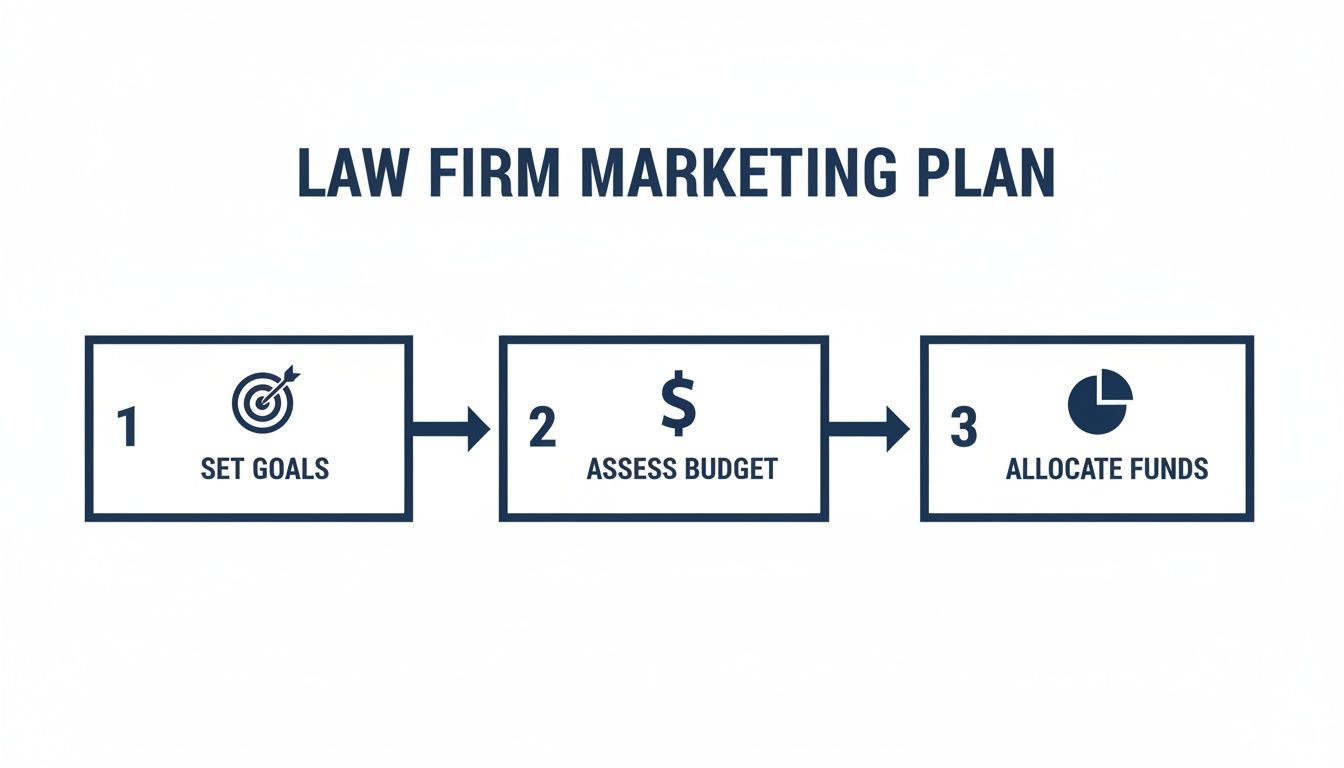
The takeaway here is simple: goals and budget come before you decide where the money goes.
Allocating Your Marketing Funds
With clear goals and a realistic budget, you can finally decide where to invest. Your budget needs a healthy mix of foundational assets (the things that build long-term value) and growth channels (the things that get the phone ringing now).
For example, a great, SEO-focused website is a foundational investment you'll benefit from for years. On the other hand, Google Ads are a growth channel designed to capture immediate leads. You need both.
Here’s a look at how a small firm might break down a modest marketing budget to get the best of both worlds.
Sample Monthly Marketing Budget Allocation for a Small Law Firm
This table provides a practical example of how a small law firm might allocate a modest monthly marketing budget across essential channels to achieve balanced growth.
| Marketing Channel | Recommended Budget Allocation (%) | Primary Goal |
|---|---|---|
| Local SEO & Google Business Profile | 40% | Build a long-term, sustainable pipeline of local leads. |
| Paid Search (PPC) | 30% | Generate immediate, high-intent leads for urgent cases. |
| Content Marketing | 20% | Establish authority, answer client questions, and support SEO. |
| Reputation & Social Media | 10% | Build trust through reviews and maintain a professional presence. |
This kind of strategic split ensures you’re building a strong foundation for the future while still bringing in new business today.
To get a head start on implementing this, you can grab a ready-to-use framework from our guide on building a law firm marketing plan template.
Building a Law Firm Website That Actually Wins Cases
Stop thinking of your website as a digital business card. It’s not. It's your most valuable marketing asset—your virtual front door, your 24/7 rainmaker, and the engine that drives your entire online presence. A great law firm website isn't passive; it's an active, powerful tool built to attract, engage, and convert prospective clients.
When someone lands on your site after a frantic, stressful search, they form an opinion in seconds. If your site is slow, hard to navigate, or just looks dated, they’re gone. They'll hit the back button and land right in the lap of your competition. This is precisely why a strategic, SEO-first design isn't just a good idea—it's absolutely essential for any small law firm trying to grow.
Start with a Rock-Solid SEO Foundation
Before you even think about colors or fonts, your website has to be built in a way that search engines like Google can easily understand and reward. That’s what an SEO-first approach is all about. This isn't about jamming keywords into a page. It's about creating a logical, fast, and user-friendly experience that search algorithms are designed to favor with higher rankings.
It all starts with a clean site architecture. Think of your website like a perfectly organized file cabinet. A potential client needs to find the right drawer (say, "Family Law") and the right file ("Child Custody") without a moment's hesitation.
A logical structure usually breaks down like this:
- Homepage: The front door that quickly guides visitors where they need to go.
- Practice Area Pages: Broad pages for each legal area you cover (e.g., "Criminal Defense," "Personal Injury").
- Service Pages: Super-detailed pages for niche services (e.g., "DUI Defense," "Truck Accidents").
- Attorney Bios: Your chance to build trust and show off your expertise.
- Contact Page: The final, crucial step to turn a visitor into a lead.
Another massive factor is page speed. The data doesn't lie: even a one-second delay in load time can slash your conversions by 7%. For a law firm, that’s a real, potential case you just lost because your site was too sluggish. Optimizing your images and insisting on clean code are non-negotiable for keeping your site snappy on both desktop and mobile.
Don't Overlook ADA Compliance
Making your website accessible isn't just about checking a legal box; it's a core business decision. The Americans with Disabilities Act (ADA) mandates that websites be accessible to people with disabilities, like those with visual or hearing impairments. Ignoring this can lead to expensive lawsuits, but just as importantly, it means you're slamming the door on a huge segment of potential clients.
An ADA-compliant website is simply a more usable website for everyone. When you focus on things like alt text for images, clear navigation, and keyboard-friendly controls, you inherently build a better user experience that benefits all your visitors, not just those with disabilities.
An accessible website also sends a powerful message: your firm is inclusive, thoughtful, and professional. That's a huge step in building trust before you've even spoken to a potential client.
The Core Pages Every Law Firm Website Must Have
While every practice is different, a website built to convert has a few essential pages. These aren't just filler; they are strategic assets, each playing a specific role in guiding a visitor from a casual search to a consultation call.
Here’s a practical checklist of the absolute must-haves:
- An Authoritative Homepage: This is your digital handshake. It has to immediately answer: who you are, what you do, and who you help. It must be packed with clear calls-to-action (CTAs) like "Schedule a Free Consultation."
- Optimized Practice Area Pages: These pages need to answer the urgent questions a potential client has. A "Car Accidents" page for a PI firm should cover common causes, what to do after a crash, and exactly how you can help—all optimized for local search terms like "Houston car accident lawyer."
- Trust-Building Attorney Bios: People hire people, not faceless firms. Your bio pages should be more than a list of credentials. Tell your story, show your passion for your work, and use a professional headshot to make a real connection.
- A Frictionless Contact Page: Make it dead simple for someone to get in touch. Include an easy-to-use contact form, your phone number, a physical address with an embedded map, and your office hours.
Putting together a website that truly performs is a heavy lift, blending technical SEO, persuasive copywriting, and smart design. For firms that want to go deeper, our guide on web design for attorneys provides a comprehensive playbook for creating a site that consistently brings in new cases. Your website is the heart of your marketing; investing in it properly is the best decision you can make for your firm's future.
Winning Clients with Local SEO and Google Business Profile
For a small law firm, your best clients are almost always right in your own backyard. While the big national firms are busy dropping a fortune on massive campaigns, your marketing battle is won or lost on the local front. This is where a razor-sharp local SEO strategy becomes your most powerful tool for growth.

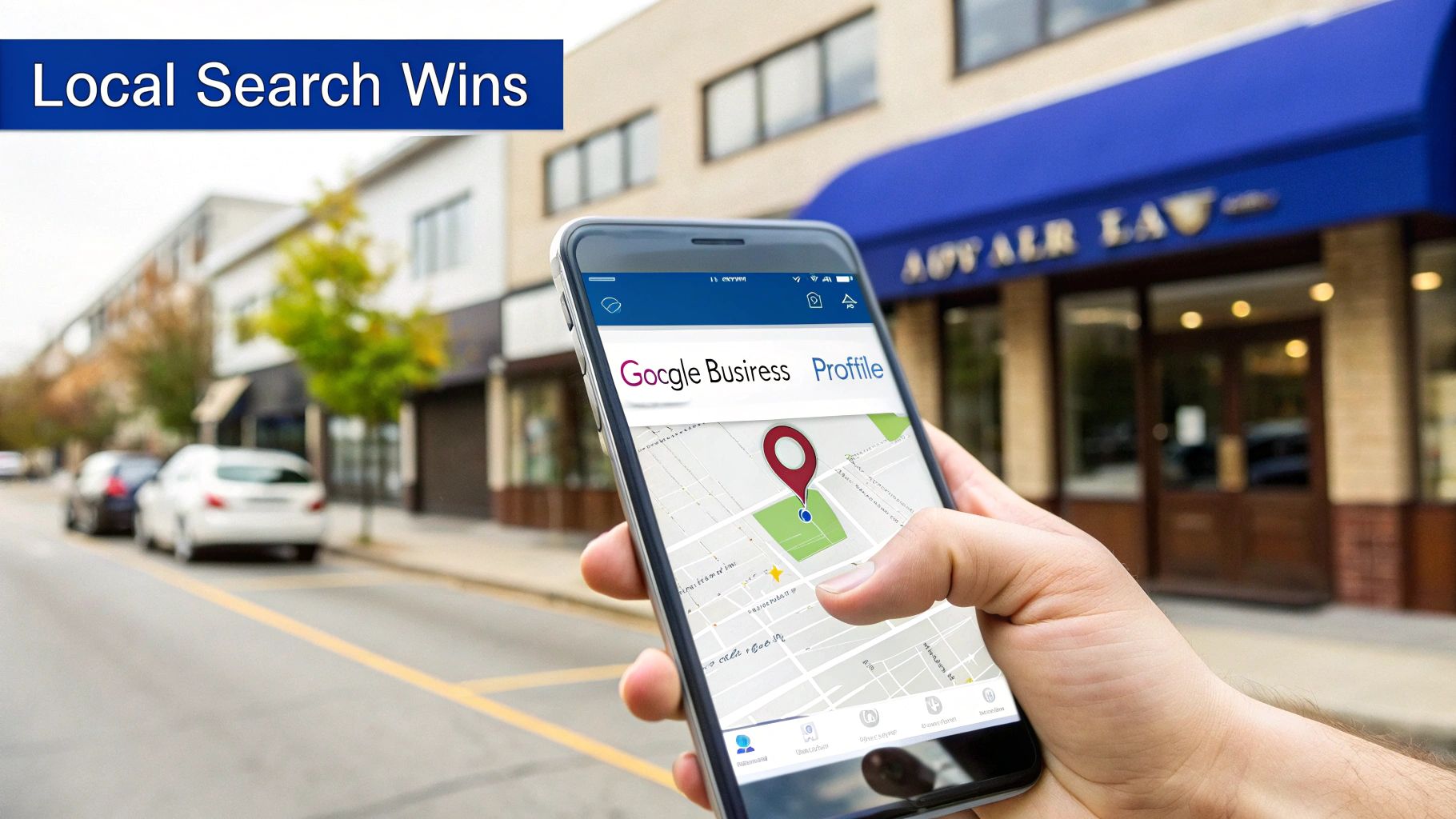
It all starts with your Google Business Profile (GBP). Think of it as your digital storefront on the world's biggest search engine. When a potential client searches for "family lawyer near me," a perfectly tuned GBP is what lands you in that coveted "local pack" map at the top of the results.
This is where the high-intent calls and website clicks come from. Honestly, ignoring this free, powerful profile is one of the single biggest mistakes a small firm can make.
Mastering Your Google Business Profile
Don't think of your GBP as a static listing you set up once and forget. It's a dynamic, active marketing channel. The first real step to winning clients through local search is to understand how to optimize your Google My Business profile. It takes attention to detail and consistent activity, which signals to Google that your firm is active, relevant, and trustworthy.
Start by making sure every single section is filled out with accurate, current information. This goes way beyond just your firm's name and address.
- Pick the Right Categories: Be as specific as possible with your primary category—think "Personal Injury Attorney" instead of just "Law Firm." Then, fill out secondary categories for every other area you practice, like "Workers Compensation Attorney" or "Criminal Justice Attorney."
- Write a Compelling Description: Use all the characters you're given. Describe who you help, what makes your firm different, and the services you offer. You'll want to naturally weave in keywords related to your practice areas and city.
- Upload High-Quality Photos and Videos: Make it a habit to add professional photos of your office (inside and out), your team, and even short videos. It humanizes your firm and screams to Google that your profile is actively managed.
Your GBP is often a potential client's very first interaction with your firm. A profile with blurry photos, an incomplete description, and outdated hours sends a message of unprofessionalism before they even visit your website.
Here's a pro-tip: start using GBP Posts. They're like mini-blog posts that show up right on your profile. Post weekly to share case results (ethically, of course), offer a helpful legal tip, or shine a spotlight on a specific practice area. This consistent activity is a huge ranking signal.
Building Your Local SEO Ecosystem
A top-notch GBP is the heart of your local strategy, but it can't do the job alone. To truly dominate local search, you need to build a consistent and authoritative presence across the entire web. This is where citations and reviews enter the picture.
A local citation is simply any online mention of your firm's name, address, and phone number (NAP). You'll find them in legal directories like Avvo and FindLaw, as well as local business listings. The absolute key here is NAP consistency. Even a tiny variation, like using "St." in one directory and "Street" in another, can confuse search engines and water down your local authority.
Turning Client Reviews into a Marketing Engine
In the legal world, trust is everything. Online reviews are today's word-of-mouth referrals, and they are a massive factor in both how clients choose and how Google ranks you. The 2022 Legal Trends Report found that client reviews are the single most influential factor when people are deciding which lawyer to hire.
You need a simple, ethical process to ask satisfied clients for reviews. It's non-negotiable. This could be a follow-up email after a case closes that includes a direct link to your GBP review section. Just as important is responding to every single review—the good and the bad.
A thoughtful response to a positive review shows you appreciate them. A professional, empathetic response to a negative one shows you care and are committed to client service. This kind of proactive reputation management turns your GBP into a powerful trust-building machine.
For a deeper dive, check out these proven Google Business Profile for attorneys tweaks to get a real edge in competitive markets.
Driving Immediate Leads with Smart Paid Advertising
While SEO and content are fantastic long-term plays, sometimes you just need the phone to ring. Right now. When a potential client has a pressing legal issue, they aren't casually browsing blog posts—they're searching for someone who can help them immediately. This is where smart paid advertising, particularly pay-per-click (PPC), becomes one of the most powerful tools in your marketing kit.
PPC lets you jump the line. It puts your firm right at the top of the search results for those critical, high-intent keywords, grabbing the attention of people at their precise moment of need. It’s a level of speed and precision that organic marketing, for all its benefits, simply can't match in the short term.
Harnessing AI for High-Impact Google Ads
Let's be blunt: the legal PPC arena is a battlefield. It's notoriously competitive and incredibly expensive. Digital marketing costs are climbing across the board, and it's not unheard of for some legal keywords to demand a cost-per-click (CPC) of up to $1,000.
But the potential payoff is huge. Well-run PPC campaigns can deliver a 200% ROI, meaning you can earn $2 for every $1 you spend. And while organic SEO might have a higher conversion rate over time, nothing beats PPC for driving targeted traffic today. You can get more insights on the skyrocketing costs of law firm marketing at Attorney at Law Magazine.
This is where AI-powered campaigns have completely changed the game, especially for smaller firms. Modern Google Ads uses sophisticated machine learning to sift through thousands of signals in real-time. It automatically adjusts your bids and targeting to find the searchers who are most likely to become your next client. This isn't just spending money; it's strategically investing it to maximize your impact and slash wasted ad spend.
Structuring Campaigns by Practice Area
Running a single, generic PPC campaign is the fastest way to burn through your budget with nothing to show for it. To succeed, you have to structure your campaigns around the distinct ways people search for help in each of your practice areas.
- Criminal Defense: The keywords here are all about urgency. Think "DUI lawyer available now" or "emergency bail attorney." Your ad copy needs to mirror that immediacy with phrases like "24/7 Consultation" and link directly to a click-to-call button. No friction.
- Family Law: The search intent is often more research-focused at the start. Someone might search for "child custody laws in California" or "steps to file for divorce." Your ads for these terms should point to informative landing pages that answer their questions, positioning a free consultation as the logical next step.
- Personal Injury: These keywords are the most competitive of all. Winning here means getting specific. You need to target long-tail keywords like "commercial truck accident lawyer near me" or "motorcycle injury claim statute of limitations" to find highly qualified leads at a more reasonable cost.
Don't just bid on "lawyer." You'll evaporate your budget in hours. The real ROI is in pinpointing the specific, high-intent phrases your ideal clients are typing into Google and creating hyper-relevant ads and landing pages just for them.
To really get this right, you have to understand the nitty-gritty of building and managing these campaigns. For a much deeper dive, our detailed guide on Google Ads for lawyers breaks down how to craft campaigns that generate a steady stream of qualified cases.
Strategic Social Media Advertising
While Google Ads is perfect for capturing people actively searching for you, social media ads let you get in front of potential clients based on who they are, not just what they're typing. Platforms like Facebook and LinkedIn have incredibly powerful targeting options that work wonders for certain practice areas.
An estate planning attorney, for instance, can target users who recently got married, had a child, or have shown interest in retirement planning. A business lawyer can zero in on people by their job title, industry, or company size on LinkedIn. The trick isn't to sell hard. It's to offer something of value—a free guide, a checklist, a webinar—to build awareness and capture their information for future nurturing. By being smarter with your targeting, you can compete with the big dogs without needing their massive budget.
Building Trust Through Content and Social Media
Paid ads are great for getting eyeballs on your firm, but they don't build trust. Trust is what turns a casual searcher into a signed client, and that's where your content strategy comes in.
This is your chance to prove you know your stuff, answer the tough questions, and put a human face on your practice. When done right, you become the obvious choice long before a potential client ever feels the need to pick up the phone. Forget about just churning out generic articles. Effective marketing for small law firms is about creating genuine assets that help people and climb the search rankings. Quality will always demolish quantity.
Creating Content That Actually Converts
Your content needs to be a direct answer to the real-world anxieties of your ideal clients. Stop thinking about what you want to say and start focusing on what they desperately need to know. The entire point is to establish your firm as a credible, authoritative voice in a sea of noise.
A powerful content plan really only needs to nail a few key assets:
- Informative Practice Area Pages: These are your digital cornerstones. Go deep. A family law firm's "Child Custody" page shouldn't just list services; it should walk through state laws, explain the mediation process, and address common challenges. Answer questions before they're even fully formed.
- Timely Blog Posts: Tie your expertise to what's happening now or to questions you hear all the time. A criminal defense lawyer could write a post titled, "Pulled Over for a DUI in Los Angeles? Here's What to Do Next." It’s immediately valuable and proves you're on top of your game.
- Simple, Authentic Videos: You don't need a Hollywood budget. A quick video from your phone introducing your team or breaking down a confusing legal concept can create a personal connection that text alone just can't match.
Content marketing is the art of demonstrating you can help people by actually helping them. When a potential client finds a clear, empathetic answer to their legal question on your blog, you’ve already started building the attorney-client relationship.
This simple shift in mindset transforms your website from a static online brochure into a dynamic library of resources that works for you 24/7.
A Sustainable Social Media Strategy
Let's be realistic. For most small law firms, social media isn't about going viral—it's about managing your reputation and networking professionally. Trying to be active on every platform is a fast track to burnout. Focus your energy where it actually counts.
For almost every practice area, LinkedIn is your most valuable player. It's the perfect forum to share your blog posts, connect with colleagues for referrals, and solidify your reputation as an expert. This isn't about hard-selling; it's about consistently sharing things that are genuinely useful.
It's also crucial to see how digital efforts amplify traditional growth. We know referrals are king—they're the top lead source for 59% of small law firms. But here's the kicker: firms that back up their referral network with a strong digital presence see 53% higher revenue and 48% more client leads. This proves that blending a solid referral base with trust-building online content creates a powerful, compounding growth engine.
The Golden Rule: Quality Over Quantity
One of the biggest mistakes I see is firms feeling pressured to post something, anything, every single day. One deeply researched blog post that completely answers a client's question is worth more than a dozen short, generic updates.
The same goes for social media.
Think of your content as an investment that pays dividends for years. Every article, video, and guide you create becomes a permanent asset, attracting clients and building your authority long after you hit "publish." For firms ready to build a serious plan, our complete guide to law firm content marketing provides a step-by-step framework for creating content that drives real, measurable results.
Common Questions About Law Firm Marketing

When you start digging into marketing for your firm, you’re bound to hit a few roadblocks or have questions pop up. It happens to everyone. Let’s tackle some of the most common ones I hear from small firms just like yours.
How Much Should a Small Law Firm Actually Spend on Marketing?
This is the big one, and the honest answer is, "it depends." You'll see a common guideline floating around suggesting 7% to 8% of your firm's gross revenue. But let's be realistic—that's just a benchmark, not a hard-and-fast rule.
A brand-new PI firm in a cutthroat market like Los Angeles is going to need a much more aggressive budget than an established estate planning practice in a smaller town. The key is to stop thinking of marketing as just another expense on your P&L and start seeing it for what it is: a direct investment in your firm's growth.
How Long Before I See a Return on My Marketing Investment?
I know you want to see the phone ring tomorrow, but genuine growth requires a bit of patience. While a well-run paid ads campaign can bring in leads almost immediately, foundational strategies like SEO and content marketing are a long game. They build momentum over time.
You should plan on seeing meaningful results and a positive return on investment (ROI) within 6 to 12 months of consistent, focused effort. That's the typical timeframe it takes for search engines to really start recognizing your authority and for your content to attract the high-quality clients you're looking for.
What's the Single Most Important Marketing Strategy for a Lawyer?
If you have to put your resources into one place to start, focus on winning your local market. For the vast majority of small law firms, the battle for clients is won or lost right in their own backyard.
That means zeroing in on two core assets first:
- A high-performing, SEO-optimized website that immediately tells visitors who you are and exactly how you can help them.
- A meticulously optimized Google Business Profile to capture that "near me" search traffic from people who need a lawyer now.
These two elements are the bedrock of your entire marketing presence. They work in tandem and are the non-negotiable starting point for any serious growth plan.
Your website and Google Business Profile are your digital storefronts. Neglecting them is like having a fantastic office with no sign on the door and an unlisted phone number. It doesn't matter how great you are if no one can find you.
Can I Handle Marketing Myself, or Do I Need to Hire an Agency?
You can absolutely get started on your own. Things like managing your Google Business Profile, posting updates, and staying active on LinkedIn are great DIY tasks. But when it comes to the technical side of things—deep-dive SEO, web design, and managing complex paid search campaigns—that's where specialized expertise really pays off.
It all boils down to a simple trade-off: time versus money. Sure, going the DIY route saves cash upfront, but every hour you spend trying to learn the nuances of Google Ads is an hour you aren't practicing law. A seasoned legal marketing agency brings the experience to get you results faster, helping you sidestep costly mistakes and accelerate your firm’s growth. Many firms find a hybrid approach works best, keeping some tasks in-house and outsourcing the more technical work to specialists.
At Case Quota, we specialize in turning marketing investments into measurable growth for law firms across Southern California. If you're ready to build a strategy that gets results, let's talk. Learn more about our approach at https://casequota.com.