

Let's be honest: social media for lawyers isn't just an option anymore. It’s a core part of bringing in new clients. A smart online strategy helps you build authority, connect with people who need your help, and create a steady stream of good leads. It’s about more than just posting updates; it's about building a system that fosters trust and showcases your expertise right where potential clients are already spending their time.
Why Your Firm Can't Afford to Ignore Social Media
If your law firm isn't active on social media, you’re essentially invisible to a huge number of potential clients. The days of getting by on referrals and old-school advertising alone are long gone. Today, clients don't just find lawyers online—they vet them there.
Think about it. Someone looking for a personal injury attorney or needing help with an estate plan will almost certainly search for you online before they even think about picking up the phone.
Your social media profiles are often their very first impression of your firm. A dead or non-existent profile can make you look outdated or unapproachable. But an active, professional, and genuinely helpful presence starts building trust from the first click, making it much easier for someone to entrust you with their most critical legal issues.
Building Real Credibility and Trust
Social media is the perfect place to demonstrate your firm's authority while also showing the human side of your practice. It’s your opportunity to translate dense legal concepts into valuable, easy-to-understand insights for your community.
- Show You're the Expert: Platforms like LinkedIn are ideal for sharing articles on new legal trends in business law or posting quick video explainers on the probate process. This isn't about giving away free legal advice; it’s about proving you are a credible authority in your field.
- Connect with Your Community: A personal injury firm can use Facebook to post about sponsoring a local 5K, showing you're invested in the community you serve. This builds incredible goodwill and makes your firm feel more relatable than a faceless competitor.
- Leverage Social Proof: Sharing client testimonials (always with their explicit permission!) or highlighting positive reviews provides powerful social proof. When potential clients see that others have trusted you and had a great experience, it weighs heavily in their decision.
The new reality is that social media has become a primary research tool. A prospect might get a referral from a friend, but you can bet their next move is to check out your firm's LinkedIn or Facebook page to get a feel for your professionalism and reputation.
Meeting Clients Where They Are
The digital shift is not a trend; it's the new standard. The data is clear: social media adoption by law firms is at an all-time high, with 89% of firms now active on social networks. This massive shift shows a fundamental change in how attorneys are thinking about client development.
LinkedIn is the clear frontrunner, with 87% of law firms using it, followed by Facebook at 62%. This means your competition is already online, talking to the very clients you want to reach.
A solid social media strategy isn't just another marketing task to check off a list—it's an essential part of your firm's brand and client relations infrastructure. It's a non-negotiable channel for growth. For a deeper look at building your client base, check out our guide on how to get more clients as a lawyer.
Choosing the Right Social Media Platforms for Your Firm
Trying to be on every social media platform is a surefire way to burn through your marketing budget with very little to show for it. I’ve seen countless firms make the mistake of spreading themselves too thin. The goal isn’t to be everywhere; it's to be exactly where your ideal clients are already spending their time.
Your firm’s specific goals—whether that’s building authority in your niche or getting more qualified client inquiries—should drive every decision you make. This simple flowchart breaks down how to map those goals to the right platforms.
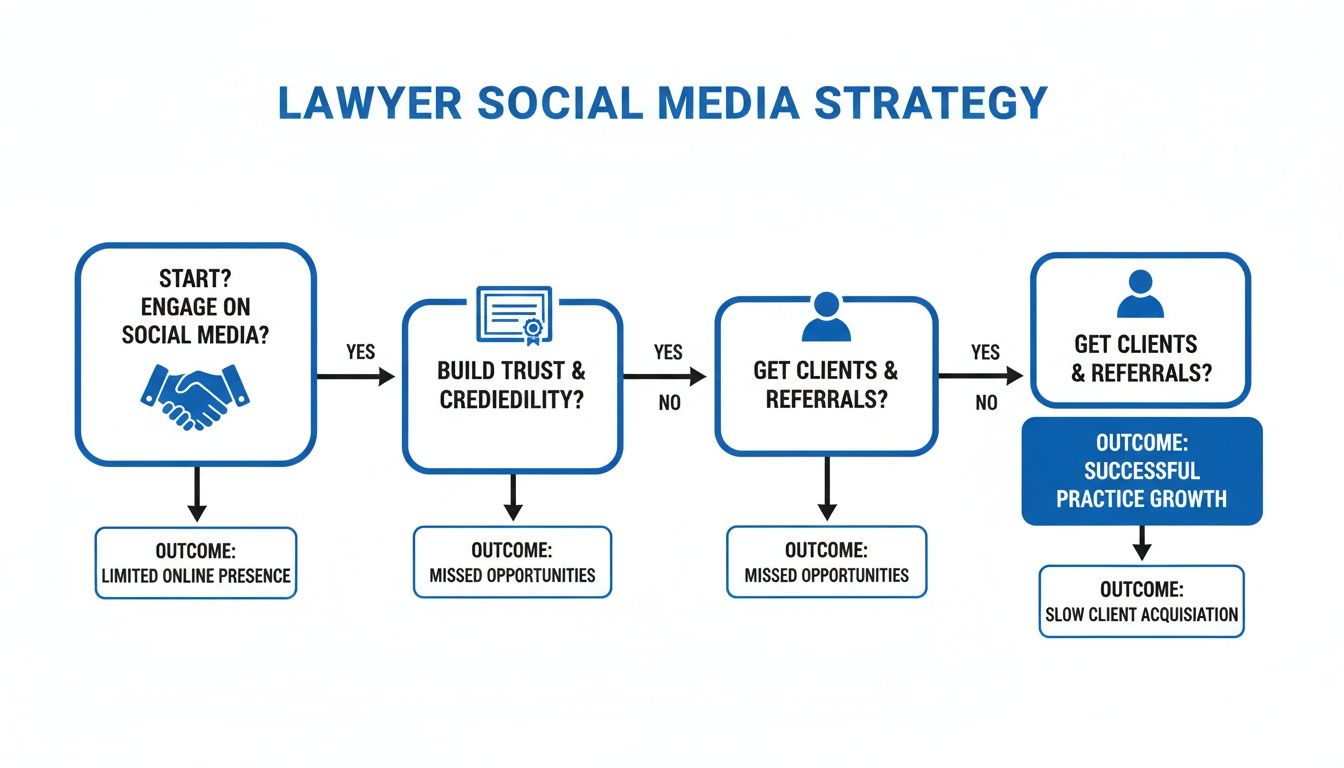
The takeaway here is simple: let your objectives dictate your platform choice. That's the first real step toward turning your social media efforts into something sustainable and, more importantly, profitable.
To help you get started, here's a quick reference guide that matches common practice areas with the platforms where we've seen them get the most traction.
Social Media Platform Strategy by Practice Area
| Practice Area | Primary Platform | Content Focus | Key Objective |
|---|---|---|---|
| Corporate/Business Law | In-depth articles, industry analysis, case studies | Build B2B authority, generate leads from execs | |
| Personal Injury Law | Client stories, safety tips, educational videos | Build local trust, capture immediate leads | |
| Family Law | Q&A sessions, guides on mediation, empathetic posts | Connect with the community, show compassion | |
| Immigration Law | Success stories (visuals), visa process infographics | Humanize the firm, reach a younger audience | |
| Real Estate Law | Instagram/FB | Homebuyer checklists, closing day photos, explainer videos | Make complex topics approachable, build local network |
| Employment Law | Legislative updates, compliance tips for HR pros | Establish expertise, connect with business leaders | |
| Estate Planning (High-Asset) | Articles on asset protection, succession planning | Target high-net-worth professionals |
This table is a starting point, not a rigid set of rules. Your firm's unique voice and client base will ultimately shape your strategy, but this framework provides a solid foundation for making an informed choice.
LinkedIn: The Professional Authority Platform
Think of LinkedIn as the digital version of a high-stakes industry conference. It’s the undisputed champion for building professional credibility and is absolutely essential for certain practice areas.
- Corporate and Business Law: This is your home turf. You should be sharing deep-dive articles on corporate governance, the nuances of intellectual property, or the legal landmines startups face. You get direct access to C-suite executives and in-house counsel—the very people who hire you.
- Employment Law: LinkedIn is the perfect channel for getting in front of HR managers and business owners. Posting about new workplace legislation or offering insights on non-compete agreements positions you as the expert they need.
- High-Asset Divorce and Estate Planning: While these are consumer services, the clients you want are often professionals and executives. Sharing sophisticated content on asset protection or business succession planning proves you can handle their complex financial lives.
On LinkedIn, your content strategy is all about depth and authority. Forget the flashy visuals; focus on substantive articles, insightful commentary, and professional case studies that prove you know your stuff.
Facebook: The Community Connection Hub
With its massive, diverse user base, Facebook is a powerhouse for consumer-facing law firms that run on local trust and community reputation. It’s your chance to build real connections where potential clients are scrolling in their downtime.
A family law attorney, for instance, can post helpful guides on navigating the mediation process, showing both empathy and expertise. The platform’s ad targeting is also incredibly powerful for lawyers. If you want to go deeper on that, our guide on Facebook advertising for attorneys breaks down exactly how to build winning campaigns.
Here are a couple of practice areas that consistently win on Facebook:
- Personal Injury: This is all about being a trusted resource in a crisis. Share client success stories (always with permission), post safety tips to prevent common accidents, and create short videos explaining what to do right after a collision.
- Family Law: The goal here is to build trust through education and support. Answer common questions about divorce or custody with a softer, human-centric approach.
Instagram: The Visual Storytelling Channel
Don't underestimate Instagram. Many lawyers write it off, but its visual-first approach is perfect for humanizing your practice and connecting with a younger demographic. It’s less about dense legal analysis and more about telling your firm’s story.
Use it to give a behind-the-scenes look at your firm, create short educational videos (Reels), or design clean graphics that simplify complex legal concepts.
- Immigration Law: This is a perfect fit. Use Instagram to share powerful client success stories (like a "Welcome to the U.S." post), explain visa processes with clear infographics, and create Reels answering the most common questions you get.
- Real Estate Law: Make the complicated feel approachable. Post a visual checklist for first-time homebuyers, a "day in the life" story from a closing, or a short video explaining a tricky concept like title insurance.
The key to winning on Instagram is authenticity. Show off your firm's culture, celebrate your team's successes, and highlight your community involvement. It builds a relatable brand that attracts clients who are looking for that personal connection.
Crafting Content That Actually Attracts and Converts Clients

This is where the rubber meets the road. All the platform strategy in the world doesn't matter without the right content. For lawyers, effective social media isn't about just selling your services—it’s about building trust and solving problems for people before they even know they need you.
The key is to ditch the aggressive sales pitches. Instead, focus on creating genuine, client-focused narratives.
Your content should be built on three core pillars that work in harmony. This approach guides a potential client from being a casual follower to someone who picks up the phone to schedule a consultation. You become a helpful resource first, a hired attorney second.
Pillar 1: Educational Content
Your first job on social media is to educate. When people face a legal issue, they're often stressed, confused, and desperately searching for clarity. Your social media can be that source of clarity, immediately positioning you as a knowledgeable and trustworthy guide.
Think about the top five questions you get during every initial consultation. That's your content goldmine. Break down those complex topics into simple, digestible pieces.
- Quick Videos: A family lawyer could shoot a 90-second video explaining the first steps in the mediation process. It provides immediate value and showcases a calm, professional demeanor.
- Simple Infographics: A real estate attorney can create a clean graphic outlining the key steps of a home closing. It’s highly shareable, easy to understand, and incredibly practical.
- Actionable Checklists: A personal injury firm might post a checklist titled "5 Things to Do Immediately After a Car Accident." This is the kind of content people save, just in case.
Remember, the goal is to demystify the law, not to give away specific legal advice. By educating your audience, you build a foundation of trust that is absolutely critical for turning followers into clients. This is a core part of any successful law firm content marketing strategy that goes well beyond social media.
Pillar 2: Authority-Building Content
Once you've established yourself as a helpful educator, it's time to build authority and show some social proof. This is where you prove you’re not just knowledgeable, but also effective. You show potential clients that other people have trusted you with successful outcomes.
This kind of content is what gives prospects the confidence they need to actually reach out.
Your audience needs to see hard evidence of your success. Authority-building content isn't about bragging; it's about providing the proof that makes a potential client feel secure in their choice to contact you.
Some of the most effective authority content includes:
- Anonymized Case Studies: Share a quick story: "Helped a local business navigate a complex contract dispute, saving them from potential litigation." You're telling a story of a problem, your strategy, and the positive result.
- Client Testimonials: That glowing Google review? Turn it into a branded graphic for Instagram. A powerful quote from a happy client is often more persuasive than anything you can say about yourself.
- Speaking Engagements: If you speak at an industry event or a local business group, post a picture and a key takeaway. This reinforces your status as a leader in your field.
Pillar 3: Connection-Building Content
At the end of the day, people hire people, not faceless law firms. Your content needs to humanize your practice and build a real connection with your audience. This is where you show the personality, people, and values behind the professional brand.
Connection content makes your firm feel approachable and relatable, which can be a massive differentiator in a crowded legal market.
Try some of these ideas to build a stronger connection:
- Behind-the-Scenes: Introduce a new paralegal, celebrate a firm anniversary, or share photos from a team volunteer day.
- Community Involvement: If your firm sponsors a local charity 5K, share it. This shows you're invested in the community you serve.
- "Ask Me Anything" Sessions: Host a live Q&A on Instagram or Facebook Stories to answer general questions about your practice area.
This multi-pillar approach turns your social media from a passive bulletin board into a powerful machine for generating real leads. In fact, 71% of lawyers report they have successfully generated new leads from social media—a testament to how well this works when done right.
To truly maximize your reach, it's not just about what you post, but how you get people to interact with it. Law firms must implement proven strategies to increase social media engagement to make sure their great content gets seen.
Navigating Ethics and Accessibility on Social Media

Jumping into social media as a law firm isn't like other businesses. We operate under a completely different, and much stricter, set of rules. This isn't just about good marketing; it's about compliance, and the professional consequences are very real. One careless comment or a slightly exaggerated post can land you in hot water with your state bar.
The American Bar Association (ABA) and state bars have specific, enforceable regulations for attorney advertising. They aren't suggestions. These rules exist to protect the public and maintain the integrity of our profession, and failing to apply them to your social media is a risk you simply can't afford.
Upholding Ethical Advertising Rules
Make no mistake: your social media profiles, posts, and ads are all considered attorney advertising. That means every single thing you publish must comply with the ethical guidelines in your jurisdiction, which can vary dramatically from state to state. California, for example, has very particular rules about what qualifies as a misleading communication.
A classic misstep is accidentally forming an attorney-client relationship. It happens all the time in DMs. Someone asks a specific question about their case, you offer some helpful thoughts, and suddenly you've blurred a critical line and created an unintended professional obligation. The solution is simple: always push these conversations offline to a formal, structured consultation.
Here are a few absolute, non-negotiable rules for your social media presence:
- Never Guarantee Outcomes: This is a cardinal sin. You can't say or even imply you'll win a case. Phrases like "We get the best results" are a clear violation.
- Avoid Misleading Claims: Don't call yourself an "expert" or a "specialist" unless you hold an official certification from your state bar or another accredited organization that allows it.
- Use Clear Disclaimers: Every post that touches on a legal topic needs a disclaimer. It should clearly state that the content is for informational purposes only, is not legal advice, and does not create an attorney-client relationship.
Your social media strategy has to be built on a rock-solid foundation of ethical compliance. Every tweet, post, and video is a direct extension of your professional practice. It demands the same care as any official firm communication. For a deep dive into these rules, our guide on ethical attorney advertising in California is an essential read.
Prioritizing Digital Accessibility and ADA Compliance
It doesn't stop with ethical rules. Your digital front door must be open to everyone, including people with disabilities. The Americans with Disabilities Act (ADA) absolutely applies to websites and digital content. Ignoring this not only exposes your firm to potential lawsuits but also alienates a huge segment of your audience.
Making your content accessible isn't just about checking a legal box. It’s a powerful statement about your firm’s values. It shows you're committed to inclusivity and professionalism.
The good news is that most of the key practices are straightforward to implement.
- Add Alt Text to Images: This is a simple written description of an image that screen readers use to help visually impaired individuals understand your content.
- Caption All Videos: Always include accurate, synchronized captions. This is crucial for users who are deaf or hard of hearing, not to mention the many people who watch videos with the sound off.
- Use High-Contrast Colors: Make sure the text in your graphics and branding is easy to read against its background.
By weaving these ethical and accessibility standards into your daily workflow, you're not just mitigating risk. You're building a stronger, more trustworthy brand that serves everyone in your community.
Using Paid Social Ads to Accelerate Firm Growth
Think of your organic social media content as the foundation for building trust and credibility. It’s essential, but it’s a long game. Paid social advertising, on the other hand, is the engine that drives rapid, targeted growth.
It's a precision tool. Instead of posting content and hoping the right clients stumble upon it, paid ads let you find them. You can put a specific message directly in front of the people who need your legal services right now. This isn't about randomly "boosting" a post; it's a strategic way to generate high-quality leads far more efficiently than most old-school marketing methods.
Defining Your Audience with Precision
The real magic behind platforms like Facebook and LinkedIn Ads is their ridiculously specific targeting. You can go way beyond broad demographics like age and location and zero in on the exact individuals most likely to become your next client. This focus ensures your marketing dollars are actually reaching relevant people, not getting wasted on impressions that will never turn into a case.
A personal injury firm, for example, can target ads to users within a 15-mile radius of their office who recently visited a hospital or showed interest in content about auto repairs. A business litigator can target C-suite executives at companies of a certain size within a specific industry.
This kind of hyper-targeting changes everything. It allows you to craft messages that speak directly to a person's immediate problems and circumstances.
Crafting Ad Copy That Converts
In a crowded social feed, your ad copy and creative are your digital handshake. They have to be compelling enough to stop someone mid-scroll and get them to take action. The best legal ad copy cuts through the jargon and focuses squarely on the client’s problem and your solution.
Here’s a simple but effective framework for ads that actually work:
- Hook with the Problem: Lead with a pain point they recognize. "Navigating a commercial lease negotiation alone?"
- Present Your Solution: State clearly how you help. "Our firm protects your business interests by reviewing and strengthening your lease agreements."
- Provide a Clear Call-to-Action (CTA): Tell them exactly what to do next. "Schedule a confidential consultation today to secure your terms."
The best social media ads don't feel like ads at all. They feel like a timely solution to an urgent problem. They offer clarity and a clear path forward, which is exactly what someone facing a legal challenge is looking for.
Setting a Budget for Maximum ROI
A lot of firms get spooked by the potential cost of paid ads. But a well-managed campaign can deliver an incredible return on investment, even with a modest starting budget. The key is to start small, test everything, and then scale up what works.
You don't need a massive budget to get going. You could begin with something you're comfortable with, like $25-$50 per day, and just watch your key metrics—especially your cost per lead (CPL) and click-through rate (CTR). This data-driven approach lets you see what's working, so you can reallocate your budget to the ads and audiences that perform best. It's the core of effective social media advertising for lawyers that delivers real, tangible results.
The legal industry is catching on fast. Recent data shows that 60% of firms plan to increase their social media spending, with 48% specifically expanding their use of paid ads. On top of that, 37% are investing directly in LinkedIn advertising, showing a clear shift toward these powerful paid channels.
To make the process even more efficient, many firms are turning to AI ad generation tools to help create high-converting copy and visuals. By combining smart spending with precise targeting, paid social ads become a predictable and scalable source of high-quality leads for your practice.
Answering Your Toughest Social Media Questions
Jumping into social media marketing can bring up a lot of questions. It's totally normal. You know you need an online presence, but you're also worried about the time commitment, making a costly mistake, or just shouting into the void with no real results to show for it.
Let's tackle those big questions head-on so you can move forward with a clear, confident plan.
How Much Time Does This Actually Take Each Week?
Look, consistency will always beat a short-term, all-out blitz. For a small firm or a solo practitioner, aiming for 3-4 hours per week is a perfectly realistic and effective starting point.
The secret is to break it down so it doesn't feel like another huge task on your to-do list.
- Batch Your Content (1-2 hours): Set aside one block of time to write and schedule all your posts for the upcoming week. This is so much more efficient than scrambling for an idea every single day.
- Daily Check-in (15-20 minutes): This is your relationship-building time. Hop on each day to reply to comments, answer messages, and interact with what others in your network are posting. This is where the real connection happens.
A firm that posts solid, valuable content twice a week, every week, will get infinitely better results than one that dumps ten posts in a single week and then disappears for a month. It’s all about finding a sustainable rhythm.
What Are the Biggest Mistakes Lawyers Make on Social Media?
The most common blunders I see come from a basic misunderstanding of why people are on these platforms in the first place. It's a place to connect and learn, not a billboard screaming for business.
The absolute biggest mistake is being overly promotional. If your feed is nothing but a constant stream of "Hire Me!" and "Free Consultation!" graphics, you'll turn people off in a heartbeat. You have to lead with value, first and always.
Another major misstep is ignoring engagement. When someone actually takes the time to leave a comment, leaving them hanging makes your firm seem cold and unapproachable. Social media is a conversation, not a monologue.
But the most critical error? Neglecting your ethical duties. Making guarantees about case outcomes, accidentally sharing confidential information, or creating an attorney-client relationship in a DM can land you in serious hot water. Getting this right is non-negotiable for building a credible, lasting online presence.
Can I Really Use AI to Create My Firm's Content?
Yes, but with a huge caveat: AI should be your smart assistant, never a substitute for your actual legal expertise. It can be a fantastic tool for getting the ball rolling and saving you time.
AI is great for things like:
- Brainstorming a list of potential post ideas around a specific practice area.
- Whipping up a rough first draft of a blog post or social media caption.
- Translating complex legal concepts into plain English that your audience can actually understand.
However, a human attorney must have the final word. Every single piece of AI-generated content needs to be meticulously reviewed, fact-checked, and edited by a qualified legal professional. Legal marketing demands 100% accuracy. Your unique voice, your perspective, and your hard-won experience are what build trust—and an AI can't fake that.
Let the AI do the heavy lifting, but make sure the final product is polished, precise, and a true reflection of your firm's brand.
How Do I Know If Any of This Is Actually Working?
Measuring the return on your social media investment means looking past "vanity metrics" like follower counts and likes. While those are nice for gauging general awareness, they don't keep the lights on. The metric that truly matters is qualified leads.
You can draw a straight line from your social media activity to real business by tracking the right things. Start by using very specific calls-to-action in your posts, like "Download our free guide to the probate process" or "Schedule a confidential call using the link in our bio."
To track this properly, use UTM parameters in your links. This is a simple tag that tells your website analytics exactly how many visitors and leads came directly from Facebook, LinkedIn, or another channel.
Other key performance indicators (KPIs) to watch:
- Website Referral Traffic: Are people clicking from your social profiles over to your website?
- Engagement Rate: Are people commenting and sharing your stuff? It’s a great sign that your message is hitting the mark.
- Audience Growth: Is your follower count on your primary platforms growing steadily month over month?
And finally, never underestimate the power of just asking. Add a simple field to your client intake form: "How did you hear about us?" When you start seeing "LinkedIn" or "Facebook" pop up again and again, you'll have all the proof you need.
At Case Quota, we specialize in turning a law firm's social media presence into a predictable engine for new cases. Our team builds strategies that are not only 100% ethically compliant but are designed to attract your ideal clients and deliver results you can actually measure. Learn how we can help your firm grow.