

Everyone wants to know the magic number, but the truth is, there isn't one. While the average settlement for a slip and fall often lands somewhere between $10,000 and $50,000, that figure is just a starting point.
Cases involving serious injuries—the kind that lead to surgery or long-term disability—can easily command six-figure settlements or even more. The final amount is never off-the-shelf; it’s custom-built around the unique facts of your case.
Decoding the Average Slip and Fall Settlement

It’s tempting to latch onto an "average" figure, but that can be misleading. Think of a settlement calculation less like a fixed price tag and more like a personalized recovery plan. Every fall is different, every injury is unique, and every journey back to health follows its own path. This is why two incidents that seem nearly identical on the surface can end with completely different outcomes.
This number isn’t just pulled out of thin air. It’s the product of a careful accounting of both your concrete financial losses and the very real, but less tangible, suffering you’ve endured. Our goal here is to give you a realistic benchmark so you can understand what your claim might be worth before we dig into the specific factors that can drive that number up or down.
Setting Realistic Expectations for Your Claim
Looking at national data gives us a clearer picture of the potential range. For instance, an analysis from CasePeer suggests that average slip-and-fall settlements can span from $10,000 to $150,000. Broader statistics for personal injury cases show an overall average settlement of $52,900, which again highlights just how much the specifics matter.
To make this more concrete, let's look at how settlements often break down based on how badly someone was hurt.
Typical Slip and Fall Settlement Ranges by Injury Severity
This table offers a quick snapshot of potential settlement amounts based on the severity of the injuries sustained in a fall.
| Injury Severity | Common Injuries | Typical Settlement Range |
|---|---|---|
| Minor | Sprains, bruises, minor cuts | $10,000 – $25,000 |
| Moderate | Fractures, torn ligaments, concussions | $25,000 – $75,000 |
| Severe | Traumatic brain injuries, spinal cord damage | $75,000 – $500,000+ |
As you can see, the gap between a minor sprain and a life-altering injury is enormous, and the settlement value reflects that reality.
A settlement isn't just about covering the medical bills you have today. It’s about securing the financial resources you need for future medical care, making up for lost earning potential, and accounting for the profound impact an injury has on your quality of life.
Understanding the potential value of your claim is the first step toward getting your life back on track. This detailed guide to slip and fall compensation offers some great insights into how the process works.
Of course, navigating this on your own can be overwhelming. Partnering with the right personal injury law firm can make all the difference. In the next sections, we'll break down exactly how these figures are calculated.
Here’s the rewritten section, crafted to sound like it was written by an experienced human expert.
Why Settlements Aren't Just About Money—They're About Making You Whole
It’s easy to get lost in the numbers, but let's take a step back and look at the bigger picture. A slip and fall isn't just a moment of bad luck. It's a disruptive, often painful event that can throw your entire life off course. And you're not alone—these incidents are a massive public health and economic problem across the country.
When you file a claim, you're not trying to win a lottery. You're seeking to restore the stability that was taken from you. A fall can leave you with a mountain of medical bills, weeks or months off work, and a recovery that’s both physically and emotionally draining. A settlement is the legal tool designed to cover those real-world costs and put the financial responsibility back where it belongs: on the negligent party.
The True National Cost of a Simple Fall
The statistics behind slip, trip, and fall incidents are genuinely staggering. Seeing the national data makes it crystal clear that these aren't minor accidents; they impose a heavy burden on individuals, families, and our economy.
The economic fallout is enormous. Just in the workplace, compensation and medical costs for employee slip-and-fall accidents are estimated at around $90 billion every single year. That number is almost too big to comprehend, and it doesn't even account for the countless falls that happen to customers in stores, guests in homes, or pedestrians on poorly maintained sidewalks.
Beyond the workplace, falls are one of the biggest reasons people end up in the emergency room.
In fact, falls are the #1 cause of hospital ER visits, sending over 8 million people for urgent medical care annually. That's more than 21% of all emergency room trips. Slip-and-fall accidents are directly responsible for over 1 million of those visits.
This isn't just data on a spreadsheet. These are real people in our hospitals, facing real injuries and expenses. Your case is a part of this larger story, and your settlement is how you address your piece of that cost.
A Settlement Is Your Path to Recovery
When you see the massive scale of the problem, the importance of a fair settlement really clicks into place. It’s the mechanism our legal system has to shift the financial burden from you—the person who got hurt—back to the property owner or their insurance company. Without it, innocent victims would be left to navigate overwhelming costs all on their own.
A settlement isn't just a single check. It's designed to cover several critical parts of your recovery:
- Paying Off Immediate Medical Bills: It provides the funds for the hospital stay, surgery, prescriptions, and any other urgent care you needed right after the accident.
- Funding Your Future Healthcare: Serious injuries often require long-term care. A settlement helps cover ongoing physical therapy, rehabilitation, or future medical procedures.
- Replacing Your Lost Income: It compensates you for the paychecks you missed while out of work. If your injury prevents you from returning to your old job, it can also cover your diminished future earning capacity.
- Acknowledging Your Pain and Suffering: This is about more than just bills. A settlement provides financial recognition for the physical pain, emotional distress, and loss of quality of life you've had to endure.
Ultimately, understanding the true cost of falls helps explain why your settlement is so important. It’s not about hitting some "average" number; it’s about getting the specific resources you need to put the pieces of your life back together after an accident that never should have happened.
How a Slip and Fall Settlement Is Calculated
Figuring out the value of a slip and fall claim isn't about pulling a number out of thin air. Instead, it’s a methodical process, almost like a forensic accountant tallying up every single loss you've suffered. The final settlement amount is built by combining two very different types of damages to capture the full impact of the accident.
This approach is designed to make you financially "whole" again. It ensures the compensation reflects everything from the tangible bills piling up on your counter to the invisible, but very real, impact the injury has had on your life.
The diagram below breaks down how these two core components—the economic and the human costs—come together.
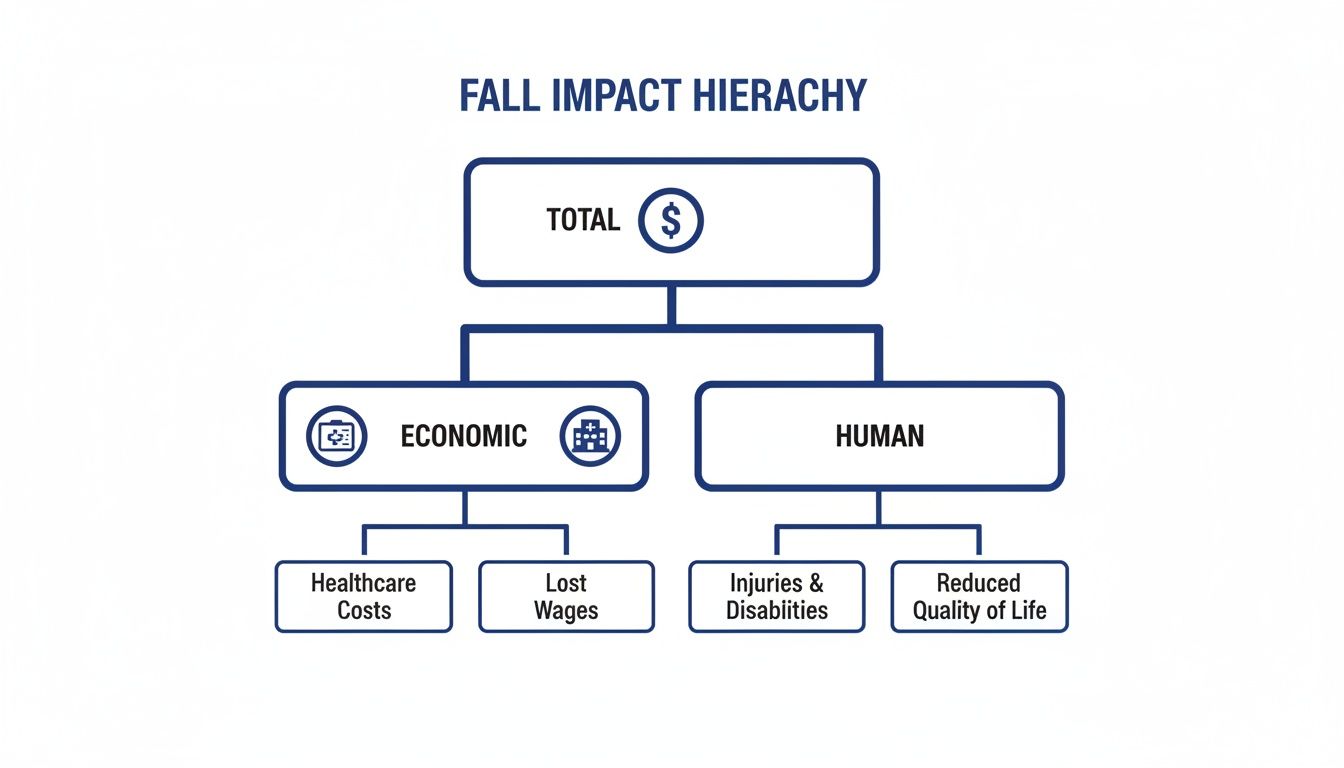
As you can see, a fair settlement has to account for both sides of the coin: the measurable financial losses and the profound human toll.
Economic Damages: The Foundation of Your Claim
The first part of the calculation, and the most straightforward, is economic damages. These are the hard, verifiable financial losses you’ve racked up because of the fall. Think of these as the concrete foundation of your claim—every item has a clear price tag attached.
Proving these damages is a matter of documentation. A good attorney will meticulously gather and add up every single receipt, bill, and pay stub to create a clear, data-backed total.
Common economic damages include:
- Medical Expenses: This covers it all—the ambulance ride, ER visit, any surgeries, hospital stays, prescriptions, and follow-up appointments.
- Future Medical Care: If your injury needs ongoing treatment like physical therapy, rehabilitation, or even future surgeries, the estimated cost for that care is factored in.
- Lost Wages: This is the income you couldn't earn because you were out of work recovering. It’s calculated precisely using your pay stubs and employment records.
- Loss of Earning Capacity: For life-altering injuries that permanently impact your ability to do your job (or work at all), this calculates the future income you'll never be able to earn.
These tangible costs form the baseline for any negotiation. They are the undeniable, out-of-pocket expenses that have to be reimbursed.
Non-Economic Damages: Valuing the Human Cost
The second piece of the puzzle, non-economic damages, is far more subjective. This is where compensation is assigned to the intangible suffering the injury caused. While pain doesn't come with a receipt, it represents a massive part of the harm you've gone through.
So how do you put a number on suffering? Attorneys and insurance companies often use what’s called a "multiplier" method.
The multiplier method works by taking the total economic damages and multiplying that figure by a number, usually somewhere between 1.5 and 5. The more severe, painful, and disruptive the injury, the higher the multiplier.
This gives everyone a structured way to quantify something that feels unquantifiable.
Non-economic damages are meant to cover a wide range of personal losses, such as:
- Pain and Suffering: This accounts for the physical pain, chronic discomfort, and general misery you’ve experienced from the moment you fell through your entire recovery.
- Emotional Distress: This is compensation for the psychological fallout—the anxiety, fear, depression, or PTSD that often follows a serious accident.
- Loss of Enjoyment of Life: If your injury stops you from participating in hobbies, playing with your kids, or simply enjoying daily activities you once loved, this category is meant to compensate for that loss.
Ultimately, a truly fair settlement is one that accurately combines both economic and non-economic damages. The goal is to create a complete financial recovery that addresses not just your medical bills, but the full human cost of the accident. Calculating this number right is the most critical step in figuring out the true value of an average settlement for a slip and fall.
The Key Factors That Change Your Settlement Amount
It’s a common question we hear: "My friend and I had the same kind of fall, so why was their settlement so different from what I'm being offered?" The answer is that no two slip and fall cases are ever truly identical.
The final number isn't just about the fall itself. It’s a carefully calculated sum based on a handful of critical variables that paint the full picture of your losses. Think of it less like a lottery ticket and more like an equation—each factor either adds to or subtracts from the final value. Understanding these moving parts is the first step to knowing what your case is really worth.
How Badly Were You Hurt? The Severity of Your Injuries
This is, without a doubt, the most significant driver of your claim's value. A sprained wrist that heals in a month simply doesn't have the same financial or personal impact as a shattered hip that requires surgery and leaves you with a permanent limp.
The worse the injury, the higher the compensation. It’s that simple. Insurance companies and juries will look closely at:
- The type of injury: A traumatic brain injury (TBI) or spinal cord damage is in a completely different league than bruises and scrapes. The potential for lifelong consequences immediately raises the stakes.
- The need for surgery: Any time a surgeon has to get involved, the value of a claim skyrockets. This isn't just about the hospital bills; it reflects the seriousness of the injury, the pain of recovery, and the inherent risks.
- Your long-term prognosis: Will you live with chronic pain? Did you lose mobility or the ability to work? An injury that permanently changes your life commands a much, much larger settlement.
Proving Fault: How Clear is the Negligence?
You can’t get paid if you can't prove the property owner was negligent. In plain English, that means you have to show they knew (or should have known) about a dangerous situation and did nothing to fix it. The more black-and-white this proof is, the stronger your negotiating power.
A case built on security footage showing a spill that was ignored for hours is rock-solid. It’s a world away from a case involving a fall on a sidewalk where a small crack had just formed. Hard evidence—photos, incident reports, witness testimony—forces the other side's hand and often leads to a quicker, higher settlement offer.
A strong case isn't just about what happened; it's about what you can prove. The more undeniable the evidence of the property owner's carelessness, the more leverage you have in settlement talks.
What Part Did You Play? The Role of Comparative Negligence
Here’s where things get tricky. In most states, the insurance company will investigate your actions leading up to the fall. This is a legal concept called comparative negligence, and it can have a huge impact on your payout.
Let's say you were looking down at your phone while walking and tripped over a hazard the property owner should have fixed. A jury might decide the owner was 80% to blame, but that you were 20% at fault for not paying attention. If your total damages were $100,000, your final award would be slashed by that 20%, leaving you with $80,000.
Adjusters use this exact math during negotiations. Anything you say that suggests you were distracted or careless can and will be used to devalue your claim.
The Elephant in the Room: Insurance Policy Limits
This is a practical reality that many people overlook. No matter how severe your injuries are, you can only recover what the property owner's insurance policy will cover.
A small business might only have a $100,000 liability policy, while a major national retailer could be covered for millions. If your medical bills and lost wages total $500,000, but the policy limit is only $300,000, collecting that extra $200,000 becomes incredibly difficult. While going after the owner’s personal assets is sometimes an option, it's rarely a practical one. A good attorney will investigate the policy limits right away to set a realistic target for recovery.
The good news is that most cases resolve favorably before ever seeing a courtroom. Success rates are high—95% of slip-and-fall cases settle pre-trial, with resolutions typically taking between 3 to 18 months. Crucially, represented plaintiffs secure settlements that are 3.5 times higher than those who represent themselves, making expert counsel essential. Discover more insights about these comprehensive legal statistics to understand how representation and jurisdiction impact outcomes.
Steps to Take to Protect Your Claim

The moments right after a slip and fall are a chaotic blur of pain and confusion. But what you do in that short window can make or break your ability to get fair compensation. Protecting your claim starts at the scene, and it’s not about being aggressive—it's about being smart.
You have to become the lead detective of your own case. Every photo you take, every person you talk to, and every report you file builds the foundation for proving the property owner was negligent. If you skip these steps, you’re handing the insurance company all the leverage right from the start.
Your Immediate Post-Fall Checklist
That first hour is everything. Adrenaline is a powerful painkiller, which means you might not realize how badly you're hurt, and the evidence—that puddle of water or broken handrail—can vanish in minutes. Following these steps protects both your health and your legal rights.
-
Seek Medical Attention Immediately: This is non-negotiable. Your health comes first, always. Even if you think you can just "walk it off," get checked out by a doctor. This creates an official medical record that directly links your injuries to the fall, which is critical evidence for your claim.
-
Document Everything at the Scene: Pull out your phone and start taking photos and videos before anything gets cleaned up or repaired. Get shots of the wet floor, the icy patch, or the crumbling step from every possible angle. Don’t forget to photograph your injuries and any damaged clothing, too.
-
Report the Incident Officially: Find the store manager, landlord, or property owner and notify them about the fall right away. Insist that they file an official incident report and make sure you get a copy. This document is your proof of when, where, and how the accident happened.
Navigating the First Call from the Insurance Adjuster
It won’t be long before you get a call from an insurance adjuster. They are trained to sound friendly and concerned, but remember their job: to protect their company’s money by paying you as little as possible. Every question they ask is designed to do just that.
Keep these points in mind when you talk to them:
- Stick to the basic facts: Confirm your name and the date and location of the incident. That's it. Don't offer extra details about your day or what you were doing.
- Do not admit any fault: Never say things like, "I should have been more careful" or "I guess I wasn't looking." An innocent comment can be twisted to argue you were partially to blame, which will absolutely reduce your settlement.
- Decline to give a recorded statement: You are under no legal obligation to give a recorded statement without an attorney present. Just politely say that you’re still assessing your injuries and will follow up later.
An adjuster’s goal is often to secure a quick, lowball settlement before you understand the full extent of your injuries and medical costs. Be wary of any offer made within days of the accident—it is almost certainly less than what your claim is truly worth.
It's easy to downplay a fall, but these incidents are incredibly serious. Falls are the second leading cause of unintentional injury deaths worldwide, with 684,000 fatalities occurring each year. For seniors, the risk is even greater, as one in five falls results in a severe injury.
Once you’ve gathered your evidence and seen a doctor, the next step is typically a formal demand for compensation. You can get a better sense of what’s involved by reviewing this sample personal injury demand letter template. From there, the negotiation process begins, so it pays to understand how to negotiate a personal injury settlement. By taking these proactive steps, you stop being a victim and start being an advocate for your own recovery.
Why You Need an Attorney to Maximize Your Claim
Trying to handle a slip and fall claim by yourself is like stepping into a professional boxing ring with no training. On the other side, the insurance company has a team of adjusters and lawyers whose entire job is to protect their bottom line—and that means paying you as little as possible.
An experienced personal injury attorney doesn't just level the playing field; they give you the advantage. They're more than just a paper-pusher. They become your strategist, your advocate, and your toughest negotiator, translating your pain, medical bills, and lost wages into a powerful legal argument that insurance companies can't ignore.
Turning Evidence Into Real Leverage
One of the most important things a lawyer does is build an ironclad case. They have the expertise and resources to track down critical evidence you’d likely never get on your own.
Think about it. Could you get your hands on these?
- Internal company records that might reveal a long history of ignoring safety problems.
- Security camera footage that the property owner is conveniently "reluctant" to hand over.
- Expert testimony from engineers or doctors to officially validate the severity and cause of your injuries.
This isn't just paperwork; it's leverage. Without it, you’re simply asking for money. With it, you are demanding the compensation you are rightfully owed.
The numbers don't lie. Study after study confirms that injury victims who hire a lawyer secure settlements that are, on average, 3.5 times higher than those who go it alone.
Hiring an attorney isn't an expense—it's one of the smartest strategic investments you can make in your financial recovery. Most work on a contingency fee, which means they don't get paid a dime unless you win. Their goals are perfectly aligned with yours: getting you the absolute maximum compensation. For legal professionals looking to connect with these clients, understanding effective marketing for personal injury law firms is key.
Ultimately, bringing a professional on board ensures you have the expertise needed to turn a traumatic event into a secure future.
A Few Common Questions About Slip and Fall Settlements
When you're dealing with the aftermath of a fall, the legal side of things can feel like a tangled mess. It's completely normal to have a lot of questions. Let's clear up some of the most common concerns people have, so you can move forward with a bit more clarity.
How Long Do I Have to File a Slip and Fall Lawsuit?
This is a big one, and it's time-sensitive. Every state has a strict deadline for filing a personal injury claim, known as the statute of limitations. Think of it as a countdown clock that starts ticking the moment you get hurt.
These deadlines vary, but they're often just two or three years. If you miss that window, your right to seek compensation is usually gone for good. The court simply won't hear your case. This is precisely why it’s so critical to talk to a lawyer sooner rather than later—to make sure that clock doesn't run out.
Do I Have to Pay Taxes on My Settlement?
An excellent and very practical question. For the most part, the IRS doesn't see the money you get for your physical injuries and medical bills as income. It's considered a reimbursement for what you lost, so that portion is generally not taxable at the federal level.
However, a few parts of a settlement can be taxed.
- Lost Wages: Any money you get to cover lost income is usually taxed, just as your regular paycheck would be.
- Punitive Damages: These are rare, but if they're awarded, the IRS sees them as income, so they're fully taxable.
- Emotional Distress: If the distress isn't a direct result of a physical injury, that part of the award might be taxed.
Tax laws can get complicated fast. It's always a good idea to run the specifics of your settlement by your attorney or a financial advisor.
Key Takeaway: The bulk of your settlement for physical injuries is typically tax-free. But always get a professional opinion on any money you receive for lost wages or non-physical damages.
What If I Fell at a Friend's House?
This is a tough one, both emotionally and legally. No one wants to sue a friend or a family member. It's a very common and understandable hesitation.
Here’s the thing to remember: you're not going after your friend's personal bank account. You're filing a claim against their homeowner's insurance policy. This is exactly why people have insurance—to protect them and their guests when accidents happen on their property. A good lawyer knows how to handle these situations with sensitivity, managing the process professionally so you get the help you need without ruining a personal relationship.
Will My Case Definitely Go to Court?
Almost certainly not. The reality is that more than 95% of personal injury cases are settled out of court. Trials are expensive, time-consuming, and risky for everyone involved, especially insurance companies.
A lawsuit is typically filed only when an insurance company refuses to offer a fair settlement. The secret is that the best attorneys prepare every single case as if it's going to trial. That thorough preparation is what gives them the leverage they need to negotiate a strong settlement for you, often without ever setting foot in a courtroom.
At Case Quota, we understand the challenges law firms face in reaching clients who need their help the most. Our marketing strategies are designed to connect you with individuals seeking justice after an accident. Find out how we can grow your firm.