

Over 80 percent of American consumers start their search for legal help online before contacting a law firm. The competition in Southern California is fierce, especially for smaller firms looking to stand out against larger practices. By understanding how well-crafted legal blog content can transform complex information into clear, client-focused insights, managing partners gain practical tools for building authority, earning trust, and driving more qualified leads to their firm.
Table of Contents
- Defining Blog Content In Legal Marketing
- Key Types Of Legal Blog Content
- How Blogging Drives Law Firm SEO
- Building Authority And Trust With Blog Content
- Compliance, Risks, And Ethical Blogging
- Best Practices For Law Firms In California
Key Takeaways
| Point | Details |
|---|---|
| Effective Blogging is Strategic | Legal blog content is a marketing tool that simplifies complex legal concepts, attracting and converting potential clients. |
| Diverse Content Types Engage Audiences | Utilize various blog formats, such as case analyses and educational posts, to reach different audiences and demonstrate expertise. |
| SEO Enhances Online Visibility | Regular, keyword-rich blogging improves search engine rankings, helping law firms attract clients through organic search. |
| Ethical Standards are Essential | Legal blogging must adhere to professional conduct guidelines to maintain credibility and protect client confidentiality. |
Defining Blog Content in Legal Marketing
Blog content in legal marketing represents a strategic communication tool that transforms complex legal information into accessible, engaging narratives for potential clients. Legal writing in this context serves a critical purpose beyond traditional legal documentation by simplifying intricate legal concepts and establishing the law firm’s expertise.
Effective legal blog content goes beyond mere information sharing. It functions as a sophisticated marketing instrument designed to attract, educate, and convert potential clients by demonstrating the firm’s deep understanding of specific practice areas. Blogging involves creating short, regularly updated entries that provide insights into legal trends, case studies, and practical advice that resonate with a firm’s target audience.
The primary components of successful legal blog content include authoritative analysis, practical guidance, and a clear demonstration of the firm’s unique perspective. These posts typically address common legal questions, explain recent legislative changes, offer interpretative insights into complex legal scenarios, and showcase the firm’s problem solving capabilities. By consistently producing high quality, relevant content, law firms can position themselves as thought leaders and trusted advisors in their specific legal domains.
Pro Tip: Develop a content calendar that aligns blog topics with your firm’s strategic practice areas and current legal trends to maintain relevance and demonstrate ongoing expertise.
Key Types of Legal Blog Content
Legal blogs encompass a diverse range of content types strategically designed to engage different audiences and demonstrate a law firm’s expertise. Legal blogs feature multiple content approaches that include case analyses, opinion pieces on current legal developments, legislative updates, and professional insights that cater to both legal professionals and potential clients.
The primary content categories in legal blogging include educational posts, which break down complex legal concepts for general audiences, and news-driven posts that provide timely commentary on recent legislative changes or significant judicial decisions. Effective legal blogging commonly utilizes content types that balance informative analysis with the firm’s unique perspective, ensuring that each piece adds genuine value for readers.
Additionally, law firms can leverage specialized content formats such as thought leadership articles, practice area deep dives, client success stories, and expert commentary on emerging legal trends. These content types not only showcase the firm’s depth of knowledge but also help build trust by demonstrating the attorneys’ comprehensive understanding of specific legal domains. By creating a varied content mix, law firms can attract different segments of potential clients and establish themselves as authoritative resources in their practice areas.
Pro Tip: Develop a content strategy that rotates through different blog post types to maintain reader engagement and showcase the full breadth of your legal expertise.
Here’s a quick comparison of popular legal blog content types and the audiences they impact:
| Content Type | Primary Audience | Business Value |
|---|---|---|
| Case Analysis | Potential clients, lawyers | Showcases expertise, builds trust |
| Legislative Updates | Clients, legal professionals | Demonstrates knowledge, attracts leads |
| Educational Posts | General public, clients | Simplifies legal topics, widens reach |
| Thought Leadership | Peers, industry media | Boosts reputation, external referrals |
| Client Success Stories | Prospects, referrals | Builds credibility, social proof |
How Blogging Drives Law Firm SEO
Blogging enhances law firm digital visibility by systematically generating fresh, keyword-rich content that directly addresses potential clients’ search queries. Search engines reward consistent, high-quality content by improving website rankings, making blog posts a critical strategy for law firms seeking to expand their online presence and attract more potential clients through organic search results.

The strategic incorporation of relevant keywords within blog content helps law firms target specific practice areas and local search markets. Regular blogging supports SEO by attracting and retaining website visitors, which signals to search engines that the website provides authoritative and valuable information. This engagement metric is crucial for improving search engine rankings and demonstrating the law firm’s expertise in specific legal domains.
Moreover, blog content creates multiple opportunities for internal and external linking, which further strengthens a law firm’s SEO performance. By developing comprehensive articles that explore nuanced legal topics, attorneys can naturally incorporate links to other relevant pages on their website, increase time spent on site, and reduce bounce rates. These technical SEO signals help search engines understand the depth and credibility of the law firm’s online content, ultimately improving overall search visibility and attracting more potential clients.
Pro Tip: Develop a consistent blogging schedule that targets long-tail keywords specific to your practice areas to maximize SEO impact and client attraction.
Building Authority and Trust With Blog Content
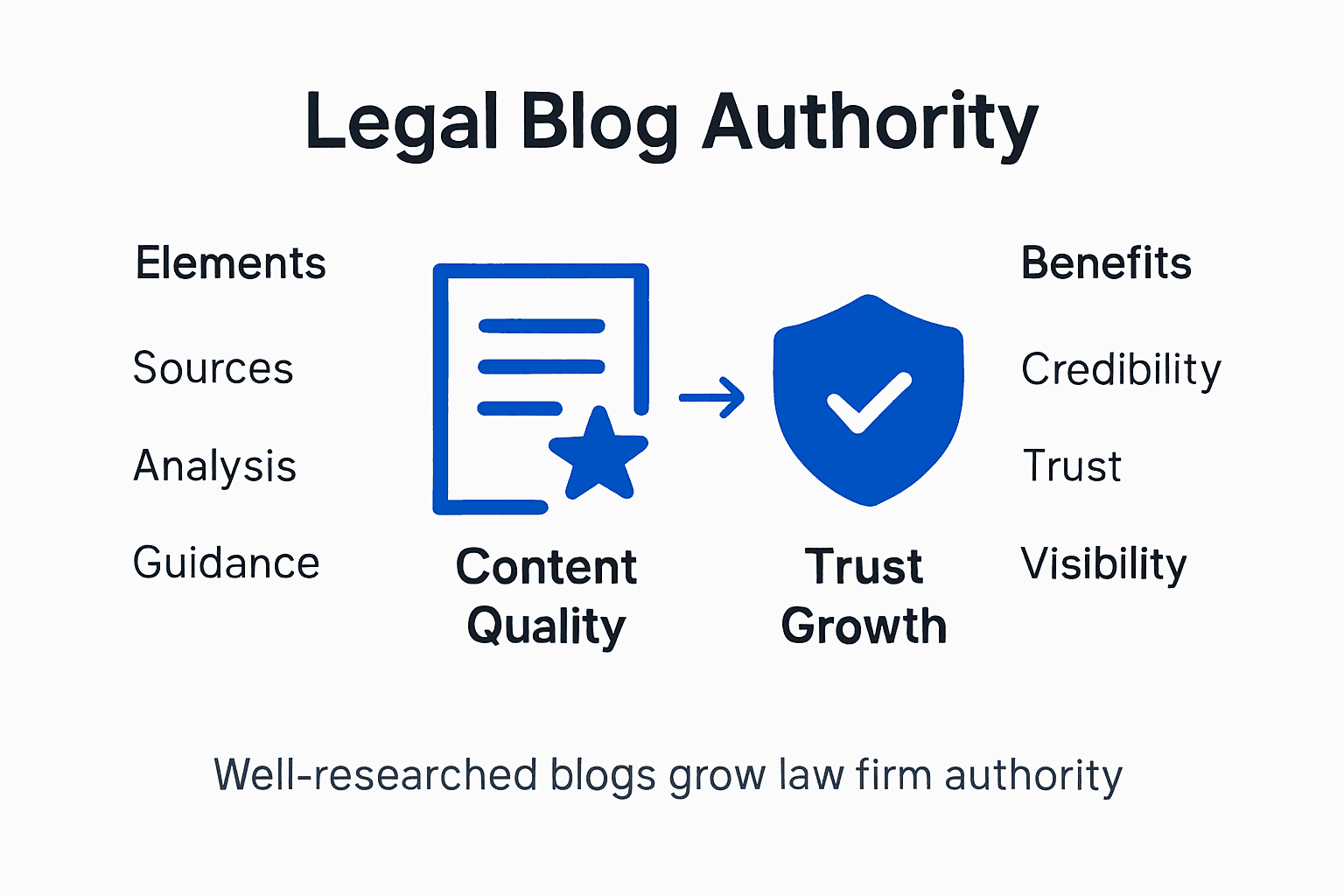
Authority in legal blog content emerges from well-researched, nuanced writing that demonstrates deep legal expertise and genuine insight into complex legal challenges. By consistently producing high-quality, accurate content that addresses potential clients’ specific concerns, law firms can establish themselves as credible and trustworthy resources in their practice areas.
The key to building digital trust lies in transparency, accuracy, and consistent value delivery. Digital content standards emphasize the importance of reliable information that speaks directly to audience needs, which for law firms means creating blog posts that not only inform but also showcase the firm’s professional understanding of intricate legal scenarios. This approach transforms blog content from simple information sharing to a powerful trust-building mechanism that demonstrates the firm’s expertise and commitment to client education.
Successful legal blogs go beyond surface-level explanations by providing in-depth analysis, citing authoritative sources, and presenting balanced perspectives on complex legal issues. By revealing the depth of legal knowledge, attorneys can humanize their practice, making sophisticated legal concepts accessible while maintaining professional credibility. This strategy helps potential clients feel more comfortable and confident in the firm’s abilities, effectively bridging the gap between professional expertise and client understanding.
Pro Tip: Incorporate real case studies and professional insights in your blog content to provide tangible proof of your legal expertise and build deeper reader trust.
Compliance, Risks, and Ethical Blogging
Legal bloggers must navigate complex legal risks surrounding digital content publication, including potential challenges related to defamation, intellectual property rights, and client confidentiality. Understanding these risks is crucial for attorneys who seek to leverage blog content as a marketing strategy while maintaining strict professional and ethical standards.
The ethical dimensions of legal blogging extend far beyond simple content creation. Digital media ethics demands ongoing vigilance in verifying information accuracy, managing potential conflicts of interest, and ensuring that published content adheres to professional conduct guidelines. This requires attorneys to carefully balance providing valuable insights with protecting client privacy and maintaining the integrity of legal discourse.
Successful ethical legal blogging involves implementing robust safeguards such as comprehensive content review processes, clear disclaimer statements, and strict protocols for discussing hypothetical or generalized legal scenarios without revealing specific client details. Attorneys must remain acutely aware that their blog content represents not just a marketing tool, but a professional communication channel subject to rigorous ethical scrutiny and potential legal consequences.
Pro Tip: Develop a comprehensive editorial review checklist that includes ethical compliance checks, confidentiality assessments, and accuracy verification before publishing any blog content.
Below is a summary of important compliance concerns for legal blog authors:
| Compliance Focus | Why It Matters | Key Safeguard |
|---|---|---|
| Defamation Avoidance | Prevents lawsuits, protects image | Avoid unsubstantiated facts |
| Intellectual Property | Respects third-party rights | Cite sources, use original content |
| Client Confidentiality | Maintains trust, abides by law | Anonymize client info, use disclaimers |
| Accuracy Verification | Prevents misinformation spread | Multi-level editorial review |
Best Practices for Law Firms in California
California’s legal marketing guidelines require law firms to maintain the highest standards of professional conduct, particularly when developing digital content strategies. This means crafting blog content that not only attracts potential clients but also upholds the ethical principles of transparency, accuracy, and respect that define the legal profession in Southern California.
Successful law firms in California understand that blog content must go beyond simple marketing to demonstrate genuine legal expertise and professional integrity. Civility guidelines encourage attorneys to engage in courteous and professional communication that reflects the nuanced expectations of the state’s legal community. This approach involves creating content that is informative, balanced, and respectful, avoiding sensationalism or misleading claims that could compromise professional standards.
Practical implementation of these best practices requires a comprehensive content strategy that integrates ethical considerations with marketing objectives. Law firms should develop clear editorial guidelines that address confidentiality, avoid potential conflicts of interest, and ensure that blog content provides genuine value to readers while maintaining the professional dignity expected of California attorneys. This includes carefully reviewing all content for accuracy, avoiding specific client details, and presenting legal information in a manner that is both accessible and professionally responsible.
Pro Tip: Create a detailed content review checklist that aligns with California Bar Association ethical guidelines to ensure every blog post meets professional standards before publication.
Elevate Your Legal Marketing with Expert Blog Content Strategy
Struggling to turn your legal blog into a powerful client attraction tool You are not alone Many law firms grapple with creating engaging, SEO-optimized content that builds trust and authority while complying with stringent ethical standards This article highlights how strategic blog content drives SEO success and establishes your firm as a leader in your practice areas At Case Quota we understand these challenges and specialize in crafting tailored digital marketing solutions that amplify your law firm’s online presence in Southern California

Ready to convert your blog content into a client-generating asset Our seasoned team delivers comprehensive services including SEO-optimized web design and AI-powered pay-per-click advertising designed exclusively for legal practices Discover how our sophisticated campaigns help small to mid-size law firms compete effectively against larger competitors Visit Case Quota now to learn more and take the first step toward transforming your legal marketing strategy With proven expertise in legal digital marketing and a deep commitment to ethical compliance you can trust us to help you grow your client base confidently
Explore the full range of our legal marketing services at Case Quota and start building authority and trust through expert blog content combined with performance-driven online strategies.
Frequently Asked Questions
What is the role of blog content in legal marketing?
Blog content serves as a strategic tool for law firms to communicate complex legal information in an accessible way, attract potential clients, and establish their expertise in specific practice areas.
How does blogging improve a law firm’s SEO?
Blogging enhances SEO by generating fresh, keyword-rich content that addresses potential clients’ search queries, improving website rankings and drawing more organic traffic over time.
What types of content should law firms include in their blogs?
Law firms should include educational posts, legislative updates, case analyses, thought leadership articles, and client success stories to engage a diverse audience and showcase their expertise.
How can law firms ensure their blog content is ethically compliant?
Law firms should implement a robust editorial review process, avoid discussing specific client details, and regularly verify the accuracy of their information to maintain ethical standards in their blog content.