

Content marketing for a law firm isn't just about blogging. It’s the strategy of using your legal expertise—packaged into helpful articles, videos, and guides—to attract potential clients online. Think of it as turning what you already know into a magnet for the exact people who need your help, building trust and authority long before they ever pick up the phone.
Why Content Is a Must-Have for Modern Law Firms
You’ve spent years building incredible legal expertise. But if that expertise stays locked in your head or confined to the courtroom, it’s not growing your practice. Content marketing for law firms is how you get that knowledge in front of the people actively searching for legal answers. It transforms your website from a static digital business card into an active, case-generating machine.
In a market flooded with attorneys, potential clients are doing their homework. They’re not just looking for a name and number; they’re looking for a trusted advisor. They want answers, reassurance, and proof you know what you’re doing before they commit to a consultation. High-quality content gives them exactly that.
Moving Beyond an Unpredictable Referral Pipeline
Referrals are fantastic, but relying on them alone is a recipe for an unpredictable, feast-or-famine workflow. Content marketing creates a steady, reliable stream of leads by establishing your firm as the go-to authority in your practice area.
This isn't just a theory; it's how the industry is moving. A staggering 86% of law firm owners now use content as part of their marketing strategy, proving it's no longer a niche tactic but a core business function.
Instead of waiting for the phone to ring, you proactively answer the specific questions your ideal clients are typing into Google. This is central to any effective plan for how to market a law firm in today's world. You build a connection by helping them, making your firm the obvious choice when they're ready to take the next step.
A law firm without a content strategy is like a brilliant lawyer arguing a case to an empty courtroom—the expertise is there, but no one is present to hear it.
The Core Pillars of Legal Content Marketing
Before diving in, it’s crucial to understand the foundational pieces that work together to turn your expertise into actual clients. Each component has a specific job in guiding someone from a late-night Google search to a scheduled consultation.
This table gives you a quick overview of the key pillars we'll be exploring.
The Core Pillars of Legal Content Marketing
| Pillar | Objective | Example Content |
|---|---|---|
| Authority Building | Demonstrate deep legal expertise and establish credibility. | A comprehensive guide on the statute of limitations for personal injury claims in your state. |
| Trust Generation | Connect on a human level and show you get results. | A video testimonial from a satisfied client or a detailed case study (anonymized). |
| Action Driving | Convert passive readers into active leads. | A "What to Expect During Your Free Consultation" article with a clear "Schedule Now" button. |
Each of these pillars is essential. You need to show you know your stuff, prove you can be trusted, and then make it incredibly easy for potential clients to reach out.
This guide will serve as your complete roadmap. We'll break down exactly how to plan, create, distribute, and measure a content strategy that hits all these goals and delivers a real, tangible return on your investment.
Building Your Law Firm Content Strategy
A winning approach to content marketing starts long before you write a single word. Just cranking out blog posts without a clear plan is like walking into a courtroom without reading the case file—you might get lucky, but a strategic opponent will almost always win. A solid strategy is what turns random acts of content into a predictable, client-attracting system.
This whole process doesn't begin with legal jargon or what you want to talk about. It starts with your ideal client. To create content that actually connects, you have to get past broad demographics and truly understand their situation. What are their immediate fears? What exact questions are they typing into Google at two in the morning?
Understand Your Ideal Client's Journey
Before you can ever offer a solution, you have to deeply understand the problem from the client's perspective. This means creating a detailed client persona, which is essentially a semi-fictional profile of the exact person you want to attract.
And you need to think beyond the basics like age and location. Dig into their real pain points:
- Emotional State: Are they anxious, confused, or completely overwhelmed? Someone facing a DUI has a vastly different emotional state than a person planning their estate.
- Urgency: Do they need a lawyer right now, or are they just starting their research? This dictates the tone and directness of your content.
- Specific Questions: What are the exact phrases they’re using? A real person doesn't search for "tort law"; they search for "sue doctor for misdiagnosis in Florida."
Once you have this persona locked down, you can map out their journey. This path usually has three key stages, and each one needs a different type of content to guide them closer to your firm.
- Awareness Stage: The person knows they have a problem but has no idea what the solution is. Content here should be educational and empathetic, answering broad questions like, "What are the first steps after a car accident?"
- Consideration Stage: Now they're actively researching their options and comparing different law firms. Your content needs to demonstrate your expertise and build trust. Think detailed guides, case studies, and in-depth FAQ pages.
- Decision Stage: The potential client is ready to hire an attorney. This is where you seal the deal with client testimonials, details about your consultation process, and crystal-clear calls-to-action that make it easy to get in touch.
This infographic does a great job of showing how a well-planned content strategy lines up perfectly with the client's journey.
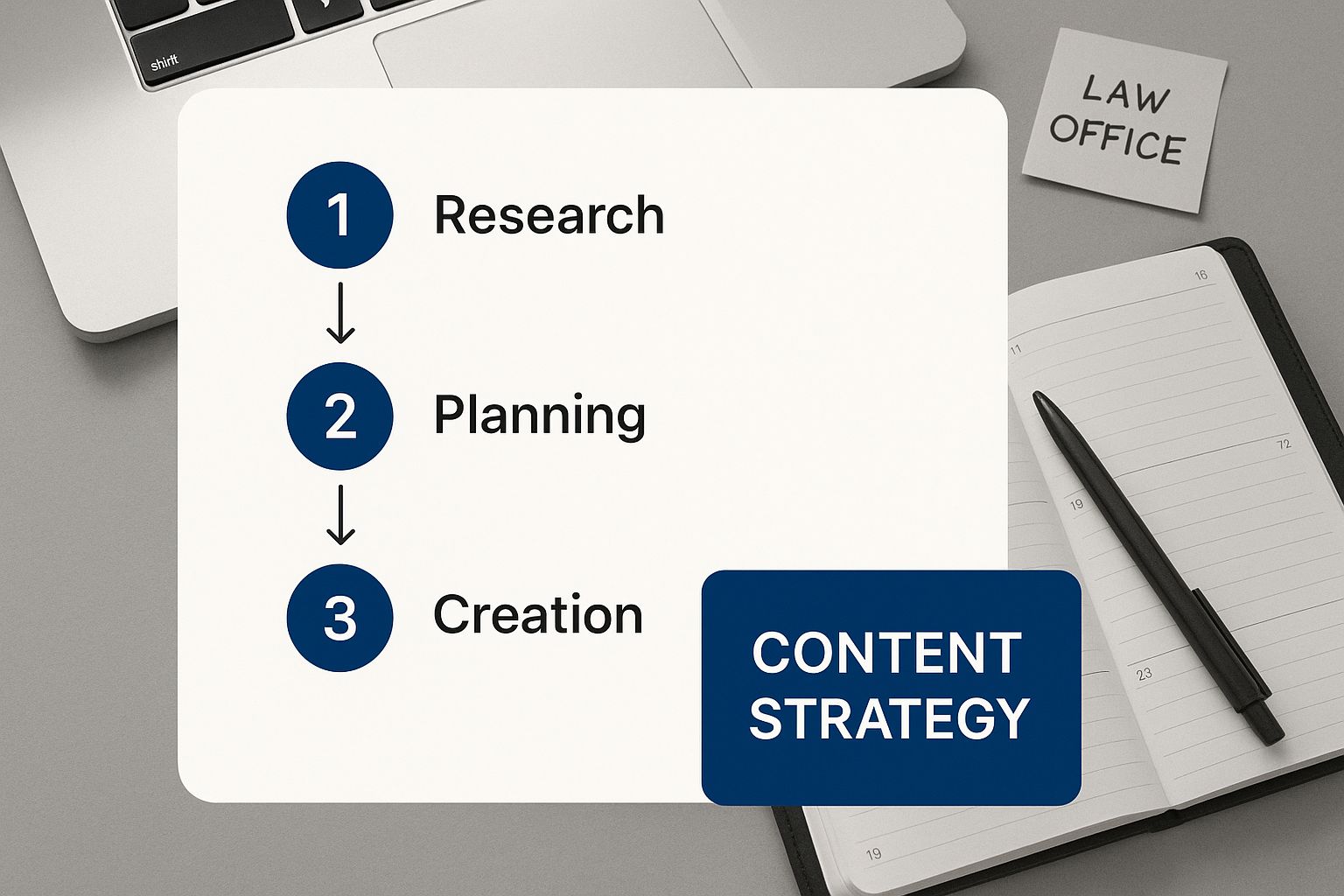
Visualizing the process like this helps turn your marketing from a simple checklist of tasks into a cohesive system, one designed to guide potential clients from their very first search all the way to a signed retainer.
Execute with a Content Calendar
With a crystal-clear picture of your client and their journey, the final step is to get practical with a content calendar. This is a simple but incredibly powerful tool—often just a spreadsheet or a project management app—that schedules exactly what you'll create and when you'll publish it.
Your content calendar is the bridge between your strategy and consistent execution. It ensures you are regularly publishing valuable information, building momentum with search engines and potential clients alike.
A well-structured calendar completely eliminates that last-minute scramble for topics and keeps your marketing efforts firmly on track. Ideally, it should map out your planned blog posts, videos, and social media updates weeks, or even months, in advance. To make this even more manageable, you might want to use a comprehensive law firm marketing plan template to structure your calendar alongside your bigger strategic goals.
A good calendar should include:
- Topic and Keyword: The specific subject and the main search term you're targeting.
- Content Format: Is it a blog post, a video, an infographic, or a checklist?
- Target Persona: Which of your client personas is this content for?
- Funnel Stage: Is this piece for the Awareness, Consideration, or Decision stage?
- Publication Date: The exact date the content is scheduled to go live.
- Distribution Channels: Where will you promote it? Think LinkedIn, your email newsletter, or even Google Ads.
By planning content that addresses specific client needs at each stage of their journey, you build a powerful marketing engine that works for your firm 24/7, establishing your authority and generating a steady stream of qualified leads.
Creating Content That Turns Prospects Into Clients

Alright, with your strategy mapped out, it's time to roll up your sleeves and create the actual content. This is where the real work begins—and where most firms miss the mark. We're not talking about churning out generic blog posts. We're talking about crafting high-value assets that answer a potential client's most urgent questions, build undeniable trust, and guide them toward picking up the phone.
Think of your firm's website as your most powerful marketing engine. A recent survey found a massive 78.2% of lawyers use their website for marketing, and nearly 65% say it delivers the best return on investment. It's the digital storefront where you publish articles, showcase case wins, and meet potential clients exactly where they are: online, searching for answers.
This means every single page, post, and guide you publish has to do double duty. It needs to be smart enough for search engines to find it and compelling enough for a human to act on it. That requires a blend of genuine authority and real empathy.
Embracing Google’s E-E-A-T Principles
When it comes to legal content, "good enough" is a failing grade. Legal advice is what Google calls "Your Money or Your Life" (YMYL) content, meaning it gets scrutinized under a microscope. To earn top rankings and a client's trust, your content must be a masterclass in E-E-A-T.
Here’s the breakdown:
- Experience: You need to show you’ve actually been in the trenches. Share insights from real-world cases (anonymized, of course) or walk readers through the practical steps of a legal process you’ve navigated hundreds of times.
- Expertise: Go deeper than the competition. Don't just list the penalties for a crime; explain the nuances of the law and offer insights that only a seasoned attorney would know.
- Authoritativeness: This is about proving you're a leader in your field. Your attorney bios, awards, published articles, and speaking engagements all work together to build this pillar.
- Trustworthiness: Build confidence through transparency. Clear contact information, authentic client testimonials, and proper legal disclaimers all signal that you're a credible, client-first firm.
Think of E-E-A-T as your digital reputation. A potential client wouldn't hand a complex case to a lawyer with a shaky track record, and they won't trust content that feels generic or lacks a clear, expert author.
High-Value Content Formats That Drive Action
A consistent blog is a great starting point, but a truly effective content strategy goes much further. You need to create cornerstone assets that solve major problems for clients, no matter where they are in their journey.
Here are a few high-impact formats to put at the top of your list:
- Comprehensive Legal Guides: Instead of a 500-word post on "DUI Penalties," create the definitive resource: "The Complete Guide to Facing a DUI in California." Cover every angle, from the traffic stop to the long-term fallout, and link out to smaller, more focused articles.
- Detailed FAQ Pages: Move beyond the basics. Build out FAQ pages for each practice area that tackle the tough, emotional questions clients are often hesitant to ask. This shows you understand their fears and have the answers.
- Client Success Stories: People connect with stories, not statistics. With confidentiality in mind, frame a case as a narrative: "The Challenge," "Our Approach," and "The Result." It’s far more persuasive than a dry list of victories.
This focus on creating substantial, valuable resources is a key part of smart website optimization for law firms. It tells both people and search engines that your firm is the go-to authority.
From Information to Consultation: The Perfect Call-to-Action
All the amazing content in the world is just noise if it doesn't lead to a conversation. The final, critical piece of the puzzle is your call-to-action (CTA). This is the bridge that takes a reader from being informed to becoming a real lead.
Your CTA isn't just a button; it's a clear, low-risk invitation to take the next step. It must be specific, compelling, and aligned with the reader's current mindset.
A lazy "Contact Us" just doesn't cut it. A powerful legal CTA reduces anxiety and speaks directly to what the reader needs in that moment.
Check out the difference:
| Weak CTA | Strong, Empathetic CTA | Why It Works |
|---|---|---|
| Contact Us | Schedule a Confidential, No-Obligation Case Review | It immediately addresses privacy concerns and removes the fear of a sales pitch. |
| Submit | Get Your Free Personal Injury Claim Assessment | It offers instant, concrete value and uses language that prompts action. |
| Learn More | Download Our Free Estate Planning Checklist | It provides a useful tool in exchange for contact information, nurturing a future client. |
When you translate complex legal topics into clear, empathetic content and cap it off with a compelling, frictionless CTA, you transform your website. It stops being a passive brochure and becomes an active, powerful engine for generating new cases. That’s the core of content that truly converts.
Amplifying Your Reach with Strategic Distribution
Creating an exceptional piece of content is a huge win, but it’s only half the battle. If that brilliant article just sits on your website with no promotion plan, it's like delivering a perfect closing argument to an empty courtroom. You need a strategic, multi-channel distribution plan to make sure your expertise reaches potential clients exactly where they’re looking for it.
This isn't about randomly blasting links into the void. It’s about building a system that consistently gets your firm’s best content in front of the right people. Think of it as constructing multiple highways that all lead directly to your firm's digital front door. The goal here is to get away from the old "publish and pray" mindset and start actively guiding traffic to your work.
Each channel in your system has a specific job. Some are meant to capture people who are searching for a lawyer right now, while others are designed for the long game of building your brand and nurturing relationships. When you use them together, you create a powerful engine that drives visibility and generates new cases.
Your Foundational Distribution Channels
Let's start with the core platforms that give most law firms the most direct path to new clients. If you can master these first, you'll have a rock-solid foundation for your entire content marketing program.
- Search Engine Optimization (SEO): This is the absolute bedrock of your distribution strategy. By optimizing your content, you pull in organic traffic from people actively typing legal questions into Google. This is often the highest-quality traffic you can get because these individuals already know they have a problem.
- Professional Networking (LinkedIn): For lawyers, LinkedIn is invaluable. It’s the perfect place to build authority and connect with powerful referral sources. Sharing your articles and insights here positions you as a thought leader among peers and other professionals who can send clients your way.
- Email Marketing: Your email list is one of the most valuable assets your firm will ever own. It gives you a direct line of communication to past clients and interested prospects, letting you nurture those relationships over time with helpful guides and firm news—all without being at the mercy of some algorithm.
This simple combination—capturing active searchers, building professional credibility, and nurturing a direct audience—creates a surprisingly robust and reliable distribution network.
Building Your SEO and Social Footprint
Search engine optimization is more than just a technical checklist; it’s the primary distribution engine for any serious content marketing for law firms. When someone in your city searches "what to do after a car accident," SEO is what decides if your guide shows up on the first page. It's all about matching your expertise to the exact words your potential clients are using.
But you can give that organic reach a serious boost. Once you publish a new article, your job isn't over. The very next step should be sharing it on your firm’s LinkedIn page. Don't just dump the link, though. Write a short, compelling summary that explains why the information matters. This simple act builds your brand’s authority and gets your content in front of other professionals.
A great piece of content without a distribution plan is a wasted investment. Promotion turns your content from a passive library into an active client-attraction tool.
This one-two punch of SEO and professional social sharing ensures your content works for you both now and in the future. You capture immediate search traffic while simultaneously building your reputation within your network for the long haul.
Nurturing Leads with Email and Paid Promotion
While SEO and social media are fantastic for bringing new people to your website, email marketing is your best tool for actually building a relationship with them. By offering something valuable in exchange for an email address—like a free checklist or a detailed guide—you can ethically build a subscriber list. That list becomes your direct channel for sharing new content and staying top-of-mind.
To really put fuel on the fire, consider using targeted paid promotion. Platforms like Google Ads let you put your most valuable content, like a comprehensive guide for a high-value practice area, directly in front of people searching for those exact services. This is an incredibly effective way to jumpstart a new campaign or drive immediate attention to a critical piece of content. You can see how all these channels work together in our complete guide to law firm lead generation.
Ultimately, a strong distribution strategy creates a powerful cycle of growth. SEO brings in new visitors, your valuable content converts them into email subscribers, and consistent email nurturing helps turn them into clients. It’s an integrated system that ensures your firm is always attracting, engaging, and converting your ideal clients.
Why Video Is Your Secret Weapon for Building Trust

In the legal world, trust isn’t just a nice-to-have; it's the entire foundation of a client relationship. While a well-written blog post can prove you know your stuff, video does something different. It creates a direct, human connection with potential clients, building rapport faster than text ever could.
Think about it from their perspective. A potential client is often scared, confused, and completely overwhelmed by their situation. Reading a dense legal guide is one thing, but actually seeing and hearing a calm, confident attorney explain their options can be incredibly reassuring. Video cuts through the formality and shows the real person behind the law degree.
This power to forge a personal connection is why high-growth law firms are pouring resources into video. In fact, video blogging is now a top investment for these firms because they understand its unmatched ability to simplify complex legal topics. You can see more on this trend by reading the full research on high-growth firms.
Simple Video Ideas You Can Start Filming This Week
You don't need a Hollywood budget or a fancy production crew to make effective video content. The real magic is in being authentic and genuinely helpful. Just focus on answering the questions your clients are already asking every single day.
Here are a few practical ideas to get the ball rolling:
- Quick Q&A Sessions: Film short, 1-2 minute videos answering a single, common legal question. Think, "What’s the first thing I should do after a fender bender?" or "Do I really need a will?" These are quick to shoot and incredibly valuable.
- Legal Explainer Videos: Break down a complicated legal process or a new piece of legislation into simple, easy-to-understand terms. Grab a whiteboard or use some basic on-screen graphics to make it even clearer.
- Powerful Client Testimonials: Nothing builds trust like a real client sharing their story. A video testimonial where a satisfied client describes their positive experience in their own words is more persuasive than any ad you could ever create.
- "Day in the Life" Shorts: A quick, behind-the-scenes video of your team preparing for a case or collaborating on a strategy can humanize your firm and showcase your dedication. It shows the work that goes on when the cameras are usually off.
Video is the closest you can get to a face-to-face meeting before the first consultation. It lets potential clients "meet" you, get a feel for your personality, and build a sense of connection—all from their own home.
To get you started, here are a few specific video ideas tailored to different practice areas.
Video Content Ideas for Different Legal Practice Areas
| Practice Area | Video Idea 1 | Video Idea 2 | Video Idea 3 |
|---|---|---|---|
| Personal Injury | "3 Critical Mistakes to Avoid After a Car Accident" | "How We Calculate the Value of Your Injury Claim" | "A Walkthrough of the Deposition Process" |
| Family Law | "The Difference Between 'Legal' and 'Physical' Custody" | "5 Things to Prepare for Your Divorce Consultation" | "How to Protect Your Assets During a Divorce" |
| Estate Planning | "Why Every Parent Needs a Will (Not Just a Trust)" | "Explaining the Role of a Healthcare Proxy" | "Common Misconceptions About Probate Court" |
| Criminal Defense | "What to Do (and Not Do) if You're Pulled Over for a DUI" | "Understanding Your Rights: The Miranda Warning" | "The Difference Between a Misdemeanor and a Felony" |
Hopefully, these examples spark some creativity and show just how much valuable content you already have at your fingertips.
Keeping Up With a Modern Audience
The explosion of short-form video on platforms like TikTok and Instagram Reels has opened up a whole new playing field for law firms. These quick, snappy clips can reach a massive audience that might never find your blog. You could turn a complex legal tip into a 30-second video or share a quick take on a recent court ruling.
Mastering this format is key, and getting a handle on the basics of social media video editing will make your content look polished and professional, helping it stand out from the crowd.
But it doesn't stop with short clips. Think about other formats that build your authority. Hosting a webinar on estate planning basics or launching a podcast focused on local business law can cement your position as a thought leader in your community. These longer formats allow you to dive deep into topics, attracting highly qualified leads who are looking for your specific expertise.
Measuring Your Content Marketing ROI
Look, creating high-quality content takes serious time and money. It's a real investment. To keep that investment going—and to get the partners on board—you have to prove it's actually working. This means getting past the fluff metrics like social media likes and zeroing in on the numbers that actually grow your firm's bottom line.
Proving the value of your content marketing for law firms isn't some dark art. It’s about drawing a straight line from a blog post you published to a new client signing a retainer. If you can't connect those dots, your content strategy is just a shot in the dark, not a predictable client-generation machine.
Key Performance Indicators That Actually Matter
To get a real sense of whether your content is pulling its weight, you have to track the right Key Performance Indicators (KPIs). Forget about anything that doesn't eventually lead to a new case.
Instead, you need to focus on the data that tells a story of genuine business growth:
- Organic Traffic Growth: Are more people finding you through Google this month than last month? This is the first sign that your content is getting in front of the right eyeballs.
- Keyword Rankings: Is your firm showing up on page one for money-making search terms like "DUI lawyer in [Your City]"? High rankings mean high visibility to people who need you right now.
- Lead Form Submissions: How many people are actually filling out your "free case evaluation" form after reading an article? This is where a reader becomes a potential lead.
- Qualified Leads: Of all those form submissions, how many are legitimate potential clients? This step filters out the spam and tire-kickers, giving you a count of real opportunities.
- New Client Acquisitions: The ultimate metric. How many new, signed clients can you trace directly back to your content marketing? This is the number that really matters.
Essential Tools for Tracking Your Success
You don't need a massive software budget to get started. In fact, two of the most powerful tools for tracking all this are completely free.
- Google Analytics: Think of this as the command center for your website's traffic. It shows you which articles are popular, how people found them, and what they do once they arrive. Setting up "Goal Completions" to track every time someone fills out your contact form is an absolute must.
- Google Search Console: This tool is your direct line to Google. It tells you exactly which search terms are bringing people to your site and where you rank for them. It’s an absolute goldmine for finding new content ideas based on what real people are searching for.
By looking at the data from these two tools every month, you stop guessing what works and start knowing what works. This lets you double down on the topics that generate cases and fine-tune your entire strategy for maximum impact.
Armed with this data, calculating your return on investment becomes simple. Just subtract the total cost of your content efforts from the total revenue generated by the clients it brought in.
When you track these bottom-line metrics, you can walk into any meeting and confidently show how your content marketing isn't just a "nice-to-have" expense—it's a powerful and profitable client acquisition engine for the firm. Those budget conversations suddenly get a whole lot easier.
Common Questions About Legal Content Marketing
Diving into content marketing can feel like prepping for a complex trial—it's easy to get bogged down by questions and uncertainties. To clear the air, we’ve tackled some of the most common questions we hear from attorneys, giving you straight answers so you can move forward with confidence.
How Much Does Legal Content Marketing Cost?
This is always the first question, and the honest answer is: it depends. The cost is tied directly to your ambition and your approach. A solo practitioner writing one blog post a month will have a much smaller investment than a multi-state firm aiming to dominate search results with a high-volume, multimedia strategy.
Generally, your costs will fall into a few key buckets:
- Content Creation: This could be hiring freelance writers, a specialized marketing agency, or a videographer.
- SEO Tools: You'll need subscriptions for keyword research and analytics. Think tools like Ahrefs or Semrush.
- Paid Promotion: This is the budget you set aside for Google Ads or social media to get your best content in front of more people, faster.
A modest but effective strategy can start at a few thousand dollars per month. More aggressive campaigns looking to make a serious dent in a competitive market will naturally scale higher.
How Long Until I See Real Results?
Content marketing is a marathon, not a sprint. This isn't like a paid ad that can make the phone ring tomorrow. You're building authority and earning organic traffic, and that takes time. While you might see some early signs of life within the first three months, it typically takes a good 6 to 12 months to see a significant, measurable return.
Think of it like building a reputation in the courtroom. It doesn't happen after one case. It’s the result of consistent, high-quality performance over time. The same exact principle applies to earning trust and rankings with Google.
Do I Need to Hire an Agency to Do This?
Not necessarily, but it often helps accelerate things. Plenty of law firms successfully manage their content in-house, especially if they have a dedicated marketing person or a few tech-savvy attorneys. The big advantage of an agency specializing in legal marketing is that they bring deep expertise in SEO, content strategy, and distribution right out of the gate.
Look at it this way: consider an agency if your team just doesn't have the time or the specific skills to execute a strategy that can actually compete. If you decide to handle it yourself, just be prepared to invest a serious amount of time into learning and doing the work to see a real impact.
Ready to build a content strategy that delivers a predictable stream of new cases? At Case Quota, we specialize in creating and executing marketing plans that help law firms dominate their local markets. Learn more about our approach and schedule your free consultation.