

Nearly 90 percent of people searching for legal help begin their journey online, making digital marketing critical for any American law firm hoping to grow. In a world where reputation and visibility can make or break success, attorneys who master online strategies stand out to prospective clients. This guide breaks down the digital tactics proven to attract, engage, and win clients in an increasingly competitive American legal market.
Table of Contents
- Digital Marketing for Law Firms Explained
- Essential Online Strategies for Attorneys
- Legal SEO and Local Search Best Practices
- Digital Advertising: PPC, LSAs, and AI Tools
- Risks of Ignoring Digital Channels
Key Takeaways
| Point | Details |
|---|---|
| Digital Marketing is Essential | Law firms must adopt digital marketing strategies to attract and retain clients in a competitive landscape. |
| Local SEO is Critical | Optimizing for local search improves visibility and attracts geographically relevant clients. |
| Invest in Quality Content | High-quality, informative content builds trust and positions firms as authoritative resources. |
| Neglecting Digital Channels Has Consequences | Ignoring digital marketing can lead to declining visibility and loss of market share. |
Digital Marketing for Law Firms Explained
Digital marketing for law firms represents a strategic approach to attracting, engaging, and converting potential clients through online channels. Unlike traditional marketing methods, digital strategies enable attorneys to precisely target their ideal client base while establishing credibility and trust in an increasingly competitive legal landscape. Digital marketing techniques are transforming how legal professionals connect with potential clients.
The core components of effective digital marketing for law firms include search engine optimization (SEO), content marketing, pay per click advertising, social media engagement, and targeted online advertising. These strategies work synergistically to increase visibility, demonstrate expertise, and build trust with potential clients seeking legal representation. SEO helps law firms appear prominently in search results, while content marketing allows attorneys to showcase their knowledge and specialized expertise through blogs, articles, and informative resources.
Successful digital marketing requires a comprehensive understanding of online platforms and client behavior. Legal technology integration has become crucial for modern law practices seeking to expand their client base. By leveraging data analytics, targeted advertising, and strategic online presence, law firms can effectively compete in a digital ecosystem that rewards strategic and authentic communication.
Here’s a summary comparing core digital marketing strategies for law firms and their business impact:
| Strategy | Primary Purpose | Key Benefit for Law Firms |
|---|---|---|
| SEO | Improve search rankings | Increases organic website traffic |
| Content Marketing | Demonstrate expertise | Builds client trust and authority |
| PPC Advertising | Drive immediate targeted leads | Produces measurable quick results |
| Social Media | Engage potential clients | Expands brand awareness |
| Local SEO | Target geographic searchers | Attracts nearby clients |
| AI Tools | Automate and optimize marketing | Enhances efficiency and personalization |
Pro Marketing Tip: Track and analyze your digital marketing metrics monthly to understand which channels and content types generate the most qualified leads for your specific legal practice area.
Quick Legal Marketing Insight: Invest in creating high-quality, informative content that addresses potential clients’ specific legal questions and concerns, positioning your firm as a trusted resource.
Essential Online Strategies for Attorneys
Attorneys today must adopt comprehensive digital marketing strategies to effectively compete in a rapidly evolving legal marketplace. Digital marketing techniques have become essential for law firms seeking to attract and retain clients through targeted online approaches. Modern legal practices need a multi-faceted digital presence that combines technical expertise with strategic communication.
Key online strategies for attorneys include developing a robust search engine optimization (SEO) plan, creating high-quality content marketing, leveraging social media platforms, and implementing targeted digital advertising campaigns. Voice search optimization and local SEO have emerged as critical components for attorneys wanting to improve their online visibility. Successful digital marketing requires attorneys to understand how potential clients search for and evaluate legal services online.
Website design plays a crucial role in digital marketing for law firms. An effective website should be mobile-responsive, load quickly, provide clear information about practice areas, and include compelling calls-to-action. Attorneys must also focus on creating authoritative content that demonstrates expertise, answers common legal questions, and builds trust with potential clients. Integrating client testimonials, professional credentials, and case studies can significantly enhance online credibility.

Pro Marketing Tip: Develop a consistent content calendar that provides valuable legal insights and addresses common client questions across multiple digital platforms.
Quick Legal Marketing Insight: Invest in professional website photography and videography to create a personal connection with potential clients and differentiate your practice from competitors.
Legal SEO and Local Search Best Practices
Local search engine optimization represents a critical strategy for law firms seeking to attract clients in specific geographic areas. SEO legal marketing strategies must focus on precise geographic targeting and hyper-local content that speaks directly to potential clients in a firm’s service area. Understanding how search engines rank local legal services requires a nuanced approach that goes beyond traditional website optimization.
Key components of effective legal local SEO include optimizing Google Business Profile listings, generating location-specific content, and building a robust network of local citations and backlinks. Attorneys should ensure their online profiles contain accurate contact information, practice area details, and professional credentials. Strategic keyword integration that includes geographic modifiers like city names, neighborhood references, and regional practice area specializations can significantly improve local search visibility.
Technical website elements play a crucial role in local search performance. Law firms must prioritize mobile responsiveness, fast page loading speeds, secure HTTPS connections, and structured data markup that helps search engines understand and categorize legal services. Creating content that answers specific local legal questions, highlighting community involvement, and showcasing local client testimonials can further enhance a law firm’s local search credibility and attract geographically targeted potential clients.
Pro Marketing Tip: Conduct a monthly audit of your local business listings to ensure 100% accuracy across all online platforms and directories.
Quick Local SEO Insight: Consistently update your Google Business Profile with recent photos, client reviews, and current service information to improve local search rankings.
Digital Advertising: PPC, LSAs, and AI Tools
AI-powered digital advertising tools are transforming how law firms approach online marketing, offering unprecedented precision and efficiency in client acquisition strategies. Pay-per-click (PPC) advertising, Local Service Ads (LSAs), and advanced artificial intelligence technologies have created a sophisticated ecosystem for legal marketing that allows attorneys to target potential clients with remarkable accuracy.
Local Service Ads represent a game-changing platform for attorneys, enabling law firms to appear at the top of Google search results with verified credentials and transparent pricing. Unlike traditional Google Ads, LSAs offer a pay-per-lead model that provides more direct value and accountability. Generative search engine optimization strategies are emerging, allowing law firms to optimize their content for AI-driven search algorithms and improve visibility across multiple digital platforms.
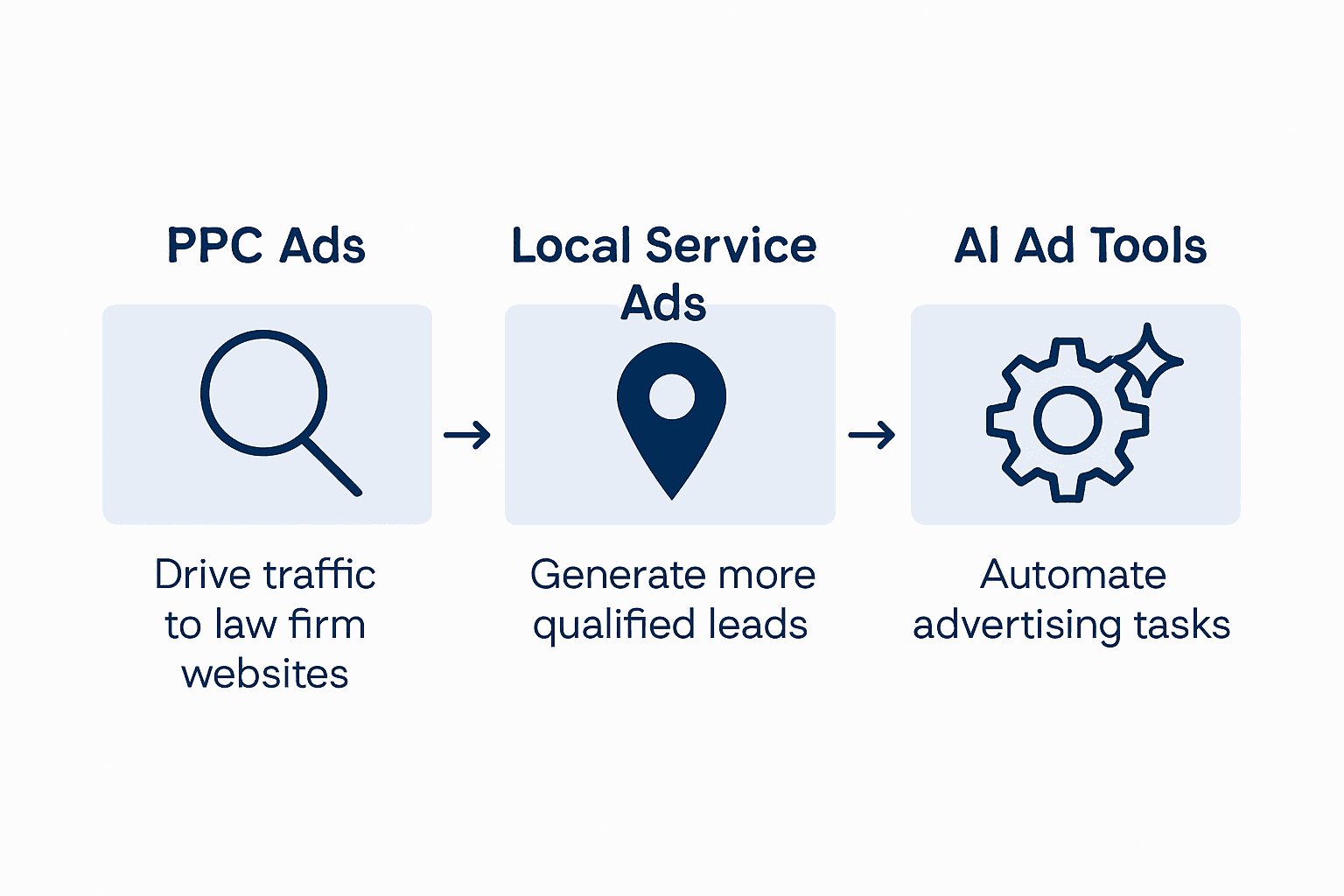
AI tools are revolutionizing digital advertising by providing advanced keyword identification, predictive client behavior analysis, and automated ad optimization. Law firms can now leverage sophisticated targeting techniques like geofencing, which allows precise geographic advertising, and AI-powered chatbots that engage potential clients instantly. These technologies enable attorneys to create more personalized, responsive, and cost-effective marketing campaigns that adapt in real-time to changing market dynamics.
Pro Marketing Tip: Implement a monthly performance review of your digital advertising campaigns, analyzing cost-per-lead, conversion rates, and audience engagement metrics.
Quick AI Advertising Insight: Experiment with AI-generated ad copy and continuously A/B test different variations to identify the most effective messaging for your target legal market.
Risks of Ignoring Digital Channels
Law firms that neglect digital marketing strategies face significant risks of becoming obsolete in an increasingly technology-driven legal marketplace. Traditional referral networks and word-of-mouth marketing are rapidly being replaced by sophisticated digital channels that connect potential clients directly with legal services through online platforms. Attorneys who fail to establish a robust digital presence risk losing market share to more technologically adaptive competitors.
Technological disruption is fundamentally transforming client acquisition and engagement strategies. Automation and AI technologies are creating unprecedented challenges for law firms that resist digital transformation. Potential clients now expect seamless online experiences, including easy access to information, quick communication channels, and transparent service offerings. Law firms without comprehensive digital marketing strategies will struggle to attract younger generations of clients who primarily search for legal services through online platforms.
The consequences of digital channel neglect extend beyond client acquisition. Firms without strong online visibility compromise their brand reputation, professional credibility, and competitive positioning. Advanced digital marketing techniques allow attorneys to showcase expertise, highlight successful case outcomes, and build trust through strategic content marketing. Without these digital touchpoints, law firms become invisible in an increasingly competitive legal landscape, missing critical opportunities to demonstrate value and connect with potential clients.
This table highlights risks for law firms that neglect digital marketing channels:
| Risk | Short-Term Effect | Long-Term Consequence |
|---|---|---|
| Declining online visibility | Fewer client inquiries | Loss of market share |
| Outdated client experience | Lower satisfaction | Weakened client trust |
| Poor competitive positioning | Missed digital opportunities | Obsolescence in legal marketplace |
| Incomplete brand representation | Mixed client perceptions | Damaged professional reputation |
Pro Marketing Tip: Conduct a comprehensive digital presence audit annually to identify and address potential gaps in your online marketing strategy.
Quick Competitive Insight: Allocate at least 15% of your marketing budget to digital channels and emerging technological platforms to remain competitive in the modern legal marketplace.
Elevate Your Law Firm’s Growth with Expert Digital Marketing
The challenge of standing out in a competitive legal marketplace is real, especially when potential clients now expect seamless online experiences and targeted digital engagement. This article highlights critical pain points like declining online visibility, fragmented client experiences, and the need for hyper-local SEO and AI-driven advertising strategies. If your firm struggles to keep pace with evolving search behaviors or is at risk of losing market share to more digitally savvy competitors, you need a tailored approach that transforms these challenges into growth opportunities.
At Case Quota, we specialize in empowering Southern California law firms to overcome exactly these hurdles through sophisticated digital marketing solutions. Our expertise includes SEO-optimized web design that boosts your organic traffic, pay-per-click advertising enhanced by AI tools to maximize ROI, and effective Google Local Services Ads to capture valuable local clients. With over 15 years of digital marketing experience and a focused six-year track record in California legal marketing, we deliver customized strategies that build trust, attract qualified leads, and position your firm ahead of larger competitors.
Ready to stop missing out on clients and start growing your practice with smart digital marketing? Discover how Case Quota’s tailored legal marketing services can give your law firm the competitive edge it deserves.

Take the first step toward a stronger digital presence today by visiting Case Quota. Explore how our expertise in SEO, pay-per-click advertising, and local legal marketing can transform your client acquisition strategy. Your firm’s growth starts with a strategic digital partnership designed just for you.
Frequently Asked Questions
Why is digital marketing essential for law firms?
Digital marketing is essential for law firms as it allows them to attract and engage potential clients online, establishing credibility and trust in a competitive landscape.
What digital marketing strategies should law firms implement?
Law firms should implement a mix of SEO, content marketing, social media engagement, and targeted online advertising to effectively reach their ideal clients.
How does local SEO benefit law firms?
Local SEO benefits law firms by improving their visibility in local search results, allowing them to attract nearby clients seeking legal services.
What role does content marketing play in legal digital marketing?
Content marketing plays a vital role by showcasing a law firm’s expertise, building client trust, and addressing potential clients’ specific legal questions and concerns.
Recommended
- Complete Guide to Digital Marketing for Legal Firms: Strategies That Drive Results – Case Quota
- Complete Guide to Multichannel Marketing for Law Firms – Case Quota
- How to Get More Clients as a Lawyer in a Digital World
- Digital Marketing Agency for Attorneys: Complete Guide to Growing Your Law Practice Online – Case Quota
- Role of Accountancy Firms: Complete UK Guide