

When we talk about lead generation for lawyers, we're talking about the art and science of attracting potential clients and turning them into paying clients. It's a strategic process, and the most successful firms build it on a solid digital foundation. This starts with a high-converting website and a crystal-clear understanding of your ideal client. Get this right, and everything else falls into place.
Building Your Law Firm's Digital Foundation
Before you even think about running a single ad, you need to see your website for what it is: your primary client intake tool. It's not just a digital brochure. A lead generation strategy that actually works begins right here, with a website designed to turn a curious visitor into a qualified lead from the moment they land on your page.
This foundation is built on two core pillars: knowing exactly who you're trying to reach and giving them what they need to see to trust you with their case.

Define Your Ideal Client Persona
You can't speak to everyone. Marketing that tries to be everything to everyone ends up being nothing to anyone. That’s why the very first thing you need to do is create detailed client personas for each of your key practice areas. A persona is essentially a character sketch of your ideal client, pieced together from market research and real data from your current and past cases.
Think about how different your clients are. A personal injury victim is in a completely different headspace than a business owner needing corporate counsel. The PI client might be up late, in pain, frantically searching for answers to questions like, "how much is my case worth?" Their persona reflects that emotional turmoil and urgency.
The business owner, on the other hand, is likely doing their research during business hours. They're focused on your firm's track record, your specific expertise, and how efficiently you can solve their problem. Creating these distinct personas allows you to tailor your website copy, your ad targeting, and your entire marketing message.
Ask yourself these questions for each persona:
- What are their biggest fears and pain points right now?
- What does a "win" look like for them? What's their ultimate goal?
- Where are they searching for a lawyer? (Google, Avvo, social media, etc.)
- What's most important in their decision? Is it experience, cost, or how you communicate?
Essential Elements of a High-Converting Website
Once you know who you’re talking to, your website has to be built to earn their trust and guide them to take action. So many firms get caught up in flashy designs and forget about function. You need both, but function is what brings in the cases.
For a much deeper look, check out our complete guide on website optimization for law firms.
Here's a quick rundown of the essential components that turn a passive website into a lead-generating machine.
Core Components of a High-Converting Law Firm Website
Your website needs to be more than just an online business card; it has to be a finely tuned engine for converting traffic into tangible leads. The table below outlines the non-negotiable elements every law firm site must have.
| Component | Purpose | Best Practice Example |
|---|---|---|
| Clear Calls-to-Action (CTAs) | To guide visitors on the next step you want them to take, removing any friction or confusion. | Instead of a generic "Contact Us," use an action-oriented button like "Get Your Free Case Evaluation Now." |
| Social Proof (Reviews & Testimonials) | To build immediate trust by showing that real people have had positive experiences with your firm. | Feature a scrolling feed of 5-star Google reviews directly on your homepage. |
| Prominent Contact Information | To make it incredibly easy for a potential client to reach you, no matter their preference. | A "clickable" phone number in the website header, a contact form, and a live chat widget. |
| Professional Photography | To humanize your firm and move beyond sterile stock photos, creating a personal connection. | High-quality headshots of your attorneys and photos of your actual office space. |
| Case Results / Success Stories | To demonstrate your expertise and prove you can deliver the outcomes clients are looking for. | A dedicated page with brief, powerful summaries of successful verdicts and settlements (abiding by bar rules). |
Getting these core elements right is the difference between a website that just sits there and one that actively works around the clock to grow your firm.
Crystal-Clear Calls-to-Action (CTAs)
A visitor should never be left wondering, "What do I do now?" Vague buttons like "Submit" or "Contact Us" are weak. You need CTAs that are specific and tied to a benefit for the client.
- Good Example: "Schedule a Free, Confidential Consultation"
- Better Example: "Get Your Free Case Evaluation Now"
Place these CTAs everywhere a potential client might make a decision—in your site's header, after a powerful testimonial, and at the bottom of every single practice area page.
Prominent Client Testimonials and Case Results
In the legal world, social proof is everything. A potential client is often in a vulnerable position, and they're looking for any sign that they can trust you.
Your website needs a one-two punch: client testimonials that speak to your service and communication, paired with concrete case results that prove your legal skill. This combination satisfies both the emotional and logical sides of a client's brain.
Sprinkle your best reviews throughout your homepage and on related practice pages. A dedicated "Case Results" page, with short and compelling summaries of your wins, can be one of the most persuasive assets you have. Just be sure you're following your state bar's advertising guidelines.
Attracting High-Value Cases with Legal SEO
The foundation of any sustainable lead generation strategy for lawyers comes down to a simple truth: you have to show up where your clients are looking. And today, that’s Google. Search Engine Optimization (SEO) isn't some dark art or a technical checklist; it's about answering a potential client's most urgent questions at the exact moment they’re asking them.
When your SEO is dialed in, you stop chasing leads and start attracting them. A potential client searches for help, and your firm appears as the trusted authority. This puts you in the perfect position to capture high-intent, high-value cases before your competitors even get a look-in.

Uncovering Client Intent with Keyword Research
Good legal SEO starts with getting inside your client's head and understanding the exact words they use when they need you. This goes way beyond generic stuff like "lawyer near me." You need to dig into what we call long-tail keywords—those longer, more specific phrases that reveal exactly what a person is looking for.
Think about the difference between someone searching for "car accident lawyer" versus "symptoms of TBI after rear-end collision." That second searcher is much further down the road. They have a specific, serious problem, and they're a far more qualified potential client.
Your research should be laser-focused on uncovering terms that reflect:
- Specific Problems: "Divorce attorney for business owner in Los Angeles"
- Urgent Questions: "What to do after a slip and fall at a grocery store"
- Location-Based Needs: "Best criminal defense lawyer in Orange County"
Tools like Ahrefs or SEMrush are fantastic for this, but you can also just start by jotting down the common questions you hear during your initial consults. That's often a goldmine.
Optimizing Your Digital Real Estate
Once you know what your clients are searching for, it's time to strategically weave those keywords into your website. This is how you signal to search engines what each page is about, helping you rank for the right searches.
Your primary focus should be your core practice area pages. Each of these pages needs to be a comprehensive, standalone resource for a single service you offer, like "Workers' Compensation" or "Estate Planning."
The goal is to make each practice area page the single most helpful resource on the internet for that specific topic in your city. When Google sees your page as the definitive answer, it rewards you with better rankings. Plain and simple.
This means you can't just list your services. You need to include FAQs, explain the legal process in plain English, and showcase relevant case results or client testimonials. If you want to dive deeper, you can explore these actionable law firm SEO tips to get ahead of the competition.
Dominating Your Local Market
Let’s be honest, most law firms serve a specific geographic area. This makes local SEO absolutely essential. Your #1 priority here should be claiming and meticulously optimizing your Google Business Profile (GBP). This is that all-important info box that pops up in Google Maps and the local search results.
A fully built-out GBP is like a digital storefront. It must include:
- Your firm’s exact name, address, and phone number (NAP)
- High-quality photos of your office, your team, and you
- Your primary business category (e.g., "Personal Injury Attorney")
- A steady stream of recent, positive client reviews
Getting satisfied clients to leave reviews is probably the single most powerful local SEO activity you can do. A high star rating and dozens of positive reviews build incredible trust and directly impact your visibility in the coveted "map pack" results.
Make it a habit to consistently ask for reviews. And just as importantly, respond to every single one—good or bad. It shows you're engaged and that you care. This simple practice can completely transform your local search presence into a reliable source of new cases.
Using Digital Advertising for Immediate Results
While a rock-solid SEO strategy is your ticket to long-term, sustainable growth, sometimes you just need the phone to ring now. This is where paid digital advertising becomes your most powerful tool. It’s like having a direct line to potential clients at the exact moment they’re searching for legal help.
But let's be honest, it's also incredibly easy to burn through a budget with nothing to show for it. The real key is knowing where to spend your money for the biggest impact and how to craft a message that gets someone to actually pick up the phone. It's about picking the right platforms and creating campaigns that speak directly to a person's immediate, often stressful, needs.
High-Intent vs. Broad-Reach Advertising
Not all ads are created equal. The most successful approach for law firms is almost always a smart mix of high-intent platforms (where people are actively looking for you) and broad-reach platforms (which help you connect with clients before they even know they need a lawyer).
The data tells a compelling story. In 2025, a staggering 71% of lawyers reported that social media was generating new client leads. Hot on its heels, Google’s Local Services Ads were named the second most effective channel by 11% of firms. At the end of the day, though, a firm's own website is still the number one lead source for 39% of law firms, which just proves how critical it is to have a strong digital home base to send all that ad traffic to.
Here’s a simple way to think about the two main ad types:
- Google Ads & Local Services Ads (High Intent): These are your bread and butter for capturing people who are already problem-aware and looking for a solution. Someone typing "car accident lawyer near me" into Google has a clear, urgent need. They're not just browsing; they're ready to hire.
- Social Media Ads (Broad Reach): Platforms like Facebook and LinkedIn are incredible for their pinpoint targeting. You can reach people based on demographics, interests, and major life events—think "newly engaged" for a family law attorney or "recently started a business" for corporate law. This lets you build awareness and plant a seed with your ideal client persona.
Crafting Ads That Convert
A winning ad campaign comes down to two things: ad copy that connects and a landing page that converts. Your ad isn't just a digital billboard; it’s the start of a conversation with someone who is likely going through a difficult time.
Your ad copy has to hit a specific pain point right away. Forget generic fluff like "Top Law Firm." Go straight for the jugular with something like, "Injured in an Accident? Get a Free Case Review & Know Your Rights." It’s direct, it shows empathy, and it offers immediate value.
One of the most common—and costly—mistakes I see is sending paid traffic to the website's homepage. A homepage is full of distractions. A dedicated landing page needs to have one goal and one goal only: getting that visitor to fill out a form or call you.
This laser-focused approach is what skyrockets your conversion rate. The landing page itself needs a headline that perfectly matches the ad, a few bullet points explaining the benefits of contacting you, client testimonials for social proof, and a dead-simple contact form right at the top. To really take it to the next level, understanding creating marketing videos that truly convert can make a massive difference in your ad performance.
An Example Facebook Ad Campaign
Let's put this into practice. Imagine you're an estate planning attorney.
You could run a highly targeted Facebook campaign aimed at people in your city aged 45-65 who are interested in "small business ownership" or "real estate investing." Your ad could be a short, helpful video explaining the top three mistakes people make when setting up a will.
The call-to-action wouldn't be "Hire Us!" It would lead to a dedicated landing page offering a free "Estate Planning Checklist." By giving away valuable information first, you capture their contact details and immediately position your firm as a helpful, trusted authority. This strategy is infinitely more effective than just asking for the sale upfront. For a deeper dive, our complete guide on attorney advertising on Facebook walks you through the entire process.
Expanding Your Reach Beyond Search Ads
Relying solely on high-intent channels like Google Ads is a solid start, but it’s like putting all your eggs in one basket. The law firms that truly dominate their markets understand that a resilient lead generation pipeline is a diversified one.
It’s about moving beyond just capturing demand and starting to create it. By expanding into channels where potential clients spend their time before they desperately need a lawyer, you build brand recognition and create a steady, predictable stream of future cases. Let's dig into a few practical tactics that can set your firm apart and make sure you aren't over-reliant on a single source of leads.
Leverage Video to Humanize Your Firm
Let's be clear: video is no longer a "nice-to-have." It’s a core component of modern lead generation for lawyers. Short, educational videos on platforms like YouTube, LinkedIn, or even TikTok can do what text alone can't—create a genuine human connection. Potential clients want to see the person behind the law degree, and video makes your entire firm feel more approachable.
A great starting point? Brainstorm the top 10-15 questions you hear over and over during initial consultations. Each one is a perfect topic for a 60- to 90-second video. You don't need a Hollywood production crew, either. A modern smartphone, good lighting, and clear audio are all you need to get rolling.
For example, a family law attorney could shoot a quick video titled, "3 Things to Consider Before Filing for Divorce in California." This content is incredibly valuable, highly shareable, and instantly positions you as a helpful authority.
The goal isn't to go viral. It's about consistently providing clear, empathetic answers to common legal questions. You're building an audience of potential clients who will remember and trust your firm when they finally need help.
Nurture Prospects with Email Marketing
Here’s a hard truth: not every person who visits your website is ready to sign a retainer today. In fact, most aren't. This is where email marketing becomes one of your most powerful tools for lead nurturing.
When you capture a prospect's email address (usually in exchange for a free guide or checklist), you earn permission to stay top-of-mind over the weeks or even months it might take them to make a decision. The key is to provide value, not just a sales pitch.
A simple, automated email sequence can work wonders. Imagine someone downloads your "Car Accident Checklist." The sequence could look like this:
- Immediate Delivery: An email sends them the checklist right away.
- Follow-Up (3 days later): A short email links to a relevant blog post or video that expands on a topic from the checklist.
- Check-In (1 week later): A friendly email offers a no-obligation, free consultation to discuss their specific situation.
This kind of automated approach ensures no lead ever falls through the cracks and allows you to build a relationship without lifting a finger.
Optimize for Legal Directories
Finally, don't sleep on the power of established legal directories like Avvo, FindLaw, and even Yelp. These sites often dominate the first page of Google for major legal search terms. An incomplete or unoptimized profile is a massive missed opportunity, as these platforms are a huge source of high-quality referrals for many firms.
Take an hour to completely fill out your profiles on these key directories. That means:
- Uploading a professional, recent headshot.
- Writing a detailed, client-focused biography.
- Listing all of your practice areas.
- Actively asking satisfied past clients for reviews.
A strong presence on these platforms works hand-in-hand with your other marketing efforts. It provides powerful social proof and another critical touchpoint for potential clients to find and vet your firm. This is also a fundamental part of reputation management, which is essential for growth. For a deeper look into this, our guide on building law firm public relations offers some more advanced insights.
Optimizing Client Intake For Higher Conversions
Getting a steady stream of inquiries is a massive win, but it's only half the battle. A lead is just a name and a number until that person signs on the dotted line.
The place where most law firm marketing strategies fall apart isn’t in getting the lead; it’s in the crucial minutes and hours right after that first phone call or form submission. Your intake process—how fast and how well you follow up—is what actually turns a curious prospect into a paying client.
Today's clients expect an immediate response. Any delay gives them a reason to doubt, and more than enough time to call the next lawyer on their Google search list. Optimizing your intake is all about removing that friction, making the first contact feel seamless and reassuring. Do that, and you’ll see your sign-up rate climb dramatically.
This infographic breaks down how different marketing channels—like video, lead nurturing, and legal directories—all work together to build a strong pipeline of potential clients that feeds directly into your intake system.
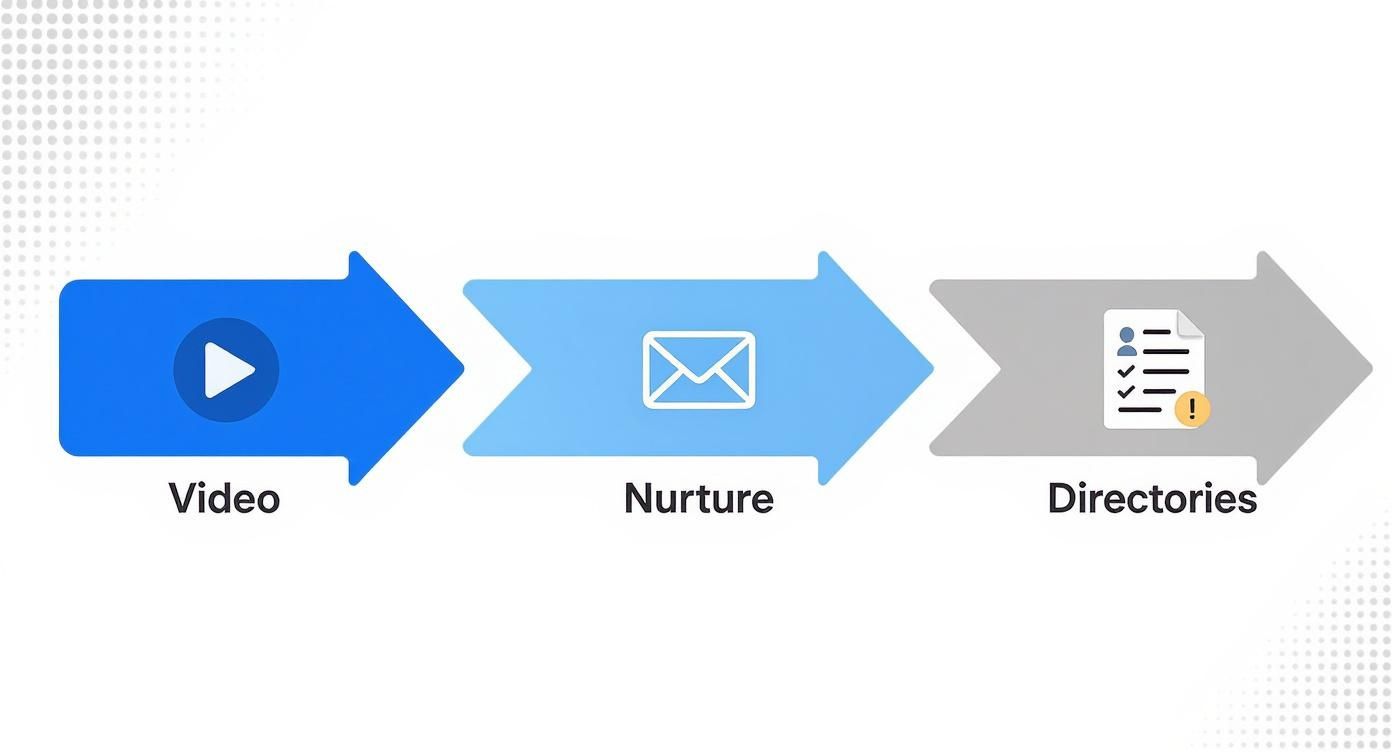
When you have a consistent flow of leads coming in from multiple sources, the efficiency of your intake process becomes that much more important for seeing a real return on your investment.
The High Cost Of Slow Responses
In the world of legal leads, speed is everything. This isn't just a theory; it’s a hard reality that directly impacts your firm's bottom line. Think about it: 67% of clients report that a firm's response time was the main reason they chose to hire them.
The numbers get even more stark. Firms that manage to respond within the first five minutes see a mind-boggling 400% increase in their conversion rates. That’s not a small edge—it's a complete game-changer.
Waiting just 30 minutes to follow up with a new web lead can tank your odds of ever connecting with them by over 21 times. By the time you’ve finished a short meeting, your best lead has probably already spoken with two of your competitors.
This is why your intake system has to be built for instant engagement. Potential clients are almost always in a state of urgency or distress. The first firm that gives them a clear, helpful response immediately builds trust and takes control of the conversation. Every minute you wait is a minute you're actively losing business.
Impact of Response Time on Law Firm Lead Conversion
The data below paints a clear picture of just how critical the first few moments are after a potential client reaches out. Speed isn't just a courtesy; it's a core business strategy.
| Response Time | Impact on Conversion Rate | Recommended Tool/Strategy |
|---|---|---|
| Under 5 Minutes | Highest (Up to 400% increase) | Automated SMS/Email Responder, Live Chat |
| 5-30 Minutes | Significant Drop (Odds decrease by 21x) | Dedicated Intake Specialist, CRM Alerts |
| 1-12 Hours | Very Low (Likely lost to a competitor) | After-Hours Answering Service |
| 24+ Hours | Effectively Zero | Review and overhaul entire intake process |
As you can see, the window of opportunity is incredibly small. The goal is to close the gap between inquiry and response as much as humanly—and technologically—possible.
Implementing A Modern, Automated Intake System
To keep up with the demand for instant communication, you have to move beyond purely manual follow-up. Relying on a paralegal or receptionist to personally answer every single web form submission just isn't a scalable or effective approach anymore. The real solution is using technology to automate and streamline those critical first steps.
Here are a few practical ways to build a near-instantaneous response system:
- Website Live Chat: Put a live chat service on your site. Whether it's staffed by a real person or a smart chatbot, it gives visitors an immediate way to get answers and leave their info, 24/7. No more missed opportunities after 5 PM.
- Automated Responders: Every single contact form on your website needs to trigger an immediate, automated email and text message. This small step confirms you got their message and tells them exactly what to expect next.
- AI-Powered Intake: Modern CRM and intake software goes way beyond simple auto-replies. These systems can ask pre-qualifying questions, let leads book consultations directly on your calendar, and even send out automated follow-up reminders if they go quiet.
The point of this tech isn't to replace the human element of your firm. It's to enhance it.
By automating the time-sensitive first contact, you free up your team to have more meaningful, high-value conversations with prospects who have already been qualified and are ready to talk. To really dial this in, you need to get inside your client's head and understand their decision-making process. Learning about how to choose a personal injury attorney, for example, gives you incredible insight into what they need to hear from you during that first call.
And of course, a well-designed website is the front door to this whole process; our guide on law firm website design tips is a great place to start.
Measuring Your Marketing ROI
Let's be blunt: you can't improve what you don't measure. A data-driven approach is the only way to know if your marketing budget is actually working for you, not against you.
Effective lead generation for lawyers means moving past the "vanity metrics" like website clicks or social media likes. Those numbers feel good, but they don't sign cases. We need to focus on the numbers that actually drive business decisions.
Tracking the right data tells you exactly which campaigns are worth your investment and which ones are just burning cash. This is how you stop guessing and start making informed choices that fuel real, sustainable growth for your firm.
Key Metrics That Actually Matter
To get a clear picture of what's happening, you need to zero in on a few core metrics. These are the numbers that cut through the noise and reveal the true health of your entire lead generation engine.
- Cost Per Lead (CPL): This one's simple but crucial. It’s the total cost of a marketing campaign divided by the number of leads it generated. It tells you exactly how much you're paying for each phone call or form submission.
- Cost Per Acquisition (CPA): Taking it a step further, CPA measures the cost to acquire a paying client. This is the ultimate measure of a campaign's financial success. It’s the number that really matters to your bottom line.
- Lead-to-Client Conversion Rate: This percentage shows how effective your intake team is at turning qualified leads into signed cases. It’s the bridge between marketing and revenue.
Understanding how these three metrics work together is fundamental. A campaign might have a dirt-cheap CPL but a terrible conversion rate, leading to a sky-high CPA. The goal is always to find the channels that deliver the best CPA, not just the cheapest leads.
Pinpointing Your Most Profitable Channels
Once you have these metrics in hand, you can start analyzing performance by channel. Is your SEO blog bringing in high-value cases with a low CPA? Or are your Google Ads delivering leads that sound great but rarely convert?
Using your CRM and Google Analytics, you can trace every new client back to their original source. This is where the magic happens.
A recent report shows the average law firm gets 60 to 80 leads per month, with CPL ranging wildly from $50 up to $300 depending on the practice area. More and more, firms are using AI-driven tools to sharpen their targeting and automate the intake process. This is a game-changer for improving conversion rates and boosting the overall return on investment far beyond what old-school methods can offer. You can dig deeper into these trends in these 2025 legal marketing insights.
This is what a data-driven approach looks like in practice. You find what works, double down on it, and confidently cut what doesn’t.
Frequently Asked Questions
When it comes to generating leads for a law firm, a lot of the same questions come up. We get it. Here are some quick, straightforward answers to the things we hear most often from attorneys looking to grow their practice.
What Role Does SEO Play in Lead Generation For Lawyers?
Honestly? It's everything. Think of SEO (Search Engine Optimization) as the engine that makes your law firm visible on Google. When a potential client desperately searches for a "divorce attorney near me," a solid SEO strategy is what puts your firm at the top of that list.
This isn't just about traffic; it's about intent. You're catching clients at the exact moment they're raising their hand for help, making SEO one of the most powerful and cost-effective ways to attract high-quality cases for the long haul.
Should My Firm Use Paid Ads or Focus on SEO?
The smartest firms do both. It's not an either/or question; it's about using the right tool for the right job. SEO is your long-term investment—it builds authority and generates a steady stream of organic traffic that you own. Paid ads, like Google Ads, are your short-term solution for immediate, targeted results.
Think of it this way: SEO is like buying a house—it takes time to build equity but pays off immensely in the long run. Paid ads are like renting—you get immediate access, but the results stop as soon as you stop paying.
A balanced strategy lets you capture leads right now with ads while you build an unshakeable foundation for the future with SEO.
How Important Are Online Reviews For Getting New Clients?
They are absolutely non-negotiable in today's market. Online reviews on platforms like Google, Avvo, and Yelp are the new word-of-mouth. A constant flow of recent, positive reviews builds a mountain of trust and social proof before a potential client ever even speaks to you.
It's not just about convincing people, either. Reviews are a huge ranking factor for local SEO, which is critical for showing up in those valuable map searches. Making it a habit to ask satisfied clients for feedback is one of the highest-impact, lowest-cost marketing activities you can do. It pays for itself time and time again.
Ready to stop guessing and start getting predictable, high-quality cases? The team at Case Quota has over 15 years of experience creating winning marketing strategies for firms just like yours. Schedule your free strategy session today.