

Social media advertising for lawyers isn't just a "nice-to-have" anymore. It's a powerhouse strategy for reaching potential clients right where they spend their time. This isn't about chasing likes; it's about using hyper-targeted ads on platforms like Facebook and LinkedIn to connect with real people who need legal help right now, moving your firm beyond the limitations of word-of-mouth referrals.
Why Social Media Ads Are a Game-Changer for Modern Law Firms
I get it. A lot of attorneys are still skeptical about social media, seeing it as more of a distraction than a serious tool for client acquisition. But that mindset misses a huge shift in how people find and vet legal services. Your potential clients are already on these platforms, and they're not just scrolling through family photos—they're researching, gathering opinions, and making decisions.
Ignoring this reality means leaving a massive opportunity on the table. Think about it: a billboard or a print ad is a shot in the dark. Social media advertising is a laser-guided missile. You can put your firm directly in front of someone based on their location, their interests, and even major life events like getting married or starting a business.
Go Where Your Clients Are
The biggest advantage here is meeting clients on their own turf. It flips the script on marketing—instead of interrupting their day, you become a timely, relevant solution that appears at the exact moment of need.
For modern law firms, which often function like lean small businesses, figuring out how to approach managing social media for small business is the first step toward successful advertising. A smart, well-executed campaign can quickly build your authority in a specific practice area, whether it's personal injury or intellectual property.
This approach gives you a more predictable stream of high-quality leads than just waiting for referrals. You gain so much more control over your firm's growth. The numbers don't lie: an impressive 71% of law firms report getting new clients directly from social media, and about 85% have made it a standard part of their marketing mix.
Build Authority and Trust at Scale
Building a rock-solid reputation used to take decades of courtroom wins and handshakes. Social media fast-tracks the entire process by giving you a direct line to your target audience. When you consistently share valuable content, client success stories (ethically, of course), and helpful insights, you establish your firm as a credible, trustworthy authority.
The real magic of social media ads is their ability to build trust before a potential client even knows they need a lawyer. When a legal problem pops up, your firm is already top-of-mind because they've seen you as a helpful, visible presence in their feed.
This isn't just about getting a quick lead; it's about playing the long game and building a brand that pays dividends for years. You can dive deeper into specific tactics in our complete guide to social media for law firms.
Choosing the right platform is just as important as the ad itself. Not all social media is created equal when it comes to legal marketing. Here's a quick rundown of the major players and where they fit in.
Key Social Media Platforms for Law Firms
| Platform | Primary Use Case | Best For Practice Areas |
|---|---|---|
| Broad Consumer Targeting: Ideal for reaching a wide audience based on demographics, interests, and life events. | Personal Injury, Family Law, Estate Planning, Bankruptcy, Criminal Defense | |
| Professional & B2B Networking: Perfect for connecting with business owners, executives, and other professionals. | Business Law, Corporate Law, Intellectual Property, Employment Law, Commercial Real Estate | |
| YouTube | Educational Video Content: Great for showcasing expertise, explaining complex legal topics, and building trust. | All practice areas. Especially effective for topics that benefit from visual explanation. |
| Visual Storytelling & Brand Building: Best for humanizing your firm and connecting with a younger demographic. | Less direct lead gen, more brand awareness. Useful for Personal Injury, Family Law. |
Ultimately, the best platform depends entirely on who you're trying to reach. Don't feel like you have to be everywhere. It's far better to master one or two channels where your ideal clients are already active.
Building Your Strategic Foundation Before You Spend a Dollar
Jumping into social media ads without a solid plan is the digital equivalent of walking into court unprepared. It’s a surefire way to burn through your marketing budget with nothing to show for it. A winning campaign doesn't start with the ad creative; it starts long before you ever click "launch."
Too many firms begin with a vague wish, like "I want more leads." That isn't a strategy. A real strategy starts by defining what success actually looks like. Are you shooting for 15 qualified consultations for your family law practice this quarter? Or maybe the goal is to sign 10 new high-value estate planning clients by year's end.
Get specific. This is what turns advertising from a frustrating expense into a predictable engine for firm growth. When you have a clear, measurable target, every decision you make—from the copy you write to the audience you select—becomes sharper and infinitely more effective.
Define Your Ideal Client Persona
Once you know your goal, you have to know who you're talking to. The best social media ads don't shout to the masses; they speak directly to the specific problems and motivations of one person. To do that, you need to build a detailed client persona.
This is much deeper than just demographics. Picture your perfect client.
- What’s the one legal problem keeping them up at night?
- What words do they use to describe their situation?
- Where are they already looking for answers online?
- What was the trigger event that made them realize they need a lawyer?
A personal injury lawyer isn't just targeting "people in car accidents." They're targeting "Sarah, a 38-year-old mom of two who is completely overwhelmed by medical bills, stressed about missing work, and intimidated by the insurance company." When you get this granular, you can create ads that resonate on a personal level and compel them to act.
Your goal is to shift from broadcasting a generic message to having what feels like a one-on-one conversation. We cover this planning stage in more depth in our detailed law firm marketing plan template, which will help you structure these foundational pieces.
This visual breaks down the journey from that first touchpoint with a potential client to making them a valued part of your practice.
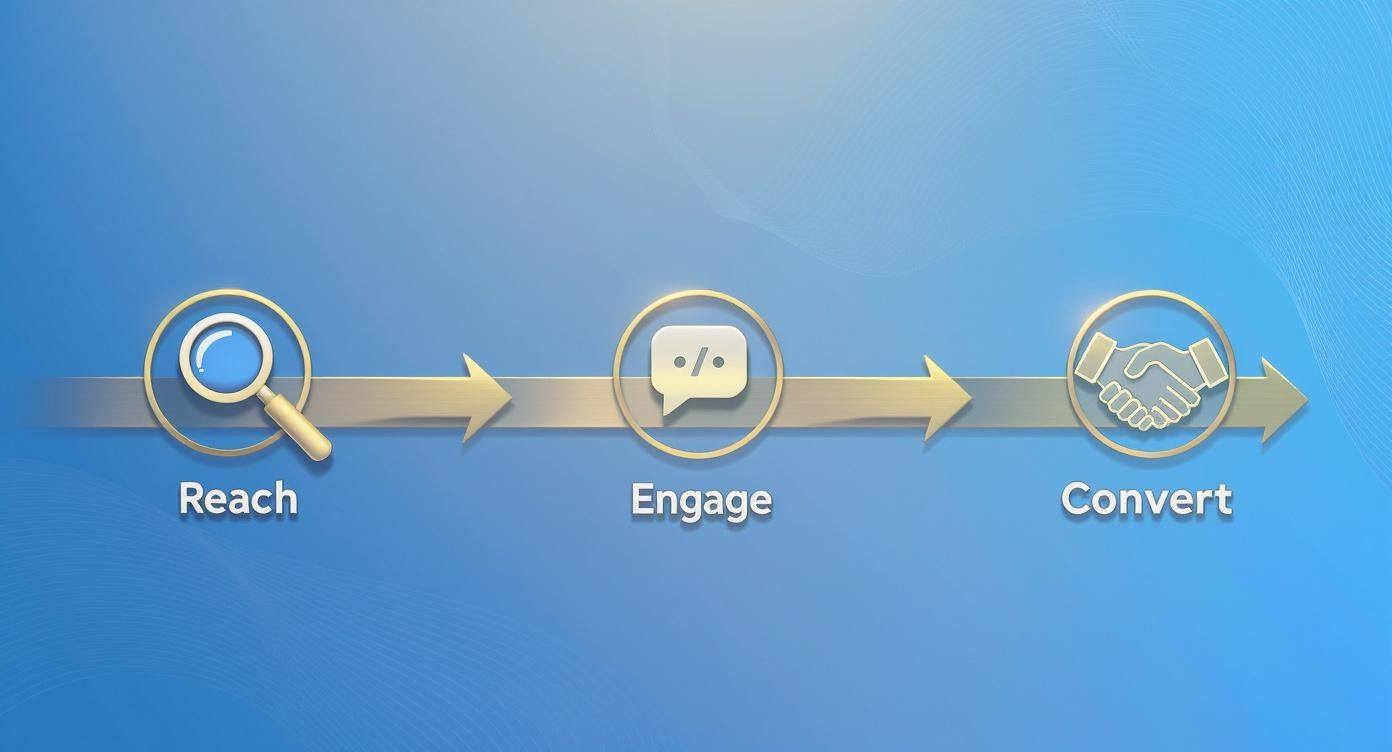
Each of these stages requires a different strategy. You can't nurture a lead the same way you build initial awareness.
Set a Realistic and Strategic Budget
"How much should I spend?" It's the million-dollar question, and the honest answer is, "it depends." Your budget shouldn't be a number pulled from thin air; it needs to be directly tied to your goals, your practice area, and how aggressive your growth targets are.
A smart way to start is by working backward. If your goal is to sign 5 new clients and your average case value is $10,000, what's a reasonable investment to acquire each one? This simple math anchors your ad spend to real business metrics, not just guesswork.
A classic mistake is spreading a small budget too thin across every social media platform. You’re far better off dominating the one channel where your ideal clients spend their time than having a weak, ineffective presence on three or four.
You also have to be realistic about the competitive landscape. Running ads for a PI attorney in downtown Los Angeles is a completely different ballgame—and budget—than for an estate planning lawyer in a small town. A $500 monthly budget might get your name out there, but it's unlikely to generate a steady stream of cases in a hyper-competitive market.
Start with a modest but meaningful budget, track your results obsessively, and be ready to double down on what's working.
Choosing the Right Platforms and Ad Formats

Simply running ads isn't enough. Where you run them matters just as much as what you say. Picking the right social media platform is a huge strategic decision, one that directly impacts who sees your message and whether they actually pick up the phone. A corporate law firm advertising on TikTok, for example, is going to get a very different result than a personal injury firm using Facebook.
The whole game is about matching your platform to your ideal client’s online habits. Don't waste your budget trying to be everywhere at once. Instead, focus your resources on the one or two platforms where your target audience is most active. This concentrated effort is the foundation of any effective social media ad campaign for lawyers.
Aligning Platforms with Practice Areas
Think of each social media platform as a different type of networking event. You wouldn't wear the same suit or use the same talking points at a tech conference as you would at a community fundraiser. The same logic applies here.
LinkedIn: The Professional Powerhouse
For any B2B practice—think business litigation, intellectual property, or employment law—LinkedIn is non-negotiable. It's the digital boardroom where professionals connect, share industry insights, and vet potential partners. Ads here let you target users by job title, company size, and industry with unmatched precision.
Facebook and Instagram: The B2C Giants
When your clients are individuals facing personal legal challenges, Facebook and Instagram are your go-to channels. These platforms are incredible at reaching people based on life events, interests, and real-world behaviors.
- Family Law: Target users who have recently become engaged or whose relationship status has changed.
- Estate Planning: Reach older demographics or individuals with interests related to finance and retirement planning.
- Personal Injury: Use geographic targeting to zero in on specific areas, then layer in behavioral data that suggests a need for legal help.
By 2025, social media advertising became an essential part of marketing for law firms worldwide. With over 4.9 billion people using these platforms, it's a massive opportunity. Firms quickly realized that channels like LinkedIn, Facebook, and Instagram offer hyper-targeted advertising that just works. You can discover more insights about these 2025 advertising trends for law firms.
Selecting the Right Ad Format for Your Goal
Okay, you've chosen your platform. Now you need to pick the right tool for the job—the ad format. Each one is designed to achieve a different objective, from generating immediate leads to building long-term brand awareness. Mismatching your format and your goal is one of the most common (and costly) mistakes I see firms make.
A static image ad, for instance, might be great for building brand recognition, but it's not going to be nearly as effective for capturing consultation requests as a lead generation form.
The most successful campaigns don't just pick one ad format and stick with it. They strategically mix and match formats based on their specific goals, guiding potential clients from initial awareness to taking that crucial first step of contacting the firm.
Here’s a quick breakdown of popular formats and how law firms can actually use them:
| Ad Format | Best For | Practical Law Firm Example |
|---|---|---|
| Video Ads | Explaining complex topics & building trust. Video puts a human face on your firm and establishes authority. | A 60-second video from an estate planning attorney explaining the basics of a living trust. |
| Lead Generation Forms | Capturing consultation requests directly. This format removes friction by allowing users to submit their info without leaving the platform. | A family law firm's ad offering a "Free 15-Minute Case Evaluation" with a simple, pre-filled form. |
| Carousel Ads | Showcasing multiple services or benefits. Carousels let you tell a more detailed story in a single ad unit. | A business law firm uses each carousel card to highlight a different service—contracts, incorporation, and IP. |
| Image Ads | Building brand awareness and driving traffic. Clean, professional images with a strong call-to-action can be highly effective. | A personal injury firm uses a powerful image with text overlay to promote a free guide on what to do after an accident. |
Choosing the right combination of platform and format is a core part of a winning strategy. If you're looking for more inspiration for your next campaign, you might want to check out these additional law firm advertising ideas that can help you stand out from the competition.
Crafting Ad Copy and Creatives That Convert Ethically
You've picked your platform. Now comes the real work: crafting the ad itself. This is about the words and images that will either grab a potential client's attention or get lost in the endless scroll. It's where your strategy becomes a tangible message—one that needs to be compelling, professional, and above all, ethical. For lawyers on social media, every single word matters.
Forget what you think you know about marketing copy. Your goal isn't to sound like a slick salesperson. It's to communicate like a trusted advisor. You need to speak directly to someone's problem with real empathy and clarity, steering clear of the legal jargon that just confuses and intimidates people. You're not drafting a motion; you're starting a conversation with someone who is probably feeling overwhelmed.
Writing Headlines That Actually Work
The headline is your one shot. It's the first—and often the only—thing someone will read. It has to instantly signal that you understand their exact situation. A headline like "Local Law Firm" is a complete waste of ad spend. Instead, laser-focus on the user's pain point or the solution you offer.
Let's look at the difference for a family law practice:
- Bad: "Smith & Associates, Family Lawyers"
- Good: "Navigating Your Divorce with Clarity and Confidence"
See the difference? The second one connects on an emotional level. It promises a tangible benefit and shows you get what the client is going through, not just what legal box they fit into.
The Power of Client-Focused Ad Copy
Once the headline has done its job, the body of your ad needs to keep that client-first focus. Stop listing your firm's accomplishments and start framing your services in terms of how they solve the client's problem. It’s a simple but powerful shift from "we do this" to "you get this."
The best ad copy doesn't sell legal services; it sells peace of mind, a resolution, or a clear path forward. Your potential client isn't buying your time; they're buying a solution to one of the most stressful problems in their life.
Here's another side-by-side, this time for an estate planning attorney:
| Ineffective Ad Copy (Firm-Focused) | Effective Ad Copy (Client-Focused) |
|---|---|
| We have over 20 years of experience in wills and trusts. Our attorneys are experts in asset protection and probate law. Call us today. | Protect your family's future and ensure your wishes are honored. Our free guide explains the 3 essential documents every parent needs. Download it now. |
The effective version goes straight for the client’s core motivation—protecting their family. It also offers immediate value with a free resource. This isn't just advertising; it's building trust from the very first interaction.
Creating Visuals That Build Trust
The image or video you run with your ad is just as critical as the text. A cheap, generic stock photo can instantly torpedo your credibility. Your visuals have to match the professional, trustworthy brand you’re trying to build.
- Professional Photos: Use high-quality, professional headshots of your attorneys or candid shots of your team. This puts a human face to the firm and helps build a genuine connection.
- Well-Designed Graphics: If you're using graphics, keep them clean and branded with your firm's logo and colors. Avoid cluttered designs that look unprofessional.
- Video Content: Short, informative videos are absolute gold. A 30-second clip of an attorney answering a common question can establish authority and build rapport faster than text ever could. Seriously, investing in quality social media video editing makes a world of difference in how your firm comes across.
The Art of the Helpful Call-to-Action
Finally, every ad needs to tell people what to do next with a clear Call-to-Action (CTA). But aggressive, generic CTAs like "Click Here!" or "Call Now!" feel pushy and don't really fit the professional tone of a law firm.
Your CTA should offer value and lower the barrier for someone who might be hesitant to reach out. Think in terms of offering help, not demanding a sale.
Actionable CTA Examples for Lawyers:
- Download Our Free Guide to the Probate Process (Offers value and captures a lead)
- Schedule a Confidential Consultation (Emphasizes privacy, which is huge for potential clients)
- Use Our Child Support Calculator (Provides a genuinely useful tool)
- Learn How We Can Protect Your Business (Focuses on a clear, direct benefit)
These CTAs feel less like a sales pitch and more like the first step in a helpful, professional relationship. When you combine empathetic copy, trustworthy visuals, and a value-driven CTA, your ads don't just follow ethical rules—they actually work to bring qualified leads through your door.
Targeting Your Ideal Clients with Precision

This is where social media advertising completely leaves traditional marketing in the dust. A billboard on the highway is a shot in the dark, but digital targeting is a scalpel. It lets you get past broad demographics and find potential clients based on what they actually do, their interests, and major life events.
It's all about making sure every dollar you spend is working as hard as possible.
The whole point is to stop wasting money on people who will never need your services. We want to place your firm's message directly in front of someone who isn't just a potential client, but a probable one. This is how you turn your ad budget from an expense into a genuine growth engine for your practice.
Mine Your Own Gold: Using Existing Client Data
One of the most powerful, and often overlooked, tools you have is your own client list. Platforms like Facebook and LinkedIn let you create what’s called a Custom Audience. You simply and securely upload a list of past or current clients, and the platform matches them to user profiles. This lets you do things like re-engage past clients or, just as importantly, exclude them from new client acquisition campaigns.
But here’s where the real magic begins.
Once you’ve built that Custom Audience, you can create a Lookalike Audience. The platform analyzes the shared traits of your best clients—their demographics, online behavior, and interests—and then builds a brand-new audience of people who "look" just like them. It's an unbelievably effective way to find high-quality prospects who are statistically predisposed to needing your services.
Think of a Lookalike Audience as a digital referral engine. It takes the DNA of your best clients and systematically finds more people just like them, scaling your reach in a way word-of-mouth never could.
This strategy is a cornerstone of effective social media advertising for lawyers because it’s based on hard data, not guesswork. If you want to dive deeper into turning these prospects into cases, our guide on strategic law firm lead generation is the perfect next step.
Layering Interests and Behaviors for Laser-Focus
Beyond Lookalikes, the real precision comes from layering different targeting criteria. This is where you can combine demographics with specific interests and online behaviors to build a hyper-relevant audience from scratch. You can find people who are in the market for legal help, often before they’ve even typed a single query into Google.
Let’s see how this works in a real-world scenario. Imagine a personal injury law firm wants to find potential car accident clients. Instead of just targeting a wide area, they can get incredibly specific.
Below is an example of how a PI firm might layer their targeting criteria on a platform like Facebook to find a highly qualified audience.
Targeting Options for a Personal Injury Lawyer
| Targeting Layer | Specific Criteria Example | Rationale |
|---|---|---|
| Location | People living within a 20-mile radius of the firm's office | Ensures the audience is within the firm's service area. |
| Demographics | Adults aged 25-65 | Broad age range to capture most potential drivers. |
| Behavioral | Users recently in a "car shopping" behavior category | Indicates a recent change in vehicle, possibly due to an accident. |
| Interest | People interested in "auto body shops" or "collision repair" | A strong signal that someone has recently been in or is dealing with an accident. |
| Exclusions | Exclude users with "Lawyer" or "Paralegal" as a job title | Removes competitors and other legal professionals from seeing the ads, saving budget. |
This multi-layered approach ensures your ad isn’t just seen by everyone in town, but by people displaying clear signals that they might need a PI lawyer. It’s this level of detail that delivers a truly powerful return on your ad spend.
When you see the ROI, the growing investment in this space makes perfect sense. The global social media marketing sector is valued at around $160 billion, and law firms are increasingly dedicating about 15% of their marketing budgets to social campaigns. It's no surprise when you see the numbers: 86% of businesses use Facebook advertising, which delivers a strong 29% ROI on average, with Instagram and YouTube not far behind at 26%. You can discover more insights about these marketing statistics to see how the data backs up a digital-first strategy.
How to Measure Success and Optimize Your Ad Spend
Launching your ad campaign is just the starting line. The real growth for your law firm happens when you start analyzing the results and making smart, data-driven adjustments.
This is how you turn a marketing budget from a monthly expense into a powerful engine for practice growth.
You have to learn to read the story your campaign data is telling. I see too many firms get distracted by vanity metrics like clicks and impressions. While those numbers have their place, they don't tell you if you're actually getting closer to signing new clients. The goal is to focus on metrics that directly impact your bottom line.
Key Metrics That Actually Matter for Lawyers
Forget about counting likes. To understand the true performance of your social media advertising, you need to track the metrics that connect your ad spend to real business outcomes. This is what separates a guessing game from a predictable marketing system.
Here are the crucial data points you should be monitoring:
- Cost Per Lead (CPL): This tells you exactly how much you're spending to get one person to raise their hand and show interest, like filling out a contact form.
- Cost Per Qualified Lead (CPQL): Now we're getting warmer. This metric measures the cost to acquire a lead who actually meets your firm's criteria and is a good potential client.
- Conversion Rate: This is the percentage of leads who take the desired action, such as scheduling a consultation. A high conversion rate means your ads and landing page are working together perfectly.
- Return on Ad Spend (ROAS): The ultimate measure of success. This calculates the total revenue generated for every dollar you spend on advertising.
Your goal is simple: drive down your Cost Per Qualified Lead while keeping lead quality high. This is the single most important lever you can pull to make your advertising more profitable and scalable over time.
The Power of Systematic A/B Testing
Once you're tracking the right numbers, you can start improving them through A/B testing. The process is simple: create two versions of an ad with one small difference, then run them against each other to see which one performs better. It’s a systematic way to discover what resonates most with your ideal clients.
For example, a personal injury firm could test two different headlines:
- Ad A: "Injured in an Accident? Get the Compensation You Deserve."
- Ad B: "Don't Let the Insurance Company Decide Your Future. Talk to Us."
By running both, the firm can see which one generates more qualified leads at a lower cost. You can test anything: the ad copy, the image, the call-to-action, or even the target audience.
This constant cycle of testing and refining is what separates amateur efforts from professional, high-performing campaigns. To further refine your campaigns and adapt to evolving trends, consider exploring how AI-powered advertising strategies can transform your marketing. This approach helps you confidently decide where to invest more and what to cut, maximizing your firm’s growth potential.
Got Questions About Social Media Ads for Lawyers?
Diving into social media advertising for the first time? It’s completely normal to have a few reservations. For lawyers, it’s not just about business—it’s about navigating professional rules and making smart financial decisions. Let's clear up some of the most common questions we hear from firms just like yours.
Most attorneys are, quite rightly, concerned about staying on the right side of state bar advertising rules. The good news is that the core principle is straightforward: your digital ads have to meet the same ethical standards as your print, radio, or TV marketing. That means you can't guarantee outcomes, make claims that could be misleading, or create an unjustified expectation of the results you can deliver.
Think of it this way: treat every social media ad as if it's a public statement that will be scrutinized. A simple, clear disclaimer—noting the content is for informational purposes and isn't legal advice—is always a smart move.
How Much Should We Actually Budget for This?
This is the big one. While there’s no single magic number, I can tell you that a monthly budget under $500 is rarely enough to make a real impact in most competitive legal markets. You just won't get enough data or clicks to know what's working.
For a small or mid-sized firm, a more practical starting point is somewhere in the $1,000 to $3,000 per month range.
This kind of budget gives you enough room to:
- Reach an audience large enough to be statistically significant.
- Run meaningful A/B tests on your ads to see what copy and creative actually connect with people.
- Gather enough data to figure out a reliable cost for each qualified lead you generate.
Should We Hire an Agency or Try This In-House?
The final major question is whether to manage these campaigns yourselves or bring in a specialized agency.
Going the in-house route can feel like you're saving money on the surface, but it comes with a steep learning curve and demands a serious time commitment from someone on your team. It's more than just a side project.
On the other hand, hiring an agency that lives and breathes legal marketing brings immediate expertise to the table. They already know the compliance minefield, how to target the right audiences, and what kind of ad copy actually gets potential clients to pick up the phone. Yes, there's a management fee, but for many firms, the improved ROI and time saved make it a clear win.
Ready to build a social media ad strategy that drives real growth for your firm? The team at Case Quota has over 15 years of experience helping lawyers like you generate high-quality leads. Learn how we can help.