

Let's be blunt: a standard, off-the-shelf SEO plan is a complete waste of money in the hyper-competitive world of personal injury law. Why? Because generic strategies completely miss the mark when it comes to connecting with a potential client in a moment of absolute crisis. Their search intent isn't casual; it's urgent and incredibly specific.
Effective SEO for personal injury lawyers demands a highly specialized approach, one that builds immediate trust and establishes authority from the very first click.
Why Generic SEO Fails Personal injury Firms
Most marketing agencies run the same SEO playbook for every client, whether they're selling running shoes or providing life-altering legal counsel. For a PI firm, that one-size-fits-all approach is a recipe for disaster.
Think about it. Your potential clients aren't just browsing. They're in distress, frantically searching for immediate help and a steady hand.
Imagine someone just got rear-ended on the freeway. They're scared, confused about their rights, and already stressed about incoming medical bills. Their search isn't a leisurely stroll through the internet. It's a desperate hunt for a credible, local expert who can bring order to the chaos.
The Unique Mindset of an Injured Client
A generic SEO strategy targeting broad keywords like "lawyer" or "legal help" is screaming into the void. A person in that situation uses highly specific, urgent search terms that reveal exactly what they need:
- "Car accident lawyer near me now": This isn't a research query. It's a cry for immediate, local help.
- "What to do after a slip and fall at a grocery store": They're looking for specific guidance and a clear plan of action.
- "Should I talk to the insurance adjuster": This is a direct search for trustworthy, expert advice.
Your entire SEO strategy has to be reverse-engineered to intercept these precise moments of need. When you understand just how unique the challenges are, it becomes obvious why so many firms partner with specialized marketing firms for attorneys who get it.
This infographic breaks down the typical journey of a potential client, from the incident to the moment they decide to reach out.
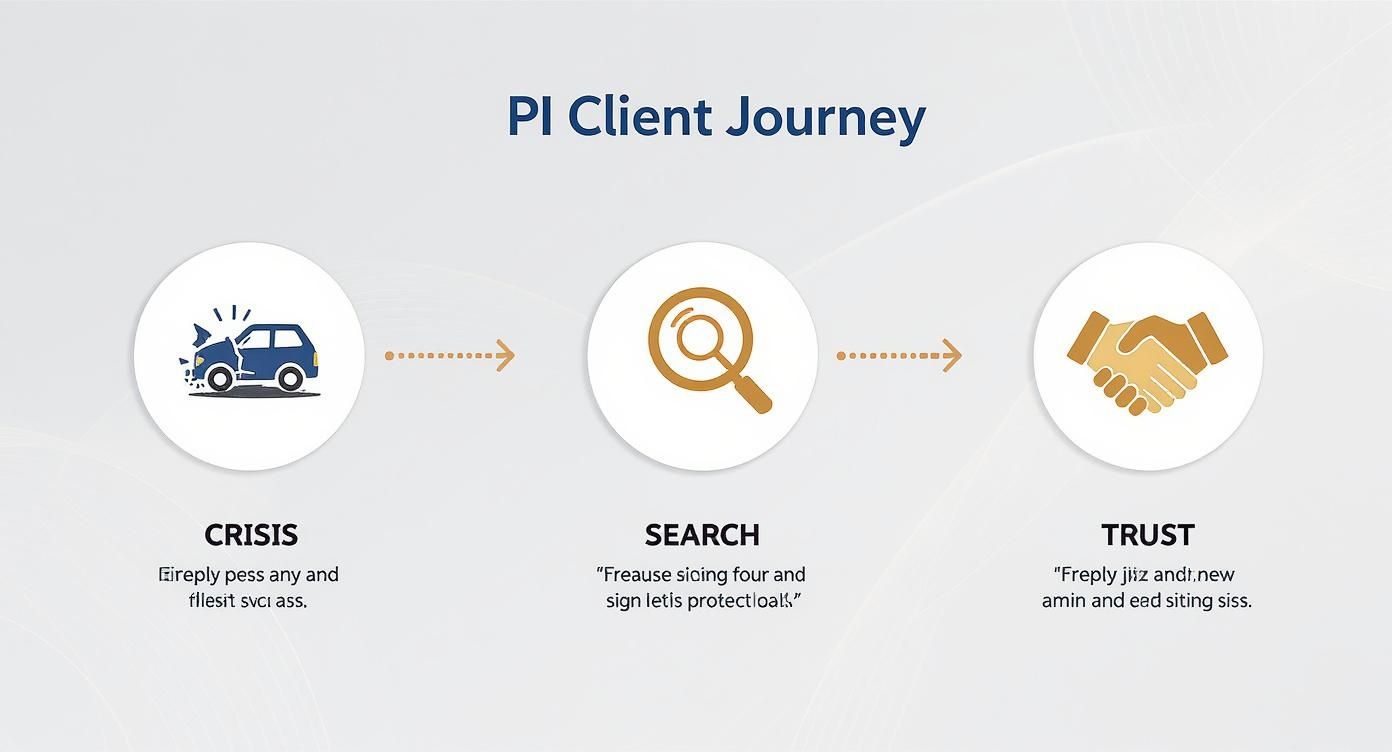
As you can see, that final step before they contact you is all about trust. Your website's first impression is everything.
Beyond Rankings to Building Trust
SEO is mission-critical for PI lawyers because when someone gets hurt, their first move is almost always to Google for help. This is your chance to be the first and best answer. A powerful SEO strategy puts your firm on page one, right where that person is looking for a solution.
To pull this off, you need a plan built on several key pillars, each designed to meet a specific goal.
Core Components of a Winning PI Lawyer SEO Plan
Here’s a look at the essential elements that separate a successful SEO campaign from one that just spins its wheels.
| SEO Component | Primary Goal | Key Tactic Example |
|---|---|---|
| Local SEO | Dominate your city's search results and map pack for "near me" queries. | Building hundreds of hyper-local citations and managing Google Business Profile reviews. |
| On-Page SEO | Create content that answers urgent questions and establishes expertise. | Developing detailed practice area pages for specific case types (e.g., "T-bone accident," "dog bite"). |
| Technical SEO | Ensure your site is fast, secure, and easily crawled by Google. | Optimizing for Core Web Vitals to ensure the site loads in under 2 seconds. |
| Link Building | Build authority and credibility through high-quality backlinks. | Earning links from local news outlets, legal directories, and community organizations. |
This isn't just about tweaking a few things; it's a comprehensive strategy where every component works together.
The goal isn't just to rank. It's to instantly establish your firm as the calm, authoritative voice in your potential client's storm. Your website content, local presence, and user experience must work together to build confidence before they ever pick up the phone.
This is exactly why a tailored, specialized plan is non-negotiable. It’s how you position your firm not just as an option, but as the only logical choice for someone seeking justice in your city. It’s how you start attracting the high-value cases that build a powerhouse practice.
Uncovering Keywords That Attract High-Value Cases
Let's get one thing straight: effective SEO for personal injury lawyers isn't about chasing every possible keyword. Sure, you could throw a ton of money at a broad term like "injury lawyer," but you'll mostly get a flood of low-quality traffic and a massive bill.
The real money is in finding the exact phrases potential clients type into Google when they’re past the "what if" stage and are actively looking to hire someone for a serious case.
This is all about search intent. Someone Googling "what to do after a car accident" is just gathering information. But someone searching "truck accident lawyer for spinal injury near me"? That person is ready to make a call. Your entire strategy needs to focus on capturing that second user.
Moving Beyond Broad Search Terms
To attract clients with significant cases, you have to think like they do. When someone is in a state of distress, their searches aren't vague; they're incredibly specific. They’ll include the type of accident, the severity of their injury, and their location.
These are what we call long-tail keywords, and they are the absolute cornerstone of a winning PI law firm SEO strategy.
Think about the difference:
- Instead of "car accident lawyer," you should be targeting "head-on collision attorney los angeles."
- Instead of "work injury lawyer," your focus should be "construction site fall injury lawyer san diego."
- And forget "slip and fall lawyer." Go after "brain injury from slip and fall grocery store attorney."
Yes, these longer phrases get fewer searches. But the intent behind them is a hundred times stronger. Each one represents a real person with a specific, life-altering problem who needs a specialist, not a generalist. This is a critical piece of the puzzle for any firm trying to figure out how to get personal injury clients with valuable cases.
A Practical Process for Keyword Discovery
Finding these gems requires a smart mix of experience, common sense, and the right tools. I always start by brainstorming every possible way a potential client might describe their situation. Think about specific accident types, the injuries that result, and all the cities or neighborhoods you serve.
Once you have a starting list, it's time to fire up a tool like Ahrefs or SEMrush. These platforms are invaluable for seeing what your top competitors are already ranking for—it’s like getting a free roadmap of what already works. You can also uncover the actual questions people are asking Google, which is gold for creating blog posts and FAQ pages.
Key Takeaway: Stop guessing what you think clients are searching for. Use real data to find out what they are actually typing into that search bar. Their language is your key to connecting with them.
For a much deeper look into the nitty-gritty, I'd recommend reading up on these keyword research best practices to really sharpen your approach.
Mapping Keywords to Your Website Content
Finding the right keywords is just the first step. The next, and equally crucial, part is strategically mapping them to the right pages on your website. If you just sprinkle keywords randomly across your site, you'll confuse Google and get nowhere.
You need a clear plan. Each page should have a distinct purpose and target a specific set of related terms.
Here’s a simple framework I use that works every time:
| Page Type | Primary Keyword Focus | Example Keyword Target |
|---|---|---|
| Homepage | Your main brand and broad service terms. | "Los Angeles Personal Injury Lawyers" + "[Firm Name]" |
| Practice Area Pages | High-intent keywords for each case type you handle. | "Traumatic Brain Injury Attorney" or "Motorcycle Accident Lawyer" |
| Blog Posts | Question-based, informational keywords. | "How long do I have to file a personal injury claim in California?" |
| Local Landing Pages | Geo-targeted keywords for specific cities you serve. | "Santa Monica car accident lawyer" or "Glendale truck accident attorney" |
This kind of structured approach sends a crystal-clear signal to Google. When someone searches for a specific service in a specific area, Google knows exactly which page on your site is the perfect match. This level of precision is what separates the law firms that get a random trickle of leads from those that build a predictable, powerful engine for generating high-value cases.
Winning the Local Search Battleground

While your practice area pages are busy fighting for broad, organic search rankings, the most valuable leads are often won on a different field: local search.
Think about it. When someone gets into a car wreck and frantically searches "car accident lawyer near me" on their phone, they aren't looking for a firm in another state. They need help, right now, from an expert down the street. This is where your Google Business Profile (GBP) becomes the single most powerful tool in your entire marketing arsenal.
For any serious PI firm, dominating the local "Map Pack" is non-negotiable. It's more than just claiming a listing—it's about turning that profile into a client-generating machine.
Beyond the Basics of Your Google Business Profile
Just filling in your firm's name, address, and phone number (NAP) is table stakes. Your competitors are already doing that. To actually win, you need to treat your GBP as a living, breathing platform that actively builds trust and showcases your expertise.
Your GBP is the digital front door to your practice. Is it professional and active, or does it look neglected?
Here’s how to make your profile a client magnet:
- Write a Compelling Business Description: Don't just list your practice areas. Tell a story. Speak directly to the pain points of an injured person and frame your firm as the only logical solution. Weave in keywords naturally, like "our attorneys specialize in catastrophic injury cases right here in Miami."
- Use GBP Posts Religiously: This feature is criminally underused by law firms. Share anonymized case results, introduce your attorneys with a personal touch, or post links to your latest blog articles. Consistent posting signals to Google that you're active and engaged.
- Master the Q&A Feature: Get ahead of potential clients by answering their questions before they even ask. You can—and should—seed this section yourself by posting common questions ("How much does a consultation cost?") and providing clear, authoritative answers. This builds instant trust.
For PI lawyers, the impact of local SEO is massive because the client's need is almost always immediate and local. Getting into that local pack can supercharge your visibility. Some studies even show it can boost views by 400% and clicks by 113%.
The Undeniable Power of Client Reviews
In the legal world, social proof is everything. A steady stream of positive, authentic client reviews is the most powerful signal you can send to both Google and prospective clients. It’s a direct reflection of your firm's quality and trustworthiness.
But just hoping for good reviews isn’t a strategy. You need a system.
Expert Tip: Set up an automated follow-up process. The moment a case is successfully resolved, a simple email or text should go out asking the satisfied client to share their experience on Google. Make it frictionless by including a direct link to your review page.
Responding to every review—good or bad—is just as crucial. A thoughtful reply shows you value your clients and are actively managing your reputation. Building and protecting your firm's image is a vital, ongoing task. For a much deeper look, check out our guide on online reputation management for lawyers.
Lock Down Your NAP Consistency
One of the most foundational—and frequently botched—elements of local SEO is maintaining perfectly consistent Name, Address, and Phone (NAP) information across the web.
Even the smallest variation can confuse search engines and water down your local authority.
If your firm is listed as "Smith Law" on one directory, "Smith Law Group" on another, and "Smith Law, P.C." on a third, Google might see these as three separate entities. This kills the trust signals you need to rank.
Use a tool like Moz Local or BrightLocal to conduct a full audit of your online presence. Hunt down and fix every single inconsistency on major legal directories like Avvo and Justia, as well as local business listings. This meticulous cleanup sends an unmistakable signal to Google: this firm is a legitimate, established authority at this exact location.
Creating Content That Converts Prospects Into Clients

Great content on a personal injury firm’s website has to pull double duty. On one hand, it needs to check all the boxes for Google, targeting the right keywords and providing deep, authoritative answers. But on the other hand—and this is far more important—it has to connect with a real person who is likely going through a crisis.
I see so many attorneys make the classic mistake of loading their websites with dense, impenetrable legalese. It might be technically flawless, but it completely alienates the very people they’re trying to help. Someone just injured in an accident isn't searching for a legal brief. They're looking for help, for clarity, and for a path forward.
Your content's real job is to be that bridge. It has to translate complex legal ideas into simple, empathetic language that builds immediate trust and gently guides an anxious visitor to pick up the phone.
Building Your Foundational Content Pillars
Any successful SEO for personal injury lawyer strategy I've ever built starts with a solid foundation of core content pages. Think of these pages as the digital workhorses of your firm; they’re what attract highly-targeted traffic and stake your claim as an authority in specific legal niches.
To even compete in today's market, your website absolutely must have these two types of pages:
- In-Depth Practice Area Pages: These are your deep dives. You need a dedicated, comprehensive resource for every single case type you handle, whether it's "Car Accidents," "Slip and Fall Injuries," or "Medical Malpractice." Each page should be a definitive guide, answering common questions, walking through the legal process, and showing off your firm's specific experience with those cases.
- Hyper-Local Landing Pages: This is where the local magic happens. You need a unique page for every single city, suburb, or even major neighborhood you serve. A page titled "Glendale Car Accident Lawyer" will always outperform a generic, statewide page for someone searching in that area. It's a direct signal to Google that you're the go-to firm right there.
Setting up these distinct content pillars is fundamental. It tells search engines exactly what you do and where you do it, forming a crucial part of a smart content marketing strategy for law firms designed to attract the right kind of clients.
Writing With Empathy and Authority
With your site structure mapped out, the focus shifts to the words on the page. How you say something matters just as much as what you're saying. Writing with empathy simply means putting yourself in the shoes of a potential client.
Let's be honest, they're probably feeling:
- Overwhelmed by a mountain of medical bills
- Anxious about what the future holds
- Confused and bullied by insurance adjusters
- Completely unsure of their legal rights
Your content needs to meet them where they are and acknowledge these fears head-on. Use straightforward headings like "You Don't Pay Us a Dime Unless We Win" or "Let Us Handle the Insurance Companies for You." This isn't just good copy; it's building an immediate connection.
Remember, you’re not just selling legal services; you’re offering a solution to a life-altering problem. Your tone should be authoritative and confident, yet compassionate and reassuring. Frame your firm as a steady guide through a chaotic time.
Structuring Your Pages for Conversion
A beautifully written page is worthless if it doesn't get someone to take action. Every single page on your site—from a blog post to a practice area page—needs a clear and compelling Call-to-Action (CTA). You have to tell people exactly what to do next.
Don't just stick a phone number in the footer and hope for the best. Be strategic. Place your CTAs thoughtfully throughout your content.
Here’s a simple, battle-tested layout that just works:
| Page Section | Call-to-Action (CTA) |
|---|---|
| Above the Fold | A big, can't-miss "Schedule a Free Consultation" button next to a clickable phone number. |
| Mid-Page | A simple contact form embedded right after you've explained a key legal concept. |
| End of Page | One last, powerful CTA urging them to call now, supported by trust signals like awards or client testimonials. |
This kind of strategic placement ensures that no matter where a visitor is on the page, the next step is always obvious. You're actively guiding them from a state of uncertainty to one of decisive action—turning a passive website visitor into your firm's next promising client.
Building Authority Through Links and Technical SEO

While compelling content and local dominance are what potential clients see, two other pillars work behind the scenes to build unshakeable authority. I'm talking about technical SEO and link building—the very elements many firms ignore but that top-ranking competitors have absolutely mastered.
Think of technical SEO as the foundation of your digital office. If that foundation is cracked—meaning your site is slow, insecure, or a maze for search engines—everything you build on top of it is at risk of collapse.
Link building, on the other hand, is your firm’s professional reputation translated into the digital world.
The Non-Negotiable Technical Foundations
Before you even think about getting links, your own website needs to be in perfect working order. Google holds personal injury law firms to an incredibly high standard because you operate in a "Your Money, Your Life" (YMYL) category. This just means trust signals are paramount, and that starts with the technical health of your site.
Three areas are absolutely critical:
- Lightning-Fast Load Speed: If your site takes more than three seconds to load, you're losing people. They’ll just hit the back button and go straight to your competitor.
- Seamless Mobile Experience: The vast majority of urgent searches for a PI lawyer happen on a smartphone. Your site has to be flawless and simple to use on any device.
- A Secure HTTPS Connection: A secure site (that little padlock in the browser) isn't optional anymore. It's a fundamental requirement for building trust with both users and search engines.
A recent large-scale study of over 112,000 personal injury law SERPs found that nearly 96% of ranking websites had a valid SSL certificate (HTTPS). Operating without one is a clear competitive disadvantage. This kind of foundational work is a key part of our comprehensive approach to website optimization for law firms, ensuring you meet Google's high standards from day one.
Earning Links That Build Real Authority
Once your technical house is in order, it's time to build your firm's online reputation through backlinks. A backlink is simply a link from another website to yours. In Google’s eyes, every high-quality backlink is a vote of confidence, a signal that your firm is a credible and authoritative resource.
But here's the thing: not all links are created equal.
A link from a local news story about a case you won is worth exponentially more than a link from a spammy, irrelevant blog. The goal is always quality over quantity.
The strength of your backlink profile is one of the most significant factors that separates firms on page one from those lost on page two. It's a direct measure of your firm's authority in the eyes of search engines.
The study I mentioned earlier confirmed this. It showed that a higher Domain Rating—a metric reflecting the strength of a site's backlink profile—was a major factor in achieving better rankings.
Practical Link-Building Tactics for PI Firms
Forget the complex, abstract theories. Building a powerful backlink profile comes down to practical, real-world actions that are also great for your business. It's about getting involved in your community and your industry in a visible, meaningful way.
Here are a few actionable strategies that consistently deliver high-value links:
- Get Listed in Reputable Legal Directories: Make sure your firm has a complete and accurate profile on major directories like Avvo, Justia, and FindLaw, plus your local Bar Association’s website.
- Sponsor Local Community Events: Sponsoring a local charity 5K or a youth sports team often gets you a link from their website—a powerful local signal.
- Create an Annual Scholarship Program: Offering a small scholarship for local students is a fantastic way to earn high-authority links from university websites (.edu links), which are highly valued by Google.
To truly get ahead of your competitors, you need to dig into Mastering Backlink Gap Analysis. This process helps you find the high-quality sites linking to your competition but not to you, giving you a clear roadmap for your own outreach. By combining a flawless technical foundation with a strategic link-building campaign, you send powerful trust signals that help you systematically climb the rankings.
Common Questions About PI Law Firm SEO
Navigating SEO for personal injury lawyers brings up a lot of questions. It's a crowded, competitive field, and firm partners and marketing managers often have the same pressing concerns about what it takes to get real results.
Let’s cut through the noise and get straight to the answers.
How Long Does SEO Really Take for a Law Firm?
I'll be blunt: there's no magic switch for page-one rankings. In a cutthroat market like personal injury law, you can expect to see meaningful movement in your rankings and traffic within 4 to 6 months of consistent, smart work.
But for those high-value, case-generating keywords? Think "truck accident attorney" or "brain injury lawyer." Securing top positions for those often takes a solid 9 to 12 months of dedicated effort.
It's absolutely critical to see SEO as a long-term investment. You're building a predictable client acquisition channel for your firm, not just running a short-term campaign.
The patience required for a strong SEO campaign pays off. It's about building an asset that generates high-value cases for years to come, unlike paid ads that stop the moment you turn off the budget.
Can Our Firm Handle SEO In-House?
While it’s technically possible to tackle some basic SEO tasks yourself, the personal injury niche is one of the most difficult arenas online. You have to assume your competitors are working with specialized agencies that live and breathe legal marketing.
Trying to go it alone requires a serious commitment of resources:
- Deep Expertise: Keeping up with Google's constant algorithm changes isn't a side project; it's a full-time job.
- Time Commitment: The hours required for technical audits, creating expert-level content, and building quality links are staggering.
- Specialized Tools: Professional-grade SEO software like Ahrefs or SEMrush can easily cost thousands of dollars per year.
From my experience, most attorneys find that partnering with a legal SEO expert yields a much stronger—and faster—return on their investment.
Should We Focus on Local SEO or Organic SEO?
This is a classic false choice. For a personal injury lawyer, you need both, and they are completely intertwined. Thinking one is more important than the other is a common mistake that will cripple your growth.
Local SEO is what gets your firm into the Google Map Pack when someone in your city searches for "car accident lawyer near me." It’s designed to capture clients who are ready to make a call right now.
Organic SEO is what gets your individual practice area pages—like "Wrongful Death" or "Spinal Cord Injuries"—to rank in the main, traditional search results. A powerful organic presence builds your firm's overall authority, which in turn gives your local rankings a major boost.
A winning strategy doesn't separate them; it integrates them. Your authoritative organic content reinforces your local presence, and your perfectly optimized Google Business Profile supports your firm's rankings across the board.
What Is a Realistic SEO Budget for a PI Firm?
SEO budgets for PI firms depend almost entirely on the level of competition in your city. What works in a small town won't make a dent in a major metro area.
Here’s a realistic breakdown of what a monthly investment looks like:
- Smaller Cities/Towns: A comprehensive campaign typically starts in the $2,500-$4,000 per month range.
- Mid-Sized Metro Areas: To compete effectively, expect to invest $4,000-$7,000 per month.
- Major Metro Areas (e.g., Los Angeles, Miami): To seriously challenge the top-ranking firms, budgets often run from $7,000 to $20,000+ per month.
This isn't just a line item for "marketing." This investment covers expert strategy, deep technical optimization, professional content creation, high-authority link building, and detailed performance reporting. It’s better to think of it as a core client acquisition cost that builds a lasting asset for your firm.
At Case Quota, we specialize in building these kinds of powerful, results-driven SEO strategies for personal injury firms. If you're ready to stop guessing and start building a predictable pipeline of high-value cases, we can help. Schedule your free marketing consultation today.