

Marketing your law firm has completely changed. Gone are the days of relying solely on handshakes and referrals; today, it's a digital-first world. The short version? You need a powerful digital presence, you have to master search engine visibility, and you absolutely must use targeted advertising.
We're going to break down the system that makes this happen—a multi-channel approach that builds a reliable, client-generating engine for your firm.
The Modern Playbook for Law Firm Marketing

This guide isn't about throwing a bunch of random tactics at the wall. It’s a clear roadmap to building a cohesive system that consistently attracts and converts your ideal clients. The real goal is to stop chasing individual leads and start building a predictable pipeline of high-value cases. To get there, we need to weave several key disciplines into one powerful strategy.
Success here demands a shift in mindset. Marketing isn't a cost center; it's a critical investment in your firm's growth. That means deeply understanding your target audience, defining your brand, and being smart about which channels you use to reach potential clients. For a deeper dive into these fundamentals, check out our guide on essential https://casequota.com/law-firm-marketing-strategies/.
What an Integrated Approach Actually Looks Like
An integrated approach simply means all your marketing efforts work together, each one making the others stronger. Your website, SEO, paid ads, and social media shouldn't be operating in separate silos.
Think about it this way: a compelling blog post (content marketing) can be boosted with a targeted Facebook ad (paid social) to drive traffic to your website. At the same time, strong SEO helps your site rank for related search terms organically. It all connects.
This synergy creates a powerful flywheel effect:
- Your Website: The central hub where all digital activity leads.
- SEO: Makes sure clients find you the moment they need legal help.
- Paid Ads: Give you immediate visibility and highly targeted leads.
- Content: Builds trust and establishes your firm as the authority.
To help you visualize how these channels fit together, here’s a quick breakdown of their roles and how to measure them.
Core Digital Marketing Channels for Law Firms
| Marketing Channel | Primary Goal | Key Performance Indicator (KPI) |
|---|---|---|
| Search Engine Optimization (SEO) | Drive organic traffic and rank for high-intent keywords. | Organic Traffic, Keyword Rankings, Conversion Rate |
| Paid Advertising (PPC) | Generate immediate, targeted leads for specific practice areas. | Cost Per Lead (CPL), Click-Through Rate (CTR), Ad Spend ROI |
| Content Marketing | Build authority, trust, and attract clients early in their journey. | Website Engagement, Time on Page, Backlinks |
| Social Media Marketing | Engage with the community and build brand awareness. | Follower Growth, Engagement Rate, Website Clicks |
| Email Marketing | Nurture leads and maintain relationships with past clients. | Open Rate, Click-Through Rate, New Consultations |
This table illustrates how each piece has a distinct job but contributes to the same overarching goal: generating more cases.
The Growing Role of Outside Experts
Let's be honest, executing a multi-channel strategy is complex. The days of handing marketing off to a paralegal or junior associate are over. This field now demands specialized knowledge in analytics, ad management, SEO, and content creation.
The trend toward specialization is undeniable. By 2025, a staggering 83% of law firms are expected to hire external marketing agencies to manage their client acquisition strategies.
This isn't a surprise. Partnering with an agency gives firms access to advanced tools and data-driven insights without the massive overhead of a full in-house team. This shift underscores just how critical a trusted partner can be in a crowded legal market.
To truly attract the right clients, you need robust inbound marketing lead generation strategies. A well-oiled system ensures every part of your marketing contributes directly to the bottom line—attracting, engaging, and converting the right clients for your practice.
Building Your Digital Foundation for Growth
Every single marketing road you take—paid ads, social media, even word-of-mouth referrals—eventually leads people back to one place: your website. It's your digital headquarters. And while a professional design is the bare minimum, a site truly engineered for client acquisition goes much, much deeper.
This isn't about building an online brochure; it's about creating your firm's most valuable marketing asset. Its performance directly impacts your ability to generate cases. A slow, confusing, or broken site doesn't just frustrate visitors—it actively sends your ideal clients straight to the competition.
The infographic below breaks down the three pillars of a website that actually works as a growth engine for your firm.
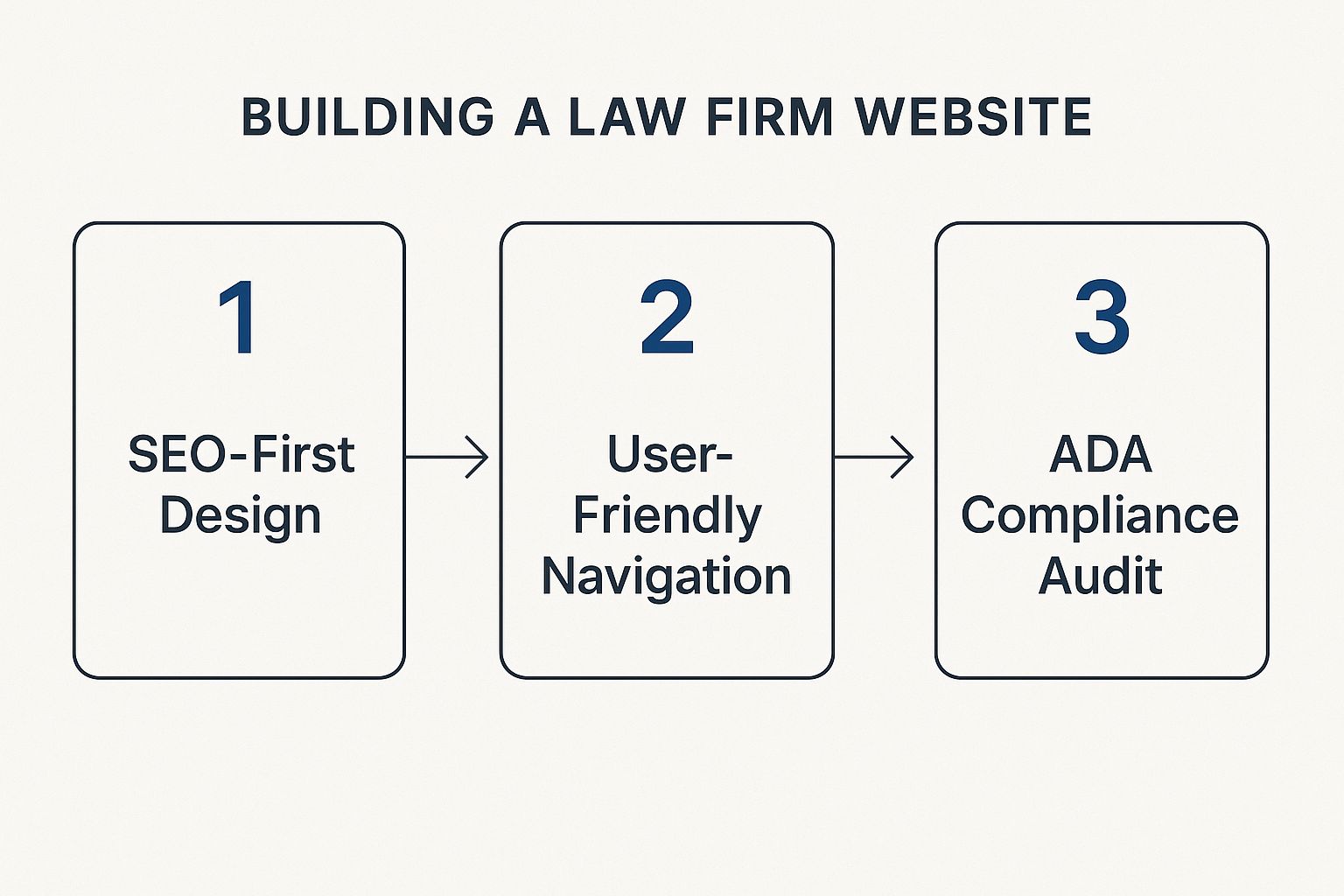
As you can see, the flow is intentional. SEO gets you found, a great user experience keeps people engaged, and ADA compliance ensures your message reaches everyone.
Adopting an SEO-First Design Philosophy
When most lawyers think "website design," they think about logos, colors, and photos. While aesthetics build trust, an SEO-first design is a totally different mindset. It prioritizes how search engines like Google understand and rank your site from the moment the first line of code is written.
Trust me, it is far more effective to build SEO into your site's architecture than to try and bolt it on after the fact.
This approach means getting a few technical things right from the start:
- Mobile-First Indexing: This isn't a trend; it's the standard. Google primarily uses the mobile version of your site for ranking. If your website is a pain to use on a smartphone, you're already behind.
- Fast Page Speed: Site speed is a confirmed ranking factor. We're talking about real business impact here. A mere one-second delay in page load time can cause a 7% reduction in conversions.
- Clean URL Structure: Your page URLs should be simple, logical, and tell a story. A URL like
yourfirm.com/dallas-car-accident-lawyer/instantly tells both users and Google what the page is about.
Building with an SEO-first mindset means that from day one, your website is structured to compete for the keywords your potential clients are actually searching for. To keep that edge, you'll need ongoing website optimization for law firms to maintain and improve performance.
Enhancing User Experience to Drive Conversions
Once a potential client lands on your site, the clock is ticking. You have just seconds to make an impression. A positive user experience (UX) is what convinces them to stay and guides them toward taking the next step.
Your goal is simple: make it incredibly easy for visitors to find what they need and contact you.
Good UX is all about clarity and removing friction. This includes:
- Intuitive Navigation: Your main menu needs to be dead simple. Use clear labels for practice areas, attorney bios, and your contact page. No clever jargon.
- Prominent Calls-to-Action (CTAs): Buttons like "Request a Free Consultation" or "Call Us Now" need to be impossible to miss on every single page. Don't make people hunt for a way to give you their business.
- Clickable Phone Numbers: On a mobile device, your firm's phone number must be a clickable link that opens the phone's dialer. This tiny detail can dramatically increase your call volume.
A well-designed website contributes directly to a client-centered experience. An easy-to-use site shows potential clients you’ve been thoughtful about their needs and what they are looking for in a time of distress.
This thoughtful approach is what turns a website from a passive digital pamphlet into an active, 24/7 lead generation machine.
Ensuring ADA Compliance for Accessibility
Here's a critical piece of the puzzle that is too often overlooked: making sure your website complies with the Americans with Disabilities Act (ADA).
Making your site accessible to users with disabilities isn't just the right thing to do; it's a legal necessity that protects you from potential lawsuits and opens your doors to a wider audience.
An accessible website ensures everyone, regardless of ability, can navigate and understand your content. Key components include:
- Alternative Text for Images: "Alt text" is a short description of an image that screen readers use to explain visuals to visually impaired visitors.
- Keyboard Navigation: All of your site's features, menus, and forms must be usable with only a keyboard, no mouse required.
- Readable Fonts and Color Contrast: Text has to be easy to read, with enough contrast between the words and the background.
By building a digital foundation that is technically sound, user-focused, and fully accessible, you create a powerful asset that supports every single marketing effort you make.
Attracting High-Value Clients with SEO

Right now, your ideal clients are online, typing their legal problems into a search bar. Will they find you?
Search Engine Optimization (SEO) is the art and science of making sure your law firm is the first answer they see. This isn't about gaming the system; it's about strategically positioning your firm's expertise where potential clients are actively searching for it.
Done right, SEO transforms your website from a static digital brochure into a powerful, automated client acquisition machine. It all starts by understanding the exact language people use when they need a lawyer and then building your entire online presence around those crucial terms.
Uncovering Client Intent with Keyword Research
Before you can rank, you have to know what you're trying to rank for. This is where keyword research comes in, and it's the absolute foundation of any effective law firm marketing plan. You're essentially listening in on the conversations potential clients are having with Google.
The real goal here is to move past the obvious, generic terms like "lawyer" and dig deeper to find high-intent keywords. These are the phrases that signal someone is beyond the research phase and is ready to pick up the phone. More often than not, these are longer, more specific phrases known as long-tail keywords.
Think about it: "car accident lawyer" is incredibly broad and brutally competitive. But a long-tail keyword like "what to do after a rear-end collision in Los Angeles" captures someone with a specific, urgent problem. That’s not just a searcher; that's a potential case.
Mastering On-Page SEO for Law Firms
Once you've identified your target keywords, you need to infuse them into your website in a way that tells Google, "This page is the best possible resource for this topic." That's the core of on-page SEO. It involves fine-tuning individual pages on your site to clearly signal their relevance and value.
This is not about jamming keywords into every sentence. Google is smarter than that. It’s about creating genuinely helpful, high-quality content that naturally incorporates your target phrases because it directly addresses the user's needs.
Here are the key on-page elements that move the needle:
- Title Tags and Meta Descriptions: This is your first impression in the search results. A compelling title tag that includes your main keyword and location can be the difference between getting the click or getting ignored.
- Header Tags (H1, H2, H3): Headers are like the chapter titles of your page. They organize the content for human readers and give search engines a clear structural outline. Your most important keyword should always be in your H1 tag.
- Content Quality: Your content must be the definitive answer to a searcher's question. A page on truck accidents, for instance, should cover everything from liability and common injuries to the legal process, positioning your firm as the go-to authority.
For a deep dive into this, especially for hyper-competitive fields, our guide on SEO for personal injury law firms lays out specific, actionable tactics.
Optimizing your on-page elements is like giving Google a clear roadmap of your website. The easier you make it for search engines to understand your content, the more likely they are to show it to the right people.
The Power of Local SEO for Your Practice
For most law firms, the client acquisition battle is won or lost at the local level. Local SEO is a specialized discipline focused on making your firm highly visible in location-specific searches—especially in Google's coveted "Map Pack." This is huge, considering that nearly 50% of all Google searches have local intent.
Your Google Business Profile (GBP) is the absolute cornerstone of your local strategy. This free listing is your firm's digital storefront on Google. It showcases your address, phone number, hours, and, most critically, your client reviews.
A well-oiled GBP listing sends powerful trust signals to Google. To get it right, focus on these areas:
- Consistent NAP Information: Your firm's Name, Address, and Phone number must be identical everywhere online—on your website, your GBP, and every other directory.
- Strategic Category Selection: Be precise. Choose "Personal Injury Attorney" or "Family Law Attorney" to tell Google exactly what you do.
- Encouraging Client Reviews: Positive reviews are arguably the most powerful local ranking factor. They build immense social proof and directly influence both rankings and potential clients.
Beyond your GBP, building local citations reinforces your geographic authority. Every mention of your firm's NAP on other trusted sites like Yelp, Avvo, or local chamber of commerce directories acts as another vote of confidence in the eyes of search engines, solidifying your local presence.
Using Paid Ads for Immediate Client Leads
While building a strong SEO foundation is crucial for long-term growth, sometimes you need clients now. This is where paid advertising shines, delivering something SEO can't: immediate results.
Think of it as opening a direct line to potential clients the very moment they realize they need legal help. It's how you get in front of qualified leads today, not six months from now.
Paid ads, especially pay-per-click (PPC) campaigns on a platform like Google Ads, let you bypass the slow climb up the organic rankings. You're essentially paying to secure a top spot for high-intent keywords, ensuring your firm is the first one a potential client sees.
This immediacy is incredibly powerful. When someone searches for "DUI lawyer near me" or "emergency child custody attorney," their need is urgent. Paid ads put you right in their path when their motivation to hire is at its absolute peak.
Choosing the Right Advertising Platforms
Not all ad platforms are created equal, particularly in the legal space. The real key is matching the platform to your specific practice area and your ideal client profile. You need to be exactly where your clients are looking for help.
For most law firms, it really boils down to two main categories: search and social.
- Google Ads (Search): This is the undisputed champion for capturing immediate client intent. You aren't trying to convince someone they have a problem; you're connecting with people who already know they do and are actively searching for a solution. It's a must-have for practice areas driven by urgency, like criminal defense, personal injury, and family law.
- LinkedIn Ads (Social): If you're a B2B practice or target clients based on their profession, this is your goldmine. A corporate lawyer, an employment attorney, or an estate planning firm catering to high-net-worth executives will find LinkedIn's targeting capabilities exceptionally precise.
- Facebook & Instagram Ads (Social): While less direct for urgent legal needs, these platforms are fantastic for building brand awareness and targeting users based on major life events. A family law attorney, for example, could target ads to users who have recently updated their relationship status.
A personal injury firm will pour most of its budget into Google Ads, while an intellectual property firm might find much more success building authority and relationships on LinkedIn. It’s all about strategy.
Crafting Ad Copy That Converts
Your ad is often the very first impression a potential client has of your firm. The language has to be clear, empathetic, and compelling enough to actually earn their click. A generic ad that just says "Law Firm in Your City" is going to get completely ignored.
Great legal ad copy speaks directly to the searcher's pain point and offers a clear, immediate solution. You have to write it from their perspective, not yours.
Your ad copy must answer the user's unspoken question: "Why should I trust your firm with my serious legal problem?" It’s your chance to convey expertise, empathy, and a clear path forward in just a few lines of text.
Take a car accident case, for instance. Instead of something generic, get specific and show the benefit.
Weak Ad Copy:
- Headline: Jones & Smith Law Firm
- Description: We handle car accident cases. Call us today.
Strong Ad Copy:
- Headline: Maximize Your Car Accident Claim
- Description: Injured? Get a Free, No-Obligation Case Review. We Fight Insurance Companies. Don't Settle For Less.
See the difference? The second example works because it focuses on the client’s ultimate goal (maximizing their claim) and removes the barrier to entry by offering a free review. If you're looking for more inspiration, exploring different law firm advertising ideas can help you find an angle that resonates with your target audience.
The Critical Role of Landing Pages
Getting the click is only half the battle. Where you send that traffic is arguably even more important.
One of the most common—and costly—mistakes firms make is directing all their paid traffic to their website's homepage. A homepage is designed for general browsing; it's overwhelming and unfocused for someone with a specific, urgent need.
Instead, every single ad campaign needs to point to a dedicated landing page. This is a standalone page designed with one, and only one, goal: converting that visitor into a lead. A high-performing landing page for a law firm absolutely must include:
- A Compelling Headline: The headline must match the promise of your ad perfectly. If your ad offered a "Free DUI Case Evaluation," that exact phrase needs to be the first thing they see on the page.
- A Clear Call-to-Action (CTA): Use big, prominent buttons and simple forms that tell the user exactly what to do next. Think "Request Your Free Consultation Now" or "Call Us 24/7."
- Social Proof: You need to build trust, fast. This is where client testimonials, case results (where ethically permissible), and attorney awards come in.
- A Simplified Contact Form: Only ask for what you absolutely need to start the conversation—usually name, email, and phone number. A long, complicated form is a guaranteed way to kill conversions.
By creating a seamless, focused journey from the ad to the landing page, you dramatically increase the chances of turning that expensive click into a valuable new case for your firm.
Building Trust Through Content and Social Media

People hire lawyers they know, like, and trust. In a world where your website is the new handshake, content and social media are your best tools for building that crucial relationship long before a potential client ever picks up the phone.
This isn’t about just blasting updates into the void. It's about a deliberate strategy of engagement designed to cement your firm as the authority in your practice area. Your entire goal is to educate, inform, and build undeniable credibility.
When you get this right, you transform your firm from just another service provider into a trusted resource. You stay top-of-mind, so when someone needs legal help, you’re the first and only call they make.
Create Content That Answers the Real Questions
Your potential clients are swimming in questions and anxiety. Your content needs to be their lifeline. The best way to do this is by creating high-value content that directly addresses the problems keeping them up at night.
This is how you demonstrate your expertise without giving away specific legal advice. A single, well-written blog post or a clear, reassuring video can build more trust than any billboard ever could.
Here are a few content formats that we see deliver consistent results for law firms:
- Practice Area Deep Dives: Go beyond the basics. Write comprehensive guides that walk people through a complex process, like the steps of a probate case or what to expect after a commercial trucking accident.
- "How-To" Guides and Checklists: Create practical, useful resources. Think checklists for gathering documents after an injury or a guide on how to prepare for a deposition. These are things people will save and reference.
- Short Explainer Videos: Record professional, 2-3 minute videos answering common questions. An attorney calmly explaining a legal process on camera is incredibly powerful and humanizing for a potential client.
This kind of content pulls double duty. It not only builds a bridge of trust with readers but also feeds your website with fresh material—something search engines love. To dig deeper into this, you should explore the essentials of content marketing for law firms.
Use Social Media for Meaningful Connection
Let's be clear: for most law firms, social media isn't about going viral. It's about building professional networks and demonstrating thought leadership with precision.
For attorneys, LinkedIn is often the most powerful platform, especially for B2B practices like corporate or employment law. It's the perfect place to connect with other professionals, business owners, and referral sources.
Social media for lawyers is less about mass marketing and more about precision networking. It's a tool for starting meaningful conversations that solidify your professional reputation and lead to high-value relationships.
Don’t just broadcast your own blog posts. Engage. Share a news article about a change in local business regulations and add your own expert take. That simple act positions you as someone who is actively on top of your field.
Real-World Content Ideas That Actually Work
Generic content gets ignored. Period. To truly connect, you have to get specific and genuinely helpful.
Here are a few practical examples you can adapt for your own firm:
- Family Law Firm: A blog post titled, "5 Mistakes to Avoid in a High-Asset California Divorce" speaks directly to the fears of a specific, high-value client.
- Criminal Defense Attorney: A short video explaining the difference between a misdemeanor and a felony in your state gives clear, valuable information to someone in a highly stressful situation.
- Estate Planning Lawyer: A downloadable PDF, "The Executor's Checklist," becomes an indispensable tool for potential clients, establishing your firm as a helpful authority from the very first interaction.
By consistently creating content that solves real problems and engaging thoughtfully online, you build a powerful digital presence. This strategy shifts your marketing from a series of one-off ads into a sustainable system for attracting your ideal clients.
Turning Leads into Clients and Measuring What Matters
Getting traffic and generating leads is a great start, but it's only half the job. Real growth happens when you have a system to turn those interested prospects into paying clients. This is where a rock-solid client intake process becomes your most valuable asset, transforming potential business into predictable revenue.
A slow or disorganized follow-up is a guaranteed way to lose a case. Think about it: a potential client in distress isn't going to wait around for a call back. You need a system—whether that's a dedicated paralegal or a streamlined Client Relationship Management (CRM) platform—to ensure every single inquiry gets a prompt, professional response.
The moment a lead comes in, the clock starts ticking. A structured intake process isn't just about efficiency; it’s about showing a potential client that your firm is responsive, organized, and ready to take their problem seriously from the very first interaction.
This immediate follow-up is the first and most critical step in nurturing that lead.
Metrics That Actually Define Marketing Success
To scale your firm's growth, you have to look past vanity metrics like website traffic. It's time to focus on the numbers that directly impact your bottom line. These are the data points that justify your marketing spend and guide every strategic decision you make moving forward.
For a clear picture of what's working, start by tracking these three essentials:
- Cost Per Lead (CPL): This tells you exactly how efficient your advertising is. If you spend $2,000 on a Google Ads campaign that brings in 20 qualified leads, your CPL is a straightforward $100.
- Client Acquisition Cost (CAC): This metric takes it a step further. What did it really cost to sign a new case? If only 2 of those 20 leads become paying clients, your CAC is $1,000 ($2,000 ad spend / 2 new clients).
- Client Lifetime Value (LTV): This is the big one—the total revenue a client is expected to generate for your firm. If the average client from that same campaign brings in $10,000 in fees, your marketing delivered a 10x return.
Understanding this data isn't optional. To truly gauge the effectiveness of your campaigns and ensure a strong return on your investment, mastering Google Ads performance metrics is a must. It gives you the clarity to cut what isn’t working and double down on the strategies that deliver profitable cases.
Your Toughest Law Firm Marketing Questions, Answered
When it comes to marketing a law firm, theory is one thing, but execution is another. Partners and marketers always run into the same tough, practical questions when it's time to actually build a growth strategy.
Let's cut through the noise and tackle the questions I hear most often.
How Much Should a Law Firm Spend on Marketing?
There’s no magic number, but the standard benchmark sits between 2% and 10% of your firm's gross revenue. Where you land on that spectrum is the real question.
Newer firms or those in hyper-competitive practice areas (think personal injury) need to be aggressive. You should be pushing that 10% mark just to get a foothold and build momentum.
On the other hand, well-established firms with a deep well of referral business can often get by on the lower end. The most important thing is to stop thinking of marketing as a cost and start treating it as an investment. Pick a budget you can stomach, track your ROI like a hawk, and then double down on the channels that are actually bringing profitable cases through the door.
What's the Single Most Effective Marketing Channel for Lawyers?
This is the million-dollar question, and the answer is always: it depends entirely on your practice area and the client you want to attract.
For firms that run on urgency—like criminal defense or personal injury—you need to be where clients are in their moment of crisis. That means SEO and Google Ads are your power players. They capture people at the exact moment they're desperately searching for legal help.
But for relationship-driven practices like corporate law or estate planning, that approach falls flat.
Your best bet here is a long-game strategy. Content marketing, genuine networking on LinkedIn, and a robust referral system are far more powerful for building the trust and authority needed to land clients who aren't making a panicked decision.
A truly effective strategy is never just one thing; it's an integrated mix of channels designed specifically for your firm's goals.
How Do I Market My Firm Without Breaking Ethics Rules?
This is non-negotiable. Navigating your state bar's ethics rules is paramount, as every single one has its own specific rules of professional conduct for advertising. Those rules are your bible.
Generally, you need to steer clear of a few major pitfalls:
- Making any statement that could be seen as false or misleading.
- Guaranteeing a specific outcome for a case. (Never, ever do this.)
- Using unsubstantiated claims or comparisons, like calling yourself "the best lawyer in town."
Always include required disclaimers like "Advertising Material" where mandated. Before you launch a single ad or publish a blog post, get intimately familiar with your state bar's advertising guidelines. When in doubt, pay an ethics expert to review your materials. It's one of the smartest investments you can make.
At Case Quota, we build marketing strategies that drive growth while staying fully compliant with legal ethics. Let us help you grow your practice the right way. Get in touch with Case Quota.