

A solid law firm marketing plan is your roadmap. It’s the difference between guessing and growing. Without one, you're just throwing money at random ads and social media posts. With one, you have a strategic framework that ties every marketing dollar to your firm's real-world growth targets.
Laying the Groundwork for Growth

Before you even think about running an ad, you have to get this part right. This is where you figure out precisely what makes your firm the only logical choice for your ideal clients. Getting this foundation solid ensures every decision you make from here on out is intentional, efficient, and laser-focused on your goals.
I see so many firms skip this part. They get excited and jump straight into the tactics—SEO, PPC, you name it. But that approach almost always leads to wasted money and disappointing results. Why? Because the message isn't sharp and nobody knows why they should choose you.
Defining Your Ideal Client Avatar
You have to get way more specific than your practice area. You aren't just a "personal injury lawyer." You're a specialist for a certain kind of person facing a very specific problem. That's why building a detailed client avatar is the first real step.
Let's take a personal injury firm fighting for attention in Southern California. A weak avatar is "someone in a car accident." A powerful one gets into the details:
- Name: "Injured Commuter Carlos"
- Demographics: Male, 35-45, lives in Orange County, and spends his mornings stuck on the I-5 or 405. He’s married with young kids.
- Pain Points: Carlos is staring at a mountain of medical bills. He can't work, so he's losing income and terrified about his family's finances. The insurance company is pressuring him to take a lowball offer, and the paperwork is a nightmare.
- Goals: He needs to know his family will be okay financially. He wants fair compensation, not a quick, cheap settlement. More than anything, he needs an attorney he can trust to handle the fight so he can focus on getting better.
When you have this level of clarity, you can write ad copy, blog posts, and website content that speaks directly to Carlos's fears and goals. Your firm stops being just another option and starts feeling like the only one that truly gets it.
Your marketing becomes exponentially more effective when you stop talking to everyone and start talking to someone specific. A well-defined client avatar is the key to creating messaging that resonates and converts.
Analyzing Your Market and Competitors
Once you know exactly who you're talking to, it's time to scope out the competition. A good competitive analysis isn't just about seeing what other firms are doing; it’s about finding what they aren't doing well.
Start by picking 3-5 of your most direct competitors in your specific city and practice niche. Then, put their online presence under a microscope:
- Website: Is their site modern and mobile-friendly, or does it look like it was built in 2010? A slow, clunky website is a major liability. Our guide on web design for attorneys details what a high-performing legal site needs.
- Content: Are they actually answering the questions your ideal client has? Or are they just publishing generic, unhelpful articles?
- Reviews: Dig into their Google, Avvo, and Yelp reviews. What are people consistently praising or complaining about? The patterns will tell you a lot.
This process will reveal the gaps you can drive a truck through. Maybe their websites are outdated and impossible to use on a phone. Perhaps they have no video testimonials from clients like Carlos. Or maybe their blog posts are all fluff. These are your openings.
And the competition is only getting more intense. The legal industry saw demand jump by 3.9% in the third quarter of 2025 over the previous year—one of the strongest quarters in two decades. Midsize firms focused on transactional law felt this surge the most, with a 6.1% increase. In a market this hot, you can't afford to be unprepared.
Building Your Client Conversion Engine

Think of your website as more than just a digital brochure. It’s your firm’s best salesperson, working 24/7 to turn curious visitors into scheduled consultations. A serious law firm marketing plan treats the website as the central hub—a machine built for one thing: conversion. If you get this foundation right, everything else falls into place.
This isn't just theory. The data proves it. Websites are still the core of legal marketing, with 65% of firms pointing to their site as the channel with the highest ROI. The numbers are even more stark when you look long-term: firms investing in a solid digital plan see an average three-year ROI of around 526%. The impact is undeniable.
Crafting a High-Performance User Experience
The moment a potential client lands on your site, the clock starts ticking. You have just a few seconds to convince them they’re in the right place. That’s why a seamless user experience (UX) isn't a luxury; it’s a requirement. It starts with a clean, professional design that works flawlessly on any device.
Remember "Injured Commuter Carlos"? He’s stressed out, in pain, and almost certainly looking for you on his phone. If your website is slow, confusing, or broken on mobile, he's gone in a heartbeat.
Your site absolutely must be:
- Mobile-First: Every single page, form, and button has to be designed for a smartphone screen. No exceptions.
- Fast-Loading: A site that takes longer than three seconds to load will hemorrhage nearly half its potential clients.
- Easy to Navigate: Your phone number should be impossible to miss, and your core practice area pages should be one click away.
A crucial, often-overlooked part of the user experience is accessibility. A website built to be inclusive for people with disabilities doesn't just serve the community better—it performs better in every metric that matters. It’s worth learning how accessibility can boost your website's UX and client acquisition.
Optimizing for On-Page and Local SEO
A beautiful, fast website is completely useless if no one can find it. On-page Search Engine Optimization (SEO) is how you tell Google that your firm is the most relevant, authoritative answer to a searcher's problem in Southern California.
This means getting specific. A generic "Personal Injury" page won’t move the needle here. You need to build out dedicated, high-value pages for "Orange County Car Accident Lawyer" or "Los Angeles Brain Injury Attorney."
Each of these pages needs to be meticulously optimized with:
- Targeted Keywords: Weave in the exact phrases your ideal clients are typing into Google.
- Compelling Content: Go deep. Answer the questions they have and explain exactly how you handle their specific type of case.
- Clear Headings: Use H2 and H3 tags to structure the information logically. This helps both users and search engine crawlers understand what the page is about.
When a potential client searches "car accident lawyer near me," they are ready to hire someone. Your on-page SEO is what puts your firm in front of them at that critical moment, turning a desperate search into a high-value case.
Building Trust and Driving Action
Once a visitor is on your site, you have to build trust—fast. Legal issues are deeply personal and stressful. People need to feel confident in your expertise before they'll even consider picking up the phone. This is where trust signals come in.
Sprinkle these elements strategically throughout your website, especially on your main practice area pages:
- Client Testimonials: Real stories from real people you've helped.
- Case Results: Showcase your track record with anonymized case outcomes and figures.
- Awards and Recognitions: Display those badges from Avvo, Super Lawyers, and the Better Business Bureau. They matter.
Finally, every page needs a clear job to do. Don't make visitors hunt for what to do next. Guide them with strong, direct calls-to-action (CTAs) like "Schedule Your Free Consultation" or "Call Us Now for Immediate Help." These elements are the final, crucial pieces for improving your lead generation for lawyers and making your website the true engine of your firm’s growth.
Choosing Your Client Attraction Channels
So, you’ve built a high-converting website—your firm's digital hub. That's a huge step, but it won't bring in cases on its own. Now it's time to build the roads that lead your ideal clients, like our "Injured Commuter Carlos," straight to your door.
This is all about picking the right client attraction channels and, more importantly, making them work together. A criminal defense firm operates in a completely different world than an estate planning practice. Your job isn't to be everywhere; it's to focus your time and budget where you'll see the biggest impact and create a predictable stream of qualified leads.
SEO: The Long-Term Asset
If there's one non-negotiable, it's Search Engine Optimization (SEO). This isn't a quick-fix tactic. It's the slow, steady work of building a powerful asset that will generate high-quality cases for years to come. When someone in a panic searches for a "workers compensation attorney in San Diego," SEO is what decides if they find you or your competitor down the street.
The numbers don't lie. Digital marketing dominates legal budgets, with about 65% of law firms planning to pour their money into online strategies in 2025. This is a direct response to how people behave—a staggering 96% of them start looking for a lawyer with a Google search.
Organic search isn't just a vanity metric; it drives over half of all traffic (52.6%) to law firm websites and converts at 7.5%. That's more than triple the 2.2% conversion rate from paid ads.
Your SEO game plan should zero in on a few key areas:
- Practice Area Pages: These need to be deep, authoritative resources on every single legal service you provide.
- Local SEO: Your Google Business Profile is your digital storefront. Keep it pristine with reviews, photos, and perfectly consistent info.
- Content Marketing: You have to regularly publish blog posts that answer the exact questions your ideal clients are typing into Google.
SEO is like planting an oak tree. It takes a while to see real growth, but once it’s mature, it provides shade and value for decades with very little effort. It’s hands-down the most cost-effective way to build a sustainable lead machine for your firm.
PPC and AI Ads: For Immediate Impact
While SEO is your long game, Pay-Per-Click (PPC) advertising, especially on Google Ads, is your sprinter. It gets you results right now. PPC puts your firm at the top of the search results for your most valuable keywords, grabbing the attention of people who need to hire an attorney today.
This is a game-changer for high-urgency practice areas like personal injury or criminal defense. The beauty of it is speed. You can launch a campaign in the morning and have your phone ringing by the afternoon. The trade-off? You pay for every single click, and the moment you shut off the ads, the leads dry up.
Modern PPC is getting a serious boost from AI, which helps optimize everything from your bids to your ad copy. It’s a fantastic way to get instant market feedback and generate case volume while your SEO efforts are still gaining steam.
Social Media That Actually Converts
Let's be clear: for law firms, social media is not about getting more likes and followers. A winning strategy is about building authority and generating real, qualified leads. The platform you choose is completely dependent on your practice area.
- LinkedIn: An absolute must for any B2B-focused practice like business law or corporate litigation. It's the perfect place to share expert articles and build relationships with professional referral sources.
- Facebook: A goldmine for B2C practices like family law, estate planning, and personal injury. The ad targeting is so precise you can reach specific demographics in your city with incredible accuracy.
The key is to give, not just take. Share genuinely helpful content, join relevant conversations, and use targeted ads to offer high-value downloads like free guides. This positions you as the go-to expert, making you the first call when someone needs legal help.
If you're looking to manage this outreach at scale, exploring the top marketing automation platforms can help you streamline follow-ups and make sure no lead falls through the cracks.
The most successful marketing plans don't just pick one channel. They build a system where every part supports the others. You can dive deeper into this integrated strategy in our guide to multichannel marketing for law firms. By blending the long-term power of SEO with the immediate punch of PPC and the focused reach of social media, you create a client attraction engine that's both powerful and resilient.
Marketing Channel Allocation for Different Practice Areas
Deciding where to put your marketing dollars can feel overwhelming. The key is to align your budget with the channels most likely to reach your ideal client at their moment of need. This table offers a starting point for allocating your focus based on common Southern California practice areas.
| Practice Area | Primary Channel Focus | Secondary Channel Focus | Key Tactic Example |
|---|---|---|---|
| Personal Injury | SEO & Local SEO | PPC / Google Ads | Creating hyper-local landing pages for specific accident types (e.g., "I-5 Car Accident Lawyer"). |
| Family Law | Local SEO | Facebook Ads | Running targeted Facebook ad campaigns promoting a "Divorce Checklist" to users in specific zip codes. |
| Criminal Defense | PPC / Google Ads | SEO | Bidding on high-intent keywords like "DUI attorney near me" for immediate lead generation. |
| Estate Planning | Content Marketing / SEO | LinkedIn & Facebook | Publishing blog posts on "Trusts vs. Wills" and promoting them to affluent demographic groups on social media. |
| Business Law | LinkedIn / Networking | SEO | Actively publishing articles on LinkedIn and connecting with local business owners and executives. |
| Immigration Law | Local SEO & Community Ads | Content Marketing | Sponsoring local community events and creating content in multiple languages to serve diverse populations. |
This table isn't a rigid set of rules, but a strategic guide. A personal injury firm will lean heavily on SEO for long-term organic growth but will use PPC to fill the pipeline immediately. Conversely, an estate planning firm might find more success building trust through in-depth content and targeted social media rather than high-cost, urgent-need keywords. Use this as a framework to build a channel strategy that works for your firm.
Budgeting and Measuring What Matters
A brilliant marketing plan without a budget is just a wish list. Allocating your marketing dollars is what turns great ideas into actual signed cases, and measuring the results is how you prove it's all working. This isn't about getting lost in complicated spreadsheets; it's about making smart, data-backed decisions that fuel your firm’s growth.
I see so many firms get stuck right here. They either don't set a formal budget—leading to random, ineffective spending—or they get distracted by the wrong numbers. Vanity metrics like website traffic or social media likes might feel good, but they don't pay the bills. The real goal is to watch the numbers that directly impact your client pipeline.
Allocating Your Marketing Dollars
The first question I always get is, "How much should my firm spend on marketing?" While there's no single magic number, a solid starting point for an established firm is between 2% to 5% of gross revenue. For new firms or those in a heavy growth phase, that can easily jump to 7% or even higher to aggressively capture market share.
Where that money goes depends entirely on the channels you chose in the last step. A PI firm going hard on PPC for immediate car accident leads will have a completely different budget split than an estate planning practice building a long-term SEO and content foundation.
To make this more concrete, here’s a sample budget breakdown for a small Southern California firm with an annual marketing spend of $120,000.
Sample Law Firm Annual Marketing Budget
This table illustrates how a small to mid-sized firm might allocate a $120,000 annual marketing spend. Notice how every channel is tied to a specific, business-focused Key Performance Indicator (KPI)—not just vague goals like "more traffic."
| Marketing Channel | Percentage of Budget | Annual Spend | Primary KPI |
|---|---|---|---|
| SEO & Content Creation | 35% | $42,000 | Organic Keyword Rankings, New Signed Cases from Organic |
| PPC / Google Ads | 40% | $48,000 | Cost Per Qualified Lead (CPQL) |
| Local Services Ads | 10% | $12,000 | Cost Per Lead |
| Social Media Ads | 5% | $6,000 | Consultation Form Submissions |
| Marketing Technology | 10% | $12,000 | System Efficiency |
Think of this as a starting point, not a rigid template. You have to adapt it to your firm’s specific goals and practice areas. The crucial part is to give every dollar a job and a metric to judge its performance.
Defining Key Performance Indicators
Key Performance Indicators (KPIs) are just the specific, measurable numbers that tell you if your marketing is actually working. It's time to forget the fluff and focus on what truly matters to your bottom line.
These are the KPIs that should be on every law firm’s dashboard:
- Cost Per Qualified Lead (CPQL): This is your north star. It tells you exactly what you're spending to get a real potential client—someone who fits your ideal profile with a valid case—to actually contact you.
- Client Acquisition Cost (CAC): This takes it a step further. It's the total marketing and sales cost to officially sign a new client. Calculating this reveals the true cost of growing your firm.
- Conversion Rate: This is simply the percentage of website visitors who take a meaningful action, like filling out your contact form or calling the office.
- Leads by Source: Where are the best leads coming from? Is it organic search, Google Ads, or referrals? Knowing this tells you where to double down and where to pull back.
Your goal isn't just to generate leads; it's to generate profitable cases. Shifting your focus from tracking website traffic to tracking your Client Acquisition Cost is the single most important step in creating a marketing plan that delivers real ROI.
Establishing a Reporting Rhythm
Data is useless if you don't look at it. A simple, consistent reporting rhythm is what allows you to make smart adjustments on the fly. You don’t need to be a data scientist; you just need to be disciplined.
Set a cadence that your team can stick to:
- Weekly Check-in: A quick, 15-minute look at your main ad campaigns. Are your PPC ads performing as expected? Is your Cost Per Lead on track? This is purely for spotting and fixing immediate problems.
- Monthly Analysis: This is a deeper dive into your core KPIs. Review your CPQL, CAC, and lead volume from each channel. This is where you make strategic calls, like moving budget from an underperforming channel to a winner.
- Quarterly Strategy Review: Time to zoom out and look at the big picture. How is the overall marketing plan tracking against your annual goals? Are your SEO efforts starting to gain real traction? This is when you plan for the next three months.
By consistently tracking the right numbers, you stop guessing and start knowing. This data-driven approach not only makes your marketing more effective but also gives you the concrete proof to show the partners that their investment is paying off. If you want to go deeper on this, our team put together a helpful guide on measuring advertising effectiveness that really breaks it down.
Bringing Your Plan to Life: A 12-Month Roadmap
A solid marketing plan is a fantastic start, but it's just a document. Its real power is unleashed when you execute it with focus and discipline. Too often, the gap between a great strategy and actual results is filled with hesitation—not knowing where to begin.
Let's walk through a practical, year-long roadmap to turn your plan from paper into a pipeline of new cases. We'll break it down into manageable phases: the first 90 days, the next six months, and the full year. This approach builds momentum, scores early wins, and creates a sustainable marketing engine that works for your firm.
The First 90 Days: Building the Foundation
You can't build a house on a shaky foundation, and the same goes for marketing. The first three months are all about getting your technical and strategic house in order. This isn't about immediate lead generation; it's about setting the stage for long-term, predictable growth.
During this critical window, your priorities need to be crystal clear:
- Technical SEO Deep Dive: Before you write a single new blog post, you need to be sure Google can actually crawl and understand your current site. This means hunting down and fixing broken links, boosting site speed, and resolving any technical gremlins holding you back.
- Website & User Experience Overhaul: Time to implement those user experience improvements. Make your contact info impossible to miss, simplify the navigation, and ensure every page looks and works perfectly on a smartphone.
- Google Business Profile Mastery: Treat your GBP listing like prime real estate. This means a complete overhaul—upload high-quality photos, respond to every single review (good and bad), and use the Q&A feature to proactively answer the questions potential clients are already asking.
- Cornerstone Content Creation: Pick one or two of your most valuable practice areas. Start outlining and writing the first "pillar pages." These are the long-form, authoritative guides that will become the bedrock of your SEO strategy.
The Six-Month Mark: Acceleration and Activation
With a solid foundation poured, the next three months are about flipping the switch. This is where you start launching campaigns, driving traffic, and actively attracting potential clients. You’re shifting from building to broadcasting.
It’s time to light up your chosen channels:
- Launch Your First PPC Campaigns: Start with a modest budget on Google Ads, targeting only your highest-intent keywords. To keep things manageable, focus on a single practice area. This lets you watch performance like a hawk and fine-tune your cost per qualified lead.
- Publish and Promote Your Content: Get those pillar pages live. Now, start a consistent blogging schedule—aim for at least two new articles per month that support and link back to your main pillar content.
- Kick Off Local Video Marketing: Create and publish your first two or three short-form videos. Simple FAQ-style clips answering common client questions are perfect. Share them on your website and social media profiles.
By the end of month six, the goal is to have a real, multi-channel marketing system humming along. You'll see organic traffic trickling in from SEO and immediate leads coming from paid ads. This gives you the data you need to make smarter decisions for the next phase.
The First Year: Optimization and Scalable Growth
As you move into the second half of the year, your marketing plan evolves. You're shifting out of "launch mode" and into a continuous cycle of optimization and growth. You now have months of real-world performance data—your most valuable asset. The game is now about analyzing what's working, doubling down on it, and scaling your success.
You’ll be refining and expanding. For instance, you'll dive into your PPC data to shift budget toward the best-performing ad groups and keywords. You’ll use Google Analytics to see which blog posts are attracting the most qualified traffic and then create more content around those winning topics.
This is often the point where firms realize they need more strategic horsepower to manage the growing complexity. For many, bringing in an expert provides the focus needed to scale effectively. Taking a look at a fractional CMO services comparison can help you decide if that's the right move for your firm without taking on the cost of a full-time executive.
This timeline gives you a bird's-eye view of how these phases come together over the first year.
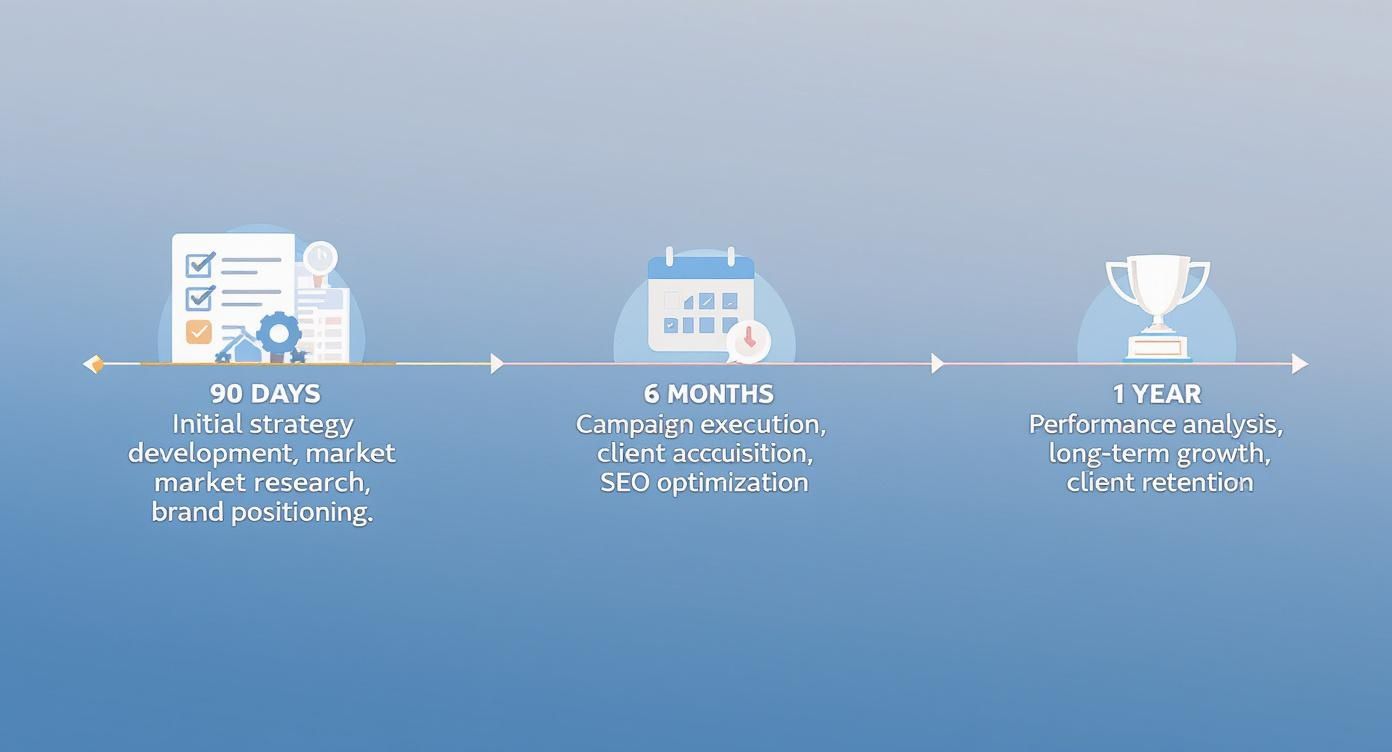
As you can see, the foundational work in the first 90 days is what makes the campaign acceleration at the six-month mark possible. It all builds toward a system of sustainable growth and optimization by the end of your first year.
Answering Your Lingering Questions
Even with the best roadmap, a few questions always come up when putting a new marketing plan into action. That's perfectly normal. Let's tackle some of the most common ones we hear from Southern California law firms so you can move forward with confidence.
How Much Should We Really Be Spending on Marketing?
This is usually the first question out of the gate, and the answer isn't a one-size-fits-all number. The industry benchmark for an established firm is to set aside 2% to 5% of gross revenue for marketing. It’s a solid starting point.
But let's be realistic. If you're a newer firm or you're serious about capturing a bigger piece of the market, you have to be more aggressive. In those cases, pushing your budget to 7% or even 10% is often what it takes to build real momentum and get noticed.
Should I Hire an Agency or Keep This In-House?
This decision comes down to a simple audit of your firm's internal resources: time, expertise, and of course, money.
- Doing it in-house can work if you have someone on your team who genuinely has the skills and, just as importantly, the time to dedicate to it. The big plus here is that all the knowledge and data stay within your firm.
- Hiring an agency is about buying expertise and speed. It’s a bigger check to write, for sure, but a good legal marketing agency hits the ground running and helps you sidestep the expensive mistakes most firms make early on.
A lot of firms land on a hybrid model that works beautifully. They'll handle the day-to-day stuff like posting on social media internally, but outsource the highly technical work like SEO and Google Ads to specialists who live and breathe that stuff.
When Will I Actually Start Seeing Results?
Patience is a virtue, especially in marketing. Different channels work on completely different clocks, and understanding this from the start will save you a ton of frustration.
Don't mistake a lack of immediate results for a lack of progress. SEO is a long-term investment that builds on itself, while paid ads offer instant feedback. Understanding this difference is key to staying the course with your marketing plan.
Here’s a realistic breakdown of what to expect:
- PPC / Paid Ads: This is your instant-gratification channel. You can see clicks, calls, and leads coming in within days, sometimes even hours, of launching a campaign. It's built for speed.
- SEO & Content Marketing: This is the long game. You’re building an asset. It realistically takes 6 to 12 months to see significant, needle-moving growth in organic traffic and leads. The foundational work you do in the first few months is what pays off down the road.
How Do I Know If Any of This is Actually Working?
Forget about vanity metrics like website visits or how many followers you have. You know your marketing is working when you can answer one simple question: "What is my Client Acquisition Cost (CAC)?"
That's it. That's the whole game.
You need to track your Cost Per Qualified Lead (CPQL) and your overall CAC for every single marketing channel you use. When you can look at a report and say, "We spent $1,000 on Google Ads last month and signed three new cases worth $15,000," you know it's working. If you can't connect the dots between spending and signing, you're just guessing.
At Case Quota, we take the guesswork out of legal marketing. We build data-driven strategies that deliver measurable results, helping Southern California law firms attract a predictable stream of high-value cases. If you’re ready to implement a marketing plan that truly grows your firm, let's talk.