

Let's be blunt: waiting for referrals to grow your law firm is a strategy from a bygone era. In today's market, the most direct and predictable path to a steady stream of high-value cases is a smart Search Engine Marketing (SEM) plan.
When a potential client desperately needs a lawyer, where do they go first? Google. SEM is what gets your firm in front of them at that exact moment of need.
Why SEM Is No Longer Optional for Your Law Firm
Think of the internet as the world's biggest courthouse, packed with people actively searching for legal help. In that chaotic environment, SEM is like having the prime corner office right by the front door.
When someone frantically searches for a "DUI lawyer near me" or a "trust and estate attorney," your firm is the first one they see, ready to help. That immediate, top-of-page visibility is the raw power of SEM.
SEM is the overarching discipline of getting traffic from search engines. It’s a two-pronged attack:
- Search Engine Optimization (SEO): This is the long game. You’re earning organic, unpaid visibility by methodically improving your website's content, authority, and technical structure. It builds lasting value.
- Pay-Per-Click (PPC): This is the advertising side. You pay for prominent ad placements at the very top of the search results, generating immediate traffic and leads. It delivers results now.
The Power of Being Seen First
The competition for a client's attention online is brutal. And make no mistake, that's where the clients are. An overwhelming 96% of people now start their search for legal advice online.
This shift in behavior is why savvy law firms are pouring about 65% of their marketing budgets into digital channels. A well-built PPC campaign puts you directly in the path of a highly motivated client. They aren't just browsing; they have a real problem and are actively looking for the person who can solve it. This makes your ad spend incredibly efficient.
SEM isn’t just another line item in your marketing budget. It's a direct investment in your firm’s client acquisition machine. By putting your practice at the top of the search results, you capture high-intent leads before your competitors even know they exist.
To really understand how these two pieces fit together, let’s look at them side-by-side.
SEM vs SEO at a Glance for Law Firms
| Attribute | SEM (Paid Search / PPC) | SEO (Organic Search) |
|---|---|---|
| Primary Role | Generate immediate leads and website traffic. | Build long-term authority, trust, and brand presence. |
| Speed to Results | Almost instantaneous. Ads can go live in hours. | Slow and steady. Can take 6-12+ months to see significant results. |
| Cost Structure | Direct cost. You pay Google for every click on your ad. | Indirect cost. You invest in content, link building, and technical expertise. |
| Position on Page | At the very top of search results, marked as "Sponsored." | Below the paid ads, in the "organic" listings. |
| Best For | Quickly testing new markets, driving leads for high-value cases. | Establishing your firm as a thought leader and creating a sustainable asset. |
PPC gets the phone ringing tomorrow. SEO makes sure it keeps ringing five years from now without you having to pay for every single click.
SEM Is a Core Part of Your Growth Strategy
While this guide dives deep into the paid advertising side of SEM, it's critical to see the bigger picture. PPC and SEO are two sides of the same coin.
PPC gives you immediate results and invaluable data on what keywords convert into actual cases. A strong SEO foundation builds your firm's long-term credibility and eventually lowers your reliance on ad spend. The most successful firms don't choose one or the other—they integrate them into a comprehensive law firm marketing strategy.
Ultimately, a serious investment in SEM allows your firm to dominate the search results, making you the obvious choice for clients in your practice area and city.
Building a Winning PPC Campaign Structure
A successful Pay-Per-Click (PPC) campaign starts with a rock-solid foundation. Just like you wouldn't build a legal case on a mountain of disorganized evidence, your Google Ads account needs a logical, clean structure to have any chance of performing.
This isn't just about being tidy. How you organize your campaigns directly impacts your results, your relevance, and ultimately, how much you pay for every single click.
The Legal Case File Analogy for PPC
Let's make this practical by using an analogy you already know inside and out: organizing a major case file. You wouldn't just toss every document, photo, and deposition into one giant folder and hope for the best. You'd create a clear, tiered system. Your Google Ads account needs that same discipline.
- Campaigns (The Case File): Think of a campaign as the top-level container for a broad practice area. For a family law firm, you might have separate campaigns for "Divorce," "Child Custody," and "Prenuptial Agreements."
- Ad Groups (The File Folders): Inside each campaign, ad groups act like individual file folders that organize specific themes. Within your "Divorce" campaign, you could have ad groups like "Contested Divorce," "Uncontested Divorce," and "Spousal Support."
- Keywords & Ads (The Documents): Finally, inside each ad group are the core documents—the keywords potential clients are actually typing into Google and the ads they see. The "Contested Divorce" ad group would hold keywords like “contested divorce lawyer Los Angeles” and ads written specifically for someone facing that difficult situation.
This granular structure is what makes the whole system work. It ensures a potential client searching for a high-conflict divorce lawyer sees an ad about that specific service, not a generic "family law" message. This relevance is the key to a higher Quality Score, which is how Google rewards well-organized campaigns with lower costs and better ad positions.
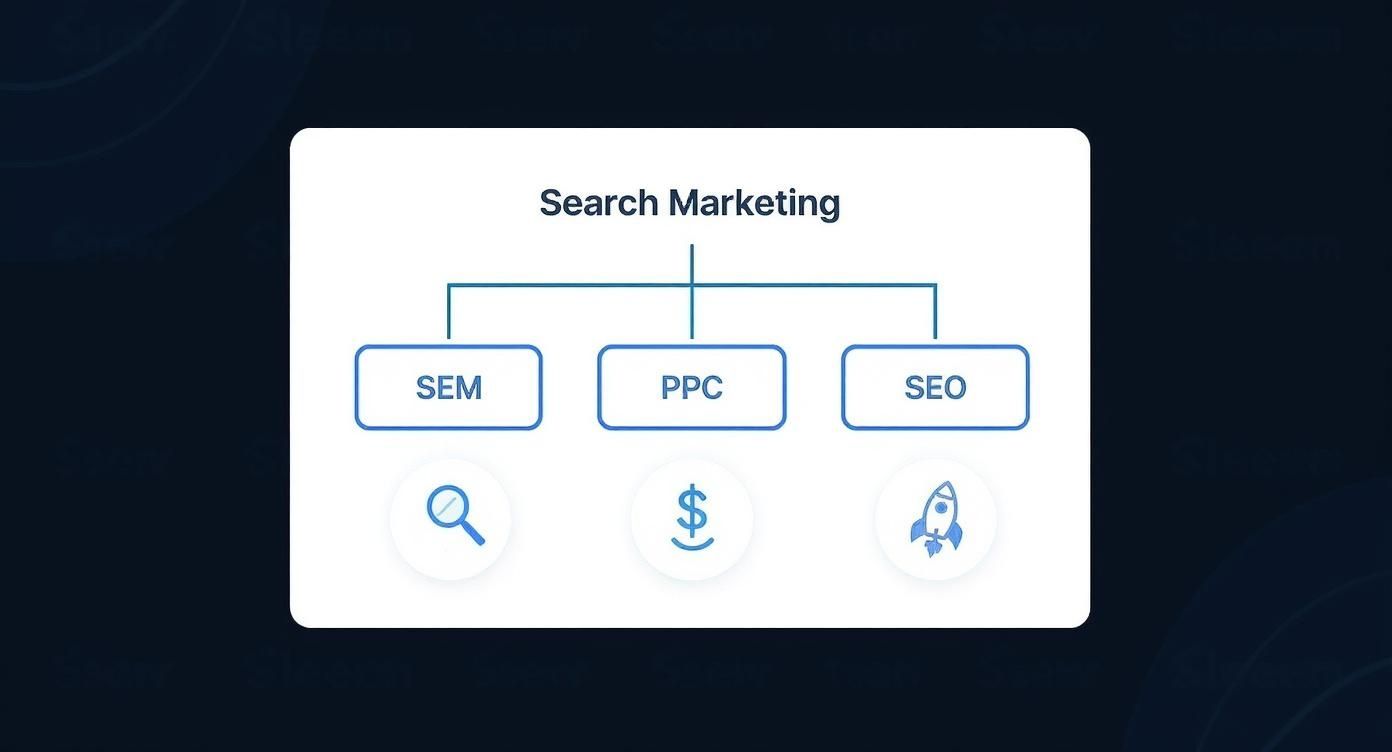
As you can see, PPC is a core component of a complete Search Engine Marketing (SEM) plan, working hand-in-hand with SEO to dominate your firm's online visibility.
Structuring Campaigns by Client Intent
The most effective way to organize your ad groups is by thinking about client intent. You want to match your ad's message as closely as possible to what the searcher is thinking at that exact moment. Getting this alignment right is what turns a click into a phone call. For a deeper look at the nuts and bolts, you can learn more about what Google Ads are and how the auction works.
Let's apply this to another practice area.
A personal injury firm might structure its account this way:
Campaign: Car Accidents
Ad Group 1: "Car Accident Lawyer" (Keywords: car accident lawyer near me, auto accident attorney)
Ad Group 2: "Truck Accident Lawyer" (Keywords: 18-wheeler accident lawyer, semi truck accident attorney)
Ad Group 3: "Motorcycle Accident Lawyer" (Keywords: motorcycle crash lawyer, bike accident attorney)
Each of these ad groups contains its own tightly-themed set of keywords and ads written just for them. The ad shown to someone searching for a truck accident lawyer will speak directly to the complexities of commercial vehicle litigation. That specificity makes it far more likely to get the click than a generic "personal injury" ad ever would.
This meticulous organization is the secret to running profitable SEM for lawyers. It allows you to control your budget with precision, deliver hyper-relevant messaging, and ultimately attract more of the high-value cases your firm is built to handle. Invest the time upfront to build a logical campaign structure, and you'll set the stage for a much stronger return on your marketing dollars.
Mastering Keyword Strategy in Competitive Legal Niches
Think of keywords as the bridge connecting a potential client’s problem to your firm’s solution. Get this right, and you attract the exact cases you want. Get it wrong, and you're just lighting your marketing budget on fire with nothing to show for it. It's that simple.
The legal space is one of the most brutal advertising arenas online. It’s not an exaggeration to say that by 2025, certain legal keywords have shot up to an eye-watering $1,000 per click. We've seen high-value, competitive searches like 'Baton Rouge truck accident lawyer' hit that peak, which shows just how fierce the competition has become.
When clicks cost that much, a smart, deliberate keyword strategy isn't just a good idea—it's the only way to survive. You absolutely cannot afford to waste a single dollar on a click from someone who isn't a real potential client. The whole game is about moving past the obvious, broad keywords and digging into what a searcher truly intends to do.
Uncovering High-Intent Keywords
Bidding on a broad term like "lawyer" is a rookie mistake. It’s not only insanely expensive, but it also attracts a crowd of people who aren’t looking to hire anyone—they might be students, researchers, or just curious. Your mission is to find the phrases that signal someone is actively looking for representation.
This is where long-tail keywords come in. They're longer, more specific phrases that reveal a user's true intent.
Instead of fighting over "personal injury lawyer," you pivot to more targeted, valuable searches.
- Geographically Specific: "car accident lawyer Santa Monica"
- Case-Specific: "statute of limitations for medical malpractice in California"
- Urgency-Based: "emergency DUI defense attorney Los Angeles"
These longer phrases don't get as much search traffic, but the quality of that traffic is exponentially higher. A person typing in that level of detail isn't just kicking tires; they're deep into their search and much closer to picking up the phone. And while ranking organically takes time, understanding the fundamentals of SEO for law firms is a great way to mine for these valuable long-tail keyword ideas.
The Critical Role of Match Types
Google Ads lets you set the rules for how closely a search needs to match your keyword before your ad shows up. These rules are called match types, and using them correctly is the key to controlling your budget.
Think of match types as setting the rules of engagement. A loose match type is like casting a wide net, catching everything. A tight match type is like precision spear fishing, targeting only the most valuable prospects.
Here’s a quick rundown of how they work:
- Broad Match: Throws your ad into the ring for searches that are even remotely related to your keyword. It’s a fast way to burn cash, so use it with extreme caution.
- Phrase Match: Shows your ad for searches that include the meaning of your keyword. This gives you a great balance between reaching enough people and maintaining control.
- Exact Match: Your ad only appears for searches with the same meaning or intent as your keyword. It offers the most control but has the narrowest reach.
For nearly every law firm, starting with a mix of Phrase Match and Exact Match is the smartest path forward. It ensures your ad spend is focused on truly relevant searches from day one.
Eliminating Waste with Negative Keywords
What you don't show up for is just as important as what you do. A negative keyword tells Google Ads, "If a search contains this word, do not show my ad."
This is your number one tool for plugging leaks in your budget. The most common negative keywords for law firms are terms that scream "I am not a client."
- free
- pro bono
- cost
- paralegal jobs
- law school
- research
Adding these to a shared negative keyword list is a non-negotiable step. It guarantees that someone searching for "free personal injury advice" never even sees your ad, let alone clicks on it. This one move can save your firm thousands and drastically improve the ROI of your entire campaign. Once you've defined your core terms, applying effective keyword targeting strategies becomes the crucial next step in attracting the right kind of client.
Crafting Ads and Landing Pages That Convert
Getting the right person to see your ad is just step one. You’ve nailed the keyword and targeting, but if that click doesn't immediately become a phone call or a consultation request, you’ve wasted your money. This is where the real work begins—mastering the art and science of ad copy and landing pages that actually turn clicks into clients.

Think of it like a chain. The journey from a frantic Google search to a signed retainer has two critical links: the ad itself and the page they land on after they click. If either one breaks, the whole campaign falls apart.
Writing Ad Copy That Builds Immediate Trust
Your ad is your digital handshake. It’s your first impression, and you only have a few lines of text to convince a potential client—often in a moment of crisis—that you are the one who can help.
Your ad copy has to do a few things at once, and it has to do them well:
- Speak Their Language: If someone searches for an "aggressive criminal defense attorney," your headline better reflect that. Mirror their intent.
- Offer Hope and Urgency: Use action-oriented phrases. Words like "Free Consultation," "24/7 Availability," or "Get Help Now" connect with people who need immediate answers.
- Showcase Your Authority: Mentioning years of experience, a big case result, or a specific specialization builds instant credibility and sets you apart from the competition.
Remember, you aren't just selling legal services. You're selling confidence and a path forward. Every single word needs to support that goal while staying compliant with your local bar's advertising rules.
Why Your Homepage Is the Wrong Destination
This is one of the most common—and expensive—mistakes law firms make. Never, ever send paid ad traffic to your homepage. Your homepage is built for a general audience. It's cluttered with navigation menus, blog posts, and links to every practice area you cover.
Sending a potential client from a hyper-specific ad to a generic homepage is like answering their direct question with a 300-page legal textbook. It creates friction, confusion, and almost guarantees they will click the back button.
This is exactly why dedicated landing pages exist. A landing page has one job: get that visitor to contact you. Period.
To turn those expensive clicks into real leads, you have to master the lead capture landing page by optimizing it for a seamless, high-conversion user experience.
The Anatomy of a High-Converting Legal Landing Page
A great landing page is all about focus. It strips away all the distractions—no main menu, no links to other pages, just a single, clear path to action. It’s a core principle of any web design for an attorney that’s serious about generating cases.
Here are the must-have components:
- A Powerful, Benefit-Driven Headline: It should echo the promise made in your ad.
- Prominent Trust Signals: Client testimonials, awards, bar association logos, and big case results need to be visible the second the page loads.
- A Simple Contact Form: Keep it short. Only ask for the absolute essentials: name, email, phone, and a quick message.
- A Clear Call-to-Action (CTA): The button should be impossible to miss, with compelling text like "Schedule Your Free Case Review."
With Google fielding over 92.8% of all search queries in 2025, getting these conversion points right is absolutely critical. Since around 87% of potential clients now use Google to find a lawyer, your ad and landing page are your primary tools for capturing your share of the market.
Optimizing Your Budget and Targeting for Maximum ROI
Getting clicks is easy. Getting profitable cases from those clicks? That’s where the real work begins.
A winning SEM strategy for lawyers isn't about getting the most traffic; it's about getting the right traffic. This means putting every dollar where it has the best chance of finding someone who can actually become a client. Wasting ad spend on unqualified searchers is the fastest way to burn through your marketing budget with nothing to show for it.
Think of your ad budget like a high-stakes investment portfolio. You wouldn't just throw money at random stocks and hope for the best. You’d target specific, high-potential opportunities. Geographic targeting is how you do that with your ads, focusing your investment only in the specific areas where your ideal clients live and work.
This is non-negotiable for law firms. If you're licensed to practice in California, a click from someone searching in Florida is 100% wasted money. Geo-targeting is the tool that stops that waste before it happens.
Pinpoint Your Clients with Geo-Targeting
Google Ads gives you a surprisingly powerful set of tools to control where your ads show up. Don't just set your campaign to "California" and call it a day. You need to get way more specific.
To really maximize your budget, you have to get granular:
- City & County Targeting: This is the baseline. Focus your spend on the core metro areas you actually serve.
- ZIP Code Targeting: This is where it gets interesting. Targeting affluent ZIP codes is a classic move for estate planning or high-asset divorce cases.
- Radius Targeting: Perfect for capturing clients who value convenience. You can draw a 15- or 20-mile circle right around your office.
The real magic happens when you layer these options. A personal injury firm in Santa Monica might target all of Los Angeles County but then strategically exclude ZIP codes known to have lower-value cases that can't support the sky-high cost of a PI click. Exclusion is often just as powerful as inclusion.
How to Budget for High-Value Cases
"So, how much should my firm spend on Google Ads?" It’s the million-dollar question, and the honest answer is: it completely depends on what a new case is worth to you.
Instead of pulling a number out of thin air, you have to work backward from your goals.
Stop thinking of your PPC budget as a marketing expense. It’s an investment in acquiring new business, and it should have a measurable return. The key is to figure out your target Cost Per Acquisition (CPA)—the absolute most you’re willing to spend to sign a new case and still be profitable.
Let's walk through it. Say a single personal injury case brings in an average fee of $25,000. You run the numbers and decide you're comfortable spending up to $5,000 to land that client.
Just like that, your target CPA is $5,000.
That one number changes everything. It becomes the North Star for your entire campaign, guiding your keyword bids, your ad copy, and your landing page strategy. Your budgeting is no longer guesswork; it’s a data-driven business decision that lets you confidently invest in campaigns that generate a clear, positive ROI.
With your target CPA in mind, you can start to build a monthly budget. The right number depends heavily on your practice area and the level of competition in your market. For a major metro area like Los Angeles or Orange County, the budgets can be substantial.
Here’s a look at some illustrative starting points to give you a clearer picture of the investment required to compete effectively.
Table: Sample Monthly PPC Budget Ranges by Practice Area
| Practice Area | Starting Budget (Monthly) | Competitive Budget (Monthly) | Aggressive Budget (Monthly) |
|---|---|---|---|
| Personal Injury | $10,000 | $25,000 – $50,000 | $75,000+ |
| Criminal Defense | $5,000 | $10,000 – $20,000 | $30,000+ |
| Family Law | $5,000 | $15,000 – $25,000 | $40,000+ |
| Estate Planning | $3,000 | $7,500 – $15,000 | $20,000+ |
| Employment Law | $7,500 | $20,000 – $35,000 | $50,000+ |
These ranges reflect the reality of competitive legal markets. A "Starting" budget will get your foot in the door, while an "Aggressive" budget is necessary for firms aiming to dominate the top search results for the most valuable keywords.
Measuring Success and Continuously Improving Campaigns
Launching an SEM campaign for your law firm is just the starting line. The real path to a profitable client acquisition engine lies in a constant cycle of measurement, analysis, and strategic refinement.
Simply “setting and forgetting” your ads is a surefire way to waste your budget and fall behind competitors.
Think of it this way: a successful campaign is like a living case file. You don't just gather the initial evidence and head to court. You continuously review new information, adapt your strategy, and refine your arguments to build the strongest possible case for a win. Your SEM efforts demand the same diligent, ongoing attention.

Defining and Tracking Your Conversions
Before you can measure success, you have to define what a "win" actually looks like for your firm. In legal marketing, a click isn't a win; a new client inquiry is. This makes setting up precise conversion tracking the most critical first step you can take.
Your primary goal is to measure the actions that directly lead to potential new cases.
- Phone Calls: For many practice areas, this is everything. Tracking calls from your ads and landing pages is essential, as potential clients in a moment of crisis want to speak directly with someone.
- Form Submissions: Every single "Free Case Evaluation" or "Contact Us" form fill must be tracked as a conversion. No exceptions.
- Live Chat Initiations: If you offer live chat, tracking each new conversation gives you another valuable data point on what’s working.
Without this data, you’re flying blind. You have no way of knowing which keywords, ads, or ad groups are actually making the phone ring and filling your inbox. This foundational step is central to measuring advertising effectiveness and justifying your ad spend.
Interpreting Key Performance Indicators
Once your conversion tracking is locked in, you can start analyzing the metrics that truly matter. It's easy to get lost in vanity metrics like impressions; you have to focus on the data that directly impacts your bottom line.
Your key performance indicators (KPIs) are the vital signs of your campaign's health. They tell you what's working, what's broken, and where your greatest opportunities for improvement lie.
Keep a close eye on these essential KPIs:
- Conversion Rate: What percentage of clicks result in a call or form fill? A high conversion rate means your ads and landing pages are hitting the mark and persuading visitors to take that next step.
- Cost Per Acquisition (CPA): This is the ultimate metric. It tells you exactly how much you're paying, on average, to generate one new lead. Your goal is to drive this number as low as possible while keeping it well below the average value of a new client.
- Click-Through Rate (CTR): This measures how often people who see your ad actually click it. A strong CTR is a clear signal that your ad copy is compelling and hyper-relevant to what people are searching for.
Powerful Optimization Tactics for Better Results
Armed with this data, you can begin the real work: continuous optimization. This is where you transform an average campaign into a predictable client-generating machine.
One of the most effective tactics is A/B testing. This is as simple as creating two slightly different versions of an ad to see which one performs better. You could test one headline against another or try different calls to action to find the language that truly resonates with your ideal client.
Another crucial strategy is remarketing. This allows you to show targeted ads to people who have already visited your website but didn't convert. By staying in front of these potential clients as they continue their search, you dramatically increase the chance they’ll come back to your firm when they're finally ready to make a decision.
Common Questions We Hear From Law Firms
Stepping into paid search can feel like a big move. It’s totally normal to have questions about the money, the timeline, and the resources involved. Let's tackle the big ones we hear from lawyers all the time, so you can get a clear picture of what the investment really looks like.
What's a Realistic SEM Budget for My Firm?
There's no one-size-fits-all answer here. The right budget really boils down to your practice area, your city's competitiveness, and how fast you want to grow.
For a firm in a less crowded market, you might start seeing some traction with a budget around $2,000-$3,000 per month.
But let's get real. If you're a personal injury firm trying to make a dent in Los Angeles, you'll likely need $15,000 or more each month just to get in the game for the most valuable keywords. The smartest way to think about it is to work backward. Figure out what a new client is worth to you, then set a target Cost Per Acquisition (CPA) that keeps every dollar you spend profitable.
How Long Does It Take to Get Results From PPC?
This is where paid search really shines, especially compared to the long game of SEO. Once your campaigns go live, you can start seeing traffic and potential leads almost immediately. That instant visibility is a huge advantage.
But there's a difference between "traffic" and "profitable results." You should expect it to take about three to four months to dial things in and achieve a consistent, positive Return on Investment (ROI). That initial period is all about gathering data—we're testing keywords, tweaking ad copy, and optimizing bids to find out exactly what makes potential clients in your specific niche click and call.
Should I Run Google Ads Myself or Hire an Agency?
Look, you absolutely can manage your own Google Ads campaigns. But the legal space is one of the most brutal and expensive advertising arenas online. It’s incredibly easy to make a small mistake—like using the wrong keyword match type—that torches thousands of dollars in ad spend before you even realize it.
For the vast majority of law firms, hiring an agency that specializes in legal marketing is the most cost-effective decision. A good agency isn't just a campaign manager; they're a strategic partner who already knows how to navigate:
- The sky-high Cost-Per-Click (CPC) bids that are common for legal keywords.
- The complex web of bar association advertising rules and compliance issues.
- Advanced tracking and optimization that goes far beyond the basics.
Bringing in that specialized expertise almost always leads to a much better ROI than going it alone. It also frees you up to do what you do best: practice law and handle the new cases coming in.
Ready to turn clicks into clients with an SEM strategy built for real-world results? The team at Case Quota has been helping Southern California law firms dominate search and land high-value cases for over 15 years. Schedule your free consultation today.