

Retargeting is a way to get a second chance with potential clients who’ve already checked you out online. Think of it as a digital follow-up. Someone visits your law firm’s website, pokes around, but then leaves without calling or filling out a form. Instead of letting them vanish, retargeting allows you to show them your ads again as they browse other parts of the internet. It’s a gentle, persistent reminder that keeps your firm top-of-mind.
Your Second Chance To Re-Engage Potential Clients
Imagine someone in need of legal advice walks into your office. They ask a few questions, take your business card, and say they’ll think about it. You wouldn’t just let that lead go cold, would you? Of course not. You’d follow up. That's exactly what is retargeting in digital marketing—it’s the digital version of that crucial second conversation.
The path to hiring a lawyer is rarely a straight line. A potential client might visit five different law firm websites, read dozens of reviews, and talk to friends before making a decision. During this critical research phase, your firm can easily get lost in the noise. Retargeting cuts through that by making sure your ads pop up while they’re on Facebook, reading the news, or watching videos on YouTube.
Why This Follow-Up Matters
The beauty of this strategy is that you’re not shouting into the void. You're talking to a “warm” audience—people who already know who you are and what you do. They’ve already shown interest by visiting your site, which means they are far more likely to engage with your ads.
It's no surprise that the click-through rate (CTR) on a retargeted ad is often 10 times higher than a standard display ad. That's the power of connecting with an audience that's already familiar with your brand.
This constant, subtle presence builds familiarity and trust. It reminds potential clients about the solutions you offer and positions your firm as the obvious choice when they're finally ready to take action. To really get a handle on this, it's worth understanding the fundamentals of what is retargeting in marketing before going any further.
At the end of the day, retargeting turns a fleeting website visit into an ongoing conversation. By staying visible, you dramatically increase the chances of converting that curious browser into a signed client, making it a cornerstone of any serious attorney lead generation plan.
How Retargeting Technology Actually Works
Ever wonder how an ad for a law firm you just visited seems to follow you around the internet? It’s not magic; it’s retargeting, and it’s simpler than you might think.
Think of it as a digital breadcrumb. When a potential client lands on your website, a small, completely anonymous piece of code—often called a pixel or cookie—is placed on their web browser. This code is harmless. It doesn’t store any personal data like names or emails. It just acts as a simple marker that says, "This person visited."
This all happens instantly and behind the scenes. For example, if someone clicks on your "Car Accident Lawyer" page, a pixel specific to that page "fires." That one action adds their anonymous browser ID to a specific audience list you can build, which you might call "Auto Accident Interest." Now, you have a way to reconnect with them.
It's a straightforward three-step dance: a person visits, they leave, and then you re-engage them with a relevant ad on another site.
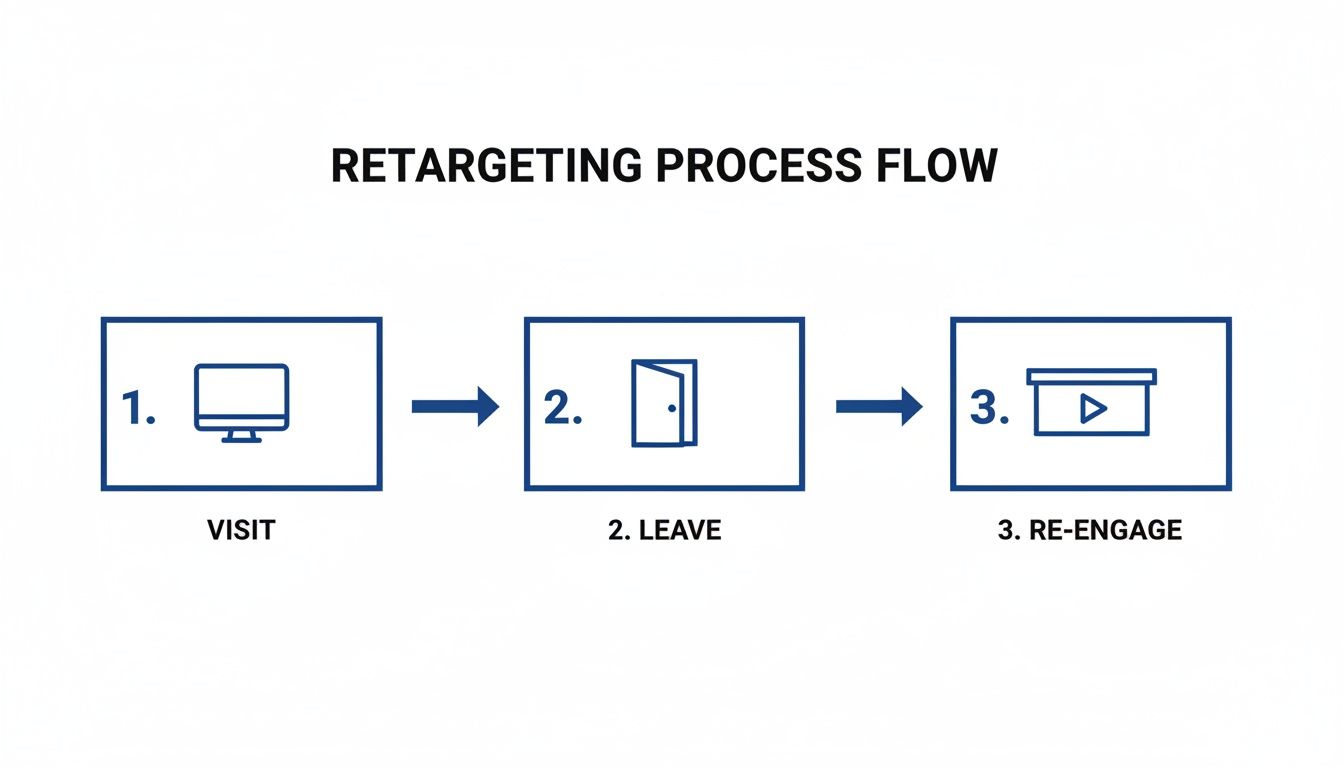
This process turns a fleeting visit into a genuine second chance to make your case.
Pixel-Based vs. List-Based Retargeting
The core idea of retargeting splits into two main methods. Knowing when to use each is what separates a good strategy from a great one.
First up is pixel-based retargeting, which is the most common approach and builds on the "digital breadcrumb" concept.
- How it Works: The pixel tracks anonymous users as they move through your website.
- Best For: Reaching warm but uncommitted leads who browsed your practice area pages or attorney bios but never filled out a form.
- Legal Example: Someone spends five minutes reading several of your blog posts on bankruptcy. You can then show them ads across the web featuring a free guide titled "5 Myths About Filing for Bankruptcy."
This method is incredibly powerful because you’re tailoring the message based on exactly what the user has shown interest in. It keeps your firm top-of-mind while they are still in the research phase.
The second method is list-based retargeting. This technique doesn't rely on anonymous web traffic. Instead, it uses contact information you already have in your possession.
With list-based retargeting, you upload a list of email addresses or phone numbers—from past clients, newsletter sign-ups, or webinar attendees—directly into a platform like Google or Meta. The platform then securely matches that information to user profiles and shows your ads only to them.
This approach is perfect for nurturing existing relationships. A 2025 study from DemandSage found that a massive 77% of marketers run retargeting campaigns specifically to win back visitors, proving its value in bringing potential clients back into the fold.
Here’s a real-world scenario for a law firm:
- Audience: You have an email list of people who attended your business formation seminar last year.
- Action: You upload this list of emails into LinkedIn's ad platform.
- Campaign: You run a hyper-targeted ad promoting a "Business Legal Health Check-Up" service, speaking directly to a primed and relevant audience.
While pixel-based retargeting is about turning browsers into leads, list-based retargeting is all about deepening existing connections and generating referrals. Both are essential for a complete marketing funnel, especially when paired with powerful platforms like Google Ads. To get a better handle on this, take a look at our comprehensive guide on Google Ads for lawyers.
Choosing the Right Retargeting Strategy for Your Law Firm
Let's be clear: not every person who visits your website is the same. Someone who glances at your homepage for five seconds is in a completely different headspace than someone who spends ten minutes reading through your "Child Custody Services" page.
If you treat them the same, you’re wasting your money. The key is choosing a retargeting strategy that matches their intent, making your follow-up feel relevant and helpful, not intrusive.

When you understand the main types of retargeting, you can stop shouting generic ads into the void. Instead, you can start having quiet, targeted conversations based on what potential clients have already shown you they care about.
Let’s break down the most powerful approaches for law firms.
Site Retargeting: The Foundational Follow-Up
This is the classic, most straightforward strategy. Site retargeting simply shows your ads to anyone who has visited your website, regardless of which specific pages they saw. It’s your digital billboard, designed to keep your firm top-of-mind.
The goal here isn't surgical precision; it's about maintaining general brand awareness with an audience that's already warm.
- Who It's For: General website visitors who left without calling, emailing, or filling out a form.
- Law Firm Example: A personal injury firm runs a simple, professional ad across the web that says, "Hurt in an Accident? The Team at [Firm Name] is Here to Help." This ad follows everyone who visited their site in the last 30 days, serving as a gentle, persistent reminder.
It works because that initial curiosity is a valuable signal. By staying visible, you dramatically increase the odds that when that person is finally ready to make a call, your firm is the first one they think of.
Search Retargeting: Capturing High Intent
Now we’re getting more sophisticated. Search retargeting, often called remarketing lists for search ads (RLSAs) on Google, is a potent mix of past engagement and current intent.
Here’s how it works: you show search ads only to people who have previously been on your website when they go back to Google to search again. You're hitting them at the exact moment their need becomes urgent.
By layering your previous website traffic with active search behavior, you connect with an audience that has demonstrated clear and immediate intent. It's one of the most efficient ways to convert a considered lead.
Imagine someone visits your criminal defense site but doesn't call. A week later, they search for "DUI lawyer near me." With search retargeting, you can bid more aggressively to ensure your ad is right at the top, just for them. It’s a powerful second chance to capture a high-value lead.
Social Media Retargeting: Building Relationships
Your firm's social media isn't just for posting updates; it's a platform for building trust and rapport. Social media retargeting lets you continue the conversation with people who have engaged with your firm on platforms like Facebook, Instagram, or LinkedIn.
This audience includes people who have liked a post, watched one of your videos, or visited your firm's profile. You can then serve them ads directly in their feeds—a place where they're already relaxed and scrolling. It feels less like an ad and more like a natural part of their online experience. For a deeper dive, check out our guide on social media advertising for lawyers.
- Who It's For: Users who have engaged with your social media profiles, posts, or ads.
- Law Firm Example: An estate planning attorney posts a video on Facebook explaining the importance of a will. They can create an audience of everyone who watched more than 50% of the video and show them a follow-up ad offering a "Free Estate Planning Checklist."
Dynamic Retargeting: The Ultra-Personalized Approach
This is the most advanced—and most personal—strategy. Dynamic retargeting automatically shows people ads featuring the exact service or practice area they just viewed on your website.
For a multi-practice law firm, this is a total game-changer. Instead of showing a generic ad about your firm, you deliver an ad that speaks directly to a user's specific, pressing legal need. It proves you were listening.
- Who It's For: Visitors who viewed specific practice area pages on your site (e.g., bankruptcy, family law, business litigation).
- Law Firm Example: Someone spends time on your immigration law firm's page about H-1B visas. A few hours later, they see an ad in their news feed featuring content specifically about H-1B visa applications and your firm's success stories. That level of relevance is impossible to ignore.
To make these options clearer, let's compare them side-by-side.
Comparing Retargeting Strategies for Law Firms
Choosing the right tool for the job is everything. This table breaks down which strategy to use based on your goals and your audience's behavior.
| Strategy Type | Best Use Case for Law Firms | Target Audience | Primary Platforms |
|---|---|---|---|
| Site Retargeting | General brand awareness and staying top-of-mind after an initial visit. | All website visitors. | Google Display Network, Meta |
| Search Retargeting | Capturing high-intent leads who are actively searching again for legal help. | Past website visitors currently searching on Google. | Google Ads |
| Social Media Retargeting | Nurturing relationships and building trust with an engaged audience. | Users who liked, shared, or watched your social media content. | Meta (Facebook/Instagram), LinkedIn |
| Dynamic Retargeting | Delivering hyper-relevant ads based on specific practice areas viewed. | Visitors who viewed specific service or practice area pages. | Google Display Network, Meta |
Ultimately, the most effective campaigns often blend these strategies. You might use site retargeting for general awareness while running a highly-focused search retargeting campaign to capture those ready-to-hire leads.
Building Your High-Converting Retargeting Campaign
Launching a powerful retargeting campaign is a lot like building a solid legal case—it demands a sharp strategy, precision, and a real understanding of your audience. Just throwing the same generic ad at every person who ever visited your website is a surefire way to burn through your budget and miss out on serious opportunities.
The secret to a high-converting campaign lies in audience segmentation. It’s all about breaking down your website visitors into smaller, more specific groups based on what they actually did on your site. When you do this, you can fine-tune your messaging to connect with their specific needs and where they are in their journey, gently guiding them from a curious browser to a confirmed client.

This segmented approach makes your ads feel less like a random interruption and more like a helpful, timely reminder. For potential clients, that small difference is huge for building trust.
Creating Powerful Audience Segments
First things first, you need to identify your most valuable visitor groups. Instead of lumping everyone into one giant, one-size-fits-all audience, think about creating segments that show different levels of intent. For law firms, these are some of the most effective segments to start with:
- Practice Area Viewers: This is anyone who landed on a specific service page, like "Family Law" or "Business Litigation." They’ve already told you what they need, making them prime candidates for highly relevant ads.
- Blog Readers: These folks engaged with your articles or guides. They’re likely in the early research phase, looking for an expert they can trust.
- Contact Page Abandoners: This is your highest-intent audience, period. They were this close to reaching out but got sidetracked. All they need is one final, compelling nudge to take that next step.
By separating these groups, you can craft messages that speak directly to their part of the story. That personal touch is what turns a good campaign into a great one.
Crafting Ad Copy That Resonates
Once your segments are defined, it’s time to create ad copy and visuals that actually speak to each group. Generic messaging is a complete waste of time here. Your ads absolutely must acknowledge their previous interaction and offer something genuinely valuable.
For example, you could show your "Blog Readers" an ad for a downloadable guide on a related legal topic. But for someone who browsed your "Personal Injury" page, an ad featuring a powerful client testimonial or a recent case win in that exact practice area will be far more impactful.
Here’s a practical breakdown for each segment:
- For Practice Area Viewers: Show them an ad that hammers home your expertise in that specific area. An ad that says, "Successfully Handled 500+ DUI Cases in Southern California," is light-years more effective than a generic firm ad.
- For Blog Readers: Nurture their interest by giving them more value. Offer a free webinar, a detailed case study, or a helpful checklist related to the topic they were just reading about.
- For Contact Page Abandoners: This group needs a direct, clear, and reassuring call to action. An ad with copy like, "Ready to Discuss Your Case? Schedule a Confidential Consultation Today," removes friction and encourages them to finish what they started. For more ideas on how to improve these crucial pages, you might be interested in our guide to website optimization for law firms.
Essential Best Practices for Legal Retargeting
Beyond segmentation and messaging, a few core principles will protect your budget and your firm's reputation. One of the most important is frequency capping. This setting limits how many times a single person sees your ad in a given timeframe. Bombarding someone with the same ad 20 times a day isn't persuasive; it's annoying and can seriously damage how people perceive your brand.
A good starting point is to cap impressions at 3-5 views per user per day. This keeps you top-of-mind without becoming a nuisance.
Additionally, platform-specific details matter. On Google Ads, you'll want to focus on Remarketing Lists for Search Ads (RLSAs) to recapture high-intent users actively searching again. For Meta (Facebook and Instagram), use compelling visuals and client testimonials to build social proof and trust. And on LinkedIn, you can get incredibly specific, targeting past website visitors who also fit professional criteria, like "Business Owners" or "HR Managers."
This strategic approach really works. Research shows that 3 out of 4 online viewers notice and consider retargeted ads, which confirms that these reminders genuinely influence their decision-making. For firms in competitive markets, where potential clients are absolutely researching multiple attorneys, this kind of persistent, helpful visibility is a massive advantage.
By combining smart segmentation, tailored messaging, and these essential best practices, you can build a retargeting campaign that not only recaptures attention but also effectively converts interested prospects into paying clients.
For a law firm, trust isn't a marketing gimmick—it’s the absolute foundation of the attorney-client relationship. While retargeting is a powerful way to stay on a potential client's radar, it demands the highest degree of care. When you're dealing with sensitive legal matters, even a small advertising misstep can feel like a breach of confidentiality, causing irreparable damage to your firm's reputation.
Navigating the web of ethical and privacy rules is about more than just dodging fines. It's about upholding your professional integrity. This means truly understanding and respecting new privacy laws, sticking to the letter of attorney advertising rules, and above all, protecting the confidentiality of potential clients.
Adhering to Privacy Laws Like CPRA
Modern privacy regulations, like the California Privacy Rights Act (CPRA), have completely changed the game for how businesses—law firms included—collect and use consumer data. These laws empower people, giving them the right to know what information is being collected, to opt out of it being shared, and to ask for it to be deleted.
For your retargeting campaigns, this boils down to being completely transparent.
- Clear Cookie Consent: Your website needs a straightforward, easy-to-find cookie banner. It must let visitors choose to opt in or out of tracking before any pixels fire. No exceptions.
- Updated Privacy Policy: Your policy has to explicitly mention that you use tracking technologies for advertising and clearly explain how people can exercise their privacy rights.
- Respecting User Choice: If someone opts out of tracking, your systems must honor that request instantly. This means they are immediately removed from all retargeting audiences.
Ignoring these rules doesn't just put you at risk of major legal penalties; it shatters the very trust you need to earn a client's business in the first place.
Upholding State Bar Advertising Rules
On top of general privacy laws, you're bound by your state bar's rules of professional conduct. These rules are there to stop any marketing that is false, misleading, or just plain sleazy. When it comes to retargeting, it means every ad has to be professional and truthful.
An ad that even hints at a guaranteed outcome or overstates your expertise is a massive ethical violation. For example, an ad banner screaming "We'll Win Your Case, Guaranteed!" is a direct breach of professional standards and could land you in hot water with the bar.
Keep your retargeted ads focused on providing value and showcasing expertise, not making wild, unsubstantiated claims. Offer helpful content, highlight your credentials, or invite them to a no-pressure consultation. That’s how you stay compliant while building real credibility.
Protecting Client Confidentiality at All Costs
This is it. The single most critical ethical line you cannot cross. The nature of legal help is intensely personal. Someone looking up a "divorce lawyer" or a "criminal defense attorney" is often in a vulnerable spot. Your retargeting must never expose their potential legal situation.
Just imagine someone using the shared family computer to research bankruptcy options. Later that day, their spouse is scrolling through their news feed and sees a hyper-specific ad: "Considering Bankruptcy? [Your Firm Name] Can Help." That's not just a marketing blunder; it's a catastrophic privacy breach with potentially devastating real-world consequences.
To avoid this disaster, follow one simple rule: keep your retargeting ads broad and professional. Focus on the firm’s brand or general practice areas, not the specific, sensitive term someone searched for. An ad promoting your firm's "20+ Years of Experience in Family Law" is both safe and effective. An ad that mentions "Child Custody Disputes" is not.
By prioritizing discretion above all else, you prove that your firm can be trusted with a potential client’s most sensitive information—long before they ever decide to pick up the phone.
Measuring Success and Proving Campaign ROI
Launching a retargeting campaign without knowing how to measure it is like going to trial without any evidence. You might feel like you're making a good case, but you have no way to prove it. To really understand the business impact of your retargeting, you have to look past the vanity metrics like clicks and impressions and zero in on the numbers that actually drive your firm's bottom line.
These are the metrics that tell a clear, undeniable story about your campaign’s financial health. They're the ones that show exactly how much it costs to bring in a new lead and, more importantly, to sign a new client.
The KPIs That Truly Matter
To get a real read on performance, you only need to track a few core financial metrics. These are the numbers that will prove the value of your ad spend to yourself, your partners, and any other stakeholders.
Here are the essential KPIs for any law firm retargeting campaign:
- Cost Per Lead (CPL): This is your ground-level truth. CPL tells you precisely how much you spent to get one potential client to fill out your contact form or call the office. You calculate it by dividing your total ad spend by the number of leads you generated.
- Client Acquisition Cost (CAC): This metric takes CPL a step further. CAC measures the total cost to acquire a new, signed client, factoring in your ad spend plus any other marketing and sales expenses involved in getting that signature.
- Return on Ad Spend (ROAS): This is the ultimate measure of profitability and the one that really gets people’s attention. ROAS reveals how much revenue your firm generates for every single dollar spent on advertising. The formula is beautifully simple: (Total Revenue from Ads / Total Ad Spend).
Honing in on these three metrics gives you a data-backed, dollars-and-cents picture of whether your campaign is a success. To dig deeper, check out our complete guide to measuring advertising effectiveness.
Using Platform Dashboards to Track Performance
The good news is you don't need a PhD in data science or expensive third-party software to monitor these KPIs. The analytics dashboards built right into platforms like Google Ads and Meta (Facebook) are incredibly powerful tools for tracking your results.
For any of this to work, you absolutely must have your platform’s pixel or tag installed correctly on your website. This little piece of code is the critical link that connects a user’s ad click to a specific action on your site, like them submitting your "Contact Us" form.
Inside your Google Ads or Meta Ads Manager dashboard, you can set up custom conversion goals that align with your firm's objectives. A classic example is creating a goal that "fires" every time a user lands on your "Thank You" page—the page they see immediately after submitting a form. Once that's set up, the platform automatically calculates your Cost Per Lead for that specific action.
By making it a habit to review these dashboards, you'll quickly see which ads, which audiences, and which messages are bringing in the most cost-effective leads. This empowers you to make smart, data-driven decisions—shifting budget toward what’s working and cutting what isn't. This constant process of optimization is exactly how you turn a good retargeting campaign into a powerful and predictable engine for client acquisition.
Of course. Here is the rewritten section, crafted to sound like it was written by an experienced human expert.
Common Questions About Retargeting for Law Firms
Even when attorneys grasp the concept of retargeting, a few practical questions almost always come up before they're ready to invest. I get it. The good news is, this strategy is far more accessible and a lot less intrusive than most people think. Let's tackle the most common concerns head-on.
Is Retargeting Affordable for a Small Firm?
Absolutely. You don't need a war chest to make this work. Most ad platforms, including Google and Meta, let you set a daily budget that can be as small as $10 or $20 per day.
The trick is to start small and be surgical. Don't try to retarget everyone who has ever visited your site. Instead, begin with a hyper-specific, high-intent audience—think about visitors who landed on your "Contact Us" page but never submitted the form. This approach funnels your initial investment toward the warmest possible leads, giving you the best shot at a strong return, even with a modest spend.
Will My Ads Annoy Potential Clients?
This is a totally valid concern, and thankfully, it's one that's entirely within your control. That creepy feeling of being "followed" by an ad comes from one thing: overexposure. To stop this from happening, every major ad platform has a built-in tool called frequency capping.
Frequency capping is simply a setting that lets you limit how many times one person sees your ad in a given timeframe (for example, no more than three times in a single day). This keeps your firm top-of-mind without becoming a digital pest.
When you pair this technical control with ads that actually offer value—maybe a link to a genuinely helpful blog post or a powerful client testimonial—your ads start to feel helpful, not harassing.
How Long Should a Retargeting Campaign Run?
The right duration really boils down to the typical client journey for your specific practice area.
For urgent, immediate-need legal issues like criminal defense or personal injury, a shorter window of 7 to 14 days is usually best. The decision-making process is compressed, and you need to stay visible during that critical, high-stakes period.
But for longer-cycle services like estate planning or business formation, you can—and should—extend that window to 30 or even 60 days. This gives you time to gently nurture potential clients who are still in the research phase, weighing their options. The goal is simple: match your campaign's timeline to your audience's natural pace.
Can I Target People Searching for My Competitors?
This is a great question, and while you can't directly retarget visitors from a competitor's website (that would be a privacy nightmare!), you can use a slick Google Ads strategy called Remarketing Lists for Search Ads (RLSAs).
Here's how it works: You can build a campaign that targets people who have already visited your website but then go back to Google to search for your competitor's firm name. This is a powerful move. It lets you capture high-intent prospects at the exact moment they are actively comparing their options, giving you a golden opportunity to win them back.
At Case Quota, we specialize in creating compliant, high-ROI retargeting campaigns built specifically for the unique needs of law firms. We manage the strategy, the tech, and the execution so you can focus on what you do best: serving your clients. Find out how we can help you recapture leads and grow your practice at https://casequota.com.