

Retargeting is your second chance to make a first impression. It’s a digital marketing strategy that lets you show ads specifically to people who have already visited your website but left without taking action—like filling out a contact form or calling your firm.
Think of it as a friendly, digital follow-up. It keeps your law firm top-of-mind and gives you another opportunity to turn an interested visitor into a new client.
Your Second Chance to Win Over Potential Clients
Have you ever looked at a pair of shoes online, only to see ads for those exact shoes popping up everywhere you go on the internet for the next week? That’s not magic; it’s retargeting in action.
The whole approach is built on one powerful idea: the people most likely to hire you are the ones who have already shown they’re interested.
Instead of pouring your entire marketing budget into attracting brand new, "cold" traffic, retargeting focuses on the ones that got away. It’s a smart way to re-engage a warm audience—people who already know your name and what you do. By getting back in front of them, you can gently nudge them back to your site to complete their journey.
The Power of Staying Top-of-Mind
This method works so well because it builds on existing awareness. Someone who has visited your site already recognizes your firm. When they see your ad again on a news site or their social media feed, it reinforces your brand and reminds them why they were looking for a lawyer in the first place. This repeated exposure can be the final push they need to make a decision.
The numbers back this up. Retargeting ads can boost conversion rates by as much as 150%. It’s no surprise that 92% of marketers say it performs as well or better than any other advertising strategy they use.
It’s an incredibly effective way to reach an audience that’s already halfway to becoming a client.
How Does Retargeting Actually Work?
At its core, retargeting is about a few key pieces working together behind the scenes. While the technology can sound complicated, the concept is pretty simple. The goal is to identify users who’ve shown interest and then deliver a relevant message to them at the right time.
For a law firm, this might mean showing an ad about your family law practice to someone who recently read a blog post on your site about divorce proceedings. You can see how this works in practice in our guide on Facebook advertising for lawyers, where these targeted campaigns really shine.
The Core Idea of Retargeting: It's about continuing a conversation you've already started. You’re not interrupting someone with a random ad; you're reminding them of an interest they’ve already expressed.
To give you a clearer picture, here’s a quick breakdown of the main components that make a retargeting campaign tick.
Retargeting Advertising at a Glance
This table provides a simple overview of the essential parts of a typical retargeting campaign.
| Component | Description |
|---|---|
| Audience | A list of users who have previously visited your website or engaged with your content. |
| Tracking | A small piece of code (a "pixel") on your website that anonymously tracks visitors. |
| Ad Platform | A network like Google or Meta that uses the tracking data to serve your ads across the web. |
| Ad Creative | The visual advertisement (an image, video, or text) that is shown to your target audience. |
| Conversion Goal | The specific action you want the user to take, like filling out a case evaluation form. |
Together, these elements allow you to create a seamless and highly effective follow-up system for your most valuable prospects.
The Technology That Powers Retargeting
Ever feel like an ad is following you around the internet after you've visited a website? It’s not magic. It's a smart, methodical process driven by a few key pieces of tech. To really get what retargeting is all about, we need to pop the hood and look at the engine that makes it run.
The whole system hinges on two core components: the retargeting pixel and cookies.
Think of the pixel as a tiny, invisible security camera you install on your website. It’s just a small snippet of code, but when someone visits, this pixel places a small, anonymous text file—a cookie—on their web browser. This cookie doesn't store any personal info. It just acts as a unique ID tag, marking that browser as having visited your site.
The Journey of a Retargeted Ad
The process is simple but incredibly effective. It all starts the second a potential client lands on your website. From that moment, a sequence of events kicks off, giving you a second chance to connect with them down the road.
Here’s a look at how that journey typically plays out, from their first visit to seeing your ad on a completely different website.
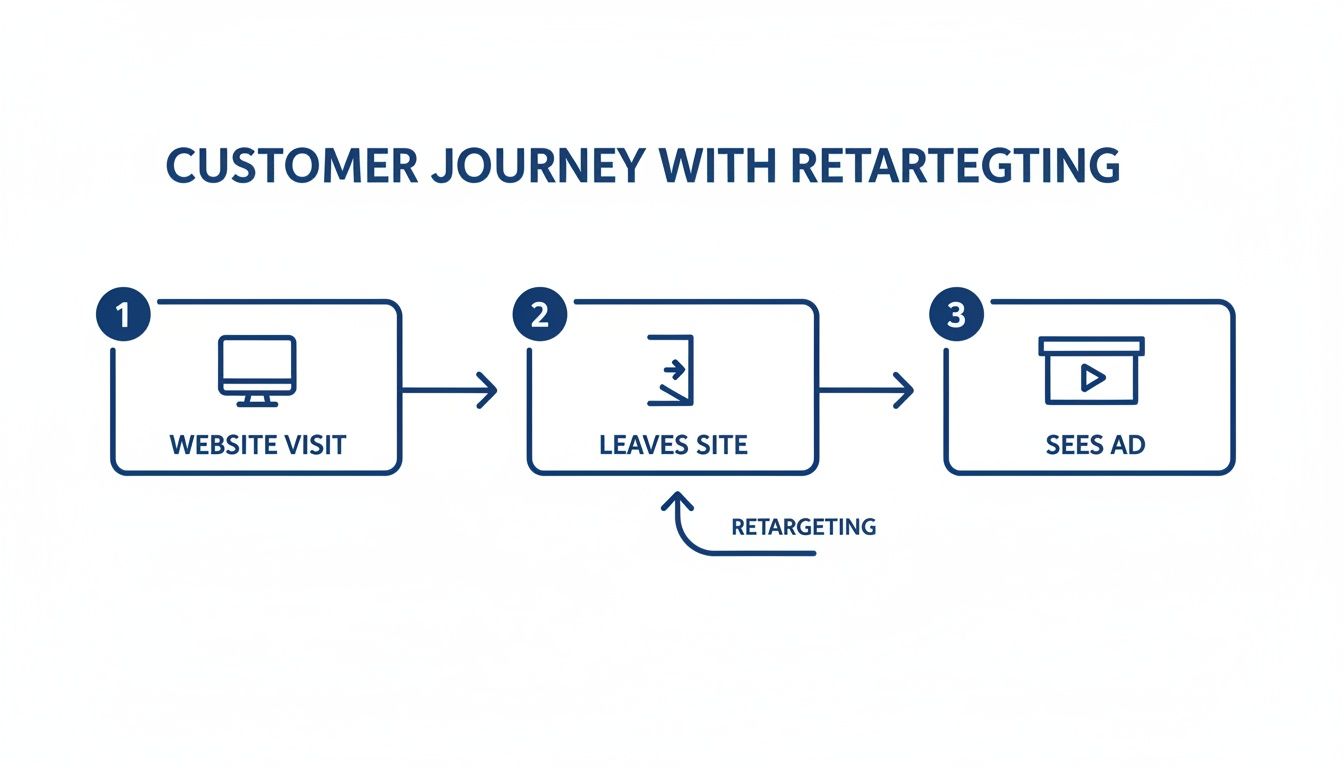
As the visual shows, it's a straightforward path. You're simply re-engaging an interested visitor, turning a one-time stop into a potential return trip.
Once someone leaves your site with that cookie attached to their browser, the real work begins. As they browse the web, major ad platforms like the Google Display Network or Meta (for Facebook and Instagram) can read that cookie. When the user visits a news site, a blog, or their social feed, the network recognizes their ID tag and knows they're part of your retargeting audience.
This recognition triggers a real-time ad auction. If your bid wins, your ad gets displayed to that specific person. It’s a seamless way to stay top-of-mind with people who have already shown they’re interested in what your firm offers.
Building Smart Audience Lists
The true power here isn't just blasting ads at every single person who ever visited your site. It’s about being smart and showing the right ad to the right person. That little pixel can track more than just a visit; it can track what pages they looked at and what they did.
This is where you get to play strategist by creating different "audience lists" based on behavior. For example:
- All Website Visitors: The broadest group—anyone who landed on your site in the last 30 days.
- Practice Area Viewers: People who visited your "Car Accidents" page but never filled out a form.
- Blog Readers: Someone who read your post on "5 Things to Know About Divorce in Texas."
- Form Abandoners: A high-value audience of people who started filling out your contact form but didn't hit "submit."
By building these focused lists, you can deliver ads that feel directly relevant to what that person was looking for. The user who read about divorce sees an ad for your family law services. It feels helpful, not creepy.
These lists are the foundation of any good retargeting campaign. They allow you to tailor your message and ensure your ad budget is spent on the most promising prospects. Platforms like Google Ads use these lists to put your ads in front of qualified people across millions of sites and apps. If you want to see how this fits into a broader advertising strategy, our guide on what are Google Ads breaks down the entire ecosystem.
This intelligent use of data is what elevates retargeting from a simple follow-up tactic to a strategic tool for turning curious visitors into new clients.
Digging Into the Different Types of Retargeting Campaigns
Retargeting isn't a one-size-fits-all tool. Think of it more like a specialized toolkit, with different instruments designed to reconnect with potential clients in specific situations. Knowing which tool to use is the key to turning a casual visitor into a signed case.
The most familiar approach, and the foundation for most strategies, is site retargeting. This is the classic setup we've been talking about: showing your ads to people after they've already visited your website. It's an incredibly effective way to pull those "window shoppers" back in and remind them why they were interested in your firm to begin with.
From there, things get more targeted. You can build campaigns based on exactly how and where someone interacted with your brand. Let's break down the main types you'll be working with.

Site Retargeting: Your Digital Follow-Up
Site retargeting is the bedrock of most campaigns. It all starts with that pixel on your website, which quietly notes who stops by and allows you to show them ads after they leave. The real power here is its versatility; you can slice and dice your audience based on their exact behavior.
For instance, a personal injury firm could run entirely separate campaigns for:
- Homepage Visitors: A general ad that keeps the firm's name top-of-mind. Simple brand awareness.
- "Car Accidents" Page Viewers: A hyper-specific ad talking about your experience with auto collision cases.
- "Contact Us" Page Abandoners: A direct ad encouraging them to finish filling out that free consultation form.
This kind of segmentation ensures your ads feel like a helpful continuation of a conversation, not just another random ad cluttering up the internet.
Search Retargeting: Capturing Active Intent
This is where you get proactive. Instead of waiting for someone to visit your site, search retargeting lets you target people based on what they're typing into Google or Bing right now. This means you can reach potential clients who have a clear, immediate need but haven't found you yet.
Imagine someone searches for "divorce lawyer in my city." Even if they don't click on your website in the search results, you can start showing them your firm's ads as they browse other sites. It's a brilliant way to get in front of a highly qualified audience at the precise moment they're looking for help.
Search retargeting bridges the gap between a user’s immediate need and your firm's solution. You're not just waiting for them to find you; you're actively finding them based on their demonstrated interest.
This method is perfect for intercepting high-intent leads that might have otherwise gone straight to a competitor.
Social Media Retargeting: Meeting People Where They Are
With so much time spent on platforms like Facebook, Instagram, and LinkedIn, it's a natural place to continue the conversation. Social media retargeting does just that by showing your ads to website visitors or existing contacts while they scroll through their feeds.
Each platform has its own strengths. Facebook lets you target people who watched most of one of your videos. LinkedIn is perfect for B2B or corporate law, allowing you to retarget individuals who engaged with your firm’s company page. Any effective social media advertising for lawyers strategy leans heavily on these features to build familiarity in a more relaxed, conversational environment.
Email Retargeting: Nurturing Your Warmest Leads
This tactic connects your email marketing directly to your paid ad campaigns, creating a powerful one-two punch. It works in two main ways. First, you can serve display ads to people who are already on your email list, reinforcing your message on multiple fronts.
Second, and even more powerfully, you can retarget users who opened a specific email or clicked a link inside it. This lets you follow up with your most engaged subscribers—the ones who've already shown interest in a blog post or webinar—and gently nudge them toward taking the next step.
Comparison of Retargeting Types
To make it easier to see how these pieces fit together, here’s a quick breakdown of each retargeting method and where it shines.
| Retargeting Type | How It Works | Best For | Common Platforms |
|---|---|---|---|
| Site Retargeting | Targets users who have visited your website. | Re-engaging past visitors and guiding them down the conversion funnel. | Google Display Network, Meta |
| Search Retargeting | Targets users based on their keyword search history. | Capturing high-intent prospects who are actively seeking legal services. | Google, Microsoft Advertising |
| Social Retargeting | Targets website visitors or contacts on social media platforms. | Building brand familiarity and nurturing leads in a social context. | Facebook, Instagram, LinkedIn |
| Email Retargeting | Targets users on your email list or who interact with your emails. | Re-engaging your warmest audience and reinforcing email campaign messages. | Most major ad networks |
By layering these different types of retargeting, you build a comprehensive strategy that connects with potential clients no matter where they are in their journey.
Why Retargeting Is a Must-Have Marketing Tool
Imagine a potential client lands on your website. They read about your services, maybe even start to fill out a form, but then they leave. Without retargeting, that person is likely gone for good. But with a smart retargeting strategy, you get a powerful second chance to continue the conversation and turn that flicker of interest into a signed client.
It's easily one of the most efficient tools a law firm can have because it laser-focuses your ad spend on a pre-qualified, warm audience. These aren't strangers. They're people who have already raised their hands and shown they’re interested in what you offer. This approach just works, dramatically boosting the odds of engagement and conversion.
The Psychology of Familiarity
The power of retargeting isn't just about clever technology; it's grounded in basic human psychology. There's a principle called the "mere-exposure effect," which basically means people prefer things just because they're familiar with them. When a potential client sees your firm's name and message again and again, it builds a real sense of trust and credibility.
Each ad they see acts as a gentle nudge, reinforcing your brand and keeping your firm top-of-mind. So when they finally decide to hire an attorney, your name is the first one they think of. This is why repeated, relevant exposure is so persuasive. The psychological impact is huge—research shows retargeting can lift brand recall by 57% and increase website revisit rates by 15%.
Turning Window Shoppers into Loyal Clients
Think of your website visitors like people browsing a store. Many are just looking, but a good number are seriously considering making a decision. Retargeting helps you separate the casual browsers from the high-intent prospects and follow up with a message crafted just for them.
This changes your advertising from a wide, speculative guess into a precise, results-driven campaign. Here's how it delivers real business value:
- Boosted Conversion Rates: By re-engaging people who have already shown interest, you gently guide them back to your site to finish what they started, like filling out that contact form.
- Increased Brand Awareness: Consistent visibility across different websites and social media platforms solidifies your firm's reputation and makes you a recognized authority in your practice area.
- Maximized Return on Ad Spend (ROAS): You stop wasting money advertising to cold audiences who may have no need for your services. Instead, every dollar is invested in nurturing leads who are already part of the way down the funnel.
By focusing on a warm audience, retargeting ensures your marketing message is not only seen but also welcomed. It’s the difference between shouting into a crowd and having a quiet, direct conversation with someone who actually wants to listen.
A Cost-Effective Path to Growth
At the end of the day, retargeting is all about efficiency. It's always more expensive to attract a brand-new visitor to your site than it is to re-engage someone who's been there before. Because you're targeting a much smaller, more qualified audience, your cost per acquisition often drops significantly compared to other ad formats.
This efficiency allows firms of all sizes to compete effectively, turning their existing website traffic into a reliable source of new cases. Of course, tracking these results is crucial. Our guide on measuring advertising effectiveness can show you exactly how to connect your campaigns to real-world business outcomes. Retargeting isn't just a tactic; it's a must-have tool because it makes your entire marketing ecosystem work smarter, not harder.
Crafting Retargeting Campaigns That Actually Convert
Knowing the theory behind retargeting is one thing. Building a campaign that actually connects with potential clients and convinces them to pick up the phone? That’s a whole different ballgame. A winning campaign is a delicate mix of smart strategy, compelling ad creative, and perfect timing—it’s about moving beyond just showing up again and instead delivering real value.
It all starts with a simple truth: not all website visitors are created equal. Someone who spent five minutes reading your in-depth blog post on personal injury claims is showing a much higher level of interest than someone who glanced at your homepage and left. Treating them the same is a huge missed opportunity.

Smart Audience Segmentation Is Key
The foundation of any high-performing campaign is intelligent audience segmentation. When you group visitors based on their on-site behavior, you can tailor your messaging so it feels incredibly relevant. This is how you transform an ad from an annoying interruption into a genuinely helpful reminder.
For a law firm, here are a few high-value segments to consider:
- Practice Area Viewers: These are people who checked out a specific service page (like "Family Law") but didn't make contact. Your ad should speak directly to that specific need.
- Form Abandoners: This is your highest-priority audience. They were just seconds away from becoming a lead. A gentle nudge with a clear, simple call-to-action can be incredibly effective here.
- High-Engagement Users: Think of visitors who browsed multiple pages or spent a good chunk of time on your site. They're clearly interested, making them prime candidates for a brand-focused ad that reinforces your firm's credibility.
Segmenting your audience properly ensures the right message finds the right person at the right moment, which dramatically improves the return on your ad spend.
Avoid Ad Fatigue with Frequency Capping
Have you ever been haunted by the same ad, seeing it pop up everywhere you go until it just becomes annoying? That’s called ad fatigue, and it’s a campaign killer. To stop this from happening, you have to use frequency capping—a simple setting that limits how many times one person sees your ad in a given timeframe.
As a general rule of thumb, aim to show an ad no more than 3-5 times per user each week. This keeps your firm top-of-mind without alienating the very people you’re trying to attract.
Respecting your audience's attention is everything. The goal is to be a persistent, friendly reminder, not an unwelcome guest cluttering up their screen.
Personalize at Scale with Dynamic Retargeting
For firms with a lot of blog content or many different practice areas, dynamic retargeting is an incredibly powerful tool. This technology automatically personalizes your ads based on the specific pages or articles a person viewed on your website.
For example, if someone read your blog post on "Steps to Take After a Car Accident," a dynamic ad could then show them a message specifically about your firm's expertise in auto collision cases. This kind of personalization makes the ad feel less like an ad and more like a direct continuation of their research. Of course, this only works if your site is well-organized—our guide on website optimization for law firms can help you get your pages set up for success.
Creating dozens of different ad variations from scratch can be a major time sink. This is where tools like an AI ad generator can really help, allowing you to quickly produce compelling visuals and copy for your different segments. By combining smart segmentation, respectful frequency, and dynamic creative, you can build campaigns that don't just get noticed—they convert interested visitors into valuable new clients.
Navigating Privacy in a Cookieless Future
Retargeting’s effectiveness has always been tied to third-party cookies—those little digital trackers that follow users around the internet. But that entire foundation is cracking. Privacy is no longer a niche concern; it’s a mainstream demand from both consumers and the tech giants who serve them.
This shift is a direct response to a growing call for control over personal data, backed by serious regulations. Laws like Europe's GDPR and California's CCPA have completely changed the rules of the game. The old "track everything by default" approach is now not just obsolete, it's a legal minefield.
For a law firm, trust is your currency. Following these privacy rules isn't just about legal compliance; it's about showing potential clients you respect them and their data, which is fundamental to your firm's reputation.
The End of Third-Party Cookies
Google's plan to phase out third-party cookies in Chrome is the final chapter for old-school retargeting. They're not the first—Safari and Firefox already made similar moves—but given Chrome's market dominance, this effectively closes the book on an era of cross-site tracking. This presents a challenge, but it also forces the industry toward better, more ethical advertising.
The entire digital advertising ecosystem, which is on track to blow past $1 trillion in spending by 2025, was built on tracking tools like cookies. That infrastructure made hyper-specific targeting possible, but now the industry has to rewire itself for a privacy-first world. You can read more about these global ad spending trends and what they signal for businesses.
The bottom line is simple: you can no longer build a long-term strategy on borrowed third-party data. The future of smart retargeting is all about using your own data and embracing new technologies that put privacy first.
This means law firms have to pivot. The goal is to focus on strategies that honor user consent while still managing to deliver a relevant, personalized message to the right people at the right time.
Preparing Your Firm for the Future
The good news? The alternatives emerging are not just workarounds; they're often more powerful because they help you build a direct, stronger relationship with your audience. Think of the cookieless future less as a setback and more as a catalyst for smarter marketing.
Here’s where you should focus your efforts:
- First-Party Data: This is gold. It’s the information you collect directly from your audience when they give you permission—think email addresses from a newsletter signup or contact details from a case evaluation form. You own it, you know it's accurate, and it came with explicit consent.
- Contextual Advertising: This is a classic idea with a modern twist. Instead of targeting the person, you target the context. Your ad for personal injury law could show up right next to a news article about local traffic accidents. It’s relevant without being invasive.
- Platform-Native Audiences: Ad platforms like Google and Meta have their own treasure troves of user data. They create interest-based audiences within their "walled gardens." This allows you to reach highly relevant users without needing third-party cookies because all the targeting happens inside their own systems.
By getting ahead of these changes, your law firm can build a retargeting strategy that’s not just effective, but also ethical, sustainable, and built for the future.
Got Questions? We’ve Got Answers.
Let's tackle some of the most common questions that come up when law firms first dip their toes into the world of retargeting.
Is This the Same as Remarketing?
Great question. You'll hear these two terms thrown around and used interchangeably all the time, even by major platforms like Google Ads. But for our purposes, there's a subtle but useful distinction to keep in mind.
Think of it like this:
- Retargeting is all about using paid ads to chase down anonymous visitors who checked out your website but left without contacting you. The goal is to bring fresh prospects back to your digital doorstep.
- Remarketing is more focused on re-engaging people you already know—your existing contacts and clients. A classic example is sending a follow-up email campaign to your newsletter list.
It's a small difference, but it helps clarify your strategy. Are you pursuing new leads or nurturing current relationships?
The simplest way to remember it: Retargeting uses ads to catch prospects. Remarketing uses email to nurture contacts.
How Much Should We Budget for This?
There’s no magic number here. Your budget will really depend on how much traffic your website gets and what you're trying to achieve.
A solid rule of thumb is to set aside 10-20% of your total digital ad spend specifically for retargeting.
Now, don't be surprised if your cost per click (CPC) is a little higher than what you see in your broader campaigns. That's normal. You're targeting a much smaller, more valuable audience of people who have already shown interest in your firm. The good news? The return on that investment is almost always significantly better because these folks are much closer to making a decision.
Start with a modest budget, see what works, and then confidently scale up once you see those leads rolling in.
How Do We Know if It’s Actually Working?
This is the most important question of all. To really know if your retargeting efforts are paying off, you have to look past simple metrics like clicks and impressions. You need to focus on what directly impacts your firm's bottom line.
Here are the three big metrics you need to live and breathe:
- Conversion Rate: This is the ultimate proof. Of all the people who saw your retargeting ad and clicked back to your site, what percentage actually filled out your contact form or called your office? A high conversion rate means your message is hitting the mark.
- Cost Per Acquisition (CPA): Plain and simple, how much did it cost you to get that new client lead? A low, sustainable CPA is the hallmark of an efficient, well-run campaign.
- Return on Ad Spend (ROAS): For every single dollar you put into your retargeting ads, how many dollars are you getting back in new case value? This is the clearest picture of profitability you can get.
Ready to turn interested visitors into confirmed clients? The experts at Case Quota specialize in creating high-performance retargeting campaigns for law firms that deliver measurable results. Schedule your free consultation today!