
When someone in Santa Monica gets rear-ended and pulls out their phone to search for a "car accident lawyer near me," your firm has a split second to show up. That’s the entire game right there.
This is the heart of local search marketing: a strategy laser-focused on making your law firm impossible to miss in geographically-specific searches. It’s not about casting a wide net across the country; it’s about being the first and best answer for potential clients in your own backyard at the exact moment they need you.
Your Next Client Is Searching Locally. Are You Showing Up?
Think of your law firm as a physical storefront on a busy street. Without a clear sign, a visible address, or good lighting, potential clients will walk right past, completely unaware you exist. Local search marketing is the digital version of putting your firm on the busiest corner in Southern California, complete with a massive, brightly lit sign pointing straight to your door.
It's a collection of strategies built to attract clients from specific areas, whether that’s a neighborhood in Los Angeles, a city in Orange County, or the greater San Diego area.

This approach is fundamentally different from broad, general SEO. General SEO might chase nationwide legal queries, but local search hones in on high-intent, location-based searches that scream "I need a lawyer now." To really get a handle on this, it's worth understanding the core principles of What Is Local SEO? and how they apply directly to a service business like yours.
Why Local Search Is a Game-Changer for Law Firms
The power of local search comes down to two things: immediacy and intent. The data doesn't lie.
A mind-blowing 46% of all Google searches are now for local information. Even better, a staggering 88% of people who search for a local business on their smartphone will call or visit within 24 hours. That’s not a lead; that’s a client waiting to happen.
For a law firm in Southern California, this translates into very real, very valuable opportunities:
- Capture High-Intent Leads: People searching locally are often in the middle of a crisis—a DUI, a sudden injury, or an urgent family matter. They aren't just browsing for information; they are actively looking for representation.
- Build Community Trust: When your firm consistently appears at the top of local searches, it establishes you as a credible, accessible authority in the community. Trust is built before they even pick up the phone.
- Compete and Win: Local search levels the playing field. It allows smaller, specialized firms to go head-to-head with the big players by dominating a specific geographic niche.
In essence, local search marketing isn't just about being found online. It’s about being found by the right people, in the right place, at the exact moment they need you the most.
By mastering the core components—from your Google Business Profile to local citations and hyperlocal content—you stop having a passive website and start running an active client-generation machine.
Your Digital Handshake: The Power of Google Business Profile
If local search is the digital equivalent of setting up shop on Rodeo Drive, then your Google Business Profile (GBP) is your storefront, welcome mat, and receptionist all rolled into one. For many people, this is the very first interaction they'll have with your law firm.
This isn't just another online directory. It's a powerful client-generation tool that can turn a casual searcher into a new case before they even think about clicking through to your website. A well-oiled GBP gives them instant answers and builds trust at a glance, showing your firm is professional, active, and exactly where they need help.

Beyond the Basics: From Listing to Lead Machine
Here’s where most law firms get it wrong. They claim their profile, plug in the basics, and just let it sit there. That's a massive missed opportunity. The goal is to transform your GBP from a static, digital business card into a dynamic marketing engine that constantly works for you. You need to feed Google—and by extension, potential clients—a steady stream of rich, accurate, and engaging information that proves your authority.
The numbers don't lie. Local search is a conversion powerhouse. An incredible 88% of mobile local searches result in a call or visit within 24 hours. For law firms, it gets even better: potential clients are 2.7 times more likely to consider a firm with a complete and well-managed profile trustworthy.
With 44% of all clicks going to the "Local Pack" results—the map-based listings powered by GBP—being visible here is non-negotiable.
To make that happen, you have to nail these critical elements:
- Precise Practice Categories: Don't just pick 'Law Firm.' Get specific. 'Criminal Defense Attorney' tells Google exactly who you are. Then, add secondary categories like 'DUI Lawyer' to grab those hyper-specific, high-intent searches.
- High-Quality Photos and Videos: Upload professional shots of your office (inside and out), your team, and maybe even a short video introducing your lead partners. This is how you humanize your firm and build an immediate sense of credibility.
- Proactive Q&A Management: The Q&A section is your chance to get ahead of common client questions. Don't wait for people to ask. Seed this area with the questions you get all the time and provide clear, confident answers. You'll instantly establish expertise.
Crafting a Compelling Profile That Converts
Once the foundation is solid, it's time to start actively engaging potential clients. Your GBP isn't a set-it-and-forget-it tool. It has features designed to showcase your expertise and encourage people to reach out. Don't let them go to waste.
A complete Google Business Profile is more than just data for an algorithm; it’s a narrative that tells a potential client, "We are the right choice for you, right here, right now."
Think strategically about what you're sharing. Your service descriptions are prime real estate. Instead of a dry list of practice areas, explain how you help clients, using language that connects with someone who is likely under a lot of stress. Detail your firm's unique approach to handling complex personal injury claims in Los Angeles or navigating estate planning in Orange County. You can find more of these advanced strategies in our guide on proven Google Business Profile tweaks for attorneys.
Finally, get into the habit of using Google Posts consistently. This feature is like a mini-blog that lives directly on your profile. Use it to share firm news, break down recent legal developments that affect Southern California residents, or highlight a successful case outcome (while always maintaining client confidentiality, of course). Every single post is another signal to Google that your firm is active and a valuable local resource, keeping you top-of-mind and, more importantly, top-of-search.
Building Local Authority with Citations and Reviews
Once your website and Google Business Profile are dialed in, you need to realize that Google’s work isn’t done. It acts like a private investigator, scanning the entire internet for independent proof that your law firm is a legitimate, prominent local player.
Two of the most powerful pieces of evidence it looks for are citations and online reviews.
Think of a citation as a simple mention of your law firm on another website. It’s not necessarily a link back to your site; it’s more like a digital breadcrumb that verifies your firm’s existence and core details.

These mentions carry the most weight when they consistently list your firm’s Name, Address, and Phone number (NAP). When Google sees the exact same NAP on high-authority sites like Yelp, Avvo, and your local Chamber of Commerce, it sends a massive trust signal. It confirms you are who you say you are, right where you say you are.
Why NAP Consistency Is Non-Negotiable
Imagine you tell one friend you live at "123 Main Street," but another hears "123 Main St.," and a third has it down as "123 Main Street, Suite 100." The core information is there, but the variations create confusion. For a search engine, that confusion breeds doubt.
Even a tiny discrepancy—like using "St." on one directory and "Street" on another, or forgetting a suite number—erodes Google's confidence. It starts to question which version is correct, and that uncertainty can directly drag down your local search rankings.
A perfectly clean, consistent NAP across the web is the bedrock of local authority. It’s you telling Google, "This is us. This is where we are. Period."
The Modern Word-of-Mouth: Online Reviews
If citations build foundational trust with search engines, online reviews build it with actual human beings—your potential clients. Reviews are today’s word-of-mouth referral, and their impact is massive.
With 75% of consumers using Google to find local businesses, your star rating and the content of your reviews often make the difference between getting the call or watching a potential client click on a competitor.
In fact, reviews are the second-most important ranking factor for Google's coveted Local Services Ads. For clients scanning the map results, a strong collection of positive reviews is often the single biggest deciding factor.
Your firm's collection of reviews tells a story. Proactively managing that story is one of the most effective local search marketing tactics you can deploy.
This isn’t about passively hoping for good feedback. It requires a clear, deliberate strategy:
- Actively Request Reviews: The absolute best time to ask is right after a successful case conclusion. Make it incredibly easy for happy clients to leave feedback on Google and key legal directories like Avvo.
- Respond to Every Review: Thank clients for their positive feedback. Even more importantly, respond professionally and quickly to negative reviews. A thoughtful, calm response can showcase your firm's commitment to client satisfaction and integrity.
- Leverage the Feedback: Your reviews are a goldmine of business intelligence. Use them—both the good and the bad—to understand what you’re doing right and where you can improve your client experience.
By mastering both citations and reviews, you're building authority from two critical angles. Citations confirm your firm’s identity to search engines, while reviews validate your expertise and trustworthiness to potential clients. For a deeper dive into this, check out our complete guide to reputation management for attorneys.
Creating Hyperlocal Content That Resonates
Generic articles about personal injury law just won't cut it in the crowded Southern California market. To make any real impact, your firm has to create content that speaks directly to the unique anxieties, landmarks, and legal quirks of the communities you actually serve. This is what a true hyperlocal content strategy is all about.
It’s about moving past the generic "serving Los Angeles" footer on your website. Instead, you need to build digital resources that prove your firm is woven into the local fabric. When a potential client stumbles upon an article that talks about their specific problem in their specific neighborhood, it creates an immediate, powerful connection.
This approach transforms you from just another lawyer into a local authority who actually gets their world.
Going Beyond Generic Service Pages
Sure, a standard "Workers' Compensation" page is a decent start, but it does nothing to set you apart. A hyperlocal strategy drills down, creating pages designed for very specific groups of people in your area. This tells Google—and more importantly, potential clients—that your expertise is directly relevant to them.
This means you need to genuinely understand the local economy and the people who live there. To make sure your content actually connects, the first critical step is to identify your target audience and get a handle on their real-world legal headaches.
Just look at these powerful examples for a SoCal law firm:
- "Workers' Comp Lawyer for Long Beach Shipyard Workers": This is laser-focused. It targets a specific industry in a specific city, letting you talk about relevant maritime laws or the common injuries that happen in that exact environment.
- "Estate Planning for Families in Venice": This speaks to the distinct financial realities of Venice residents, from artists to tech professionals, showing you understand their community's values.
- "DUI Defense for Cases near the Hollywood Bowl": Imagine the value here. You can discuss specific details like common DUI checkpoints in the area or which courthouse handles those cases. That’s immensely useful to someone in that stressful situation.
Developing Blog Content with a Local Pulse
Your blog is the perfect arena to flex your local knowledge and show you're part of the community. It’s your chance to tackle timely, location-specific legal questions that a generic content mill would never think to cover. This doesn't just pull in highly relevant traffic; it builds unshakeable local authority.
Put yourself in the shoes of someone living in Los Angeles, Orange, or San Diego county. What are their unique questions? This is a pillar of any strong content marketing for law firms.
Hyperlocal content answers the question your potential client is actually asking, not the one you think they should be. It meets them where they are, with information that is immediately useful and reassuring.
Build your content calendar around topics that deliver real, local value:
- A Guide to Navigating the Los Angeles County Family Court System: This isn't just content; it's a public service. It demystifies a confusing local process and positions your firm as a trusted guide.
- How New California Rent Control Laws Affect Orange County Landlords: An article like this targets a very specific audience with timely, location-based legal analysis they can't get elsewhere.
- What to Do After a Motorcycle Accident on the Pacific Coast Highway: This connects a common legal problem with an iconic local landmark, capturing incredibly specific search intent.
When you consistently produce this kind of targeted content, your firm stops being just another name on a Google search results page. You become the go-to legal resource for your community, building trust that generates qualified leads long before a potential client ever has to make a call.
Your Local Search Implementation Checklist
Knowing what local search marketing is and actually putting it to work are two different things. To get real, tangible results, you need a methodical plan of attack. I've broken down the entire process into a few manageable phases, designed specifically for a busy Southern California law firm.
Think of this as the blueprint for building your firm's local authority. Each step lays a critical part of the foundation, making sure the final structure is strong, visible, and brings in a steady stream of new clients. We'll start with the basics and move all the way to ongoing optimization, with clear goals for each stage.
Here's a detailed checklist that walks you through the entire process, from getting your digital foundation right to advanced strategies for growth.
Local Search Marketing Implementation Checklist for Law Firms
| Phase | Action Item | Key Objective |
|---|---|---|
| 1: Foundational Setup | Claim & Optimize Google Business Profile (GBP) | Establish your "digital front door" with complete, accurate information and high-quality photos. |
| Conduct Comprehensive Citation Audit | Find every online mention of your firm's Name, Address, and Phone number (NAP). | |
| Clean Up & Standardize NAP | Ensure every single listing matches your GBP profile exactly to eliminate confusing signals for Google. | |
| Ensure Website is Mobile-First | Deliver a fast, seamless experience for the majority of users searching on their phones. | |
| 2: Building Authority & Trust | Establish a Review Generation System | Create a simple process to consistently get fresh, positive feedback from satisfied clients. |
| Respond to All Reviews (Good & Bad) | Show potential clients you are engaged and committed to client satisfaction. | |
| Build Foundational Local Backlinks | Secure listings in high-authority local directories like the local Bar Association and Chamber of Commerce. | |
| 3: Ongoing Optimization & Growth | Develop a Hyperlocal Content Calendar | Regularly publish content that answers local questions and targets specific neighborhoods. |
| Utilize Google Posts Weekly | Keep your GBP profile active with firm updates, case wins, and blog posts to signal engagement to Google. | |
| Monitor Rankings & KPIs | Track map rankings, calls from GBP, and local website traffic to make data-driven decisions. |
Let's dig a little deeper into what each phase actually involves.
Phase 1: Foundational Setup
This first phase is all about claiming your digital turf and making sure your firm's core information is spot-on everywhere it appears online. Getting this right is non-negotiable. If your foundation is inconsistent, the whole strategy will crumble before it even gets started.
- Claim and Fully Optimize Your Google Business Profile (GBP): This is your digital front door. You need to fill out every single section—services, hours, accessibility, you name it. Use high-resolution photos of your team and office to start building trust the second someone finds you.
- Conduct a Comprehensive Citation Audit: Use a tool to hunt down every mention of your firm's Name, Address, and Phone number (NAP) across the web. Get it all into a spreadsheet so you can see where the inconsistencies are.
- Clean Up and Standardize Your NAP: This part is tedious but absolutely essential. You have to contact directories with the wrong info and get it updated. Every listing, from Avvo to Yelp, has to match your GBP profile perfectly—right down to whether you use "St." or "Street."
- Ensure Your Website Is Mobile-First: The vast majority of local searches are happening on smartphones. Your website has to be fast and dead simple to use on a small screen. Test it. See how it feels.
Phase 2: Building Authority and Trust
Once your foundation is solid, the next step is to send powerful trust signals to both Google and your potential clients. This is where you start building a reputation that precedes you, turning your firm into a name people recognize and trust in your community.
- Establish a Review Generation System: You need a simple, repeatable process for asking happy clients for a review after their case is over. An automated email or even a simple handout can work wonders. The goal is a steady drip of fresh, positive feedback.
- Respond to All Reviews (Good and Bad): Make a point to engage with every single review. Thank clients for the good ones, and address the negative ones professionally. It shows everyone watching that you truly care about client satisfaction.
- Build Foundational Local Backlinks: Get your firm listed in high-authority local directories. We're talking about your local Bar Association, the Chamber of Commerce, and other respected community organizations.
This simple flowchart shows how your content strategy should branch out, starting with core pages and expanding to connect with your community on a deeper level.
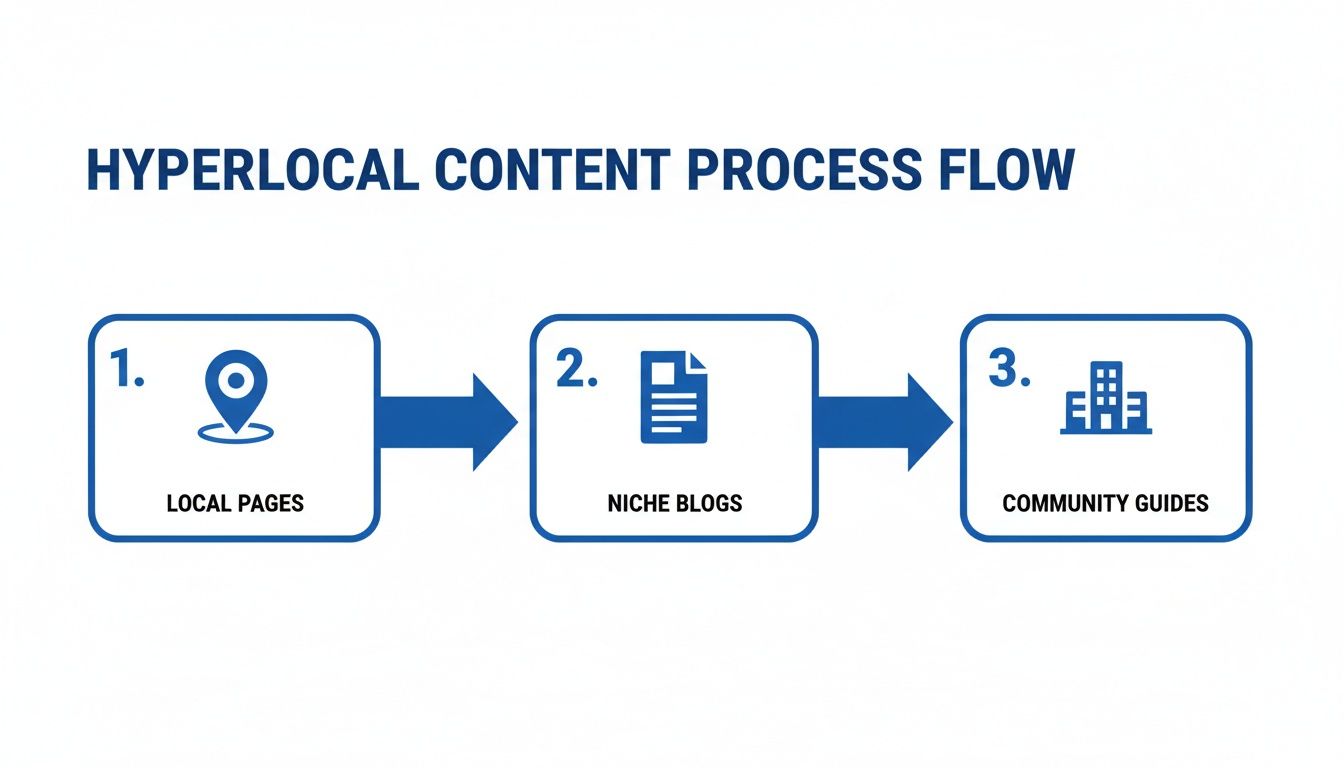
As you can see, a smart content plan starts broad with your main service pages and then gets more and more specific, creating niche content that builds real community connections.
Phase 3: Ongoing Optimization and Growth
Local search isn't a "set it and forget it" task. It needs constant attention to keep your firm visible and ahead of the competition. This last phase is all about building sustainable habits that keep you at the top of the local results. For a more in-depth look at how this fits into the bigger picture, our law firm SEO guide is a great resource.
A successful local search strategy is a living system. It must be monitored, nurtured, and adapted to stay ahead of the competition and meet the evolving needs of your clients.
To ensure you get long-term results, make these tasks part of your regular marketing routine:
- Develop a Hyperlocal Content Calendar: Plan on publishing at least one or two new pieces of hyperlocal content every month. This could be a blog post about a legal issue impacting your city or a new service page for a specific neighborhood you serve.
- Utilize Google Posts Weekly: Share firm news, recent successes (with client consent, of course), or a link to your latest blog post directly on your GBP. This is a huge signal to Google that your firm is active.
- Monitor Your Rankings and KPIs: Keep an eye on your key metrics. Track your map pack rankings for your most important keywords, the number of click-to-calls from your GBP, and how much traffic is coming to your site from local search. Use that data to fine-tune your approach.
Measuring Success and Avoiding Common Pitfalls
Launching a local search campaign without tracking it is like driving through Los Angeles with a blindfold. Sure, you're moving, but you have no idea if you're actually getting closer to your destination. To make sure your efforts are bringing in new cases, you have to focus on the Key Performance Indicators (KPIs) that truly impact your firm’s bottom line.
Forget about vanity metrics like impressions or a general uptick in website traffic. Those numbers feel good, but they don't pay the bills. Instead, your focus needs to be on the tangible actions a potential client takes right before they decide to hire you. Real success is measured by genuine client engagement and qualified leads.
Key Performance Indicators That Actually Matter
Your real goal is to track the digital handshakes that turn into initial consultations. By zeroing in on these specific metrics, you get a crystal-clear picture of your return on investment and can make smart decisions about where to put your energy next.
These are the data points that count:
- Clicks to Call from Your GBP: This is a direct line from a local searcher to your front desk. It's one of the highest-intent actions a potential client can take.
- Driving Direction Requests: When someone asks Google for directions to your office, they aren't just browsing—they're planning a visit. This is a huge indicator of a serious inquiry.
- Appointment or Form Submissions from Local Landing Pages: Tracking contact forms filled out on your geo-targeted pages proves your hyperlocal content is doing its job and converting readers into leads.
Monitoring these specific actions tells the real story of your campaign's health. For a more comprehensive look at this, our detailed article on measuring advertising effectiveness shows how these principles work across all of your marketing channels.
Common Mistakes That Sabotage Local Campaigns
Even a brilliant strategy can be completely derailed by a few simple, avoidable mistakes. Too many law firms pour time and money into local search only to see disappointing results because a few foundational pieces are out of place. Knowing what these common pitfalls are is the first step to making sure your campaign doesn't fall into the same traps.
These errors can quietly sabotage your hard work, making your firm less visible or trustworthy in the eyes of both Google and the clients you want to attract.
The biggest failures in local search marketing rarely come from complex strategy mistakes. They come from neglecting the basics. Consistency, responsiveness, and accessibility are everything.
Here are the most frequent blunders to watch out for and fix immediately:
- Inconsistent NAP Data: Your firm's Name, Address, and Phone number (NAP) has to be identical everywhere online. A tiny variation, like listing "St." in one place and "Street" in another, can confuse search engines and seriously weaken your local authority.
- Ignoring Negative Reviews: A bad review left hanging without a response makes it look like you don't care about client outcomes. Responding professionally shows potential clients that you're engaged and committed to satisfaction.
- Keyword-Stuffing Your GBP Name: Jamming terms like "Los Angeles Personal Injury Lawyer" into your official firm name on Google Business Profile is a direct violation of Google's rules and can get your profile suspended. Keep it clean, professional, and accurate.
- A Non-Mobile-Friendly Website: The vast majority of local searches happen on a smartphone. If your website is slow or a pain to navigate on a small screen, you're frustrating potential clients and sending them right into the arms of your competition.
Frequently Asked Questions About Local Search Marketing
Jumping into local search can bring up a lot of questions. We get it. Here are some straightforward answers to the most common things we hear from law firms across Southern California, designed to give you clarity and confidence.
How Long Does It Take for Local Search Marketing to Show Results?
This is the big one, and the answer has two parts. You can often see an immediate bump in calls within a few weeks just by optimizing your Google Business Profile. That's the low-hanging fruit.
But a comprehensive local search strategy—the kind that builds lasting authority through consistent citations, reviews, and local content—is more of a long game. Realistically, it takes about 3-6 months to see significant, sustainable growth in your rankings and lead flow. In competitive markets, consistency is everything.
Can I Do This Myself, or Should I Hire an Agency?
You can absolutely handle the basics yourself, like claiming your GBP or asking a few clients for reviews. And for some firms, that's a great start.
However, the legal market in Southern California is a different beast—it's incredibly crowded and competitive. A specialized agency doesn't just bring more hands to the table; they bring deep expertise in legal marketing, access to advanced tools for tracking and analysis, and a nuanced understanding of what actually converts a local searcher into a signed client. Partnering with an expert means you can focus on practicing law while they focus on dominating the local map pack.
"Local SEO is a specialized subset focused on making your firm visible to potential clients in a specific geographic area who are actively searching for your services now…"
What’s the Difference Between Local SEO and "Regular" SEO?
Think of it this way: "regular" SEO is like casting a wide net to catch a national or even global audience. It targets broad topics like "what is probate law."
Local SEO, on the other hand, is like precision fly-fishing. It’s a specialized discipline focused entirely on making your firm pop up for potential clients in a specific city or neighborhood who are ready to hire right now. They're using terms like "probate attorney in Irvine," and Google uses local signals—your address, geo-tagged keywords, and local reviews—to decide if you're the most relevant answer.
Ready to turn local searchers into your next clients? At Case Quota, we specialize in building powerful local search marketing strategies that drive measurable results for law firms across Southern California. Get in touch with us today to schedule your consultation.