

Let's be honest, video marketing isn't some new, trendy thing anymore. For law firms, it's become a fundamental tool for cutting through the noise and actually connecting with potential clients. A well-made video isn't just content; it's your first handshake, your chance to let someone meet you before they even think about picking up the phone.
Why Your Firm Can't Afford to Ignore Video
In a field built entirely on trust, words on a page have their limits. When people are facing a personal injury, a criminal charge, or a complex family matter, they're not just looking for credentials. They're looking for a human being—an attorney who gets it, who projects confidence, and who they feel they can trust with their future.
This is exactly where video shines.
A sharp, well-crafted video can do what a thousand words of website copy can't. It shows your empathy through your tone of voice. It builds confidence with your body language. It establishes you as an authority when you break down a complex legal issue in simple terms. In 60 seconds, a potential client can get a better read on you than they would from your entire "About Us" page.
The Modern Client's Journey Starts with a Search Bar
Think about it. When someone needs a lawyer today, they don't grab the Yellow Pages. They grab their phone and head straight to Google. They're searching for answers, reassurance, and a glimpse of the person who might represent them. They're watching videos to understand the process and to vet their options from the comfort of their couch.
This digital-first reality means your online presence is your new front door. If you don't have video, you're essentially invisible to a huge number of potential clients who would rather watch than read.
Here's the bottom line: When a potential client lands on your website, a compelling video is often the one thing that convinces them to call you instead of the firm three spots down in the search results. It’s your opportunity to make a powerful first impression, completely on their terms.
Building Trust Before the First Handshake
Ultimately, video marketing is about forging a direct line to your ideal clients. It lays the groundwork for a relationship before you've even spoken. By showing the real people behind the letterhead, you stop being just another law firm and become a team of actual, trusted advisors.
This isn't just about getting more views. It’s about creating a powerful advantage that turns those viewers into signed cases. It’s an investment in the single most important asset your firm will ever have: trust.
Building Your Video Strategy Before You Press Record
A high-quality video without a clear strategy is just a creative project, not a client-acquisition tool. Before you even think about cameras or scripts, you need to lay a solid foundation. This means getting past vague goals like "get more clients" and setting specific, measurable objectives.
For instance, a weak goal is just wanting more web traffic. A powerful one is to boost qualified consultation requests by 20% within the next quarter. That sharp focus transforms video marketing from a simple expense into a measurable investment.
Every decision you make—from the video's topic to its tone—should flow directly from these objectives. Without them, you’re just creating content that might look good but fails to move the needle on what actually matters: growing your firm.
Defining Your Target Client Persona
Next, you have to pinpoint exactly who you're trying to reach. The worries of someone facing a DUI charge are a world away from a couple looking to draft an estate plan. One client is dealing with immediate fear and uncertainty; the other is planning for the future. Your message has to connect with their specific pain points.
Create a detailed client persona. Go beyond the basic demographics and ask the real questions:
- What are their most pressing legal questions keeping them up at night?
- What are their biggest fears about hiring a lawyer? (Cost, judgment, complexity)
- Where do they go to find answers? (Google, YouTube, Facebook groups)
- What tone would make them feel understood and confident? (Empathetic, authoritative, reassuring)
Answering these questions ensures your content speaks directly to the person you want to attract. It's how you build videos that don't just grab attention, but create an immediate sense of connection.
Navigating Legal Ethics and State Bar Rules
This is the part of video marketing for lawyers you absolutely cannot skip. Legal advertising is heavily regulated, and state bar rules are strict. One misstep here can jeopardize your reputation and your license.
Compliance isn't about killing creativity; it's about building credibility. Your videos must be truthful, non-misleading, and must never promise specific outcomes. Common mistakes include using language that implies a guarantee ("we'll win your case") or using dramatizations without crystal-clear disclaimers.
Always consult your state bar’s specific advertising guidelines before you publish anything. What’s perfectly fine in one state might be a serious violation in another. This isn't just a best practice—it's a professional necessity.
Building your strategy with these rules in mind from day one will save you from costly edits and potential ethical headaches down the road. You can use a comprehensive law firm marketing plan template to keep all your strategic initiatives, including video, organized and fully compliant.
This whole process is about guiding a potential client from initial awareness to placing their trust in your firm.
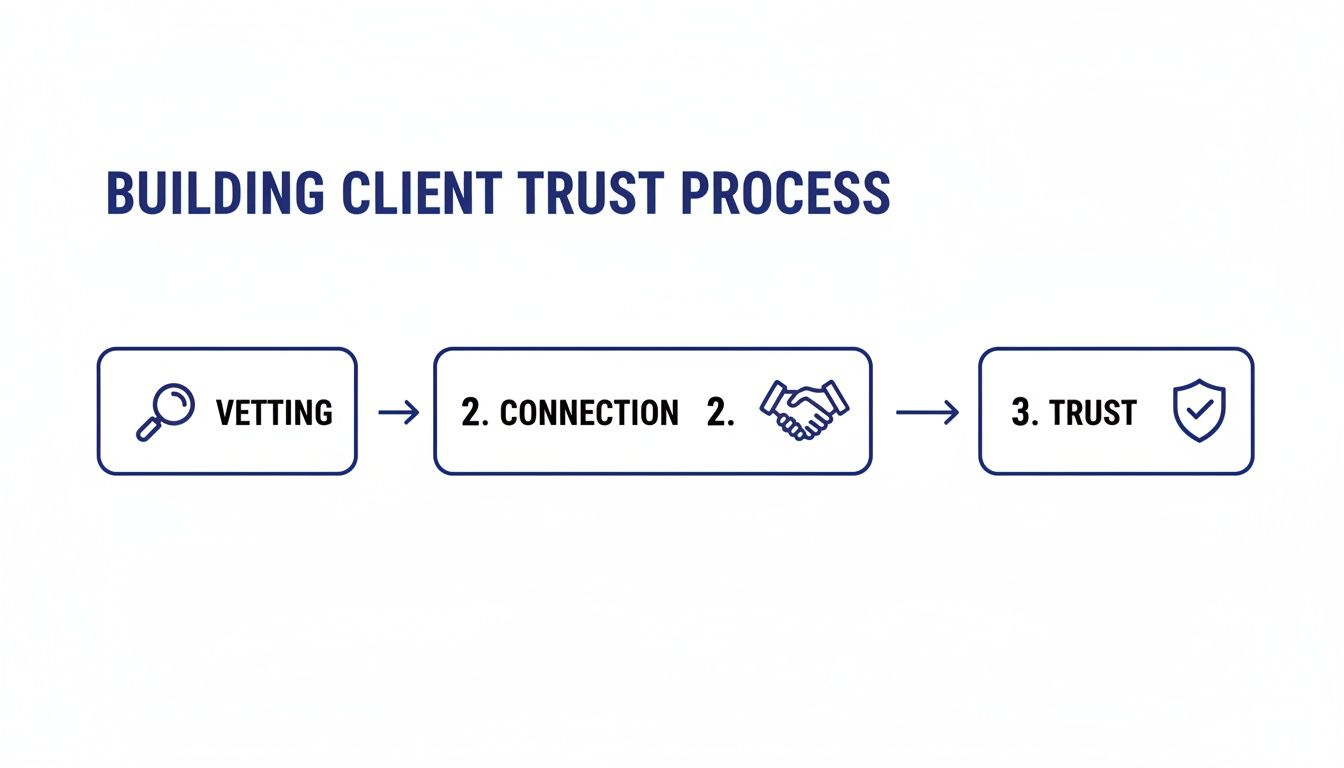
As you can see, trust isn't built overnight. It’s a deliberate process that starts with the client vetting you, moves to a feeling of connection, and finally culminates in genuine trust.
Crafting a Compelling and Compliant Message
With your goals, audience, and ethical guardrails in place, you can finally craft your core message. It needs to live at the intersection of your ideal client’s problem and your firm’s unique solution.
Focus on education and empathy, not a hard sell. For example, instead of a video titled, "Why We're the Best Personal Injury Firm," try something like, "3 Things You Must Do Immediately After a Car Accident." The second title offers instant value and positions you as a helpful authority. To really nail this, it’s worth understanding the latest video marketing best practices.
This groundwork is what ensures every single video you produce is a strategic asset designed to attract, engage, and convert your ideal client.
Choosing the Right Videos to Attract Your Ideal Client

With a solid strategy in place, it's time to get into the fun part: deciding what kinds of videos to actually create. This is where the rubber meets the road. Not every video format is going to resonate with someone facing a serious legal challenge.
For law firms, success isn't about going viral. It’s about building trust, proving your expertise, and making a genuine human connection with people when they are at their most vulnerable.
Think of each video as a specific tool for a specific job. You wouldn't use a hammer to turn a screw. Likewise, you need to match the video format to the mindset of your ideal client at each stage of their journey.
Videos That Build Immediate Trust and Social Proof
When a person needs legal help, they're scared and uncertain. More than anything, they're looking for reassurance that you can solve a problem like theirs because you’ve done it before.
This is where your clients become your best marketers.
- Client Testimonial Videos: Nothing—and I mean nothing—builds social proof faster than a sincere client testimonial. A real person sharing their story, in their own words, about how you guided them through a crisis is infinitely more powerful than any marketing copy you could write. These videos cut through the noise and provide the emotional proof potential clients are desperately seeking.
A single, authentic 90-second client testimonial can do more to convert a hesitant lead than a dozen pages of text. It replaces abstract claims with a relatable human story, which is the foundation of trust.
Videos That Demonstrate Authority and Offer Value
Your ideal clients are already on Google, typing in urgent questions. By answering those questions directly, you position your firm as a credible authority and a trusted resource long before they even think about hiring an attorney.
- FAQ and Explainer Videos: This is your chance to shine. Create short, direct videos that answer the questions you get every single day. Think "What Are the First Steps After a Work Injury?" or "How Is Child Custody Determined in Florida?" These videos are magnets for search traffic from people who are actively looking for help.
This approach flips the script on marketing. You're not selling; you're helping. And that's the absolute best way to earn someone's trust—and eventually, their business.
Videos That Humanize Your Practice
Let's be honest: law firms can be intimidating. People hire people, not faceless corporations, and one of the biggest hurdles is getting a potential client comfortable enough to pick up the phone.
Video is the perfect tool to break down that wall.
- Firm Culture Videos: A short video introducing your team, giving a quick tour of the office, or explaining your firm's mission can work wonders. It helps a potential client feel like they already "know" you, which can dramatically lower the anxiety of making that first call.
Authenticity beats a slick production here. It’s about showing that behind the legal expertise are real, caring people. For a dose of inspiration, you can check out some excellent examples of attorney marketing videos that are connecting with clients right now.
Deciding Between DIY and Professional Production
This is the question that stops many firms dead in their tracks: "Can we do this ourselves, or do we need to hire someone?" The right answer depends entirely on your budget, your time, and the level of quality you're aiming for.
This isn’t just a financial decision; it's a strategic one. You have to weigh the cost of a professional against the true cost of your own billable hours spent wrestling with a camera and editing software.
To make it clearer, let's look at a head-to-head comparison.
Comparing DIY vs. Agency Video Production for Law Firms
The choice between a do-it-yourself approach and hiring a professional agency comes down to a trade-off between cash, time, and quality. Here’s how it typically breaks down for law firms.
| Factor | DIY Production | Agency Production |
|---|---|---|
| Initial Cost | Lower upfront cash outlay. Primarily the cost of basic gear (smartphone, mic, lighting). | Higher initial investment. You are paying for expertise, high-end equipment, and a polished final product. |
| Time Investment | Extremely high. Your team handles everything: scripting, shooting, lighting, audio, editing, and distribution. | Minimal. The agency handles the entire workflow, from strategy to post-production, freeing up your billable hours. |
| Quality & Strategy | Variable. Can easily look amateurish, which can harm your brand's credibility. Often lacks strategic marketing integration. | Consistently high quality that reflects your firm's professionalism. Includes expert input on messaging and distribution. |
| Best For | Quick social media updates, informal firm culture clips, or firms on a very tight initial budget. | Cornerstone assets like your website's welcome video, client testimonials, and polished FAQ explainers. |
Ultimately, this is an ROI calculation. A DIY video saves cash upfront but could cost you clients if it looks unprofessional. A professionally produced video costs more but often delivers a much higher return by effectively converting viewers and reinforcing your brand's authority.
Many firms find a hybrid approach works best. Use DIY for casual, high-frequency content on social media, but invest in an agency for your most important, evergreen videos that will serve as foundational marketing assets for years to come.
Getting Your Videos Seen by People Who Need You

You’ve done the hard part. You've created a powerful, trust-building video that speaks directly to your ideal client. But here's a hard truth I've seen play out too many times: a brilliant video that nobody sees is just a file on a server. It doesn't generate calls, it doesn't sign cases.
For your investment to truly pay off, that video has to reach the right people at the exact moment they need legal help. That means showing up when a potential client types a desperate question into Google or YouTube. It’s all about making your firm the immediate, authoritative answer they’ve been looking for. This takes a smart mix of organic search tactics and surgically targeted paid promotion.
Mastering Video SEO for Lawyers
Video Search Engine Optimization (SEO) sounds more intimidating than it is. Think of it as simply signaling to Google and YouTube what your video is about, so they know who to show it to. And since YouTube is the world's second-largest search engine, getting this right is non-negotiable.
It all starts with understanding what your potential clients are actually searching for. Forget "tort litigation." Your client is typing "what to do after a slip and fall at a grocery store" into the search bar. Use simple keyword tools or even YouTube's own search autocomplete to find these exact phrases.
Once you have them, weave these keywords into your video’s:
- Title: Make it compelling and clear. "What to Expect at Your First DUI Hearing" is infinitely better than "DUI Video 1."
- Description: Write a detailed summary of what the video covers. Naturally include your keywords and, most importantly, a link back to your firm’s website.
- Tags: Use a mix of broad and specific tags related to the topic, your practice area, and your city (e.g., "personal injury lawyer," "car accident attorney Los Angeles").
Optimizing your video's metadata is the digital equivalent of putting a clear, helpful sign on your office door. It tells both search engines and potential clients exactly who you are and what problems you solve, making them far more likely to click.
Ensuring Accessibility With ADA Compliance
As you work to get your content seen, don't accidentally exclude a huge portion of your audience. ADA (Americans with Disabilities Act) compliance isn't just an ethical box to check; it's a legal requirement and, frankly, just smart marketing.
Providing accurate captions for all your videos makes your content accessible to the 1 in 4 U.S. adults with a disability, including those who are deaf or hard of hearing. But the benefits don't stop there. Captions also help people watching in sound-off environments, like on public transit or in a quiet office.
YouTube’s auto-captioning is a good start, but always, always review it for accuracy. Legal terminology can easily be mangled by AI. Taking a few extra minutes to clean it up expands your audience and shows that your firm is thoughtful and inclusive. To get the most out of your efforts, check out these YouTube SEO optimization tips to ensure your videos are fully primed for discovery.
Hyper-Local Paid Promotion Strategies
While SEO is your long-term engine for organic traffic, paid promotion is the jet fuel for immediate, targeted visibility. Platforms like YouTube Ads and Meta (Facebook and Instagram) let you put your videos directly in front of your ideal clients with stunning precision. This is where you can see a direct, measurable return on your video marketing.
The key here is hyper-local targeting. You can run video ads that are only shown to people within a certain radius of your office, in specific zip codes, or who have recently shown interest in legal services.
Imagine a personal injury firm running a short, informative video. They could target it to people within 20 miles of their city who recently searched for "car accident lawyers near me" or even visited a hospital's website. This level of focus means your marketing dollars aren’t wasted on a broad, uninterested audience; they're spent reaching people actively looking for help right now.
Amplifying Your Reach on Social Media
Finally, your distribution plan needs a strong social media arm. Sharing your videos on platforms like LinkedIn, Facebook, and Instagram connects you with potential clients and referral sources where they already spend their time. But don't just have your firm's page post a link.
The real magic happens when individual attorneys share the content natively on their own profiles. When an attorney shares a video on their LinkedIn with a thoughtful caption, it comes across as a genuine recommendation, not a corporate broadcast. This personal touch is what drives real engagement.
For a deeper playbook on platform-specific tactics, our guide on social media marketing for lawyers is a great resource. Encourage every lawyer in your practice to share and engage—it creates a powerful network effect that amplifies your firm’s expertise far beyond what a company page could ever achieve alone.
Measure What Actually Matters

Getting your videos made and out there is a huge step, but honestly, it’s only half the battle. The real power of video marketing for law firms comes from digging into the data to understand what’s working and, just as importantly, what isn’t.
Without measurement, you're just guessing. And guessing is a terrible way to invest your firm's time and marketing budget.
It’s tempting to get swept up in "vanity metrics" like views and likes. They feel good, but they don't sign retainers. A video with 10,000 views that generates zero calls is a failure compared to one with 500 views that brings in three solid client consultations. The goal is to connect your video performance directly to real business outcomes.
Look Past Views to KPIs That Drive Business
To really see the ROI from your video marketing, you have to track Key Performance Indicators (KPIs) that actually line up with your firm's growth goals. These are the numbers that tell you if your videos are truly attracting and converting potential clients.
Forget raw view counts. You need to focus on metrics that measure engagement and action.
Here are the KPIs that should be on your firm's dashboard:
- Audience Retention Rate: This is gold. It shows you exactly where viewers drop off. A huge dip in the first 10 seconds? Your hook isn't working. High retention on an educational video? You've clearly hit on a major client pain point.
- Click-Through Rate (CTR): This is the percentage of people who clicked a link in your video description or an on-screen call-to-action. A high CTR on a video titled "What to Do After a Car Accident" that links to your contact page is a massive win.
- Conversion Rate: This is the bottom line. It tracks how many viewers actually took the desired action—like filling out a form or calling the office. You’ll need to have goal tracking set up in your website analytics to see this, but it’s the most important metric of all.
The goal isn't just to be seen; it's to be acted upon. Shifting your focus from view count to conversion rate is the single most important mindset change a firm can make to ensure its video strategy drives tangible growth.
Getting a handle on these numbers is essential for optimizing your campaigns. For a more detailed look at this, our guide on measuring advertising effectiveness provides a great framework specifically for law firms.
A Simple KPI Tracking Template for Your Firm
You don't need fancy, expensive software to start. A simple spreadsheet is more than enough to help you spot trends and make smarter decisions. Just create a table to track each video's performance over time.
Something like this works perfectly:
| Video Title | Platform | Audience Retention (Avg. %) | Click-Through Rate (CTR) | Leads Generated (Form Fills/Calls) |
|---|---|---|---|---|
| 3 Steps After a Work Injury | YouTube | 65% | 4.2% | 5 |
| Our Firm's Mission | Website | 80% | 1.5% | 1 |
| DUI Process Explained | 35% | 2.1% | 2 |
Even this basic tracking gives you powerful insights. The "Work Injury" video is clearly a lead-gen machine. Meanwhile, the "DUI Process" video on Facebook, with its low 35% retention, probably needs a stronger intro to keep people watching.
Multiply Your Impact by Repurposing Content
Creating a single high-quality video is a big lift. The smartest firms don't just post it once and forget it—they squeeze every last drop of value out of it. This strategy, known as content repurposing, maximizes your return on effort and keeps your marketing channels humming.
Think of one solid, 5-minute video not as a single asset, but as the source material for a dozen smaller pieces of content.
For example, a video explaining the probate process can be chopped up and transformed into:
- Three 60-second clips for social media, each one focused on a key takeaway.
- A detailed blog post built from the video’s transcript and optimized for search engines.
- Quote graphics for Instagram and LinkedIn featuring the attorney’s most powerful advice.
- An audio file that can be dropped into a podcast episode.
This approach lets you amplify your expertise across multiple platforms without constantly having to start from scratch. It’s about working smarter, not harder, to make sure your video marketing delivers for your firm.
Common Questions About Video Marketing for Law Firms
Diving into video marketing can feel overwhelming. It's totally normal to have questions. Most firms I talk to hesitate because they're worried about the cost, the time commitment, and whether it will actually work.
Let’s cut through the noise and tackle those concerns head-on. The great news is you don't need a Hollywood budget or a massive production crew to create videos that build trust and bring in new cases.
How Much Should My Law Firm Budget for Video Marketing?
This is always the first question, and the honest answer is, "it depends." But that's not very helpful, so let's break it down into real-world tiers.
You can get started with a basic DIY setup for under $500. Seriously. Your smartphone, a decent microphone, and some simple lighting are all you need to create authentic, short-form content for social media. It's perfect for quick Q&As or firm updates.
For the more polished, cornerstone content—like a powerful homepage video or compelling client testimonials—investing in a professional is worth every penny. A single, professionally shot and edited video can run anywhere from $1,500 to over $5,000, depending on how complex it is.
A smart starting point for most small to mid-sized firms is to earmark 10-20% of your total marketing budget for video. That gives you enough runway to create high-quality content and, just as importantly, promote it so you can see a real return.
What Is the Ideal Length for a Lawyer's Marketing Video?
There’s no magic number here. The right length depends entirely on the platform and the video's goal.
Here’s a simple way to think about it:
- Social Media (Reels, Shorts): Keep it short and punchy. We're talking 15 to 60 seconds. Your job is to stop the scroll and deliver one powerful idea, fast.
- Website Welcome Video: Aim for under 90 seconds. This is your firm's handshake. Introduce who you are, what you do, and tell visitors exactly what to do next.
- Educational/FAQ Videos: You have more room here, usually 2 to 5 minutes. People watching these are actively looking for answers, so you can take the time to explain a complex legal topic thoroughly.
No matter the format, always deliver your most important message within the first 10 seconds. You have to earn their attention.
Can I Use AI to Create My Firm's Videos?
Yes, but with a major caveat. AI tools are incredible for streamlining the behind-the-scenes work. Use them to draft initial scripts, brainstorm topics from client questions, or generate accurate captions in minutes instead of hours.
But be extremely careful with AI avatars or synthetic voiceovers. Trust is the currency of the legal profession, and potential clients can spot a fake a mile away. When someone is dealing with a sensitive legal issue, they need to see and hear a real, empathetic attorney. This is especially true when navigating strict state bar advertising rules. Our guide to ethical attorney advertising in California offers more on that front.
The winning formula is a hybrid one: let AI handle the grunt work in the background, but make sure a real attorney from your firm is always the face and voice of your content.
At Case Quota, we build video marketing strategies that connect with viewers and drive measurable growth for law firms. If you're ready to turn your audience into your next client, let's talk. Learn more about our approach at https://casequota.com.