

Let's get straight to the point: social media marketing isn't just an "option" for law firms anymore. It's a fundamental part of staying relevant and attracting new clients. A law firm without a social media presence today is like an attorney without a business card. You might be the best in your field, but if potential clients can't find you where they spend hours every day, you're practically invisible.
Why Social Media Is Non-Negotiable for Law Firms
The legal profession, traditionally built on handshakes and word-of-mouth referrals, now lives in a world where the search for an attorney starts on a screen. Platforms like LinkedIn, Facebook, and even YouTube have become the new town squares. This is where reputations are forged and trust is earned long before someone even thinks about scheduling a consultation.
This massive shift means your firm's online presence is a direct reflection of its credibility and approachability. For any modern practice, understanding how to build an online presence that gets results isn't just a marketing tactic; it's a core business strategy. It’s about so much more than posting firm updates—it's your chance to connect with your community, showcase your expertise, and put a human face to your practice.
The New Digital Handshake
Think of your social media profile as your first handshake with a potential client. It's your opportunity to make a strong impression and begin building a relationship based on authority.
An active, professional social media feed accomplishes several key things:
- Builds Authority and Trust: When you consistently share valuable insights, explain complex legal changes, or offer helpful tips, you position your firm as a go-to resource.
- Dramatically Increases Visibility: It helps you reach people who would never find you through traditional ads or a simple Google search.
- Generates Qualified Leads: The right content naturally attracts people who are actively looking for legal help, turning your followers into actual consultation requests.
The numbers don't lie. By 2025, a staggering 84% of law firms were already using social media for their marketing. Even more telling, 71% of lawyers reported that their activity on these platforms directly generated new client leads. It’s a proven client acquisition channel.
When you treat social media as a core part of your strategy, it stops being a simple broadcast tool and becomes a powerful engine for practice growth. It works hand-in-hand with other essential law firm marketing techniques to build a strong, consistent client pipeline.
Choosing the Right Platforms for Your Practice
Feeling overwhelmed by all the social media options out there? You're not alone. The secret isn't to be everywhere at once. It's about being smart and showing up where your ideal clients are already spending their time.
Think of each platform as a different kind of networking event. A corporate law firm targeting CEOs would naturally go to a high-end business conference—that’s LinkedIn. On the other hand, a family law practice trying to connect with local parents would get more value from a community town hall, which is a lot like Facebook.
This section is your map. We'll break down the major platforms from an attorney's perspective, looking at who uses them, what kind of content works, and which practice areas are a natural fit. The goal is to give you a clear framework to focus your energy for the best results.
This decision tree helps visualize that first critical question: Who are you trying to reach?
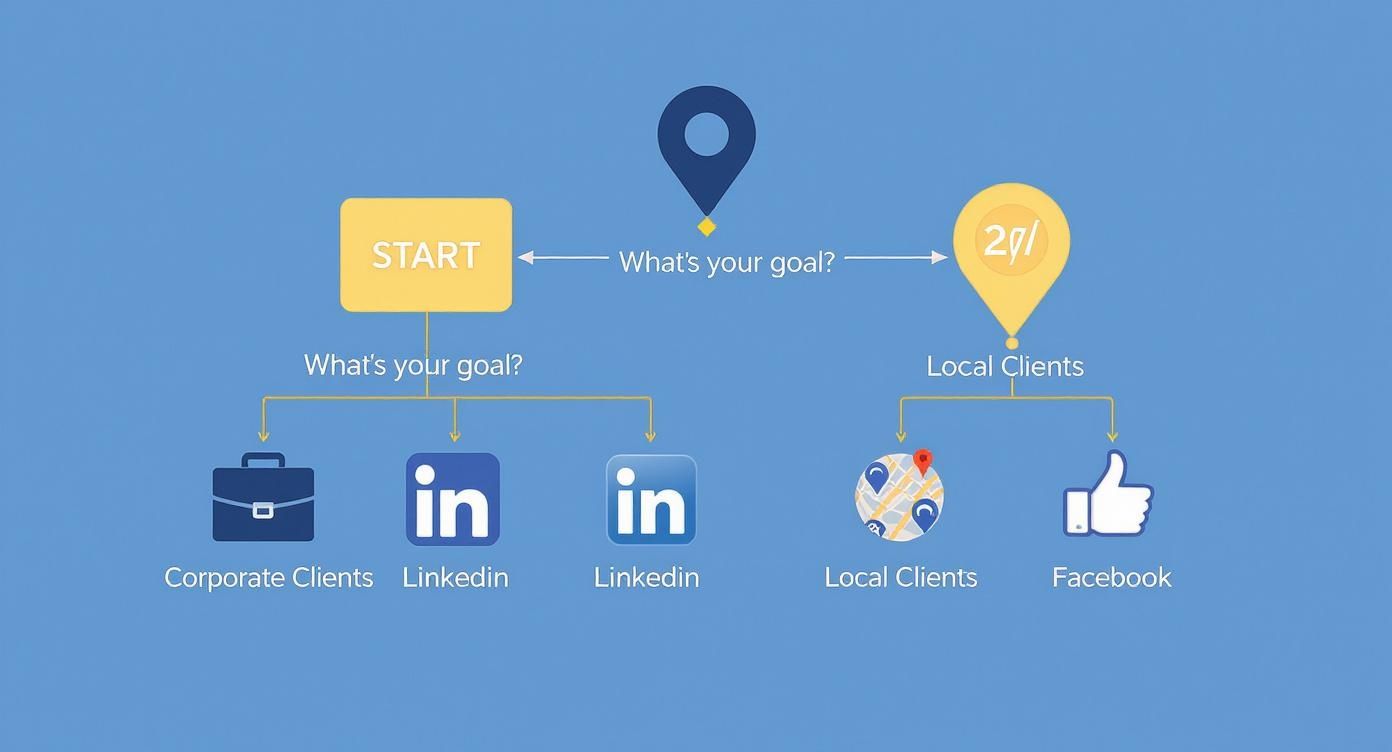
As you can see, matching your main goal with the right platform is the most efficient way to get started.
To make this even clearer, let's compare the heavy hitters side-by-side.
Strategic Social Media Platform Selection for Law Firms
| Platform | Primary Audience | Best Use Case for Attorneys | Ideal Practice Areas |
|---|---|---|---|
| Business Owners, Executives, In-House Counsel, Professionals | B2B networking, thought leadership, and building referral partnerships. | Corporate Law, Intellectual Property, Commercial Litigation, Employment Law | |
| Local Community, Families, General Consumers (Broad Demographics) | B2C lead generation, building local trust, and community engagement. | Personal Injury, Family Law, Criminal Defense, Estate Planning, Real Estate | |
| Younger Demographics (Under 40), Visually-Oriented Users | Humanizing the firm, showcasing firm culture, and sharing quick, visual tips. | Boutique Firms, Modern Practices, Personal Injury (Lifestyle Impact) | |
| YouTube | Anyone Searching for "How-To" Information and In-Depth Explanations | Creating evergreen educational content that builds long-term authority. | All practice areas, especially complex ones like Bankruptcy or Immigration Law |
This table gives you a starting point, but the real magic happens when you understand the unique culture of each platform.
LinkedIn: The Professional Powerhouse
For attorneys with a B2B focus, LinkedIn is non-negotiable. If your clients are business owners, executives, or other professionals, this is your digital headquarters. The entire platform is built around industry insights and professional networking.
This is where you establish yourself as a thought leader. Forget the hard sell; focus on content like:
- Detailed Articles: Publish in-depth posts on topics like "Navigating Commercial Lease Agreements" or "Key IP Considerations for Tech Startups."
- Case Studies: Ethically share high-level summaries of business litigation wins or complex transactional work to demonstrate your expertise.
- Strategic Networking: Directly connect with referral sources like accountants, financial advisors, and HR managers in your area.
A professional network like LinkedIn demands a polished presence. This guide on creating a business profile on LinkedIn and attracting clients is a fantastic resource for getting it right. It's where you build credibility and professional relationships that lead to high-value cases.
Facebook: The Community Connector
While LinkedIn is all business, Facebook is about personal connections and community. This makes it an incredibly powerful tool for B2C practices that serve local individuals and families—think personal injury, family law, criminal defense, and estate planning.
Facebook is still the heavyweight for lead generation among law firms. An impressive 82% of firms on social media use it, and 57% have a dedicated business page. Its real strength is in building local trust and making your firm feel approachable, not intimidating.
Key Takeaway: Facebook isn't just for vacation photos. For consumer-facing law practices, it's a lead-generation engine when used correctly. The key is to provide genuine value, engage with your local community, and build real relationships.
Effective content on Facebook looks different. It's less formal and more about helping people:
- Educational Videos: Short, simple videos answering common questions like, "What are the first steps after a car accident?"
- Community Involvement: Posts showing your firm sponsoring a local little league team or participating in a charity 5k.
- Client Testimonials: Sharing positive reviews (with explicit permission, of course) to build social proof and trust.
The ad targeting on Facebook is also incredibly precise. You can reach people in a specific zip code who have shown interest in topics directly related to your practice. Paid campaigns are a core part of a winning strategy here, and you can learn more in our dedicated guide on social media advertising for lawyers.
Visual Platforms: Instagram and YouTube
Instagram and YouTube are all about humanizing your practice and explaining complex legal ideas in a way that’s easy to digest. Instagram, with its focus on photos and short videos (Reels), is perfect for showing the people behind the law firm—your team, your values, your culture.
YouTube is a different beast entirely. As the world's second-largest search engine, it’s ideal for building a library of evergreen educational content. A well-made video on "Understanding the Probate Process in California" can attract qualified clients for years, establishing you as the go-to authority and driving traffic back to your website long after you post it.
Developing a Content Strategy That Builds Authority

Here's a hard truth about social media for lawyers: it's not about self-promotion. It's about becoming a trusted authority. Think of your content as the engine driving your entire strategy—it’s what builds a reputation, earns client trust, and ultimately gets qualified people to call your firm.
Instead of constantly shouting "hire me," the real goal is to share your expertise generously. When you consistently answer the questions your ideal clients are already asking online, you start building a relationship long before they ever need legal help. This simple shift turns your social media feed from a stale advertisement into a genuinely valuable community resource.
The Foundation of Authority: Content Pillars
The most common roadblock for attorneys is simply figuring out what to post. It's a daily struggle. The solution? Establish content pillars.
These are three to five core topics that your firm will own and discuss consistently. Pillars act as your strategic guide, making sure every single post reinforces your specific expertise and aligns with your firm’s brand. No more guesswork.
For a personal injury firm, these pillars might look something like this:
- Post-Accident Guidance: Practical content walking people through the immediate steps after a crash.
- Insurance Claim Myths: Busting common misconceptions about dealing with adjusters and lowball offers.
- The Legal Process Explained: Demystifying what actually happens during a personal injury claim, from filing to settlement.
- Firm Culture & Community: Showcasing the human side of your practice and your involvement in local events.
With pillars in place, you’re not staring at a blank screen. You just ask, "Which pillar am I supporting today?" This framework is a fundamental piece of any successful law firm content marketing plan because it forces consistency and relevance.
From Legal Jargon to Relatable Content
The real art of legal content is translating complex legal concepts into plain English. Your audience doesn’t want a legal brief; they want clear, practical answers to their immediate problems.
This is where mixing up your content formats comes in. A diverse approach keeps your audience engaged and lets you present information in the most digestible way.
- Educational Short Videos (Reels/TikToks): These are perfect for answering one specific question in under 60 seconds. A criminal defense attorney could crush it with a video titled, "3 Things You Should Never Do If Pulled Over."
- Helpful Infographics: Visually break down a complex process, like the timeline of a divorce proceeding or the steps in an estate plan.
- FAQ Posts: Just take a common client question and answer it directly in a text or simple graphic post. This positions you as an accessible, helpful expert.
This move from selling to educating isn't just a theory; the data backs it up. A solid 86% of law firm owners now use content marketing as part of their strategy. Even more telling, 31% of lawyers report having personally signed a client who came directly from their social media activity. There's a straight line from valuable content to business growth. You can discover more insights about legal marketing statistics to see just how prevalent this has become.
Showcasing Your Firm's Human Side
Legal expertise is crucial, but clients hire people they know, like, and trust. Social media is the single best place to humanize your firm and build connections that go beyond statutes and case law.
Your content should not only demonstrate what you know but also who you are. Authenticity builds the trust that legal qualifications alone cannot.
Showing off your firm's culture isn't about having a huge budget. It’s about being genuine.
Simple Ways to "Humanize" Your Firm:
- Meet the Team Features: Post a friendly photo and short bio of an attorney or paralegal. Share a fun fact or what they love to do outside of work.
- Community Involvement: Sponsoring a local 5K or a Little League team? Share photos and explain why that cause matters to your firm.
- Behind-the-Scenes Glimpses: A quick photo of your team collaborating on a case (without any confidential details, of course) or celebrating a firm milestone shows the real people fighting for your clients.
This type of content makes your firm feel approachable and less intimidating—a huge deal for potential clients who are often anxious about even picking up the phone.
Ethically Sharing Success and Building Social Proof
Sharing your wins is a vital way to show you’re competent, but it has to be done ethically and within your state bar's guidelines. The goal is to build powerful social proof without making improper promises or breaking client confidentiality.
Here’s how to get it right:
- Focus on Anonymized Outcomes: Never name clients. Instead, describe the situation and the result in general terms. For example, "Successfully negotiated a six-figure settlement for a client injured in a commercial vehicle accident."
- Use Testimonials with Explicit Consent: Client reviews are marketing gold. Always get written permission before sharing a testimonial. Better yet, turn a powerful quote into a branded graphic for your feed.
- Highlight the Process, Not Just the Payout: Talk about the strategy and hard work that went into a successful case. This showcases your diligence and expertise, which is often more impressive to potential clients than just a big dollar amount.
By building a content strategy around these principles—establishing pillars, ditching the jargon, humanizing your firm, and ethically sharing wins—you create a powerful social media presence that builds real authority and attracts the right kind of clients.
Navigating Ethics and Compliance in Legal Social Media
For a lot of attorneys, the biggest thing stopping them from using social media isn't a lack of time or tech-savvy—it's the nagging fear of an ethical misstep. Let's be honest, the rules of professional conduct were written long before "going viral" was even a phrase, which leaves a lot of gray area that can feel pretty intimidating.
But these rules aren't a brick wall. They just mean you need to be thoughtful and deliberate about your online presence. In fact, effective social media marketing for lawyers is all about building authority and trust, which lines up perfectly with your ethical duties.
Once you grasp the core principles, you can engage online with confidence, without ever putting your license on the line. The key is to treat every single post, comment, and message as a public professional statement. Your ethical obligations don't just vanish because you're on Facebook or LinkedIn.
Avoiding Unintentional Attorney-Client Relationships
One of the sneakiest risks out there is accidentally creating an attorney-client relationship. This can happen more easily than you think—if a potential client reasonably believes you're giving them specific legal advice about their situation, you could be in hot water. This is especially true in direct messages or comments.
To sidestep this, your mantra should be: stick to general information. Think of your role as a legal commentator, not a personal consultant.
- Educate, Don’t Advise: It's great to share insights about legal processes or recent changes in the law. Just never apply that information to an individual's specific set of facts.
- Use Clear Disclaimers: Your profile bio and website need to state clearly that your social media content is for informational purposes only and does not create an attorney-client relationship.
- Redirect the Conversation: If someone asks for specific advice in a comment or DM, politely guide them toward a formal consultation. A simple, "I can't provide legal advice here, but our firm offers consultations to discuss these matters. Please call our office at…" works perfectly.
Crucial Takeaway: Your social media content should be a resource, not a legal service. That line between general information and specific advice is the most important ethical boundary you have online.
The American Bar Association's Model Rules of Professional Conduct are the bedrock for most state bar regulations.
This is the starting point. These model rules directly shape the specific advertising regulations you have to follow in your state.
Complying with Advertising Rules
Every single state bar has its own set of rules for attorney advertising, and yes, your social media profiles absolutely count. These rules are there to protect the public from being misled.
For example, most states will come down hard on attorneys who call themselves an "expert" or "specialist" unless they hold an official certification. And promising a specific outcome—like "We guarantee a win!"—is a massive red flag and a clear violation.
Your content has to be truthful and can't create unrealistic expectations. It's on you to know the specific guidelines in your jurisdiction. For lawyers in California, navigating Rule 7.2 provides a detailed guide to ethical attorney advertising and is a must-read.
Finally, client confidentiality is sacred. Never, ever share details about a case, even if you change the names. A client's story is theirs to tell, not yours. If you want to share testimonials or case results, you must have the client's explicit, informed, and written consent. By making compliance a priority, you're not just protecting your professional standing—you're building a brand that clients can trust.
Measuring Success and Calculating Your ROI

Likes and followers are great for the ego, but they don't pay the bills. The real test of your social media efforts is whether they actually contribute to your firm’s bottom line. It's time to stop chasing surface-level engagement and start focusing on the numbers that truly drive growth.
This means looking right past the vanity metrics—things like page likes or video views—and drilling down to the Key Performance Indicators (KPIs) that translate into real client acquisition. The goal isn't just to be seen online; it's to connect your activity directly to qualified leads, consultation requests, and new retainers.
Moving Beyond Vanity Metrics
Vanity metrics are tempting because they’re easy to track and often look impressive. A high follower count feels like a win, but it offers zero guarantee that anyone is taking the next step to hire your firm.
The smarter play is to prioritize metrics that signal genuine interest and intent. These are the numbers that prove your social media is actively guiding potential clients from passive scrolling to taking action.
- Website Clicks: How many people are curious enough to leave the social platform and visit your firm's website? This is the first real step.
- Consultation Form Fills: This is a direct measure of lead generation. How many people who came from social media actually filled out your "Contact Us" form?
- Inbound Calls: Using a unique, trackable phone number in your social profiles shows you exactly how many calls your content is driving. No guesswork involved.
Key Performance Indicators for Attorneys
To really get a grip on what's working, you have to measure what matters. Focusing on the right KPIs gives you a clear, honest picture of your performance and shows you exactly where to double down.
Think of your social media analytics as the story of your client acquisition journey. When you learn to read them correctly, you can fine-tune your strategy and put your time and money where they’ll have the biggest impact.
To make this practical, let's break down the essential metrics you should be tracking, from top-of-funnel awareness to bottom-line business impact.
| Key Performance Indicators for Law Firm Social Media | |||
|---|---|---|---|
| Metric Category | Specific KPI | What It Measures | Why It Matters for Attorneys |
| Awareness | Reach & Impressions | The number of unique users who saw your content. | Shows the overall visibility of your firm's brand and content. |
| Engagement | Clicks, Comments, Shares | How users are interacting with your posts. | Indicates that your content is resonating and building a connection with your audience. |
| Conversion | Lead Form Submissions | The number of users who request a consultation via your website form. | A direct measure of qualified leads generated from your social media efforts. |
| Business Impact | Client Acquisition Cost (CAC) | The total cost of marketing divided by the number of new clients acquired. | Helps determine the efficiency and profitability of your social media campaigns. |
Tracking these KPIs provides a much clearer view of success than simply counting followers. Our guide on measuring advertising effectiveness goes even deeper into these concepts, helping you build out a comprehensive tracking system.
Calculating Your Return on Investment
At the end of the day, you need to know if the time and money you're pouring into social media is actually paying off. Calculating your Return on Investment (ROI) is how you prove the value of your marketing, plain and simple.
The formula is refreshingly straightforward:
ROI = (Revenue from Social Media – Marketing Costs) / Marketing Costs
Let's run a quick example. Say your firm spent $1,000 on social media ads this month. From those ads, you signed two new clients, and each case is valued at $5,000.
- Revenue: $10,000
- Costs: $1,000
- ROI = ($10,000 – $1,000) / $1,000 = 9, or a 900% return.
That simple calculation tells a powerful story, justifying every penny of your marketing spend.
The data backs this up. Social media consistently generates nearly double the leads of old-school methods like trade shows. Law firms can see an average organic conversion rate around 4%, and with ROI hitting 29% on platforms like Facebook and Instagram, the business case is hard to argue with.
Still Have Questions About Social Media for Your Firm?
Even with a solid plan, a few lingering questions can create just enough hesitation to keep you on the sidelines. Let's tackle the most common ones I hear from attorneys head-on.
Think of this as clearing up the practical, day-to-day realities of managing your firm's online presence. Once you see how manageable it is, you’ll be ready to go.
"How Much Time Will This Actually Take Every Week?"
This is always the first question, and the answer is probably less than you’re imagining. When you're just getting started, budget about 3-5 hours per week to figure out your strategy, create some initial content, and get it scheduled.
But here’s the good news: once you have a workflow down, you can maintain a powerful, consistent presence in just 2-3 hours a week. The key is using scheduling tools to "batch" your content. A focused 20-30 minutes each day is far more effective than trying to cram it all into one marathon session.
"Can Social Media Really Attract High-Value Clients?"
Absolutely. People often mistake social media for just a brand awareness tool, but when used correctly, it’s a proven machine for generating high-value cases.
- For B2B Practices: Think corporate, IP, or employment law. A platform like LinkedIn lets you connect directly with the C-suite executives and in-house counsel you want as clients.
- For B2C Practices: For personal injury, family law, or estate planning, highly targeted content and ads on a platform like Facebook can put you in front of the exact people who need your help.
The goal isn't just to be on social media; it's to build so much authority that your firm is the only one people think of when a serious legal issue pops up.
The single biggest mistake attorneys make is treating social media like a billboard. If all you do is shout "Contact us now!" you're going to be ignored. You have to generously share your expertise first to build the trust that actually turns followers into clients.
"Should I Do This Myself or Hire an Agency?"
This decision boils down to your firm's two most valuable resources: time and money.
Many smaller firms do a fantastic job managing social media in-house. The trick is to pick just one platform, get really good at it, and focus on creating authentic, valuable content.
If time is your biggest bottleneck and you have the budget, a specialized legal marketing agency will get you polished results much faster. There's also a hybrid option: your firm sets the strategy, and an agency handles the daily grind of creating and posting content. There’s no wrong answer—just the one that fits your firm's goals right now.
At Case Quota, we build and run social media strategies that don't just build your firm's authority—they drive a predictable stream of qualified leads. If you're ready to turn your online presence into a real client acquisition engine, learn more about our services at https://casequota.com.