

SEO vs PPC strategy: How Law Firms Balance Short-term Leads and Long-term Growth
Choosing the right mix of SEO and PPC can make or break a law firm’s growth trajectory. In this article we analyze the SEO vs PPC strategy tradeoffs using data and practical experiments. We focus on when to prioritize paid search for quick case intake and when to invest in organic visibility for sustainable traffic.
We begin with measured outcomes. First, we explain query intent and how AI Overviews and zero-click trends change clicks. Then we quantify short-term paid results versus long-term organic ROI, because budget and measurement maturity matter. Moreover, we show how remarketing and first-party data can blend both channels.
Next, we provide a step-by-step framework. Use paid tests to identify converting keywords. Then scale organic content around proven converting queries. As a result, you shorten time to value and reduce wasted ad spend.
Finally, we offer pragmatic recommendations for law firms at different sizes and budgets. You will get tactical priorities, measurement setups, and a sample budgeting playbook. Throughout, we cite recent studies and real-world examples to keep recommendations actionable and evidence-based.
By the end of this guide you will understand how to map campaigns to intent. You will learn how to allocate budget across channels. You will measure outcomes reliably. As a result you can decide when to accelerate with ads and when to commit to content.
Understanding the SEO vs PPC strategy for Law Firms
Law firms need both immediate intake and steady growth. Therefore, they must understand how search channels serve different goals. This section explains SEO and paid search / PPC. It shows how each supports short term leads and long term organic visibility. Above all, the goal is pragmatic and data driven decision making.
What SEO delivers
- Organic visibility that compounds over time. As a result, content continues to attract traffic months after publication.
- Cost efficiency for high volume informational queries once content ranks.
- Authority and brand presence that improve conversion rates for branded queries.
- Requires content readiness, editorial investment, and technical SEO work before results appear.
What paid search / PPC delivers
- Immediate visibility for high intent queries and urgent case intake.
- Precise control over messaging, testing, and landing pages. Therefore, you can optimize conversion quickly.
- Measurable short term revenue impact when campaigns are well tracked.
- Ongoing cost that scales with competition and bid prices.
Key differences and how to blend them
- Speed versus permanence. Paid search gives instant coverage, while SEO builds sustainable rankings.
- Testing versus compounding value. Paid campaigns reveal which keywords convert, which messaging resonates, and which landing pages drive action. Then you can scale winners into organic content.
- Cost structure. PPC uses ongoing spend. SEO asks for upfront investment and editorial bandwidth.
- Measurement hurdles. Organic measurement depends on traffic attribution and channel overlap. Therefore, firms should maintain robust first party data and consent based tracking.
Practical rules for law firms
- Use paid search to test keywords for high intent queries. Then invest in content around proven queries. This follows the adage quoted earlier: “Paid search campaigns reveal which keywords convert, which messaging resonates with different audiences, and which landing page approaches drive action.”
- Expect not all organic visitors to convert on first visit. As a result, layer remarketing and email capture to improve conversion over time.
- Recognize AI driven changes to click behavior. For example, Google rolled out AI Overviews in May 2024 and click patterns shifted dramatically. See Pew Research Center for user behavior and Seer Interactive for paid performance analysis. Relevant sources include Pew Research Center and Seer Interactive and Search Engine Land.
In short, “For most businesses, the real answer isn’t SEO or PPC; it’s SEO and PPC.” Therefore, build a blended approach that maps channels to intent and budget.
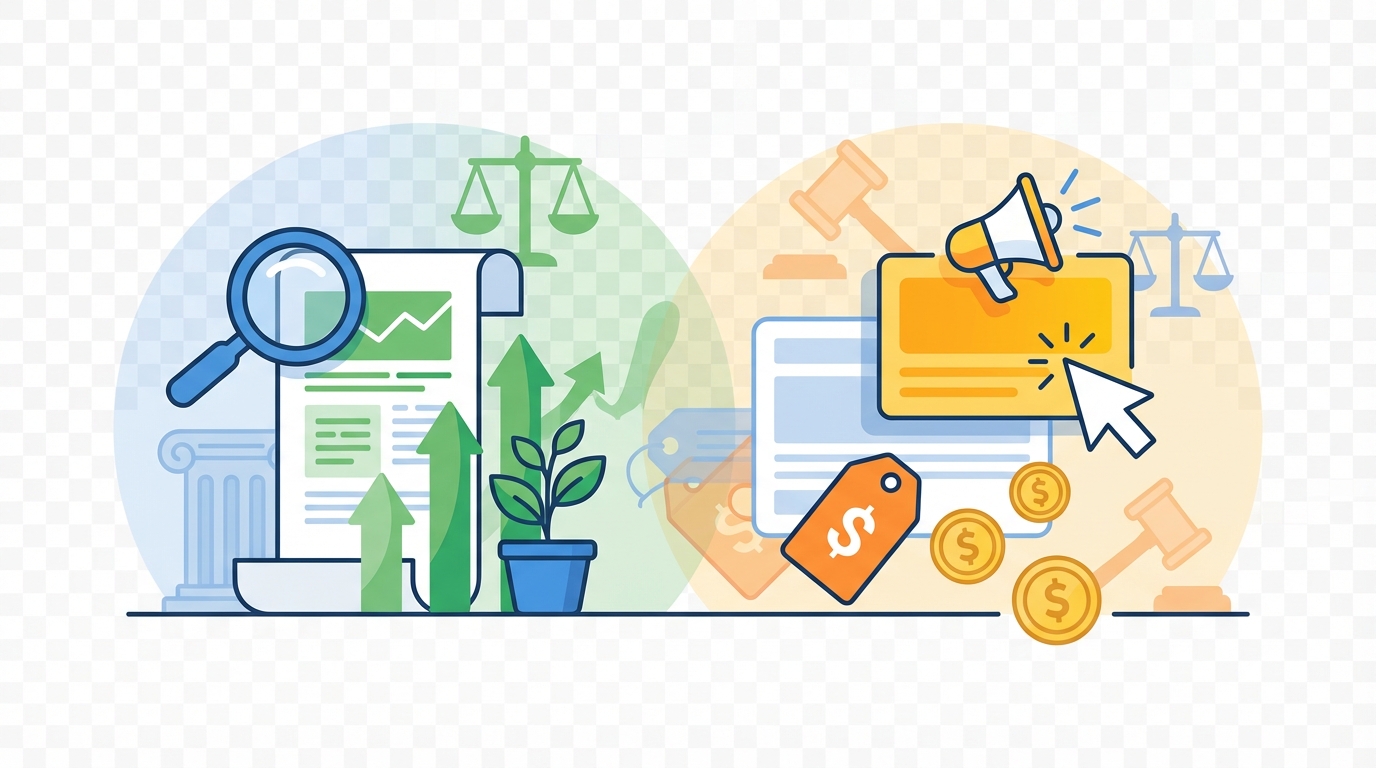
Data-Driven Evidence Comparing SEO and PPC Impact for Law Firms
Search behavior changed rapidly after AI Overviews rolled out. Google deployed AI Overviews to all U.S. users in May 2024. As a result, click patterns shifted and both organic visibility and paid performance changed. This section uses that data to compare SEO and PPC impact for law firms.
Key data points
- When AI summaries appear, users click traditional links only eight percent of the time. By contrast, clicks were 15 percent without AI summaries. See Pew Research Center for the study: Pew Research Center.
- Zero-click behavior rose in many verticals. For example, Similarweb reported zero-click news queries increased from 56 percent to 69 percent between May 2024 and May 2025. This suggests SERP features now capture more attention.
- Paid CTR on informational queries fell when AI Overviews appear. Seer Interactive found CTR dropped to 6.34 percent versus 13.04 percent without AI Overviews. View the full analysis at Seer Interactive.
- Branded searches that trigger AI Overviews saw an 18 percent increase in click-through rate. Therefore, brand presence still matters and can benefit from AI-driven summaries.
- Broader adoption of generative AI influences discovery. Deloitte found 53 percent of consumers experiment with generative AI, while Bain reported a 70 percent jump in ChatGPT usage. These trends signal a rise in AI-driven discovery pathways.
What this means for law firms
- SEO matters more for brand and content readiness. Because AI Overviews pull summaries, firms with authoritative content win branded exposure. Therefore invest in content readiness and structured data.
- PPC remains vital for high-intent queries. However, informational queries now drive fewer clicks for paid ads. Consequently, allocate paid budgets toward urgent case intake and high-intent keywords.
- Measurement and first-party data become critical. As a result, firms must build consented tracking and remarketing audiences to re-capture zero-click users.
- Test then scale. Paid search reveals which messaging converts. Then, convert winning ads into organic content and landing pages. As the article notes, “Paid search campaigns reveal which keywords convert, which messaging resonates with different audiences, and which landing page approaches drive action.”
Practical implications for SEO vs PPC strategy
- Prioritize PPC for short-term lead flows on high-intent queries. Then use insights to guide SEO topics.
- Invest in brand authority and technical SEO to improve organic visibility for branded queries and SERP features.
- Build remarketing lists and email capture to offset zero-click drift and maximize lifetime value.
- Finally, plan for AI readiness across content, schema, and measurement because AI-driven discovery will grow.
Together these data points show why a blended SEO vs PPC strategy is the most resilient option for law firms.
Comparison Table: SEO vs PPC Strategy Benefits for Law Firms
| Aspect | SEO | PPC (paid search / PPC) | Practical note for law firms |
|---|---|---|---|
| Lead generation speed | Slow to build; fast scale after ranking | Immediate visibility; quick case intake | Use PPC for urgent leads; SEO for steady flow |
| Cost efficiency | Lower marginal cost over time; needs editorial investment | Ongoing spend tied to bids and volume | Invest in SEO for long term ROI; use PPC for testing budgets |
| Brand presence and SERP features | Builds authority and organic visibility; helps branded queries | Ads can dominate top positions; helps immediate brand capture | Focus organic for SERP features; combine with branded PPC |
| Measurement maturity and first-party data | Requires attribution models and content-level tracking | Highly measurable; direct attribution to spend | Build consented tracking and remarketing lists |
| Typical timeline to results | Months to 12+ months depending on competition | Days to weeks with immediate traffic | Plan mixed timelines and pace budgets accordingly |
| Impact of AI Overviews and AI-driven discovery | Can reduce clicks on organic snippets; content readiness helps control summaries | Paid CTR on informational queries can fall; ads still work on high-intent queries | Prioritize AI readiness, schema, and branded content |
| Scalability and ongoing cost | Scales with content output; lower marginal cost over time | Scales with budget; costs rise with competition | Use PPC for short spikes; scale SEO for sustainable growth |
| Best use cases | Evergreen guides, practice area pages, and brand awareness | Urgent intake, bidding on high-intent queries, and testing | Test with PPC then optimize content and organic pages |
CONCLUSION
A blended SEO vs PPC strategy gives law firms the best of both worlds. SEO builds organic visibility and brand equity over time. Meanwhile PPC delivers immediate visibility for high-intent queries and urgent case intake. Therefore a combined approach captures short-term leads while also funding long-term growth.
Data shows search behavior is changing fast because of AI Overviews and AI-driven discovery. As a result, click volumes for traditional links have fallen on some queries. However branded queries can still benefit from organic authority and SERP features. Consequently firms should prioritize content readiness, structured data, and measurement maturity to protect organic gains.
Practically, use paid search to test messaging and find converting keywords. Then convert winning ad approaches into organic pages and evergreen guides. Also build first-party audiences and remarketing lists to recover zero-click users. Finally, align budgets so PPC covers immediate intake and SEO compounds value over months.
Case Quota specializes in bringing Big Law level strategies to small and mid-sized firms. Their approach mixes data-driven paid search with content systems and AI readiness. If you want a partner that scales paid wins into organic authority, explore Case Quota’s services at Case Quota.
Start with a simple test. Allocate a controlled PPC budget to high-intent queries and measure conversions. Then invest editorial resources in proven topics. As a result you shorten time to value and build durable market presence.
In short, the right SEO vs PPC strategy maps channels to intent, budget, and measurement capability. Adopt a pragmatic, data-driven plan and you will capture immediate cases while building long-term dominance.
Frequently Asked Questions (FAQs)
Should my law firm prioritize SEO or PPC?
A blended SEO vs PPC strategy usually works best. For most firms, use PPC for immediate case intake. Then invest in SEO to build organic visibility and brand equity. Paid tests reveal which keywords convert. As a result, you can scale winning topics into content.
How fast will PPC deliver leads compared to SEO?
PPC drives traffic in days to weeks. SEO often takes months to rank and stabilize. Therefore, PPC suits urgent intake and high-intent queries. Meanwhile, SEO compounds value and lowers marginal cost over time. Combine both to capture immediate leads while you build long-term traction.
How do AI Overviews and zero-click trends change strategy?
AI Overviews reduced clicks on traditional links, according to Pew Research. Paid CTR on informational queries fell too, per Seer Interactive. In addition, zero-click rates rose in some verticals. So prioritize content readiness and branded pages. Also build remarketing lists and first-party audiences to recapture zero-click users. For details see the Pew study and Seer’s analysis.
How should small and mid-size law firms allocate budget?
Start with a test split based on urgency and capacity. For example, allocate 60 percent to PPC and 40 percent to SEO when you need immediate leads. Shift gradually to 30/70 as SEO gains traction. However adjust by competition and conversion rates. Also reserve budget for remarketing and measurement improvements.
How do we measure success and avoid wasted ad spend?
Track conversions at the campaign and landing page level. Use first-party data and consented tracking. Then attribute leads across touchpoints with a simple model. Also run short paid experiments to validate keywords. Finally, feed results into your content plan to lower acquisition cost over time.
If you follow these practical steps, you will map channels to intent and budget. Therefore your SEO vs PPC strategy will deliver both short-term revenue and long-term growth.