

If you’re not taking SEO for immigration attorneys seriously, you’re essentially handing new clients to your competitors. This isn't just about buzzwords or digital marketing; it's about building an automated, predictable system for bringing new cases through your door. Let's cut through the jargon and get straight to what a powerful online presence means for your firm's bottom line.
Why SEO Is a Non-Negotiable Investment

Today, your firm’s growth is directly tied to how easily it can be found online. When individuals and families are facing overwhelming immigration issues, their first action isn't opening a phone book—it's opening Google.
If your firm doesn’t show up on that critical first page of search results, you might as well be invisible. You're missing out on the vast majority of potential clients who are actively looking for the exact services you provide.
A smart SEO strategy makes sure that when someone in your city searches for "deportation defense lawyer" or "H-1B visa attorney," your firm is the one they find. This isn't about casting a wide, hope-for-the-best net. It’s about precision-targeting clients with urgent needs right when they're searching for help.
The Financial Stakes of Digital Visibility
The competition in this space is intense for a reason. The U.S. immigration law market is projected to hit $10.6 billion by 2026, serving a community of over 47 million immigrants. Every single one of those clients represents thousands of dollars in potential revenue. That simple fact turns the fight for online attention into a high-stakes game.
This is why SEO isn't just a marketing line item; it's a core business-growth engine. It delivers a steady stream of qualified leads without the endless, recurring costs of pay-per-click ads or traditional advertising.
Your ideal clients aren’t looking at billboards anymore. They are typing their legal problems into a search bar. Being there in that moment is the single most important factor for modern client acquisition.
Differentiating Your Firm in a Crowded Field
A well-executed SEO plan does more than just drive traffic. It builds your firm’s authority and establishes trust before a prospect even picks up the phone. By creating content that genuinely answers their most pressing questions, you position your practice as a credible, expert resource.
Highlighting your expertise in specific, critical areas, like providing immigration attorney bond support, can dramatically boost your visibility and attract clients who need specialized help right away.
This is why investing in SEO for immigration attorneys is a direct investment in the long-term health and profitability of your practice. To get a better handle on the foundational principles that apply across all legal specializations, take a look at our guide on the fundamentals of SEO for law firms.
Why Standard Marketing Is Not Enough
Relying solely on old-school marketing tactics in today's digital-first world is like trying to compete in a car race on a bicycle. The methods are outdated, and the results are nearly impossible to measure effectively.
Here’s a clear breakdown of why a targeted SEO strategy outperforms traditional methods every time.
| Metric | Traditional Marketing (e.g., Billboards, Print) | SEO for Immigration Attorneys |
|---|---|---|
| Audience Targeting | Broad, untargeted audience (whoever sees it) | Highly targeted individuals actively searching for legal help |
| Client Intent | Passive; viewers may not need services now | High-intent; searchers have an immediate, urgent need |
| Cost | High recurring costs with unclear ROI | Upfront investment with compounding, long-term returns |
| Measurability | Very difficult to track leads and conversions | Every click, call, and form submission is trackable |
| Trust Building | Relies on brand recognition alone | Builds authority through helpful content and expertise |
| Longevity | Impact ends when the campaign stops | Rankings and content continue to generate leads for years |
The table makes it obvious: while traditional marketing shouts a message into a crowd, SEO has a direct, one-on-one conversation with your ideal client at the exact moment they need you most. This shift is fundamental to building a modern, thriving immigration law practice.
Finding the Keywords Your Future Clients Actually Use
Effective SEO for an immigration firm starts with one simple truth: you have to understand the exact words potential clients use when they’re stressed, confused, and desperately searching for help.
Chasing a broad term like "immigration lawyer" is a rookie mistake. It’s a crowded battlefield, and honestly, it’s not how most of your best clients are searching anyway. Your goal is to meet them right at their point of need, using the specific phrases they’re typing into Google.
This means you have to get out of the "lawyer mindset" and think like someone facing a real, often urgent, immigration problem. They aren't just looking for an attorney; they're looking for an answer.
Beyond the Obvious Search Terms
Your ideal clients are using very specific, high-intent phrases that signal they’re ready for help. These usually fall into a few key buckets that should be the bedrock of your keyword strategy.
- Service-Specific Keywords: This is about targeting the precise legal service someone needs. Think "H-1B visa lawyer," "deportation defense attorney," or "how to apply for a green card."
- Location-Based Keywords: Local search is everything. A potential client is almost always looking for help nearby. They're searching for "immigration attorney in Miami" or "abogado de inmigración cerca de mi."
- Question-Based Keywords: A huge volume of searches begins with a question. "What happens if my visa expires?" or "can I work on a tourist visa?" are prime examples.
When you organize your keywords this way, you start capturing clients at every stage—from the person just beginning their research to the one who’s ready to pick up the phone. This whole process is a core part of a bigger picture, which we break down in our guide to law firm content marketing.
Uncovering High-Intent Multilingual Keywords
It’s shocking how many firms miss this. A huge portion of your potential clients probably aren’t searching in English. Ignoring multilingual keywords is like leaving the front door of your office locked.
Terms like "abogado de inmigración," "avocat d'immigration," or searches in Mandarin, Hindi, and other languages common in your community are absolute goldmines.
A person searching in their native language is often far more comfortable and ready to trust a firm that speaks their language. It builds an instant, powerful connection before they’ve even clicked on your site.
For immigration lawyers, digging into localized keyword research is non-negotiable. It helps you uncover the exact terms—including those crucial multilingual variations—that people in your specific city or neighborhood are using to find help.
Tools for Practical Keyword Discovery
You don’t need a massive budget to get started. A smart mix of free and paid tools will give you all the data you need to build a killer strategy.
- Google's Free Tools: Start right at the source. The "People Also Ask" and "Related Searches" sections on Google's results page are phenomenal for finding long-tail keywords and common questions. Google Keyword Planner, though built for ads, is still a great way to find keyword ideas and get a rough sense of search volume.
- Competitor Analysis: Why reinvent the wheel? Look at the firms that are already ranking at the top for your dream keywords. Tools like Ahrefs or Semrush let you peek under the hood and see exactly which keywords are sending them traffic. It’s one of the fastest ways to find proven terms you might have overlooked.
- Client Conversations: Honestly, your best keyword research tool is right in your office. Listen carefully to the exact words your clients use during their initial consultation. How do they describe their problems? Those are the most authentic, high-intent keywords you'll ever find.
Getting this initial research right is everything. It's the foundation for your website content, your blog posts, and your local SEO. With the right keywords, you're not just creating content; you're building a direct path for new clients to find you.
Structuring Your Website to Convert Visitors Into Clients

Think of your website as your most diligent employee. It works 24/7, greeting potential clients, figuring out what they need, and guiding them toward a consultation. A messy or confusing site is like having a disorganized front office—it makes a terrible first impression and sends qualified leads straight to your competitors.
An effective site structure isn't just about looking good; it's a strategic map for both users and search engines. When someone lands on your site, they need to know instantly where to go for their specific, often urgent, problem. Getting this right is the first step in turning a curious visitor into a paying client.
Building Your Core Practice Area Pages
Your practice area pages are the digital storefronts for your services. You could argue they're the most important conversion-focused pages on your entire site, and they need to be treated that way. These pages have to be much more than a simple list of what you do.
Each page should be a comprehensive, standalone resource dedicated to a single service. For instance, a page targeting "Deportation Defense Attorney in Dallas" must answer every critical question someone facing deportation might have. This approach not only builds immense trust but also helps you rank for those high-intent, service-specific keywords we talked about earlier.
A well-built practice area page does more than inform—it reassures. It tells a potential client, "You've come to the right place; we understand exactly what you're going through and we know how to help."
To turn these pages into true client-magnets, you absolutely must include:
- A Clear Explanation: Break down the legal process into simple, easy-to-understand language.
- Eligibility Requirements: Clearly outline who qualifies for that specific visa or form of relief.
- Common Challenges: Address the likely hurdles head-on and explain how your firm helps clients overcome them.
- Success Stories: Share anonymized case studies or client testimonials that are directly relevant to that service.
- A Direct Call-to-Action: Make it incredibly obvious how to "Schedule a Consultation" or "Call Us Now."
This level of detail is crucial. Remember, the average content length for a page-one Google result is nearly 1,500 words, which tells us that Google rewards in-depth, authoritative content.
Using a Blog and FAQs to Capture More Traffic
While your practice pages target people ready to hire an attorney, your blog and FAQ section are for those still in the research phase. This is your chance to answer the thousands of "what if" and "how to" questions that people type into Google every single day.
A blog post like "What to Do If Your Green Card Application Is Delayed" can attract someone who doesn't think they need a lawyer yet, but probably will soon. By providing a genuinely helpful answer, you become their go-to resource. When their situation gets more serious, your firm will be the first one they call.
Likewise, a well-organized FAQ page acts as a central hub for answering common questions about visa types, legal fees, and application timelines. This not only makes for a better user experience but also helps you rank for a huge variety of long-tail, question-based keywords. Of course, great content is just one piece of the puzzle; for more on the visual and functional sides of the equation, it's worth understanding the core principles of effective web design for attorneys.
Essential Content for an Immigration Law Firm Website
To build a powerful, client-generating website, you need a mix of content, with each piece doing a specific job. Here is a simple breakdown of the non-negotiable pages every immigration law firm needs and their strategic purpose.
| Content Type | Primary Goal | Example SEO Keyword Target |
|---|---|---|
| Practice Area Pages | Convert high-intent visitors into leads | "family-based visa lawyer Houston" |
| Attorney Profile Pages | Build trust and showcase expertise | "[Attorney Name] immigration lawyer" |
| Blog Posts | Attract and educate top-of-funnel traffic | "how to prepare for a citizenship interview" |
| FAQ Section | Answer common questions and capture long-tail keywords | "cost of an immigration lawyer" |
| Testimonials/Reviews | Provide social proof and build credibility | "best immigration attorney reviews [City]" |
By thoughtfully putting these core components together, you create a system that works around the clock to bring you business. You'll attract more of the right clients, answer their questions with authority, and seamlessly guide them toward hiring your firm. This structure is the very foundation of effective SEO for immigration attorneys.
Dominating Local Search With Google Business Profile
For an immigration law firm, the battle for local clients is often won or lost before someone even clicks on your website. It all happens in the Google Map Pack—that prime real estate at the top of the search results for queries like "immigration lawyer near me."
Your key to owning that space? A perfectly optimized Google Business Profile (GBP).
Think of your GBP listing as your digital front door. Seriously. Research shows that 76% of people who search for a nearby service on their phone will visit a related business within a day. If your profile is barren or inaccurate, you're essentially turning away clients who are right in your neighborhood and ready to hire you.
Setting Up Your Profile for Success
Just claiming your GBP listing isn't enough. You have to treat it with the same care and attention you give your firm's homepage. This is often the very first impression a potential client gets, and every single detail matters.
Get the basics right, but make them perfect. Your primary business category must be "Immigration attorney." This is non-negotiable. It’s the clearest signal you can send to Google about what you do. For secondary categories, you can add things like "Law firm," but that primary choice is absolutely critical.
Next, lock down your NAP (Name, Address, Phone Number). It needs to be identical everywhere—on your website, your GBP, and any other online directory. A tiny inconsistency, like "St." versus "Street," can be enough to confuse search engines and hurt your local rankings.
Optimizing Every Section of Your GBP
A complete, fully built-out profile signals to Google that you're an active, legitimate, and trustworthy business. Go way beyond the basics and use every feature GBP offers.
- Business Description: This is your mini-elevator pitch. You have 750 characters, so make them count. Write a compelling description of your firm, naturally weaving in keywords like "family-based visas," "deportation defense," and your city name.
- Services: Don't just list "Immigration Law." Get granular. Detail every single service you offer—H-1B Visas, Green Card Applications, Asylum Petitions, Citizenship, you name it. Each service you add is another keyword you can potentially rank for.
- Photos and Videos: People hire people. Upload high-quality photos of your office (both inside and out), your team, and professional headshots of the attorneys. It humanizes your firm and builds instant trust.
- Google Posts: Use this feature like a mini-blog. Share firm news, link to your latest blog posts, or highlight recent case successes. Consistent posting shows Google your profile is actively managed, which is a solid ranking signal.
For a much deeper dive into turning your profile into a client-generating machine, check out these proven Google Business Profile tweaks for attorneys that can give you a serious competitive edge.
The Power of Client Reviews
Your reputation is built on what your clients say about you online. Reviews aren't just a "nice-to-have"; they are a massive local ranking factor and the social proof that new clients desperately need before they'll even consider picking up the phone.
A steady stream of positive, five-star reviews tells both Google and potential clients that your firm gets results. Don't be passive about this. A single bad review left unanswered can scare away a surprising number of people.
The key is to build a simple, repeatable process for asking. When you wrap up a successful case, ask your satisfied client for their feedback. Make it incredibly easy for them by sending a direct link to your GBP review page via email or text. This one small step can completely transform your local visibility.
Responding to all reviews—good and bad—is just as important. A thoughtful, professional response to a negative review shows you care about client outcomes and can often neutralize the damage. This proactive approach to reputation management is a cornerstone of effective local SEO for immigration attorneys.
Building Authority That Google Trusts
Getting your keywords and on-page optimizations right is the foundation. But if you want to truly own the search results, your firm needs something that can't be tweaked in a title tag: authority.
Google's entire mission is to point users to the most credible, trustworthy experts. One of the biggest ways it measures this is by looking at who links to you. Think of high-quality backlinks as digital referrals from other respected players on the web.
Every link from a reputable website is a "vote of confidence." It signals to Google that your firm is a legitimate, respected voice in immigration law. This whole process, often called link building or digital PR, is what separates the law firms that just show up online from the ones that truly command their market.
Earn Links by Being the Expert
Let’s get one thing straight: the best links aren't bought, they're earned. The only sustainable way to build a powerful backlink profile is to create resources and share expertise that others can't help but reference. You have to shift your thinking from "how do I get links?" to "how can I provide so much value that people want to link to me?"
Your firm is sitting on a goldmine of knowledge that journalists, bloggers, and community leaders are desperate for. By sharing it strategically, you can attract the kind of high-authority backlinks that will rocket your rankings.
Here are a few proven, ethical strategies that work wonders for immigration firms:
- Be a Go-To Source for Journalists: Reporters constantly need expert legal takes on breaking immigration news. Sign up for services like Help a Reporter Out (HARO) to connect with them. Landing even one sharp, insightful quote can earn you a link from a major news outlet.
- Create "Link-Worthy" Content: Go beyond basic service pages. Develop comprehensive guides, checklists, or infographics that are genuinely indispensable. Think about it: a deep-dive "Ultimate Guide to the H-1B Visa Process" is far more likely to get linked to than another generic page.
- Sponsor Local Events and Charities: Plant roots in your community. Sponsoring a local cultural festival or a nonprofit that assists immigrant families often comes with a backlink from their website. That's a huge local signal for Google.
The Power of Local and Niche Connections
Sure, a link from a national newspaper is a grand slam. But don't sleep on the power of local and niche-specific links. They're often easier to get and send incredibly relevant signals to Google about who you are and where you operate.
A link from your city's Chamber of Commerce or a respected community blog tells Google, "This law firm is a trusted, active part of this community's fabric." You can't buy a stronger signal for local SEO.
Look for opportunities within your legal ecosystem. Could you write a guest post for another legal blog? Be a guest on a podcast for lawyers? Getting listed in top-tier legal directories like Avvo or Justia also builds highly relevant authority. It’s also vital to proactively manage your firm's online image; you can learn more in our detailed guide on reputation management for attorneys.
Building authority is a long game, but it’s the one that pays the biggest dividends. It cements your credibility, drives high-quality referral traffic, and is the secret ingredient to owning the top spots for your most important keywords.
Your First 90 Days: A Practical SEO Roadmap
Alright, we've covered a lot of ground. Taking all these concepts and putting them into practice can feel overwhelming. I get it. The trick isn't to boil the ocean and do everything at once.
Instead, you need a structured, manageable plan. Let's break this down into a practical 90-day roadmap, turning theory into tangible results for your firm with focused, monthly sprints.
Month 1: Foundational Setup (Weeks 1-4)
The first month is all about getting your house in order. Think of it as building a solid foundation for all the growth to come. This work isn't always glamorous, but it's absolutely crucial for long-term success in SEO for immigration attorneys.
Your primary focus is on two core tasks: a deep dive into your website's technical health and supercharging your Google Business Profile.
- Technical SEO Audit: First things first, you need to find and fix anything that’s holding your site back. We're talking broken links, sluggish page speed, and making sure your site works perfectly on a smartphone.
- Google Business Profile Optimization: Go through your GBP with a fine-tooth comb. Complete every single section—from adding detailed service descriptions to uploading high-quality photos of your team and your office.
- Initial Keyword Mapping: Start connecting the dots. Assign your most important local and service-based keywords to their most relevant pages on your website.
By the end of month one, you should have a technically sound website and a fully optimized GBP listing that acts as a powerful local magnet for potential clients. This groundwork makes every single thing you do next that much more effective.
Month 2: Content Creation and On-Page SEO (Weeks 5-8)
With a solid foundation in place, month two is all about creating the high-value content that actually attracts and converts clients. This is where you start building out your most important digital real estate: your practice area pages.
The goal here is to prove your expertise to people actively searching for the services you offer.
- Develop Core Practice Area Pages: Don't just list your services; build comprehensive, in-depth pages for your top 3-5 practice areas (like Deportation Defense or Family-Based Visas). These pages need to be the definitive resource, at least 1,000-1,500 words long, answering every possible question a potential client might have.
- Publish Your First Blog Posts: Using the question-based keywords you found, write and publish two or three blog posts. Focus on addressing common client pain points and anxieties head-on.
Month 3: Authority Building and Reputation Management (Weeks 9-12)
In the final month of this initial push, we shift our focus to amplifying your presence and building trust. You've got great content on a well-oiled website; now it’s time to get more eyes on it and solidify your firm's reputation.
This process takes time. You start by building your own resources and gradually earn external validation through features and backlinks from other trusted sites.
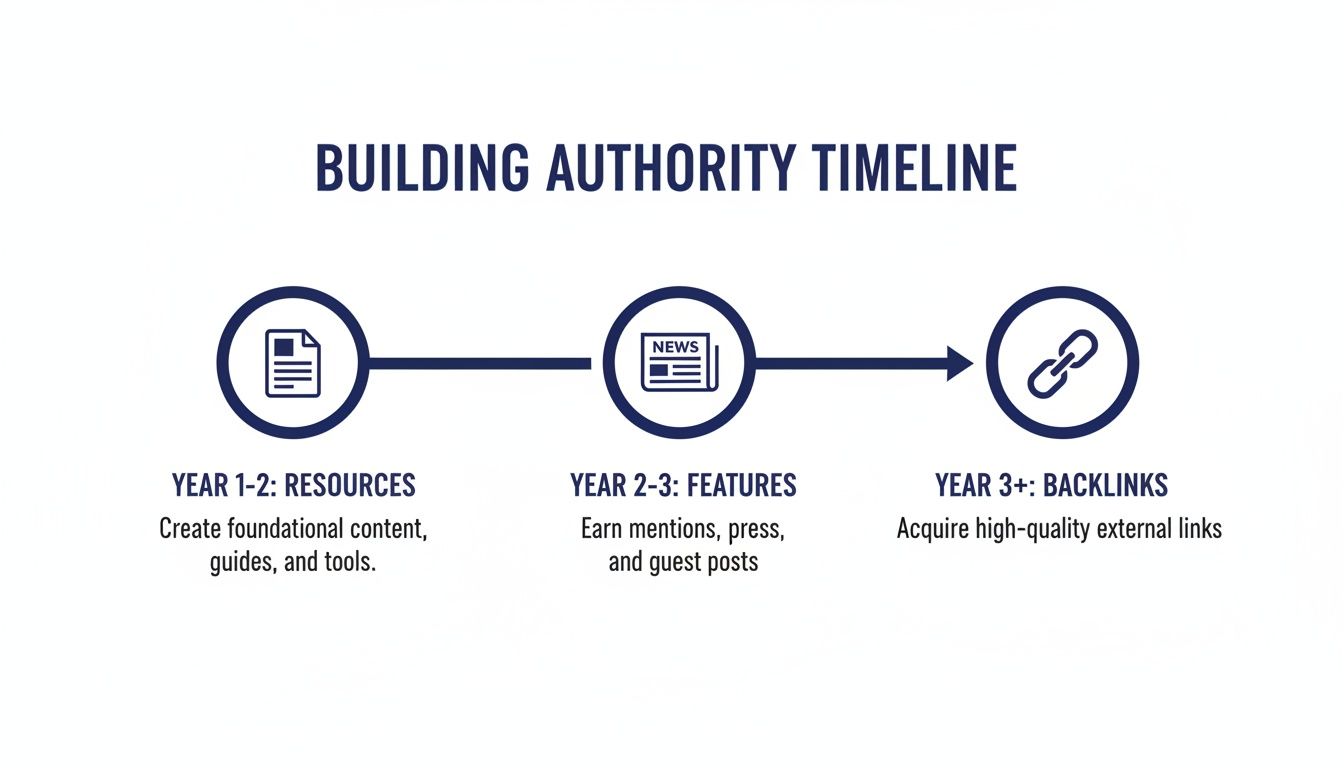
As you can see, real authority isn't built overnight. It’s a strategic journey that moves from the content you own to the media you earn.
- Implement a Review Generation System: Create a simple, repeatable process for asking satisfied clients for reviews. This is the single best way to bolster your GBP listing and build social proof.
- Begin Local Link Building: Start getting your name out there. Secure listings in key legal directories and reach out to local organizations or community groups for potential sponsorships or features.
Following this 90-day plan gives you a clear, actionable path to get your firm’s SEO off the ground. It’s about building momentum, one strategic step at a time.
Common Questions About SEO for Immigration Lawyers
Diving into SEO can feel like learning a new language. You know it’s essential, but you’ve got questions about the timeline, the cost, and where to even begin. Let’s tackle some of the most frequent questions we get from immigration attorneys who are exactly where you are now.
How Long Does It Really Take to See Results?
This is always the first question, and the honest-to-goodness answer is that SEO is a marathon, not a sprint. It's about building a long-term asset, not flipping a switch for overnight leads.
You can often see some encouraging early signs—like better visibility in the local Google Map Pack—within 3-4 months. But getting to the top of page one for competitive terms like "immigration attorney in [your city]"? That's a different game. That typically takes a focused, consistent effort over 6-12 months.
The real power of SEO is that it compounds. Unlike a paid ad that vanishes the moment you stop paying, every piece of content and every backlink you earn continues to build your firm's authority for years to come.
Can I Do SEO Myself, or Should I Hire an Agency?
You can absolutely get your hands dirty with some foundational SEO. Taking control of your Google Business Profile and creating a solid process for gathering client reviews are manageable tasks you can do in-house. Frankly, it's a great place to start.
But when you get into the weeds—the complex multilingual keyword research, creating truly authoritative content, deep technical audits, and building high-quality backlinks—it becomes a full-time job. A specialized agency that lives and breathes SEO for immigration attorneys doesn't just speed things up; they help you sidestep costly mistakes and let you get back to what you're best at: practicing law.
What Is the Single Most Important Part of SEO?
If I had to tell you to focus on just one thing, it would be local SEO. Hands down. For the vast majority of immigration firms, your next client is searching for help right in your own backyard. Winning the local search battle is the most direct path to getting your phone to ring.
This boils down to three core activities:
- A flawless Google Business Profile. Every single section needs to be filled out with care and detail.
- A steady stream of positive client reviews. This builds the social proof and trust that turns a searcher into a consultation.
- Website content that screams "local." Your pages should be laser-focused on your city and the specific concerns of the people living there.
When someone in your area searches for "immigration lawyer near me," these are the very things that will put your firm at the top of their screen.
How Should I Handle a Negative Online Review?
It's going to happen eventually, and how you respond says everything. A negative review isn’t a disaster unless you ignore it or get defensive. The key is to act fast and professionally.
Your best move is to post a public response that is calm, professional, and helpful. Thank them for the feedback, acknowledge their frustration, and—most importantly—offer to take the conversation offline to resolve it. A composed response shows potential clients that you take service seriously, which can completely neutralize the impact of the bad review.
At Case Quota, we build marketing playbooks that help immigration law firms like yours get noticed and attract the right kind of clients. We get the unique challenges and opportunities you face every day.
Ready to turn your website into a client-generation machine? Learn more and schedule your consultation at https://casequota.com.