

Search engine marketing, or SEM, is all about getting your law firm in front of potential clients at the precise moment they’re searching for legal help. It's a direct line to people who are actively looking for the services you provide, combining paid ads (PPC) and organic search optimization (SEO) to turn a Google search into your next signed case.
Building Your Law Firm's SEM Blueprint
Before you even think about spending a dollar on ads, you need a rock-solid plan. Great SEM isn't about throwing money at keywords and hoping for the best; it's about creating a repeatable system that consistently delivers the right kind of clients to your firm. The most powerful strategies weave together paid search and organic SEO to dominate the search results page, ensuring your firm is impossible to miss.
This isn't just theory—it's an actionable framework. It all starts with setting crystal-clear goals. Are you trying to book more divorce consultations over the phone? Or are you focused on landing a few high-value personal injury cases each quarter? Your answer to that question will shape every single decision you make down the line.
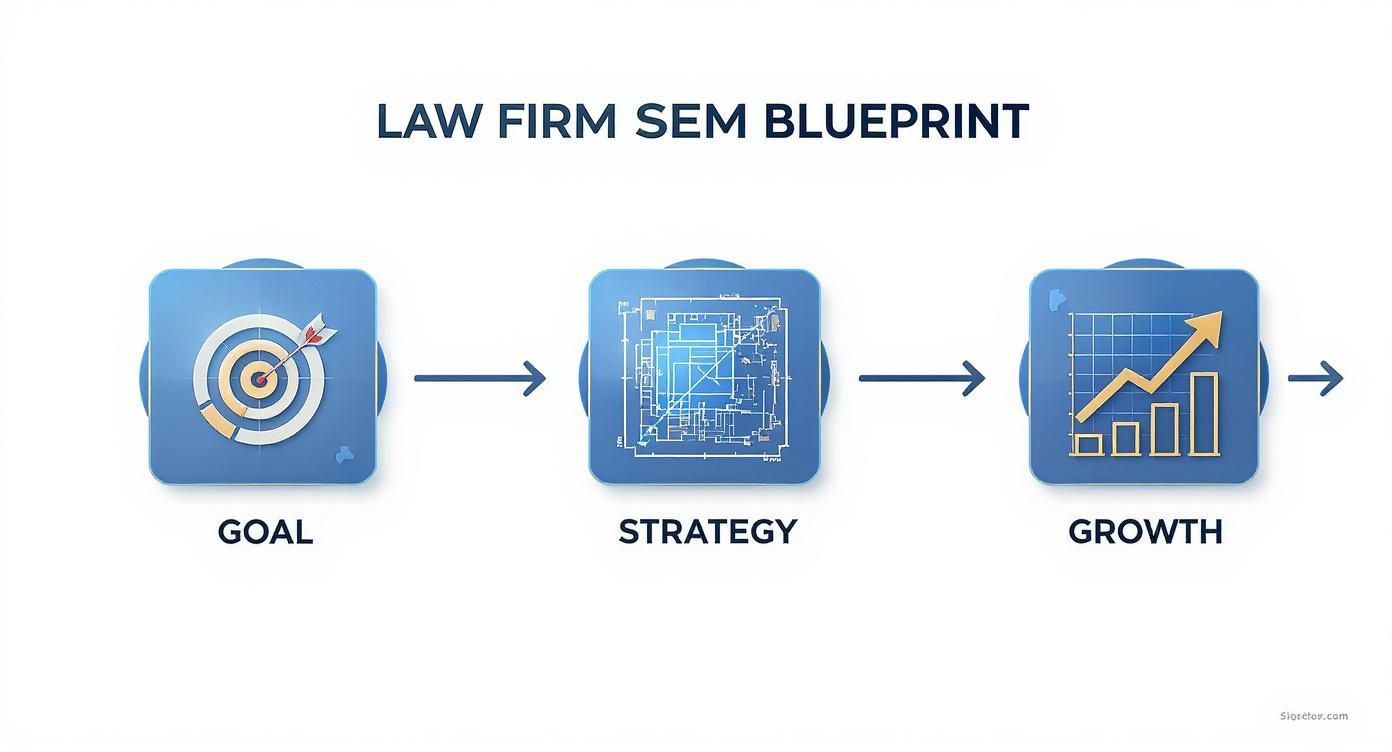
As you can see, a clear strategy is what connects your firm’s goals to actual, measurable growth.
Defining Your Core Objectives
Every marketing dollar you spend should be tied to a specific, measurable business outcome. Without a target, you're just firing in the dark, and you'll have no real way of knowing what's working.
Think about what success actually looks like for your firm. Here are a few common objectives we see:
- Increase Qualified Leads: Generate 25 new client inquiries per month through the website's contact form.
- Boost Phone Consultations: Drive 40 inbound calls each month directly from paid search ads.
- Dominate a Niche Practice Area: Become the top search result for a specific service, like "Chapter 13 bankruptcy attorney," in your city.
A well-defined goal transforms your marketing from a line-item expense into a revenue-generating investment. Don't just aim for "more website traffic." Aim for "generating 20 qualified family law leads per month with a cost-per-acquisition under $500."
Integrating SEO and PPC for Maximum Impact
While SEM is the umbrella term for both SEO and PPC, too many firms treat them like they live on separate islands. The truth is, they're most powerful when they work together. SEO builds your firm's long-term authority and organic ranking, while PPC provides immediate visibility and a treasure trove of keyword data you can act on today.
The synergy is undeniable. Consider that a staggering 96% of people looking for legal advice start with a search engine. Organic search is a beast, driving over 52% of all website traffic for law firms—blowing other channels out of the water. Your SEM plan has to tap into both the speed of paid ads and the long-term credibility of organic search.
Before we dive into the nuts and bolts, it's helpful to have a clear picture of how these core components fit together.
Core SEM Components for Law Firms
| Component | Primary Goal | Key Metric |
|---|---|---|
| PPC Advertising | Generate immediate leads from high-intent searchers. | Cost Per Acquisition (CPA) |
| SEO | Build long-term authority and organic visibility. | Organic Keyword Rankings |
| Landing Pages | Convert ad clicks into client contacts (calls/forms). | Conversion Rate |
| Analytics | Measure performance and identify growth opportunities. | Return on Ad Spend (ROAS) |
This table maps out the essential pillars. A holistic blueprint that integrates each of these is what separates firms that get by from those that truly dominate their market. To get the full picture, you can explore this detailed guide on creating a law firm marketing plan that aligns all your digital efforts for compounding returns.
Winning the Legal Keyword Research Battle

Success with paid search comes down to one thing: getting inside the head of a potential client at their moment of crisis. They aren't just browsing; they're looking for an immediate solution to a serious problem. This is where you can leapfrog competitors who are stuck bidding on broad, wildly expensive terms like "lawyer" or "attorney."
Your entire goal is to intercept a search that screams "I need to hire a lawyer, now."
Think about the massive difference between a search for "car accident laws" and one for "car accident lawyer free consultation Los Angeles." The first is research. The second is a buying signal. Understanding that distinction is the absolute core of effective keyword research for law firms.
Uncovering High-Intent Keywords
The real gold isn't in the single-word searches; it's in the longer, more specific phrases known as long-tail keywords. These are less competitive and convert at a much higher rate precisely because they're so specific. They mirror the exact questions and urgent thoughts of someone looking for legal help.
You have to put yourself in their shoes. What problem are they trying to solve this very second?
- A family law firm shouldn't just target "family lawyer." They should go after phrases like "emergency child custody order California."
- A criminal defense attorney will find better clients by focusing on "first offense DUI penalties Orange County."
- An estate planning practice gets traction with searches like "how to set up a living trust for my parents."
These phrases signal a clear, immediate need. This mindset is crucial for both paid ads and building a strong organic presence. For a deeper dive into how this fits into the bigger picture, our guide to law firm SEO lays out the complete foundation.
Using Tools to Find Golden Nuggets
While your intuition is a great starting point, you need data to build a truly powerful keyword strategy. Tools like Ahrefs, Semrush, and even Google's own Keyword Planner are non-negotiable.
These platforms show you what people are actually searching for, how often they're searching for it, and how much competition you're up against. Even better, they let you spy on your competition. You can see the exact keywords your rivals are bidding on, which ones drive real traffic to their sites, and even what their ads look like. It's like someone handing you their entire playbook.
Your competitors have already spent a fortune figuring out what works. By analyzing their winning keywords, you get to skip the expensive trial-and-error phase and start with a list of proven winners.
The Power of a Negative Keyword List
Knowing what to bid on is only half the battle. Knowing what not to bid on is just as important. A negative keyword list is your shield, stopping your ads from appearing for irrelevant searches and saving you an incredible amount of money on wasted clicks.
Every irrelevant click burns cash that should have been spent on a real potential client.
Think about all the legal-related searches that have zero client intent. Your negative list should be a living document, but you can get a huge head start by blocking terms related to:
- Employment-related:
jobs,paralegal,salary,careers,internship - Informational/DIY:
forms,template,free,pro bono,how to file - Educational:
school,classes,university,books,study
If you're a personal injury attorney, you absolutely do not want to pay for a click from someone searching "personal injury paralegal jobs." Adding "jobs" to your negative keyword list ensures your budget is reserved exclusively for people who need your help. This simple step is one of the fastest ways to boost your campaign's ROI.
Creating Ads and Landing Pages That Convert
So you've nailed your keyword research. Great. But that was just the first battle. Now comes the moment of truth: creating the ad and landing page that a potential client actually sees. This is your digital handshake, your first impression. A sharp ad gets their attention, but a compelling landing page is what turns a click into a client.
Your ad copy has to connect with someone who is likely in a moment of distress. It needs to cut through the noise with both empathy and authority. Generic, boilerplate ad copy gets ignored. Specific, human copy gets clicks.
Writing Ad Copy That Connects
The best ads I've ever seen speak directly to a user's pain point and immediately pivot to a clear, confident solution. Instead of just announcing you're a "Family Law Attorney," you need to focus on the outcome they desperately need. This is one of those fundamental principles that separates high-performing campaigns from expensive money pits.
Let's look at a few real-world examples that nail this blend of empathy and action:
- For Personal Injury: Hurt in a Car Accident? Focus on Your Recovery. We'll Handle the Insurance Companies. Get a Confidential Case Review Now.
- For Criminal Defense: Facing DUI Charges? Don't Risk Your Future. Our Defense Team is Available 24/7. Call for a Free Consultation.
- For Estate Planning: Protect Your Family's Future. Create Your Will or Trust with a Trusted Local Attorney. Start with a Simple Consultation.
See the pattern? Each one identifies the problem, positions the firm as the answer, and offers a low-friction next step. That call-to-action (CTA) is absolutely crucial. Phrases like “Get a Confidential Case Review” or “Speak with an Attorney Today” are worlds more effective than a passive "Learn More."
Designing Landing Pages That Build Instant Trust
Getting the click is only half the journey. The landing page has to deliver on the ad's promise and convince that visitor to take the next step. If your ad promises a free consultation for a truck accident case, the landing page better be about truck accidents—not your firm's generic homepage. Sending traffic to your homepage is a classic conversion killer.
A high-converting landing page has one job: generate a lead. It has to be clean, professional, and built to establish trust in seconds.
Your landing page isn't just another web page; it's your digital consultation room. It must feel welcoming and professional, and it has to make it incredibly easy for a potential client to reach out.
To make that happen, every single element needs to work in concert. Here's what you need:
- Trust Signals: Get your bar association logos, "Super Lawyers" badges, and powerful client testimonials front and center. These are visual shortcuts that validate your expertise instantly.
- Clear Contact Information: Your phone number needs to be clickable and impossible to miss at the top of the page. The contact form should be short and simple—just the essentials like name, email, phone, and a brief message.
- Mobile-First Design: The vast majority of people looking for legal help are doing it on their phones, often in an urgent situation. Your landing page must load fast and be effortless to use on a small screen.
This isn't just good advice; the data backs it up. Recent insights show that 94% of law firms still count on search engines as their top channel for brand awareness, and an incredible 65% say their website delivers the highest return on investment. You can discover more 2025 statistics for law firms to see just how critical a top-tier website truly is.
Finally, let's talk about accessibility. Your site must be ADA compliant. This isn't just a best practice; it's a legal and ethical imperative to ensure that everyone, regardless of ability, can access your services. For a deep dive, take a look at our guide on ADA-compliant web design for attorneys.
Smart Bidding and Targeting Strategies

Let’s be honest: competing for legal keywords is a high-stakes, high-cost game. But you don't win by just throwing more money at the problem. The real difference between a campaign that brings in cases and one that just drains your bank account comes down to smart bidding and surgical targeting. This is where strategy trumps budget.
The old way of doing things was manually setting your Cost-Per-Click (CPC) bids. While that gives you a sense of control, it’s like trying to day-trade the stock market by hand—you just can't keep up. The real power now is in Google's automated bidding strategies. These systems use sophisticated machine learning to adjust bids in real-time based on thousands of signals, doing a job no human ever could.
Choosing the Right Bidding Model
For a law firm, clicks are vanity, but leads are sanity. Your goal is to get the phone to ring or a form submission to land in your inbox. With that in mind, two automated bidding models are your best friends: Target CPA (Cost Per Acquisition) and Maximize Conversions.
- Maximize Conversions: This is your go-to when you're launching a new campaign. You tell Google to get as many leads as possible within your daily budget. It’s perfect for gathering that crucial initial data.
- Target CPA: Once you’ve got some conversion data and know what a good lead is worth to your firm, you can switch to this. You literally tell Google, "I don't want to pay more than X dollars for a new client inquiry." This gives you direct control over your cost-per-lead.
If you want a deeper dive into the nuts and bolts, our guide on what Google Ads are breaks down how these bidding systems work within the larger campaign framework. The core idea is to shift from buying traffic to buying results.
Smart bidding isn't about paying less per click; it's about paying the right price for the clicks that are most likely to become valuable cases. It shifts the focus from traffic volume to lead quality.
Laser-Focused Client Targeting
Even the best bidding strategy is worthless if you're showing ads to the wrong people. For lawyers, effective SEM is all about filtering out the noise and getting in front of your ideal local client. This requires a few layers of targeting.
Geotargeting Your Ideal Service Area
This is your first line of defense against wasted ad spend. Don't just target your whole city or state—that’s a rookie mistake. You need to get granular. Think specific zip codes or even drawing a radius around your physical office.
Take a personal injury lawyer in Los Angeles. Targeting the entire city is a recipe for burning cash. A much smarter move is to focus on the specific neighborhoods or suburbs where your ideal clients actually live. This lets you sidestep the hyper-competitive downtown core where massive national firms are in a bidding war. Going local shrinks the competition and puts your ads in front of people who can actually hire you.
Scheduling Ads for Peak Intent
Think about it: your potential clients probably aren't desperately searching for a lawyer at 3 AM on a Tuesday. By digging into your campaign data, you'll start to see patterns—the specific days and hours when the most qualified leads come in.
That's where ad scheduling comes in. You can program your ads to run only during these peak times or, even better, to bid more aggressively when potential clients are most active.
A family law attorney, for instance, might find that inquiries flood in during weekday lunch hours and right after 5 PM. By telling Google to increase the bids during those windows, they ensure they are front and center when their ideal clients are looking. It's a simple, powerful tweak that can dramatically improve your return on investment.
Launching your SEM campaign is a great first step, but it's just that—the start. The real work, and where you'll see a serious return on your investment, happens after the launch. It’s all about relentless analysis and optimization.
Without solid data, you're just throwing money at Google and hoping for the best. With it, you turn your ad spend from a simple expense into a predictable, case-generating machine.
The bedrock of any successful campaign is airtight conversion tracking. This isn't a "nice to have" feature; it's the only way to figure out which keywords, ads, and targeting strategies are bringing actual clients through your door, not just window shoppers. For law firms, this boils down to two critical actions.
Tracking What Truly Matters
Vanity metrics like clicks and impressions can make for pretty charts, but they don't sign retainers. You have to laser-focus on the actions that show a potential client is serious about engaging with your firm.
These are the two conversions that matter most:
- Phone Calls: Many people in urgent legal situations want to talk to someone now. You absolutely must use call tracking software that dynamically shows a unique phone number on your site and landing pages. This is how you trace a call directly back to the specific ad and keyword that drove it.
- Form Submissions: This is the other main way leads will reach out. Make sure a tracking pixel is installed on the "thank you" page a user sees after submitting their contact or case evaluation form. This is your proof of a successful submission.
Getting these two conversion points set up is non-negotiable. It’s the difference between guessing and making data-driven decisions that grow your practice.
Key Metrics Beyond the Click
Once your conversion tracking is live, you can start looking at the numbers that define success for a law firm. It’s time to move past the surface-level data and dig into the metrics that measure real business impact.
The table below breaks down the key performance indicators (KPIs) that should be on your firm's SEM dashboard.
| Metric | What It Measures | Law Firm Benchmark |
|---|---|---|
| Cost Per Conversion | The total ad spend divided by the number of leads (calls + forms). | Varies by practice area (e.g., $150-$500+) |
| Conversion Rate | The percentage of ad clicks that result in a conversion. | 5-10% is a solid target for legal landing pages. |
| Cost Per Qualified Lead | How much you pay for a lead that is a good fit for your firm (meets intake criteria). | Your firm must define this based on intake data. |
| Return on Ad Spend (ROAS) | The total revenue from signed cases divided by your ad spend. | A 3:1 or 4:1 ratio is a common profitability goal. |
These metrics give you a clear, honest picture of your campaign's performance, helping you understand not just how many leads you're getting, but how valuable they truly are.
Moving your focus from Cost Per Click (CPC) to Cost Per Qualified Lead (CPQL) is one of the most important mindset shifts a law firm can make. It forces you to optimize for quality, not just quantity.
A Culture of Continuous Improvement
Data is worthless if you don’t act on it. The final piece of the puzzle is using these insights to constantly refine your campaigns. This isn't a one-and-done task; it's an ongoing cycle of testing, learning, and improving. Continuous campaign optimization is the only way to maximize your ROI and stay ahead of the competition.
Start by implementing a simple A/B testing schedule. This just means creating a variation of an ad or landing page and running it against the original to see which one performs better.
Here are a few high-impact areas to start testing:
- Ad Headlines: Pit different angles against each other. Does a headline focused on experience ("20+ Years Experience") outperform one focused on a client benefit ("Get the Compensation You Deserve")?
- Landing Page CTAs: Try changing your button text. You might be surprised by the lift you get from switching "Submit" to something more compelling like "Get Your Free Case Review."
- Budget Allocation: Your data will quickly tell you which campaigns are your winners. Don't be afraid to pull the budget from underperforming ad groups and double down on the ones that consistently deliver high-quality, low-cost leads.
Navigating Attorney Advertising Ethics

Here’s where running ads for a law firm gets tricky. Unlike almost any other industry, search engine marketing for lawyers operates under a microscope of strict ethical rules.
A single misstep in your ad copy or a poorly worded claim on a landing page can trigger serious consequences, including disciplinary action from your state bar. This isn't just about marketing best practices; it's about professional survival.
The most common trap I see firms fall into is using language that creates unjustified expectations. Your ads can never promise or guarantee a specific outcome. Words like “win,” “guaranteed,” or even hinting at a certain settlement amount are completely off-limits. You have to pivot the focus to your experience, your process, and your services—not future results.
Staying Compliant with State Bar Rules
Every single state bar has its own detailed advertising guidelines that you must follow to the letter. These aren't suggestions. These rules dictate everything from how you can use client testimonials to the exact disclaimers your ads and website must feature.
For instance, many jurisdictions require you to explicitly label your marketing materials as such. This often means including phrases like:
- “This is an advertisement”
- “Advertising Material”
- A clear statement identifying the responsible attorney or firm
These requirements are a moving target and can be wildly different from one state to the next. For a deep dive into just how specific these regulations can get, take a look at this guide to ethical attorney advertising in California. It's a great example of the complex web of rules firms have to navigate.
Think of your SEM campaigns as a direct extension of your professional conduct. Every word must be truthful, non-misleading, and respectful of the attorney-client relationship—even before one officially exists.
Another critical point is how you handle sensitive information submitted through your landing page forms. You have an ethical duty to protect confidentiality from the very first click. This means ensuring your data collection and storage processes are secure and transparent, with a clear policy explaining how a potential client's information will be used. It's about building trust from the outset.
Answering Your Top Questions
How Much Should My Firm Actually Budget for SEM?
This is the million-dollar question, isn't it? The honest answer is: it depends entirely on your practice area and how fierce the competition is in your city.
For a firm in a smaller market, you might see traction starting with a budget of $2,000-$5,000 a month. But if you're a personal injury firm in a major metro area going after hyper-competitive keywords, you're looking at a completely different ballpark—think $10,000 to $30,000 per month, or even more.
The smartest way to approach this is to start with a test budget you're comfortable with. From there, you have to obsessively track your cost-per-lead and cost-per-signed-case. Once you have a clear picture of your return on investment, you can confidently scale up.
Should We Focus on PPC or SEO?
Attorneys ask me this all the time, and the answer is you need both. Thinking of it as an "either/or" is a mistake. They work together, each playing a distinct but vital role.
SEO is your long game. It's the foundational work that builds your firm's authority and credibility over time, earning you that coveted organic visibility that drives a steady stream of traffic. On the other hand, PPC delivers immediate results. It’s perfect for getting your firm in front of high-intent searchers right now and generating qualified leads quickly.
A truly effective search engine marketing strategy for lawyers doesn't choose between the two. It uses SEO to build long-term, sustainable growth and PPC for targeted, on-demand client acquisition. This dual approach ensures you're covered for both the marathon and the sprint.
Can't I Just Run These SEM Campaigns Myself?
Technically, yes. Realistically, it’s a recipe for burning through a lot of money with little to show for it. Legal SEM is an incredibly competitive arena where a single click can cost hundreds of dollars. One wrong move or a poorly optimized campaign can become an expensive lesson fast.
Managing these campaigns effectively isn't a "set it and forget it" task. It demands constant attention, deep data analysis, and the experience to know which levers to pull and when. Most law firms quickly find that their time is better spent practicing law, and their marketing dollars go much further when managed by a specialized legal marketing agency that lives and breathes this stuff every single day.
Ready to turn clicks into clients? The team at Case Quota has been building high-performance SEM campaigns for law firms like yours for over 15 years. Schedule your free strategy session today and let's talk results.