
When we talk about public relations for law firms, we’re not just talking about press releases or damage control. It’s the art of strategically managing your firm’s public image to build rock-solid credibility and, most importantly, bring in the right kind of clients.
This isn’t about buying ads. It’s about earning trust. PR works through media coverage, positioning your attorneys as experts, and engaging with the community to build a reputation that speaks for itself.
Why Modern Law Firms Need Strategic Public Relations

Let’s be blunt: in today’s crowded legal market, just being a great lawyer isn’t enough to grow. A powerful reputation, carefully built through smart public relations, is what turns a good firm into a go-to firm.
Think of PR as your firm’s most convincing advocate in the court of public opinion. It builds the kind of deep trust that a paid advertisement simply can’t buy.
While traditional marketing shouts a message, strategic PR tells a story. It’s the difference between a billboard on the highway and a feature article in a top legal journal celebrating a landmark case you won. That kind of earned credibility is exactly what high-value clients are looking for. They don’t just want a lawyer; they want the authority.
Differentiating Through Expertise and Trust
Public relations is your platform to showcase the incredible expertise hiding within your firm. When your partners are quoted in the news commenting on legal trends or are invited to speak at major industry events, you build a brand that’s impossible to ignore. This isn’t just about getting your name out there; it’s about shaping how people perceive you.
Effective public relations for law firms hits several critical goals that directly fatten your bottom line:
- Builds Unmatched Credibility: Positive media mentions and expert commentary create a level of trust that makes your firm the clear choice for potential clients.
- Attracts Ideal Clients: By shining a spotlight on your biggest wins and specialized knowledge, PR naturally pulls in the exact cases and clients you want to work with.
- Safeguards Your Reputation: In a world where one bad online review can do real damage, a proactive PR strategy is your best defense. It allows you to control the narrative during good times and bad.
The core function of legal PR is to manage and protect your firm’s most valuable asset: its reputation. A strong public image not only draws in new clients but also helps attract and retain top legal talent, creating a cycle of success.
Integrating PR into Your Growth Strategy
At the end of the day, PR doesn’t exist in a vacuum. It’s a crucial piece of a modern growth plan that makes all your other marketing efforts punch harder. For a deeper look at building a complete plan, our guide on how to market a law firm lays out the entire framework.
When your SEO, content marketing, and advertising are all backed by a stellar public reputation, the results are explosive. This strategic alignment ensures every dollar you spend on marketing works harder, cementing your firm’s status as a leader in its field.
The Four Pillars of a Powerful Legal PR Strategy
A strong public relations strategy isn’t a single silver bullet. It’s more like building a winning legal case—you need several compelling arguments working in tandem to convince the jury. For a law firm, these “arguments” are the core pillars of PR, and when they work together, they build an unshakeable reputation.
Each pillar has a specific job, from landing a feature in a major publication to building real trust in your hometown. When you execute them together, they create a powerful engine for growth that brings in not just leads, but the right kind of leads.
Pillar 1: Media Relations
This is the classic, old-school PR most people think of. Media relations is all about earning positive coverage in news outlets, legal journals, and business publications. The key word here is earned. You’re not paying for an ad; you’re convincing a journalist that your firm’s expertise, a recent case victory, or a unique perspective is genuinely newsworthy.
When a respected publication features one of your partners, it’s a massive dose of third-party credibility. That kind of validation is far more powerful than any advertisement because it comes with the outlet’s built-in authority. It’s the difference between telling people you’re an expert and having a trusted source tell them for you.
For law firms, this usually involves:
- Targeted Pitching: Knowing which journalists cover your practice area and sending them timely, relevant story ideas or expert commentary they can actually use.
- Press Releases: Announcing major firm news—like a landmark verdict, a new high-profile partner, or the launch of a new practice group—in a way that grabs media attention.
- Expert Positioning: Making your attorneys available as go-to sources for reporters working on complex legal stories.
Pillar 2: Content Creation
While media relations builds your reputation on other people’s platforms, content creation builds it on your own turf. This is where you produce valuable, insightful materials that prove your firm’s deep knowledge and directly speak to the problems your ideal clients are facing.
Here, you control the entire narrative. You get to craft resources that position your attorneys as helpful authorities, not just service providers. The legal market is incredibly crowded, and great content is what sets you apart. In fact, by 2025, a staggering 65% of law firms see their website as their highest ROI channel—and strategic content is the fuel that makes that engine run. You can learn more in our complete guide to law firm content marketing.
Effective content doesn’t just tell people you’re an expert—it proves it. When you create insightful articles, detailed case studies, or helpful guides, you give potential clients a reason to trust you before they ever pick up the phone.
Once created, you can share this content across your website’s blog, on professional networks like LinkedIn, and in newsletters, amplifying your reach and proving your expertise over and over again.
Pillar 3: Speaking Engagements & Thought Leadership
Speaking engagements take your expertise off the page and put it on the stage. When one of your attorneys presents at an industry conference, a bar association event, or a business seminar, it cements their status as a genuine thought leader. It’s live, in-person proof of their authority.
This pillar is all about getting your best people in front of the right audiences—potential clients, valuable referral sources, and influential industry peers. It’s a direct, human way to build connections and showcase the brilliant minds behind your firm’s logo.
These opportunities rarely just fall into your lap. More often than not, they’re the direct result of your other PR efforts. A well-placed article from your media relations work or a widely shared blog post can easily lead to a speaking invitation.
Pillar 4: Community Engagement
Finally, community engagement is what grounds your firm in the local area you serve. This is all about building goodwill and showing that your firm is more than just a business—it’s an invested member of the community. People want to work with firms they feel good about.
This can take many forms, including:
- Sponsoring a local charity run or a youth sports team.
- Providing pro bono services for a community organization in need.
- Encouraging partners to serve on the boards of local non-profits.
These aren’t just feel-good activities; they create a deep, positive association with your firm’s brand. It fosters a level of trust with local clients and referral sources that no amount of advertising can ever replicate. It sends a clear message: we’re not just here for business; we’re here to make this community better.
Building a Brand That Sets Your Firm Apart

In a legal market crowded with look-alike firms, your brand is the only thing that truly sets you apart. It’s not just your logo or your tagline. It’s the story people tell about you when you’re not in the room.
Public relations is how you take control of that story. It’s the difference between being just another name in a directory and becoming the go-to authority in your practice area.
A strong brand answers one crucial question for a potential client: “Why this firm over all the others?” It’s your promise—a promise of a certain experience, a specific expertise, or a unique approach. Without a story you’ve crafted yourself, the market will define you on its own terms. Or worse, it won’t notice you at all.
Defining Your Unique Value Proposition
Every memorable brand is built on a crystal-clear unique value proposition (UVP). This is the bedrock of what makes your firm different, and better. It’s not about what you do; it’s about how and why you do it. Finding your UVP means asking some tough questions.
Are you the litigation boutique that lives for the fight, taking on the toughest cases others won’t touch? Or are you the corporate law firm that becomes an indispensable strategic partner for growing businesses?
Your UVP has to be:
- Authentic: It must be grounded in your firm’s genuine strengths and culture. If it isn’t real, clients will see right through it.
- Specific: Vague promises like “we provide excellent service” are completely forgettable. Get granular.
- Client-Focused: It has to solve a key problem or speak to a core desire of your ideal client.
Once you’ve nailed this down, every single PR action you take should reinforce it. This laser focus is what builds a powerful public identity that connects with the exact people you want to attract.
Weaving Your Brand Into a Public Narrative
With your UVP locked in, it’s time to translate it into a compelling story the public can understand and remember. This is where PR becomes your most powerful tool. Instead of just telling people you’re great, you show them through client successes, expert commentary, and impactful case studies.
Let’s look at two different brand stories in action:
- The “Fearless Trial Advocates”: A litigation firm wants to be known for its aggressive, never-back-down courtroom style. Their PR machine would be busy securing media spots that highlight major trial wins, positioning partners as go-to commentators on high-stakes legal drama, and publishing articles on bold litigation tactics. Their brand becomes synonymous with power and victory.
- The “Strategic Business Partners”: A corporate law firm wants to be seen as essential counsel for the C-suite. Their PR efforts would focus on placing articles in top business journals, hosting webinars on complex regulatory changes, and showcasing stories where their legal advice directly fueled a client’s growth. Their brand is built on foresight and partnership.
Your brand isn’t what you say it is. It’s the consistent message that your actions, your content, and your public presence communicate over time. Every press release, article, and speaking engagement is a chance to tell your story.
This focus on brand-building isn’t just a trend; it’s a massive global investment. The public relations market hit roughly $113 billion in 2025 and is on track to rocket toward $215 billion by 2030. This explosion shows just how vital sophisticated PR is for building trust and driving growth, especially in a high-stakes field like law.
Ensuring Brand Consistency Across Every Channel
A powerful brand story is worthless if it isn’t consistent. Every single touchpoint—from your website and social media profiles to how your attorneys introduce themselves at a conference—must echo the same core message. Consistency is what builds recognition and, most importantly, trust.
This means your PR strategy has to be in perfect sync with your digital footprint. The authoritative, expert brand you build through media placements must be reflected in the design and feel of your online presence. To see how your digital storefront can powerfully reinforce your brand identity, check out our guide on website design for law firms.
Mastering Reputation and Crisis Management
In the legal world, your firm’s reputation is everything. It’s an asset built over years of hard work, late nights, and successful cases, yet it can be shattered in an instant. Getting a handle on reputation management isn’t just about playing defense; it’s a proactive strategy for building a brand so resilient it can weather any storm.
This means you need to be actively listening to what’s being said about your firm and have a playbook ready for when—not if—a crisis hits. A well-managed crisis can actually protect or even enhance your reputation. A poorly handled one? It can cause damage that lasts for years.
The Power of Proactive Monitoring
The absolute best way to handle a crisis is to see it coming a mile away. Proactive monitoring means keeping a constant watch on what people are saying about your firm, your partners, and your high-profile cases across the entire web. Think of it as your early warning system, letting you stamp out a spark before it erupts into a wildfire.
But monitoring isn’t just about hunting for negative comments. It’s a golden opportunity to spot positive mentions, identify happy clients you can turn into advocates, and get a real feel for the public conversation around your key practice areas.
You need to keep your eyes on a few key battlegrounds:
- Social Media Platforms: Keep track of mentions, tags, and relevant legal hashtags on networks like LinkedIn and X (formerly Twitter).
- Online Review Sites: Stay on top of every new review on Google, Avvo, and other crucial legal directories.
- News Media and Blogs: Monitor for any article or blog post that mentions your firm or its key attorneys.
In a world where a potential client’s first move is a Google search, reputation and crisis communication have become the bedrock of legal PR. Today’s PR pros lean heavily on real-time monitoring platforms like Meltwater and Brandwatch, along with simpler tools like Google Alerts, to catch online chatter and emerging threats the moment they appear. This agility allows firms to respond to bad press or misinformation immediately, containing the fallout.
This screenshot from Meltwater shows exactly how firms can track brand mentions, gauge public sentiment, and see what themes are trending in real-time.

Having this kind of data at your fingertips shifts your firm from a reactive crouch to a proactive stance, letting you spot risks before they spin out of control. For a deeper dive into these strategies, our guide on online reputation management for lawyers is a must-read.
Building Your Crisis Communications Plan
When a crisis finally lands on your doorstep—whether it’s a controversial case blowing up, a client review going viral, or an internal issue spilling into public view—having a plan isn’t a suggestion. It’s non-negotiable. Your crisis communications plan is the playbook that helps you navigate these high-stakes moments with confidence and control.
A crisis doesn’t build character, it reveals it. A prepared law firm can use a tough situation to demonstrate transparency, leadership, and integrity, turning a potential disaster into an opportunity to build trust.
This plan can’t be some document that gathers dust on a server. It needs to be a living, breathing guide that outlines crystal-clear steps and responsibilities, ensuring your response is swift, consistent, and professional.
Here are the absolute essentials for a rock-solid crisis plan:
- Identify a Crisis Response Team: You need a small, core group of decision-makers. This team should include a managing partner, your head of communications or PR lead, and your own legal counsel. Everyone must know their exact role, no questions asked.
- Establish a Chain of Command: Who has the final say on public statements? Who is authorized to speak to the press? Answering these questions now prevents mixed messages and chaos later.
- Appoint a Spokesperson: Designate one or two individuals to be the public face of the firm. They must be media-trained, credible, and able to stay cool under intense pressure.
- Prepare Holding Statements: Draft pre-approved statement templates for different scenarios (think: data breach, negative verdict, major client complaint). These let you respond immediately while you gather the facts, showing the world you’re taking the situation seriously.
- Define Communication Channels: Decide how you’ll communicate with everyone who matters—clients, employees, the media, and the public. Will it be a press release? An update on your website? A direct email to clients? A social media post?
By preparing for the worst, you empower your firm to control the narrative, protect its hard-won reputation, and maintain the trust you’ve worked so tirelessly to build.
Your Step-by-Step Guide to Implementing a PR Plan
A brilliant public relations strategy is worthless if it just sits on a shelf. The real challenge—and where many firms get stuck—is moving from paper to practice. But with a structured plan, you can turn those ambitious goals into tangible results. This is your roadmap for getting a PR program off the ground and building real momentum.
It all starts by defining what a “win” actually looks like. Without clear objectives, your efforts will feel scattered, and you’ll have no way to know if what you’re doing is actually working.
Set SMART Goals
Before you draft a single press release or reach out to one reporter, you need to know your destination. The best way to map this out is with SMART goals: Specific, Measurable, Attainable, Relevant, and Time-bound. A vague goal like “get more press” is a recipe for failure.
Think about it this way. A personal injury firm could set a goal like this: “Secure three media placements in local news outlets discussing our recent multi-million dollar verdict within the next quarter.”
See the difference? It’s specific, you can count the placements, it’s achievable, it’s highly relevant for showcasing expertise, and it has a firm deadline. These goals become the compass for your entire strategy, making sure every single activity has a purpose.
Conduct a PR Audit
You can’t plan your route without knowing where you’re starting from. A PR audit is simply a deep dive into your firm’s current reputation and public footprint. It gives you a critical baseline so you can measure your progress down the road.
Your audit should answer a few key questions:
- Media Mentions: Where has your firm or its attorneys been mentioned online or in print over the last year?
- Online Presence: What comes up on the first page of Google when you search for your firm and its key partners?
- Competitor Analysis: How visible are your main competitors? What kind of press are they getting?
- Content Assets: What do you already have? Think articles, case studies, or videos that you could repurpose for PR.
This process shines a light on both your strengths and your blind spots. It gives you a clear-eyed view of where to focus your energy first. If you want to see how this fits into a bigger picture, our law firm marketing plan template offers a great framework.
Identify and Develop Compelling Stories
At its core, public relations for law firms is storytelling. Reporters and potential clients aren’t interested in a list of your services; they’re drawn to compelling narratives. Your job is to dig through your firm’s daily work to find these hidden gems.
Don’t just fixate on the big, flashy case wins. Look for the human interest angles, unique legal perspectives, or stories that show your firm’s impact on the community.
The most powerful stories often come from unexpected places. It could be an associate’s pro bono work that changed a family’s life or a partner’s unique analysis of a new piece of legislation that affects a local industry.
Once you have a few potential stories, you need to develop a clear angle for each one. Frame it in a way that’s newsworthy and relevant to a wider audience, not just a room full of other lawyers.
This infographic breaks down a simple, effective way to use social media to share these stories and connect with your audience.
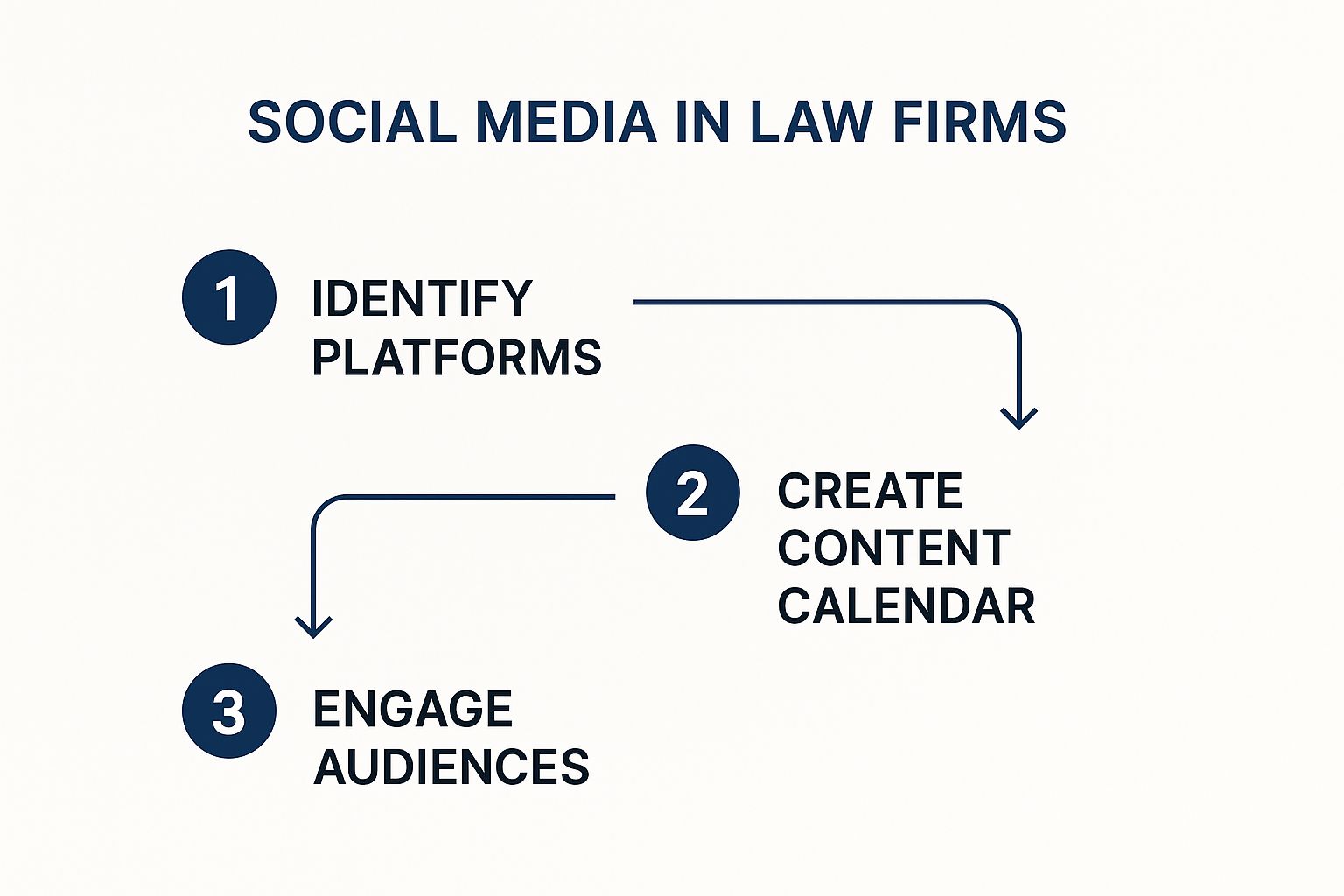
As the visual shows, success on these platforms isn’t about luck. It requires a disciplined approach, from choosing the right channels to creating consistent content and genuinely engaging with people.
Choose Your Implementation Path
Finally, you have to decide who is going to do all this work. There are three main paths you can take, and each has its own trade-offs.
- In-House Team: Hiring a dedicated PR professional gives you total control and someone who lives and breathes your firm’s culture. The downside? It can be expensive, and one person might not have the broad media relationships that an entire agency does.
- PR Consultant: A freelance consultant offers specialized expertise with more flexibility and lower overhead than a full-time hire. This is often a fantastic middle-ground for firms that are just getting started with PR.
- Specialized PR Agency: Partnering with an agency that knows the legal industry inside and out gives you immediate access to a full team of experts and their established media contacts. It’s usually the most expensive option, but it often delivers the fastest and most significant results.
To help you get started, here’s a straightforward checklist to walk you through the initial steps.
PR Implementation Checklist for Law Firms
This table breaks down the foundational actions for launching your firm’s PR program. Following these steps will ensure you build on a solid, strategic base rather than jumping straight to tactics.
| Phase | Action Item | Key Consideration |
|---|---|---|
| Phase 1: Foundation | Define 3 SMART goals for the next 6 months. | Focus on what’s realistic. Is the goal to build local authority or national recognition? |
| Phase 1: Foundation | Conduct a baseline PR audit. | Document current media mentions, search rankings, and top 3 competitors’ PR activity. |
| Phase 2: Story Mining | Brainstorm and list 5-10 potential stories. | Think beyond case results: pro bono work, community involvement, expert commentary. |
| Phase 2: Story Mining | Develop a core messaging document. | What are the key takeaways you want the public to have about your firm? |
| Phase 3: Execution | Choose an implementation path (In-house, Consultant, or Agency). | Base this decision on your budget, timeline, and the complexity of your goals. |
| Phase 3: Execution | Build your initial media list of 20-30 key contacts. | Focus on local journalists, industry bloggers, and legal trade publications. |
This checklist isn’t exhaustive, but it provides the critical structure needed to move from planning to doing.
Your choice will ultimately come down to your budget, your goals, and the resources you have internally. The most important thing is to make a conscious decision and put someone in charge of driving the plan forward.
How to Measure Your Public Relations ROI
So, how do you prove that all this PR work is actually paying off? In a world of billable hours and razor-thin budgets, showing a clear return on investment isn’t just nice—it’s essential. It means moving past the fuzzy “vanity metrics” and digging into data that ties your PR directly to the firm’s bottom line.
Measuring the impact of public relations for law firms demands a different way of thinking. You have to stop counting how many people might have seen an article and start tracking how many people took real action because of it. This is how you get the concrete evidence the partners need to see the true value of a powerful public image.
Moving Beyond Vanity Metrics
Vanity metrics, like media impressions or a flurry of social media likes, feel good on the surface but don’t tell you much. They show potential reach, not actual impact. To demonstrate real ROI, you have to connect the dots between your PR efforts and tangible business outcomes.
The goal isn’t just to be seen; it’s to be seen by the right people who then take a desired action. True PR measurement tracks the journey from media placement to new client inquiry, proving its direct contribution to firm growth.
By focusing on more substantial data points, you can paint a much clearer picture of how your PR is directly fueling client acquisition and generating revenue.
Key Metrics That Truly Matter
If you want to prove your PR strategy is working, you need to focus on metrics that draw a straight line between your public presence and business development. These are the indicators that give you an honest look at your success.
Here are the essential KPIs you should be tracking:
- Website Referral Traffic: Fire up Google Analytics and see how many visitors are landing on your website directly from an article or online mention. If a feature in a prominent legal journal sends 150 qualified visitors to your practice area page, that’s a real, measurable result.
- Branded Search Volume: Keep an eye on how many people are specifically searching for your firm’s name or your key attorneys’ names on Google. A sudden spike in these searches right after a big PR campaign is a fantastic sign that you’ve captured people’s attention and interest.
- Lead Source Attribution: This one is simple but powerful. When a new potential client calls or fills out a form, make it standard practice to ask, “How did you hear about us?” Every time someone mentions a specific article, podcast, or speaking gig, you’re gathering direct proof of ROI.
- Share of Voice: Think of this as market share, but for media attention. This metric stacks up your firm’s media mentions against your top competitors. When you start owning a larger piece of the conversation, it’s a clear signal that your PR is successfully positioning you as a thought leader in your field.
Got Questions? We’ve Got Answers.
Jumping into public relations can feel like learning a new language, especially when you’re already juggling cases and clients. Let’s clear up some of the most common questions we hear from legal pros and get you on the right track.
What’s the Real Difference Between PR and Advertising?
Think of it this way: advertising is what you pay for, while public relations is what you earn.
Advertising is straightforward—you buy space. Whether it’s a Google Ad, a billboard, or a radio spot, you’re broadcasting a message you control completely. The catch? Everyone knows you paid for it, which can make them a bit skeptical.
PR, on the other hand, is all about earning credibility. When a respected legal journal quotes one of your partners or a local news station covers your firm’s pro bono work, that’s PR in action. It builds a level of trust that advertising just can’t buy because the validation comes from a neutral, trusted third party.
How Long Does It Actually Take to See PR Results?
Public relations is a marathon, not a sprint. While one fantastic story placement can give you an immediate bump in website traffic, the real power of PR comes from consistency over time. You’re building a reputation and positioning your attorneys as the go-to experts in their field, and that doesn’t happen overnight.
You can realistically expect to see early signs of traction—like increased social media engagement or a few media mentions—within the first three to six months. But the game-changing results, like a steady stream of high-quality leads and becoming the dominant voice in your market, typically take 12 to 18 months of sustained effort.
The goal of PR for law firms isn’t just a quick headline; it’s about building a durable, long-term asset. A powerful reputation, built carefully over years, will keep paying dividends long after a single ad campaign has faded.
Is PR Only for the Big Firms?
Not a chance. While the big players often have hefty budgets, the core principles of PR are incredibly scalable and can be a massive advantage for solo practitioners and boutique firms.
In fact, a smart, focused PR strategy can be the great equalizer. A smaller firm can use it to own a specific niche, build deep roots in the local community, and punch way above its weight class. It’s how you outmaneuver the giants. Many firms get help to do this right—about 60% of online businesses outsourced their digital PR in 2024–2025, a trend that gives law firms of all sizes access to top-tier expertise. You can dive deeper into these public relations statistics on prlab.co.
At Case Quota, we build powerful reputations for law firms through targeted marketing and PR. Let’s create a plan that gets you noticed for all the right reasons. Learn more at Case Quota.