

A well-crafted personal injury demand letter is the cornerstone of a successful claim. It's not just a procedural step; it is a strategic legal document that sets the stage for negotiations and can significantly influence the final settlement amount. This letter is your first and best opportunity to present a compelling narrative, outline the undeniable facts of the incident, establish clear liability, and meticulously quantify your client's damages with supporting evidence. A weak or poorly constructed demand often leads to a lowball offer, inviting a prolonged and unnecessary legal battle. Conversely, a powerful, persuasive demand letter signals that you are prepared and serious, compelling insurance adjusters to negotiate in good faith.
This guide provides an in-depth look at various personal injury demand letter example templates, each meticulously tailored for specific scenarios commonly encountered under California law. We will move beyond simply presenting templates; we will dissect each one, offering a strategic analysis of its most critical components. You'll learn how to frame the facts, articulate liability, and calculate damages, including non-economic losses like pain and suffering.
For those looking to deepen their understanding of the foundational elements, further insights can be found on the principles of personal injury law. Understanding these core concepts is vital before drafting your demand. From minor motor vehicle accidents to complex wrongful death claims, mastering these examples will equip you with the tools to build a case that commands attention and maximizes rightful compensation. Let's dive into the examples that will help you secure the justice your clients deserve.
1. Motor Vehicle Accident Demand Letter
A Motor Vehicle Accident Demand Letter is a foundational document in personal injury practice, serving as the official start of settlement negotiations with an insurance company. This letter meticulously outlines the facts of the accident, establishes the other party's liability, details the full extent of your client's injuries and damages, and makes a specific monetary demand for compensation. It is a persuasive narrative backed by hard evidence, designed to compel the adjuster to offer a fair settlement and avoid litigation.

This type of letter is essential for nearly all claims arising from car, truck, or motorcycle collisions. Its primary purpose is to present a comprehensive, organized, and compelling case that an insurance adjuster can easily process and evaluate. A well-crafted letter demonstrates professionalism and a thorough preparation of the case, signaling to the insurer that you are ready for litigation if a reasonable settlement is not reached.
Strategic Application and Examples
In California, this letter must strategically address the state's comparative negligence rule. Even if your client is partially at fault, you can still recover damages. The letter should preemptively counter potential liability arguments from the defense.
- Rear-End Collision: In a clear-liability rear-end collision, the letter focuses heavily on maximizing damages. It details medical treatments, lost income, and uses a higher pain and suffering multiplier (3x-5x special damages) justified by the severity and duration of injuries, often leading to settlements exceeding $50,000.
- Multi-Vehicle Accident: For a freeway pile-up, the letter allocates fault among multiple parties, citing the police report and witness statements to build a clear liability argument against each defendant's insurer.
- Hit-and-Run: When the at-fault driver is unknown, the demand is directed to your client’s own insurance provider under their Uninsured/Underinsured Motorist (UM/UIM) coverage, framing the case just as you would against a third party.
Actionable Tips for a Stronger Demand
To create a powerful personal injury demand letter example, integrate these tactics:
- Cite the Police Report: Immediately reference the official police report number to establish a factual, unbiased foundation for your liability argument.
- Create a Medical Timeline: Organize all medical records chronologically and include a summary that highlights key diagnoses, treatments, and prognoses. This simplifies the adjuster's review process.
- Quantify Everything: Track and itemize all expenses, from mileage for medical appointments to prescription co-pays. Small, documented costs add up and demonstrate meticulous record-keeping.
- Justify Your Multiplier: Don't just state a number for pain and suffering. Explain why you chose it, citing factors like permanent scarring, long-term physical therapy, or significant life disruptions.
For a comprehensive structure and phrasing, you can find a detailed motor vehicle accident demand letter template by reviewing our specialized resources. Explore a customizable personal injury demand letter template to ensure you cover all critical components for your California-based claims.
2. Slip and Fall / Premises Liability Demand Letter
A Slip and Fall / Premises Liability Demand Letter is a specialized legal document used to initiate settlement negotiations when an injury occurs on someone else's property due to a hazardous condition. This letter asserts that the property owner breached their duty of care, leading to the incident. It meticulously details the nature of the hazard, establishes the owner's knowledge (or constructive knowledge) of the danger, outlines the claimant's injuries and damages, and presents a formal demand for financial compensation.

This type of letter is critical for claims involving negligent maintenance, inadequate security, or dangerous property conditions. Its purpose is to construct a compelling narrative that proves liability by showing the property owner knew or should have known about the risk and failed to take reasonable steps to fix it. A well-argued letter demonstrates a strong, evidence-backed case, encouraging the insurer to settle rather than face the costs and risks of litigation.
Strategic Application and Examples
In California, the success of a premises liability claim hinges on proving the property owner's negligence. The demand letter must clearly articulate the owner’s breach of their duty to maintain a safe environment.
- Grocery Store Slip and Fall: After a client slips on an unmarked wet floor, the letter emphasizes the store’s failure to follow standard cleaning protocols. It often leads to settlements around $35,000 for soft tissue injuries by highlighting the transient nature of the hazard and the store’s negligence.
- Apartment Complex Assault: For a claim involving inadequate security (e.g., broken gates or poor lighting), the letter focuses on a pattern of similar incidents in the area, establishing foreseeability and breach of duty, often resulting in awards exceeding $60,000.
- Shopping Mall Hazard: If a client trips over a broken tile, the demand letter uses maintenance records (or the lack thereof) to prove the mall had constructive notice of the defect and failed to make timely repairs.
Actionable Tips for a Stronger Demand
To build a more persuasive personal injury demand letter example for a premises liability case, incorporate these tactics:
- Preserve Evidence Immediately: Send a spoliation letter demanding the preservation of all surveillance footage and obtain timestamped photos of the hazard and lighting conditions.
- Document the Scene: Photograph the exact location of the incident from multiple angles immediately after it occurs to capture the dangerous condition before it is altered.
- Obtain Incident Reports: Formally request a copy of the incident report filed with property management. This document can contain crucial admissions or details.
- Establish a Timeline: Use witness statements and maintenance logs to establish how long the hazard existed, proving the owner had ample opportunity to address it.
Developing a strong client base is crucial for handling these types of cases. You can explore effective strategies for building your practice and learn more about how to get personal injury clients to ensure a steady flow of premises liability claims.
3. Medical Malpractice Demand Letter
A Medical Malpractice Demand Letter is an exceptionally complex and high-stakes document that initiates settlement negotiations for injuries caused by negligent medical care. Unlike standard personal injury claims, this letter must articulate a breach of the professional standard of care, directly linking a healthcare provider's actions or inactions to the patient's catastrophic injuries. It presents a highly detailed narrative, supported by expert medical analysis, to establish liability, causation, and extensive damages.
This letter is indispensable for claims involving surgical errors, misdiagnosis, or treatment failures. Its core purpose is to present an undeniable case to the provider's medical malpractice insurer, demonstrating that you have retained credible experts and are prepared to prove negligence and causation at trial. A meticulously prepared letter can compel a high-value settlement offer by showcasing the significant financial and reputational risk of litigation for the healthcare provider.
Strategic Application and Examples
In California, a medical malpractice demand must navigate the Medical Injury Compensation Reform Act (MICRA), which caps non-economic damages. The letter must strategically frame the damages, often emphasizing future medical costs and lost earning capacity to maximize the total recovery value.
- Surgical Never-Event: In a case where a surgeon operates on the wrong body part, the letter establishes clear negligence (res ipsa loquitur). The focus shifts to quantifying immense damages, often leading to settlements exceeding $1 million by detailing the need for corrective surgeries, permanent impairment, and lifetime care costs.
- Misdiagnosis of Cancer: The letter would detail how a delayed diagnosis allowed cancer to progress, citing expert testimony that an earlier, correct diagnosis would have led to a better prognosis. This focuses on causation, with damages often reaching $750,000+ for the diminished quality of life and increased treatment needs.
- Medication Error: If a hospital administers the wrong drug causing permanent organ damage, the demand letter documents the clear deviation from safety protocols, using expert reports to calculate the lifelong costs of dialysis or other required medical interventions.
Actionable Tips for a Stronger Demand
To construct a compelling personal injury demand letter example for medical malpractice, integrate these critical tactics:
- Retain Experts Early: Secure affidavits and reports from board-certified medical experts before sending the demand. Their preliminary findings form the backbone of your standard of care argument.
- Document the Standard of Care Deviation: Do not just allege negligence. Precisely cite established medical guidelines, hospital protocols, or peer-reviewed literature that the provider violated.
- Calculate Lifetime Care Costs: Work with a life care planner and vocational expert to create a detailed, defensible report outlining all future medical expenses and lost earning capacity. This is crucial for claims with permanent injuries.
- Understand MICRA: Structure your demand to maximize economic damages, which are not capped, while clearly justifying the demand for the maximum allowable non-economic damages under California law.
4. Workplace Injury / Workers' Compensation Demand Letter
A Workplace Injury Demand Letter is a specialized legal document used when a third party, not the employer, is responsible for an on-the-job injury. While workers' compensation typically covers injuries caused by employer or co-worker negligence, this letter targets a separate entity whose actions led to the accident. It formally initiates a third-party liability claim, seeking damages beyond what workers' compensation benefits provide, such as full compensation for pain and suffering.
This letter is crucial for maximizing an injured worker's recovery. It must clearly distinguish the third party's negligence from the general workplace environment, presenting a standalone personal injury case. A well-constructed letter establishes liability, details damages, and accounts for the complexities of workers' compensation liens, setting the stage for negotiations that complement, rather than conflict with, the workers' comp claim.
Strategic Application and Examples
In California, where many industries involve multiple contractors on a single site, third-party claims are common. The demand letter must meticulously separate the duties and failures of each party, proving the third party's independent negligence caused the harm. This is a critical component for a successful personal injury demand letter example involving workplace accidents.
- Construction Site Accident: A construction worker is struck by equipment negligently operated by a subcontractor. The demand letter to the subcontractor's insurer would detail OSHA violations and contractual safety breaches, often leading to settlements over $250,000 to cover damages beyond workers' comp.
- Defective Machinery: An employee suffers an amputation due to a manufacturing defect in a piece of equipment. The demand is sent to the machine's manufacturer, focusing on product liability law rather than employer negligence.
- Unsafe Premises: A delivery driver slips and falls on a hazardous spill at a client's facility. The demand letter is directed to the property owner's insurance, arguing a premises liability claim for failure to maintain a safe environment for invitees.
Actionable Tips for a Stronger Demand
To build a compelling workplace injury claim, incorporate these targeted strategies:
- Identify All Third Parties: Immediately investigate and identify every potential non-employer defendant, such as contractors, property owners, equipment manufacturers, or third-party maintenance companies.
- Account for the Workers' Comp Lien: Clearly state your awareness of the workers' compensation carrier's subrogation lien and express your intent to negotiate and resolve it as part of any global settlement. This shows the adjuster you understand the full legal landscape.
- Cite OSHA Violations: Research the defendant’s OSHA complaint history and cite any relevant violations in your letter. This provides powerful, government-backed evidence of a pattern of negligence.
- Quantify Future Lost Earnings: Use the permanent disability rating from the workers' compensation claim as a baseline to calculate future lost earning capacity, a key component of damages in the third-party claim.
Crafting a persuasive demand letter in these complex cases is essential for securing fair compensation. Proper case presentation can significantly influence settlement outcomes, which is a key element in a successful legal practice. Explore more on how effective case framing contributes to attracting high-value cases with our insights on personal injury law SEO.
5. Assault and Battery / Premises Security Demand Letter
An Assault and Battery / Premises Security Demand Letter is a specialized legal document used when a person is injured by a criminal act on someone else's property. This letter blends claims of intentional tort (assault and battery) with negligence (premises liability), arguing that the property owner failed to provide adequate security, which allowed the attack to occur. It outlines the violent incident, establishes the owner's legal duty to protect patrons, details the resulting physical and severe psychological injuries, and demands compensation for all damages.
This letter is crucial for holding commercial property owners accountable when their negligence contributes to foreseeable criminal acts. Its purpose is to construct a compelling narrative that proves the property owner knew, or should have known, about the risk of such an incident but failed to take reasonable steps to prevent it. A well-prepared letter demonstrates a firm grasp of premises liability law and signals a readiness to litigate a complex and high-value claim.
Strategic Application and Examples
In California, property owners have a duty to take reasonable measures to secure their premises against foreseeable criminal acts. The demand letter must focus on establishing this foreseeability. It connects the property owner's specific failures directly to the client's injuries, creating a strong foundation for a substantial settlement.
- Nightclub Assault: After an assault by another patron, the letter would highlight the nightclub's history of similar fights, lack of trained security personnel, and failure to eject aggressive individuals. This establishes a pattern of negligence, often leading to settlements exceeding $200,000 for serious injuries.
- Apartment Complex Robbery: If a tenant is robbed inside a complex with a known broken security gate and no patrols, the letter details management's prior knowledge of the security breach and cites local crime statistics to prove foreseeability.
- Parking Lot Mugging: In a case where a customer is mugged in a poorly lit commercial parking lot, the demand letter emphasizes the owner's failure to provide adequate lighting and surveillance, which created an environment conducive to crime.
Actionable Tips for a Stronger Demand
To build an impactful personal injury demand letter example for a premises security claim, incorporate these critical elements:
- Obtain All Police Reports: Reference the official police report and any supplemental reports, which document the criminal act and may contain witness information.
- Document Security Failures: Use photographs and videos to show broken locks, non-functioning gates, inadequate lighting, or the absence of security cameras and personnel.
- Research Prior Incidents: Formally request a property's incident history or use police records for calls to that address to establish a pattern of crime that made your client's assault foreseeable.
- Quantify Psychological Trauma: Emphasize damages beyond physical injuries. Include records from therapists or psychiatrists to document conditions like PTSD, anxiety, and depression, which significantly increase the claim's value.
6. Dog Bite / Animal Injury Demand Letter
A Dog Bite Demand Letter is a specialized legal document used to initiate settlement negotiations for injuries caused by an animal, most commonly a dog. This letter is distinct because it often leverages strict liability statutes, which hold an owner responsible for damages regardless of the animal's previous history of aggression. It presents the facts of the incident, details the victim's injuries and medical treatment, and makes a formal demand for compensation from the owner's homeowner's or renter's insurance policy.
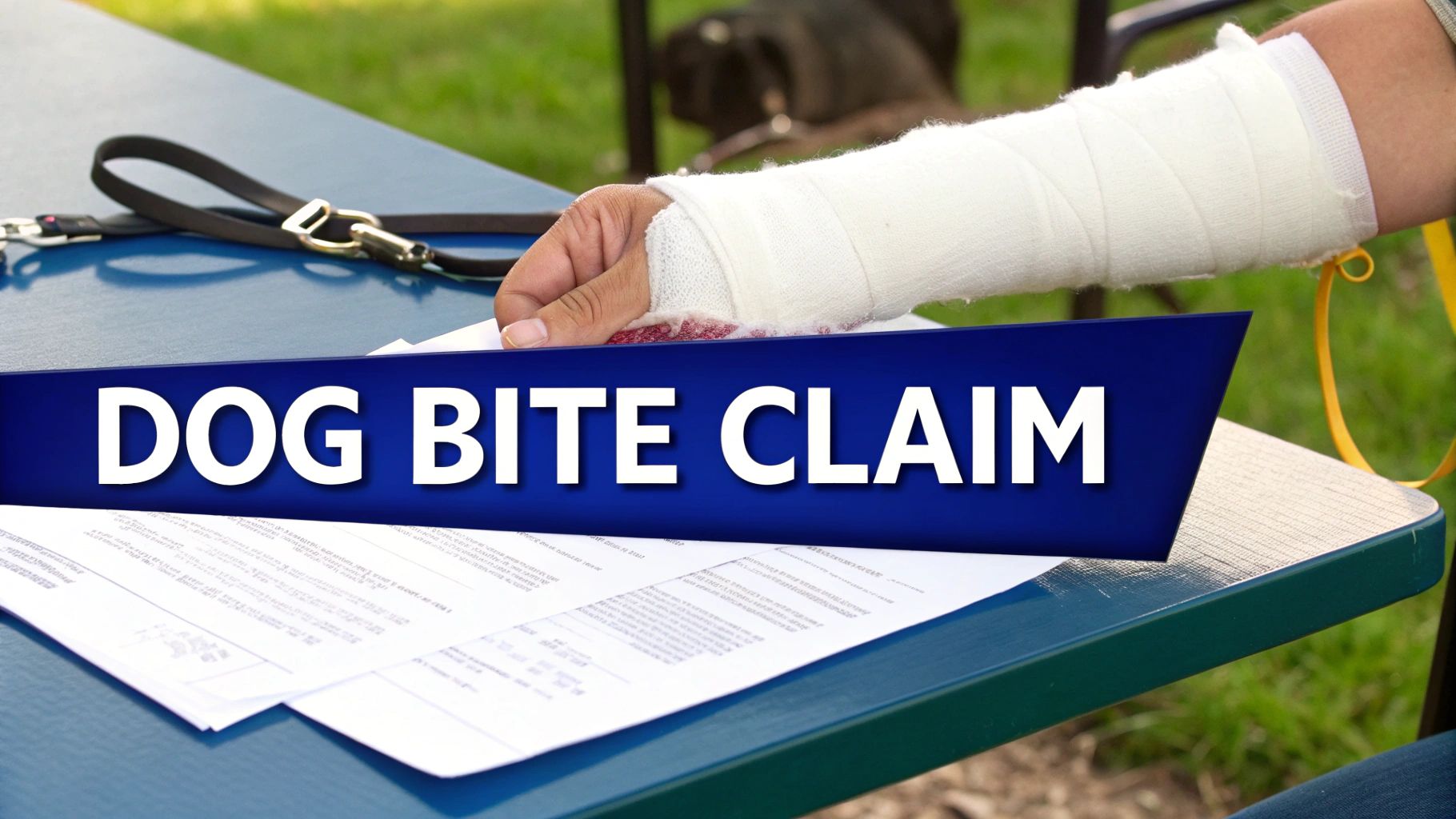
The primary purpose of this letter is to present a clear, undeniable claim directly to the responsible party's insurer. Because California Civil Code § 3342 imposes strict liability on dog owners, the demand letter can focus more on the extent of damages rather than proving negligence. This makes it a powerful tool for securing fair settlements efficiently, especially for claims involving scarring, infection risk, or psychological trauma like cynophobia (fear of dogs).
Strategic Application and Examples
In California, the strict liability rule is a significant strategic advantage. The demand letter should prominently cite this statute to bypass debates about whether the owner "knew" the dog was dangerous. The focus shifts entirely to proving the scope of the victim's damages.
- Neighbor's Dog Attack: A child is bitten while playing in their own yard by a neighbor's loose dog. The letter cites the strict liability statute, includes photos of the injuries, and details the child’s resulting fear of being outside, justifying a settlement demand between $25,000 and $50,000.
- Postal Worker Bite: A mail carrier is bitten while delivering a package. The demand letter highlights the victim's inability to perform their job duties, presenting a significant lost wages claim alongside medical bills, often leading to settlements over $30,000.
- Severe Facial Scarring: An attack in a public space results in severe facial injuries requiring plastic surgery. This personal injury demand letter example would include a life care plan and expert reports on future medical costs and psychological harm, pushing the claim value well over $100,000.
Actionable Tips for a Stronger Demand
To maximize the impact of your dog bite demand letter, incorporate these specific tactics:
- Cite the Animal Control Report: Immediately reference the official animal control or police report to establish the incident's facts and the dog's identity and ownership.
- Document Injury Progression: Use a series of dated photographs showing the wound from the day of the incident through the healing process to visually demonstrate the severity and potential for scarring.
- Quantify Psychological Trauma: Include costs for therapy or a psychologist's report diagnosing PTSD or cynophobia. Frame this as a direct, compensable injury resulting from the attack.
- Obtain the Bite History: Formally request the dog's bite and vaccination history from animal control. A history of prior incidents can introduce a negligence claim for punitive damages, increasing leverage.
7. Wrongful Death Demand Letter
A Wrongful Death Demand Letter is a profoundly sensitive and complex legal document used to seek compensation when a person's death is caused by the negligence or wrongful act of another. This letter is sent on behalf of the decedent's surviving family members or estate to the at-fault party's insurance company. It must not only establish liability but also articulate the immense financial and emotional losses suffered by the survivors, including loss of financial support, companionship, and guidance.
This letter is the cornerstone of a wrongful death claim, initiating the settlement process for catastrophic events like fatal car accidents, medical malpractice, or workplace incidents. Its purpose is to present a compassionate yet firm case, detailing the full scope of damages and demanding a settlement that reflects the true value of the life lost. A meticulously prepared letter demonstrates a profound understanding of the case's gravity and signals a readiness to pursue justice through litigation if necessary.
Strategic Application and Examples
In California, wrongful death claims are governed by specific statutes (Cal. Code of Civ. Pro. § 377.60) that define who can file a claim and what damages are recoverable. The demand letter must be precisely aligned with these laws, clearly distinguishing between damages for the wrongful death action (for the heirs) and a potential survival action (for the estate).
- Fatal Motor Vehicle Accident: When a primary earner is killed, the letter centers on quantifying the devastating economic loss. It will include expert reports from an economist projecting lost lifetime earnings, benefits, and household services, often leading to settlement demands well over $1,000,000.
- Medical Malpractice: If a surgical error leads to a patient's death, the demand letter must meticulously outline the breach in the standard of care, supported by a medical expert's affidavit. It details the pre-death pain and suffering for the survival action and the heirs' loss of love and companionship, targeting a high-value settlement.
- Workplace Fatality: In cases of gross negligence, such as a known safety violation causing death, the letter may argue for punitive damages. It would highlight the employer's reckless disregard for safety to justify a demand that includes both compensatory and punitive elements, potentially resulting in settlements exceeding $750,000.
Actionable Tips for a Stronger Demand
Crafting an effective wrongful death personal injury demand letter example requires a unique blend of legal precision and human empathy:
- Retain an Actuarial Expert Early: Engage an economist or actuary immediately to produce a detailed report on the decedent’s lost future earnings and financial support. This provides a concrete, data-driven foundation for your economic damages.
- Document the Human Loss: Go beyond numbers. Include personal anecdotes, photographs, and testimonials from family and friends to create a compelling narrative about the decedent’s character and the profound void their absence has created.
- Separate Survival and Wrongful Death Claims: Clearly delineate the damages sought under the survival action (e.g., the decedent’s pre-death pain and suffering, medical bills) from the wrongful death damages (e.g., the family’s loss of support and companionship). This ensures all recoverable damages are properly claimed.
- Coordinate with a Probate Attorney: Wrongful death proceeds are distributed through the decedent’s estate or to statutory heirs. Collaborating with a probate attorney ensures all legal and financial administration is handled correctly, preventing delays in settlement distribution.
8. Product Liability / Defective Product Demand Letter
A Product Liability Demand Letter is a highly specialized document used to initiate a claim when a consumer is injured by a defective or dangerously designed product. Unlike a standard negligence claim, this letter often argues strict liability, focusing on the product's inherent defect rather than the manufacturer's specific carelessness. It must meticulously outline the product's failure, connect the defect directly to the client's injuries, and present a compelling case based on manufacturing flaws, design defects, or a failure to provide adequate warnings.
This letter is crucial for holding corporations accountable for placing unsafe products into the market. It functions as the initial legal volley, presenting evidence that may include expert analysis, industry standards, and documentation of similar incidents. A well-constructed product liability letter signals to the manufacturer and their insurer that you have conducted a thorough investigation and are prepared to litigate a complex and potentially high-value case.
Strategic Application and Examples
In California, product liability claims can be complex, often involving large corporate defendants with extensive legal resources. Your demand letter must be technically precise and legally sound, often requiring early expert consultation to validate the defect theory.
- Defective Car Airbag: An airbag fails to deploy in a collision, causing severe facial and traumatic brain injuries. The letter cites federal safety standards and expert engineering reports to prove a manufacturing defect, leading to a settlement demand over $250,000 that accounts for permanent impairment.
- Pharmaceutical Drug: A medication is marketed without adequate warning of severe side effects like liver damage. The demand letter highlights the manufacturer's failure to warn, referencing internal documents and FDA reports to justify a claim exceeding $500,000 for long-term medical care and diminished quality of life.
- Power Tool Defect: A power saw's safety guard fails due to a manufacturing flaw, resulting in an amputation. The letter includes an expert opinion on the defect and documents a clear breach of the user's reasonable safety expectations, supporting a demand over $300,000.
Actionable Tips for a Stronger Demand
To build a formidable personal injury demand letter example for a defective product claim, you must integrate technical evidence with legal arguments:
- Preserve the Evidence: Immediately secure the defective product and all its packaging. This is your primary piece of evidence; spoliation can be fatal to the claim.
- Engage an Expert Early: Retain a product safety expert to analyze the product and provide a preliminary report. Citing an expert's findings in your initial demand adds significant weight.
- Research Prior Complaints: Use databases like the Consumer Product Safety Commission (CPSC) to find records of similar incidents involving the product. This helps establish that the manufacturer had prior knowledge of the defect.
- Document Safer Alternatives: Identify and describe safer alternative designs available on the market. This strengthens a design defect argument by showing the flaw was both foreseeable and avoidable.
For a deeper understanding of how these claims are built, you can review numerous product liability case examples that illustrate successful strategies against manufacturers.
Comparison of 8 Personal Injury Demand Letters
| Demand Letter Type | Implementation Complexity 🔄 | Resource Requirements ⚡ | Expected Outcomes ⭐📊 | Ideal Use Cases | Key Advantages 💡 |
|---|---|---|---|---|---|
| Motor Vehicle Accident Demand Letter | Moderate 🔄 — standard chronology, liability and comparative-negligence checks | Moderate ⚡ — police report, medical records, repair estimates; limited expert use | High ⭐📊 — strong settlement success; avg $15,000–$100,000 | Car, motorcycle, truck collisions with clear at-fault party | Familiar format to insurers; speeds negotiation; established damage formulas |
| Slip and Fall / Premises Liability Demand Letter | Moderate–High 🔄 — must prove duty, notice, and maintenance failures | Moderate ⚡ — photos, incident/maintenance records, possible safety expert; time-sensitive evidence | Moderate–High ⭐📊 — elevated value with prior notice/video; typical midrange awards | Retail, apartment, restaurant hazards, inadequate maintenance/security | Prior-notice and surveillance often decisive; adaptable across property types |
| Medical Malpractice Demand Letter | Very High 🔄 — detailed standard-of-care and causation analysis required | Very High ⚡ — expensive medical experts ($5k–$15k+), full medical record review, peer materials | Very High ⭐📊 — high average settlements ($500k+); MICRA caps non-economic damages | Surgical errors, misdiagnosis, failure to treat with permanent harm | Expert testimony is persuasive; large recoveries possible but capped by MICRA |
| Workplace Injury / Workers' Compensation Demand Letter | High 🔄 — coordinate comp benefits, subrogation and third‑party liability | Moderate–High ⚡ — workers’ comp records, OSHA reports, third‑party identification | Moderate–High ⭐📊 — substantial recoveries possible (examples $250k+), offsets likely | Jobsite accidents involving negligent third parties or defective equipment | Comp documentation validates injury; OSHA/subrogation issues clarify liability |
| Assault & Battery / Premises Security Demand Letter | High 🔄 — foreseeability and security failure proof required; criminal facts involved | High ⚡ — police reports, surveillance, security experts, prior-incident research | High ⭐📊 — high settlement potential ($200k+); punitive damages possible | Nightclubs, parking lots, apartment complexes with inadequate security | Emotional impact + surveillance/prior incidents strengthen foreseeability claims |
| Dog Bite / Animal Injury Demand Letter | Low–Moderate 🔄 — strict liability simplifies negligence element | Low ⚡ — medical photos/records, animal control report, witness statements | Moderate ⭐📊 — typically quick settlements; avg $15,000–$75,000 | Dog bites and animal attacks with identifiable owner | California strict liability; insurer coverage common; low litigation cost |
| Wrongful Death Demand Letter | Very High 🔄 — complex dependency, probate and sensitive family coordination | Very High ⚡ — actuarial experts, probate counsel, extensive documentation | Very High ⭐📊 — highest-value claims (often $500k+); multiple damage categories | Fatal car accidents, medical fatalities, workplace deaths | Multiple recoverable damages; strong incentive for insurer settlement; punitive possible |
| Product Liability / Defective Product Demand Letter | Very High 🔄 — technical defect proof, design alternatives and regulatory analysis | Very High ⚡ — product safety engineers ($8k–$20k+), testing, extensive discovery | High ⭐📊 — large recoveries possible ($250k–$500k+); punitive in egregious cases | Defective vehicles, pharmaceuticals, dangerous consumer products | Manufacturer insurance and regulatory records aid claims; engineering experts are decisive |
Turn Your Demand Into a Result: Let Case Quota Help You Win
Throughout this guide, we have deconstructed multiple types of personal injury demand letters, moving far beyond simple templates. We've explored the strategic architecture required for everything from a straightforward motor vehicle accident claim to a deeply complex wrongful death or product liability case. The goal was to equip you with a nuanced understanding of how each section of a demand letter functions as a tool of persuasion and leverage.
By analyzing each personal injury demand letter example, we've uncovered the core principles that transform a mere statement of facts into a compelling narrative for settlement. These examples demonstrate that a powerful demand is not just about listing injuries and expenses; it's about crafting a story that an insurance adjuster cannot ignore. It involves meticulously documenting liability, quantifying damages with precision, and anticipating and neutralizing potential counterarguments before they are even raised.
Key Takeaways: From Template to Tactic
Mastering the art of the demand letter is a critical step in securing fair compensation. As you move forward, keep these essential strategies at the forefront of your process:
- Narrative is Power: Don't just state facts; tell a compelling story. Frame the incident, the injuries, and the subsequent impact on the victim's life in a way that creates a clear, human connection to the damages claimed.
- Precision in Damages: Vague claims are weak claims. Every dollar you demand, from medical bills and lost wages (special damages) to pain and suffering (general damages), must be supported by credible evidence and a logical calculation methodology.
- Anticipate the Defense: A strong demand letter preemptively addresses and dismantles potential defenses. Whether it's a question of comparative negligence in a slip and fall or causation in a medical malpractice case, confronting these issues head-on demonstrates confidence and thorough preparation.
- Customization is Crucial: As our diverse examples show, a one-size-fits-all approach is ineffective. The tone, structure, and evidence required for a dog bite claim are fundamentally different from those needed for a wrongful death action. Tailor every letter to the specific facts and legal nuances of the case.
Your Next Step: Securing Expert Advocacy
While understanding a personal injury demand letter example is an invaluable first step, the strategic execution is what ultimately determines the outcome. An experienced California personal injury attorney brings an indispensable layer of expertise. They understand the tactics insurance companies use to minimize payouts and know how to counter them effectively. An attorney can identify hidden sources of recovery, engage the right expert witnesses, and ensure every legal formality is met, protecting your claim from procedural missteps.
Your demand letter is the opening move in a complex negotiation. When that letter is signed by a reputable law firm, it signals to the insurer that you are serious and fully prepared to litigate if a fair offer is not made. This leverage is often the single most important factor in achieving a successful settlement. As you consider your options, the importance of professional guidance cannot be overstated; the process of choosing the right personal injury attorney is just as critical as the evidence you gather.
You have now seen what goes into building a powerful demand. The principles of clear liability, detailed damages, and compelling narrative are your roadmap. Use these examples not as rigid templates, but as strategic guides to build a case that is organized, persuasive, and prepared for the negotiation ahead. This preparation is your best tool for turning a devastating injury into the justice you deserve.
Ready to connect with a top-tier personal injury attorney in Southern California? Case Quota provides a direct line to experienced legal professionals who specialize in turning compelling demand letters into maximum settlements. Let us match you with a firm that has the expertise and resources to champion your case.