

Any solid marketing strategy for a law firm stands on three legs: in-depth market analysis, detailed client personas, and a compelling value proposition. Getting this foundation right ensures every dollar you spend on marketing hits its mark, attracting the right clients with a message that actually connects.
Building Your Law Firm's Marketing Foundation
Before you put a single dollar into Google Ads or an SEO campaign, you have to build a rock-solid foundation. Too many firms rush into tactics without a strategy, which is like building a house on sand—it gets expensive fast and is doomed to collapse.
The most successful Southern California firms I've worked with always invest the time upfront. They get granular, understanding their unique corner of the market, defining exactly who they serve, and hammering out why those clients should choose them over the dozen other firms on the same block.
This isn't just theory. It's a practical playbook that makes every marketing decision that follows easier and far more effective. It's about shifting from guesswork to a data-backed approach that creates a predictable stream of high-quality cases.
This simple flow chart breaks down the three core steps to getting your marketing foundation right.
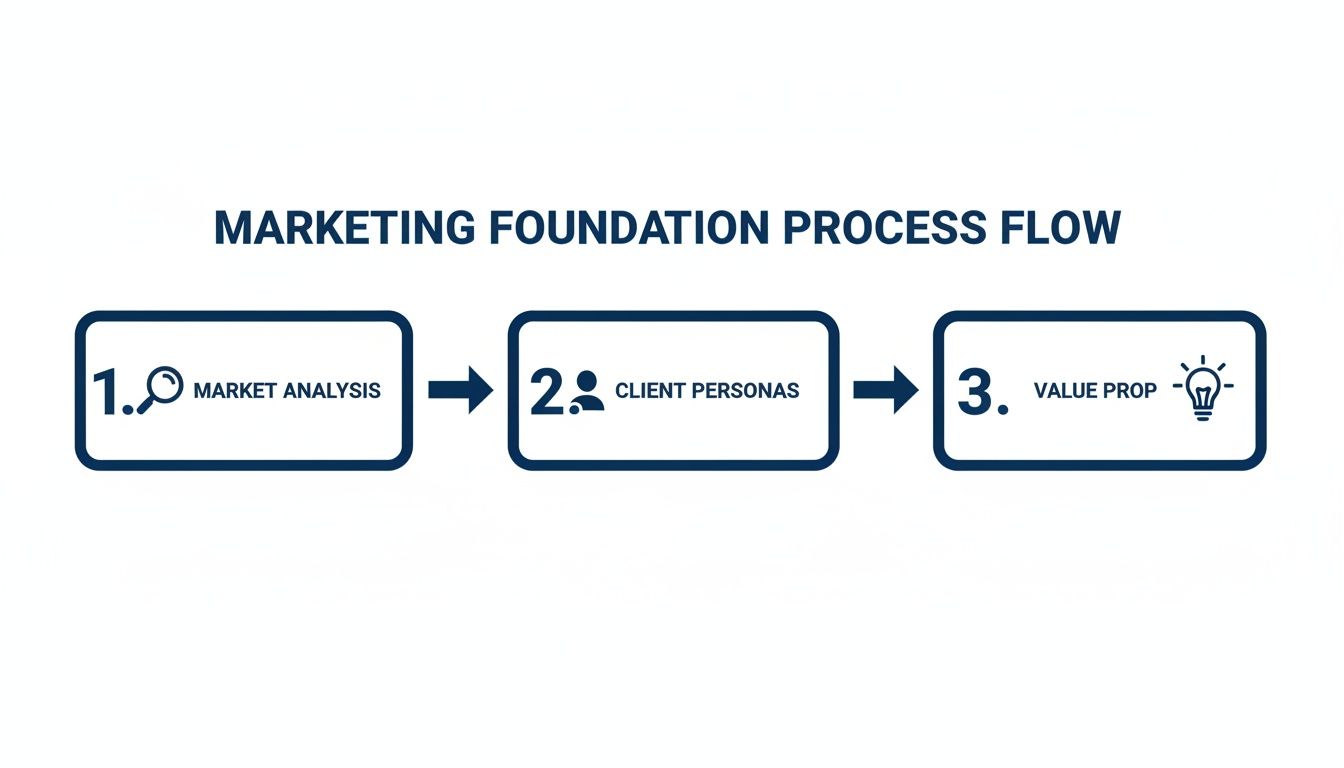
This sequence is crucial. You move from the broad (the market) to the specific (your ideal client) and then to your unique promise (your value). This keeps your messaging grounded in the reality of what your clients actually need and want.
Conducting Practical Market and Competitor Analysis
The goal here isn't to write an academic paper; it’s about digging up actionable intelligence you can use immediately.
Start by identifying your top five direct competitors. Be specific—if you’re a personal injury firm in Orange County, look at other PI firms in Orange County, not LA. Then, start dissecting their digital footprint.
Here’s what you’re looking for:
- Their Core Message: What’s the first thing they promise on their homepage? Are they all about speed, compassion, aggressive tactics, or flaunting big case results?
- Keyword Focus: Use a few free tools to see what keywords they’re ranking for. Are they targeting "car accident lawyer Irvine" or much broader terms? This tells you exactly what their SEO focus is.
- Content Gaps: Is every competitor churning out the same generic blog post on "what to do after an accident"? Maybe there’s a huge gap for content about specific local road hazards or complex case types they’re completely ignoring.
This analysis is how you find your opening. If every other firm is screaming about being "aggressive," you can stand out by positioning yourself as "strategic and compassionate." You’ll attract a completely different type of client—one who is likely turned off by the chest-thumping.
Creating Specific Client Personas
Forget generic demographics like "male, age 30-50." That’s useless. A truly powerful client persona gets deep into the motivations and pain points of your ideal client. It should feel like you’re describing a real person, because it's built from real-world insights.
A great client persona doesn’t just describe who your client is; it explains what keeps them up at night. Understanding their fears, frustrations, and desired outcomes is the key to crafting marketing that connects on an emotional level.
Think about an estate planning attorney in San Diego. A persona might be "Proactive Planner Penelope." She’s a 45-year-old physician, worried about protecting her assets for her kids, but she’s so busy and overwhelmed by the legal jargon that she keeps putting it off.
Her pain point isn't just "needing a will." It's the constant, low-grade anxiety of the unknown and a total lack of time. Your marketing needs to speak directly to her by promising an efficient, clear, and reassuring process. To get started, you can even find a comprehensive law firm marketing plan template to structure your persona research at https://casequota.com/law-firm-marketing-plan-template/.
Crafting Your Unique Value Proposition
Your value proposition is the clear, direct answer to a potential client's biggest question: "Why should I hire your firm?"
This isn’t just a catchy slogan. It's the core promise of the experience and results you deliver. It has to be specific, unique, and compelling.
A weak proposition is something generic like "We fight for you." A strong one is, "We are former insurance defense attorneys who now exclusively represent injury victims, using our insider knowledge to maximize your settlement."
When you're building your firm's operational and marketing foundation, it’s worth exploring resources specifically tailored for law firms to help sharpen these strategic decisions. This crucial statement should be front and center on your website and become the guiding principle for every ad, email, and social post you create.
Dominating Local Search with an SEO-First Approach
In a market as saturated as Southern California, if a potential client can't find your law firm on the first page of Google, you might as well be invisible. It's a harsh reality. Building a real digital presence means adopting an SEO-first mindset, treating organic search not as just another marketing expense, but as your single most valuable long-term asset.

Think about it: paid ads are like renting. The moment you stop paying, the traffic stops. A strong SEO foundation is like owning the property. It continuously generates high-quality leads, positioning your firm as an authority and connecting you with clients at the exact moment they’re searching for help.
When you look at the numbers, it's a no-brainer. SEO delivers a staggering 526% return on investment for law firms within just three years. Organic search alone is responsible for 52.6% of all website traffic to law firms, blowing every other channel out of the water.
The Three Pillars of Law Firm SEO
A successful SEO strategy isn't just one thing; it’s a system built on three interconnected pillars. If you neglect one, the whole structure becomes wobbly, and you'll never hit your full ranking potential.
Here’s the simplest way to think about them:
- On-Page SEO: This is everything on your website—the quality and relevance of your content.
- Off-Page SEO: This is your reputation across the internet—the authority and trust your site earns from other sources.
- Technical SEO: This is your website’s foundation—the backend infrastructure that search engines crawl.
Let's dig into how you can get each of these right for your Southern California firm.
Mastering On-Page SEO for High-Intent Keywords
On-page SEO is all about optimizing your site's content and structure to send clear signals to Google about what you do and who you serve. This process always starts with targeting the right keywords—specifically, the high-intent local phrases that ready-to-hire clients are typing into the search bar.
Your potential clients aren't just searching for "lawyer." They're getting specific. They're looking for a "criminal defense attorney Santa Monica" or a "probate lawyer Orange County." These are the money phrases you need to build your content around.
You’ll want to weave these keywords naturally into key places:
- Page Titles and Meta Descriptions: This is your digital billboard in the search results.
- H1 and H2 Headings: These are the headlines that structure your content and tell Google what’s important.
- Body Content: The actual text on your service pages and blog posts.
- Image Alt Text: Descriptions for your images that help search engines understand the context.
A huge mistake I see firms make is "keyword stuffing"—jamming a phrase into a page over and over. That's a relic of the past and will get you penalized. The goal now is to create genuinely helpful, deep content that naturally includes your target phrases and related topics.
Building Authority with Off-Page SEO
Off-page SEO is where you build your firm's credibility beyond your own website. The most critical piece of this puzzle is backlinks. A backlink is simply a link from another website to yours, and Google views each high-quality link as a vote of confidence.
Getting backlinks from reputable sources—think local news outlets, established legal directories, or the state bar association—is pure gold. These links tell Google that your firm is a trusted, authoritative voice in your practice area and your city.
Another key piece is managing your local business listings, often called "citations." You have to make sure your firm's name, address, and phone number (NAP) are perfectly consistent everywhere online, especially on major players like Google Business Profile, Yelp, and Avvo. Any inconsistency confuses search engines and can seriously damage your local rankings.
For a much deeper dive on this, check out our guide: https://casequota.com/law-firm-marketing-seo-the-complete-guide-to-dominating-legal-search-rankings-in-2025/
Ensuring a Flawless Technical Foundation
Technical SEO is the non-negotiable bedrock of your entire digital presence. Honestly, you could have the best content and the strongest backlinks in the world, but if your site is slow, broken, or insecure, it's never going to rank.
There are three technical elements you absolutely have to nail:
- Lightning-Fast Speed: Your site has to load almost instantly on both desktop and mobile. A slow site is the number one reason potential clients hit the back button.
- Mobile-First Design: The vast majority of legal searches now happen on a smartphone. Your website must be a breeze to use on a small screen.
- ADA Compliance: Your site has to be accessible to people with disabilities. This isn't just an ethical and legal must-do; it's also a growing ranking factor. The link between good accessibility and good SEO is undeniable, as explained in this excellent guide: Accessibility and SEO: A Guide to Inclusive Design for Better Rankings.
By getting these on-page, off-page, and technical fundamentals right, your firm will build a powerful, sustainable engine for attracting the right clients through organic search.
Expanding Your Reach with a Strategic Channel Mix
While a dominant SEO presence is the bedrock of any solid law firm marketing plan, putting all your eggs in one basket is a risky game. True market leadership and resilience come from layering in other powerful channels that get your message out there and meet potential clients right where they are.
Think of it as creating a synergistic system—a strategic, multi-channel approach where each part makes the others stronger.

This means moving beyond just hoping for organic search traffic. By integrating paid ads, video, and social media, you create a web of touchpoints that builds real brand recognition and drives a consistent flow of high-quality leads. The goal is simple: no matter where a potential client in Southern California is looking for legal help, your firm is there with a compelling message.
Leveraging Google Ads for Immediate Impact
SEO is a long game. It delivers incredible ROI over time, but it takes patience. Let's be real—when a personal injury firm needs to generate leads this week after a major pile-up on the 405, waiting for rankings to climb just isn't an option.
This is where AI-powered Google Ads, specifically Pay-Per-Click (PPC) campaigns, become an absolutely essential tool for getting the phone to ring now.
PPC lets you jump to the very top of Google for hyper-specific, high-intent keywords. We're talking about phrases like "motorcycle accident lawyer Santa Ana" or "emergency probate attorney." You only pay when someone actually clicks your ad, making it an incredibly efficient way to capture the attention of people actively searching for an attorney.
Modern Google Ads campaigns are far more sophisticated than just bidding on keywords. They give you incredible control with advanced targeting options:
- Geographic Targeting: Show your ads only to people within specific cities, zip codes, or even a tight radius around your office.
- Demographic Targeting: Zero in on potential clients based on age, income level, and other specific demographic data.
- Remarketing: This is huge. You can re-engage potential clients who visited your website but didn't call, keeping your firm top-of-mind as they make their decision.
For urgent practice areas like criminal defense or personal injury, a well-managed PPC campaign isn't just a nice-to-have; it's a necessity for competitive growth.
Building Trust with Local Video Marketing
In the legal field, trust is the ultimate currency. While text and images can showcase your expertise, nothing builds a genuine human connection quite like video. It’s an often-overlooked but incredibly powerful tool for showing the real people behind the firm name, easing a potential client's anxieties, and building rapport before they even pick up the phone.
Video is your opportunity to turn abstract legal expertise into a tangible, trustworthy presence. It allows potential clients to see your confidence, hear your empathy, and feel a connection that a block of text can never replicate.
Consider weaving these high-impact video formats into your strategy:
- Client Testimonials: A heartfelt, authentic story from a past client is more persuasive than any marketing copy you could ever write.
- Attorney Profiles: Short, two-minute videos introducing your attorneys let potential clients "meet" them and get a feel for their passion and personality.
- FAQ Videos: Get on camera and answer the most common legal questions you hear every day. This positions you as a helpful expert and provides immense value right from the start.
These videos are versatile assets. Feature them on your website, share them on social media, and even drop them into your email marketing. They humanize your brand and make you stand out in a seriously crowded market.
Turning Social Media into a Lead Generation Engine
Too many firms see social media as just a digital billboard—a place for simple brand awareness. That’s such a limited perspective. When you use it strategically, social media can transform into a potent lead-generation machine.
The key is to shift from broadcasting to engaging. You do this by sharing content that truly connects with your ideal client personas—things like legal insights, breakdowns of complex topics, and celebrating client wins (with their permission, of course). This content establishes your authority and keeps your firm top of mind.
The numbers don't lie. Social media has exploded as a source of cases, with a whopping 71% of lawyers reporting they’ve landed new clients from platforms like LinkedIn, Facebook, and Instagram. This is part of a massive digital shift, with over 4.95 billion global users scrolling every day. Southern California personal injury or family law attorneys simply can't afford to ignore it.
By creating a diverse channel mix, you build a marketing machine that is far more powerful than the sum of its parts. Each channel supports the others, creating multiple pathways for clients to find and connect with your firm and ensuring sustainable growth for years to come. For a deeper dive, check out our dedicated article on social media marketing for attorneys.
Turning Website Visitors Into Signed Clients
Getting traffic to your law firm's website is a huge win, but honestly, it’s only half the battle. The real magic—and where your marketing investment starts to pay off—is in the science of conversion. This is about methodically turning those anonymous clicks into signed retainers and building a predictable pipeline of new cases.
A high-performance lead generation funnel isn't just a marketing term; it's a guided journey for your potential clients. It’s designed to anticipate their needs, answer their most pressing questions, and smoothly direct them from a curious researcher into a confirmed lead for your firm. Without this structure, even the best traffic will just drift away, lost in the noise.
The whole thing works on a simple value exchange. You offer something genuinely useful right now in exchange for their contact info. That's the critical first step in starting a professional relationship.
Designing Lead Magnets That Actually Work
A lead magnet has to be an irresistible, high-value offer that a potential client gets for free just for giving you their email or phone number. For law firms, this can't be some generic "5 Legal Tips" PDF. It has to be practical, solve a very specific problem, and provide immediate value.
You have to get inside the head of your ideal client. What is their most immediate, gut-wrenching concern? Someone who just got into a car wreck isn't looking for a 50-page ebook on tort law; they need to know what to do in the next 24 hours.
Here are a few powerful lead magnet ideas I've seen work wonders:
- "Post-Accident Checklist": A simple, one-page guide for a personal injury firm outlining the exact steps someone should take to protect their rights immediately after a crash.
- "DUI Stop Rights Card": A downloadable graphic a criminal defense client can save to their phone, telling them exactly what to say and do if pulled over.
- "Estate Planning Starter Guide": A clear, jargon-free workbook that demystifies the first steps of setting up a trust for a family or probate practice.
These offers hit the mark because they’re hyper-specific and provide an instant solution to a stressful problem. Right away, you're positioned as the helpful authority.
The Anatomy of a High-Converting Funnel
Once you’ve got a killer lead magnet, you need the machinery to deliver it and capture the lead. This means building a simple, frictionless path for the user—usually a clear call-to-action, a dedicated landing page, and a short, optimized contact form.
Your conversion funnel should be the easiest part of a potential client's day. In a moment of crisis or confusion, they are looking for clarity and simplicity. Every extra click, confusing field, or unnecessary question is a reason for them to leave.
The journey needs to be seamless. For example, a blog post about dangerous intersections in Orange County could have a prominent call-to-action (CTA) button that says, "Download Our Free Accident Evidence Checklist."
Crucially, that button shouldn't just dump them on your homepage. It must take them to a dedicated landing page that does one thing and one thing only: reinforces the value of the checklist and presents a simple form to get it.
Optimizing Your Calls-to-Action and Forms
You'd be shocked at how much the tiny details on your CTAs and contact forms matter. Vague, passive language is a momentum killer.
Forget buttons that just say "Submit." You need action-oriented text that tells the user exactly what they're getting. Try something like:
- "Get My Free Evaluation Now"
- "Download the Guide"
- "Schedule My Consultation"
This language sets clear expectations and frames the action as a direct benefit to them.
When it comes to your forms, less is always more. Every single field you add creates friction and will tank your conversion rate. Just ask for the bare minimum to start the conversation: a name and an email or phone number. You can always gather more details later. For a deeper dive, our guide on lead generation for lawyers offers more practical tips on building these critical assets.
Building a system that consistently turns visitors into leads isn't just marketing—it's the engine that will drive the growth of your law firm.
Budgeting and Measuring Your Marketing Success

Let’s be honest. A marketing strategy without a clear budget and a way to measure success isn't a strategy at all—it's just wishful thinking. While your instincts as a lawyer are sharp, marketing growth is driven by hard data, not gut feelings.
Too many firms, especially here in the competitive Southern California market, take a scattershot approach. They might boost a Facebook post one month or sponsor a local event the next, but without a plan, they have no idea if those dollars are actually bringing new cases through the door.
Setting a budget and tracking your results is what separates sustainable growth from just wasting money. It’s the difference between gambling on your firm’s future and making a calculated investment in it.
How to Set a Realistic Marketing Budget
There's no magic number here, but there are some solid, field-tested models to follow. A common rule of thumb is to dedicate between 7% to 8% of your firm’s gross revenue to marketing. But that number can—and should—flex based on where your firm is right now.
- New or Growth-Focused Firms: If you're just hanging your shingle or you're an established firm making an aggressive push into a new practice area, you'll need to invest more heavily. Think in the 10% to 15% range to really gain traction and build that initial awareness.
- Established Firms with Strong Referrals: A well-known practice with a consistent flow of word-of-mouth business can often invest closer to 5% to 7%. The focus here is less on discovery and more on maintaining brand presence and optimizing the channels you already own.
For example, a boutique PI firm in Irvine trying to double its caseload in a year needs a much more aggressive budget than a legacy estate planning practice in Pasadena that’s been a community staple for decades. The key is simple: align your spending with your goals.
The Key Performance Indicators That Actually Matter
Once you have a budget, you need to track what's happening with it. And please, forget the vanity metrics. "Likes" and "impressions" don't pay the bills. You need to zero in on the Key Performance Indicators (KPIs) that directly map back to your bottom line.
Your marketing data should tell you a clear story: what does it cost to get a qualified, paying client in the door? If you can’t connect your spending to signed retainers, you’re flying blind.
For any law firm, it really boils down to three critical numbers:
- Cost Per Lead (CPL): This is simply the total cost of a campaign divided by the number of legitimate leads it generated. You spend $2,000 on a Google Ads campaign for "Orange County DUI lawyer" and get 20 qualified inquiries? Your CPL is $100.
- Client Acquisition Cost (CAC): This takes it a step further. It’s your total marketing spend divided by the number of new clients you actually sign. If that same $2,000 campaign resulted in two new signed retainers, your CAC is $1,000.
- Return on Investment (ROI): This is the ultimate scorecard. It calculates the total revenue from new clients, subtracts the campaign cost, and then divides that by the cost. This tells you exactly how profitable your efforts are.
Tracking these metrics is how you find your workhorses. You might discover that your SEO investment yields a much lower CAC than your social media ads, which is a bright, flashing sign telling you where to allocate more of your budget. For a deeper dive, our guide on measuring advertising effectiveness can help you really dial in your approach.
Essential Tools for Tracking and Optimization
You don't need a massive, complicated software suite to get a handle on your data. In fact, a few essential—and often free—tools can give you everything you need to make smarter decisions.
- Google Analytics 4 (GA4): This is non-negotiable for anyone with a website. It shows you exactly where your visitors are coming from (search, ads, social), how they behave on your site, and lets you track how many people complete your contact form.
- Google Search Console: This is your window into your organic search performance. It shows which keywords are bringing people to your site and uncovers opportunities to improve your rankings and attract more of the right kind of traffic.
- Call Tracking Software: Using a service like CallRail is a game-changer. It assigns unique phone numbers to each of your marketing channels—one for your website, another for your Google Business Profile, another for a specific PPC ad. Suddenly, you know with certainty which campaign is actually making the phone ring.
By checking in on the data from these tools regularly, you can shift from just spending money to actively optimizing your strategy. This is how you ensure your marketing plan is constantly evolving to deliver the best possible return for your firm.
Answering Your Law Firm Marketing Questions
Building a modern marketing strategy brings up a lot of questions. I hear them all the time from partners and attorneys trying to navigate the incredibly competitive Southern California market. Where do you even start? How much should you spend? What actually works?
Let's cut through the noise. Here are straightforward answers to the most common questions we get, backed by years of experience helping firms just like yours.
How Much Should a Law Firm Spend on Marketing?
This is always the first question, and the honest answer is: it depends entirely on your goals. But if you're looking for a reliable benchmark, a good starting point for most established firms is 7% to 8% of your gross revenue.
That percentage isn't a hard-and-fast rule, though. It has to match your firm's ambition and current stage of growth.
- Aggressive Growth Firms: If you’re a newer practice or you're making a serious push to dominate a new market, you need to invest more heavily. Think closer to 10% to 15% of gross revenue. This front-loads your investment to build that critical initial awareness and grab market share.
- Established Firms: A firm with a solid reputation and a steady stream of referrals can often maintain its position by dedicating 5% to 7%. The focus here is less on discovery and more on maintaining visibility and optimizing the client acquisition you already have.
The key is to stop thinking of marketing as an expense. It's a direct investment in generating new cases. Your budget should be a direct reflection of the growth you want to see.
Which Marketing Channels Are Best for Lawyers?
While a multi-channel strategy is the ideal, not all channels are created equal, especially when you're just starting out or working with a tight budget. You have to focus your energy where it will deliver the biggest impact, both immediately and long-term.
The best marketing channels are simply the ones where your ideal clients are actively looking for a solution to their problem. For the vast majority of law firms, that means winning on search engines first, then strategically expanding your reach from there.
Here’s a practical breakdown for building a solid foundation:
- Google Business Profile & Local SEO: This is completely non-negotiable. For any local firm, your Google listing is often your single most valuable marketing asset. It’s free to optimize and puts you right in front of potential clients searching for a lawyer in their immediate area.
- Your Website: Think of your website as your digital storefront. It's the hub for everything else you do. It has to be professional, fast, mobile-friendly, and, most importantly, designed to convert a curious visitor into a consultation call.
- Google Ads (PPC): For practice areas with urgent client needs—think criminal defense or personal injury—Pay-Per-Click ads deliver immediate results. They put your firm at the very top of the search results the exact moment someone is desperately looking for help.
Once you have this foundation firmly in place, you can begin to layer in social media, content marketing like blogging, and video to build your firm's authority and connect with clients earlier in their decision-making process.
Can I Do My Own Marketing or Should I Hire an Agency?
Many attorneys are perfectly capable of handling some marketing tasks themselves, especially in the early days. Claiming your online profiles, writing an occasional blog post, or running a basic social media page are all achievable.
But a comprehensive marketing strategy that actually drives growth involves highly specialized and time-consuming work. Effective SEO, managing a complex Google Ads campaign, and producing high-quality video content require deep expertise.
As your firm grows, it really comes down to opportunity cost. Is your time better spent practicing law and serving your clients, or trying to keep up with the constantly changing rules of digital marketing? Hiring a specialized legal marketing agency lets you focus on what you do best while experts handle the complex work of driving new business through your door.
At Case Quota, we specialize in creating and executing data-driven marketing strategies that get real results for Southern California law firms. If you're ready to build a predictable pipeline of new cases, let's talk. Learn more at https://casequota.com.