

A solid marketing plan is the bedrock of any growing law firm. It's the strategic document that outlines where you're going, who you need to talk to, and precisely what actions you'll take to bring in and keep the right clients. It’s about moving beyond just "doing marketing" and creating a clear roadmap for every dollar you invest.
Defining Your Strategy Before Spending a Dollar
Jumping into Google Ads or social media without a clear strategy is a lot like a trial lawyer walking into court without cracking open the case file—it's expensive, and the outcome is rarely good. A winning marketing plan for your law firm has to start with a strong foundation. This initial work ensures every action is intentional and every dollar is invested with purpose, preventing wasted resources and focusing your efforts where they'll actually make a difference.
The whole process really boils down to three core phases: setting your objectives, defining your ideal client, and then investing your resources.
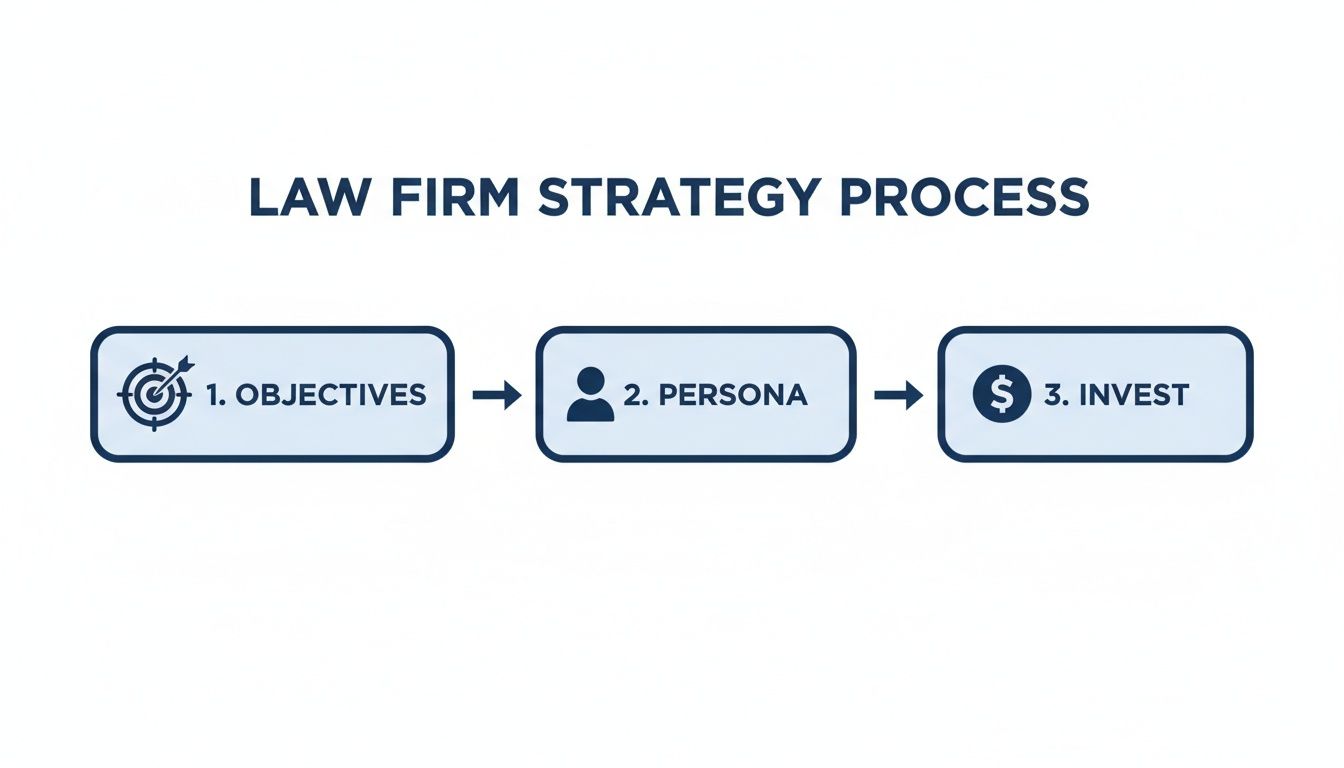
This flowchart says it all. The financial investment should be the last thing you do, only after you have crystal-clear goals and know exactly who you're trying to reach.
Set Specific and Measurable Objectives
First things first, you have to trade vague ambitions like "get more clients" for specific, measurable, achievable, relevant, and time-bound (SMART) goals. This simple shift in thinking transforms your marketing from a cost center into a predictable engine for firm growth.
So, what does this look like for a real Southern California law firm?
- Vague Goal: "I want more PI cases."
- SMART Goal: "Increase qualified personal injury consultations from Los Angeles County by 20% within the next quarter through targeted local SEO and Google Ads."
See the difference? That level of specificity gives you a clear target. You know exactly what you're aiming for and can build a realistic plan to get there.
To make this more concrete, we've put together a few examples of what strong SMART goals can look like for different Southern California practices.
Sample SMART Goals for Southern California Law Firms
This table provides concrete examples of SMART goals across different practice areas, helping firms translate broad ambitions into actionable marketing objectives.
| Practice Area | Objective (SMART Goal) | Key Performance Indicator (KPI) |
|---|---|---|
| Personal Injury | Increase signed car accident cases from Riverside County by 15% in Q3 by launching a targeted video marketing campaign. | Number of new, signed retainer agreements. |
| Family Law | Generate 25 qualified leads for high-asset divorce consultations in Orange County per month via our website contact form. | Number of form submissions from qualified prospects. |
| Criminal Defense | Boost organic website traffic for "San Diego DUI lawyer" keywords by 30% over the next 90 days through on-page SEO. | Organic search traffic for target keywords. |
| Estate Planning | Secure 5 new high-net-worth estate planning clients from the Newport Beach area each month for the next six months. | Number of new HNW clients. |
| Employment Law | Increase discovery calls for wrongful termination cases in LA by 20% in Q4 through an AI-powered Google Ads campaign. | Number of scheduled discovery calls. |
These examples show how to tie marketing activities directly to the results that actually grow your practice.
Build Your Ideal Client Personas
Once you know what you want to achieve, the next critical step is defining who you need to reach. This is where an ideal client persona comes in. It’s a semi-fictional profile of your perfect client, built from market research and hard data on your best existing clients. This goes way beyond basic demographics.
Let's imagine a criminal defense firm in Los Angeles. A persona might be "Stressed Steven," a 35-year-old tech professional staring down his first DUI charge.
- What are his anxieties? He's terrified of losing his job, damaging his reputation, and trying to navigate the complex court system alone.
- Where is he looking for help? He’s on his phone, frantically Googling things like "best DUI lawyer downtown LA." He’s also scouring reviews on Avvo and checking out Google Business Profiles.
- What language will connect with him? You need messaging that conveys experience, discretion, and a clear plan of action. Generic promises won't cut it.
When you create detailed personas like this for each of your main practice areas, you can tailor your website content, ad copy, and social media messaging to speak directly to the people you want to attract.
As you map out your strategy, it’s also helpful to ground your plan with some proven small business online marketing tips. And if you're thinking about bringing in some outside help, getting familiar with the different types of marketing firms for attorneys can give you valuable context for making the right choice.
Building Your Digital Office: SEO-First and ADA-Compliant
Think of your law firm’s website as your primary office—the one that’s open 24/7, making a first impression on every potential client. It's no longer a simple digital brochure. It’s the single most powerful client-generation tool you have, and it needs to be built from the ground up with search visibility and user accessibility locked in.
This starts with what we call an SEO-first architecture. Trying to bolt SEO onto an already-built website is like trying to add a foundation to a finished skyscraper. It just doesn’t work. Your site needs a rock-solid technical structure that search engines like Google can easily crawl, understand, and most importantly, rank.

Target Keywords That Actually Convert
So many firms make the mistake of chasing broad, hyper-competitive keywords like "LA lawyer." The reality? Your best potential clients—the ones with an urgent legal problem—are searching with much more specific phrases. These are called long-tail keywords.
Let's look at how people really search:
- Instead of "car accident attorney," they're typing in "hit and run lawyer for bicyclists in Santa Monica."
- Instead of "family law," they're searching for "contested divorce child custody attorney Orange County."
These long-tail keywords have less search volume, but the intent behind them is sky-high. When you target them, you’re attracting visitors who are looking for the exact services you provide. That's how you turn a website visitor into a consultation. Your practice area pages have to be meticulously optimized for these phrases.
The Critical Role of ADA Compliance
Beyond showing up in Google, your digital office has to be open to everyone, including individuals with disabilities. This is where the Americans with Disabilities Act (ADA) comes in, and it's not just about avoiding lawsuits. It's smart business and even better marketing.
An accessible website opens your doors to an estimated 15% more potential clients—the portion of the population living with a disability. Better yet, many ADA requirements, like proper heading structures and descriptive alt text for images, directly overlap with SEO best practices.
When you make your site accessible, you improve the user experience for every single visitor. That sends positive signals to Google, which can boost your rankings. It's a powerful cycle: accessibility improves SEO, and great SEO brings more people to your accessible, user-friendly website. A simple but effective tactic is using captions for accessibility and SEO on all your video content.
Why Outsourcing Is Now the Norm
Building a modern legal website that nails both SEO and ADA compliance is incredibly complex. That reality has forced a huge shift in the industry. In today's fiercely competitive legal market, a staggering 83% of law firms now outsource their marketing to specialized agencies.
This isn't a failure of in-house teams; it's a recognition that DIY marketing just can't keep up with sophisticated ad algorithms and constantly changing search standards.
An agency that lives and breathes legal marketing understands the nuances. They know how to build a site that not only ranks but is engineered to convert, with clear calls-to-action, intuitive navigation, and trust-builders like testimonials and case results. This is how you transform a website from a static online listing into an active, lead-generating machine for your firm. You can learn more about what an effective SEO-first and ADA-compliant web design strategy involves right here.
Dominating Local Search with Targeted Content
Once your digital office is built, it's time to put up the local equivalent of a bright, flashing "Open for Business" sign.
For most law firms, especially in a sprawling area like Southern California, the battle for new clients is won at the neighborhood level. A smart marketing plan has to be laser-focused on local search, because that’s where your most valuable, high-intent clients are looking for immediate help.
This isn't about being found by everyone, everywhere. It’s about being the first and best answer when someone in your service area searches for the exact legal help you provide.
Your Google Business Profile Is Your Local Billboard
Before you even think about content strategies, you have to nail your Google Business Profile (GBP). This free listing is arguably the single most powerful local marketing tool you have. When someone searches for "personal injury attorney near me," the GBP listings in the "map pack" are the first thing they see.
A bare-bones profile just won’t cut it. You need to treat it like a dynamic, living extension of your firm. That means going way beyond just your name, address, and phone number.
- Gather a Steady Stream of Reviews: Social proof is everything in the legal world. You need a system for requesting reviews from satisfied clients. A consistent flow of positive, recent reviews is a massive signal to both potential clients and Google's algorithm that your firm is active and trusted.
- Use High-Quality Photos and Videos: Show off your office, your team, and even short, professional video clips. This simple step humanizes your practice and builds an immediate sense of familiarity.
- Leverage the Q&A Feature: Proactively answer the common questions your clients always ask. Think like them: "Do you offer free consultations?" or "What's your experience with truck accident cases?" Answering these directly on your profile establishes your authority and provides instant value.
A fully optimized Google Business Profile does more than just list your information; it actively builds credibility. It's often the first and only interaction a potential client has with your firm before deciding to call.
For a much deeper dive, we've outlined some proven Google Business Profile for attorneys tweaks that can help you truly own the Southern California map pack.
Creating Content That Connects Locally
With a rock-solid GBP in place, your next move is creating content that speaks directly to the legal needs of your community. Generic blog posts about federal law are useless here. Your content needs to be hyper-local to resonate with people in your specific service areas and send strong relevance signals to search engines.
It all comes down to answering the exact questions your ideal clients are asking. Instead of a broad article on probate law, create a short, digestible video or blog post titled, "Navigating the Los Angeles County Probate Court: What Families Need to Know." See the difference?
A Local Content Strategy in Action
Let's make this real. Imagine you're a workers' compensation attorney in Long Beach. Here’s what a targeted, local content plan looks like:
- Service-in-Location Pages: Build out dedicated pages on your website for each core service and city. Think "Long Beach Construction Accident Lawyer" or "Carson Warehouse Injury Attorney." These pages should detail your experience with cases specific to those areas and their main industries.
- FAQ-Driven Blog Posts: Write articles that answer questions with a local spin. Something like "What Are the Deadlines for Filing a Workers' Comp Claim in California?" or "Can I Choose My Own Doctor After a Work Injury in Orange County?"
- Short-Form Video: Film quick, one-to-two-minute videos perfect for social media and your website. Answering a single, specific question like, "What should I do immediately after a slip and fall at work in Torrance?" is incredibly effective. It's highly shareable and establishes you as a helpful authority.
This focused strategy pulls double duty. First, it directly addresses the concerns of potential clients in their moment of need, building trust. Second, it populates your website with highly relevant, location-specific keywords that Google's local search algorithm loves. This combination is how you move from just being online to actively dominating your local market.
Using AI-Powered Ads to Get Clients in the Door—Now
Let's be clear: a great SEO strategy is your firm's long-term play for authority and organic growth. It's the foundation. But paid advertising? That’s the accelerator. It’s how you get your firm in front of people who need a lawyer right now. A winning marketing plan needs both, using ads to drive immediate revenue while your SEO builds a digital legacy.
Simply bidding on keywords is old news. Today's ad platforms, especially Google Ads, are powered by sophisticated AI that predicts a searcher's intent with uncanny accuracy. This ensures your marketing budget isn't just spent, it's invested in clicks that are far more likely to become actual, paying clients.
How AI Makes Your Ad Spend Smarter
Think of it this way: AI algorithms are constantly analyzing thousands of signals in real-time. They look at a user's search history, their location, the time of day, and even the device they're using. This allows the system to make lightning-fast, intelligent bids, placing your ad in front of a potential client at the exact moment they signal they need your help.
This isn't about casting a wide net with broad keywords anymore. The AI is smart enough to target high-intent individuals. It knows that someone searching for "emergency criminal defense attorney Los Angeles" at 2 AM on a Saturday is a much hotter lead than someone vaguely browsing legal topics on a weekday afternoon. It then prioritizes your ad spend on that highly motivated searcher.
The payoff? A lower cost-per-lead and a much higher quality of calls and form submissions coming into your firm.
We've seen AI-driven ad campaigns deliver a 25% or greater increase in conversion rates compared to the old, manually managed approach. The system learns and adapts, meaning your ads get smarter and more efficient over time, pushing your return on investment higher and higher.
When you have this kind of system dialed in, it becomes a predictable client-generating machine. To see what a well-oiled campaign looks like, you can dig into the specifics of AI-powered Google Ads for attorneys.
Your Ad Copy Has to Hit Hard
In a fiercely competitive market like Southern California, your ad copy needs to do more than just state your practice area. It has to connect directly with the searcher's specific problem and offer a clear, immediate solution. The AI can find the perfect person, but your message is what earns the click.
Let’s look at a couple of real-world examples:
For Personal Injury: A generic ad that just says "LA Personal Injury Lawyer" is invisible. It blends in with dozens of others. A much more powerful, AI-targeted ad would read: "Car Accident on the 405? Get Immediate Medical & Legal Help. Free Consultation. We Come to You." See the difference? It addresses a specific scenario, highlights a key benefit (we come to you), and ends with a strong call to action.
For Family Law: Don't just run an ad saying "Orange County Divorce Attorney." A far better ad would be: "High-Asset Divorce in Newport Beach? Protect Your Future. Confidential Strategy Session. Experienced Litigators." This speaks directly to a high-value client, uses emotionally resonant words like "protect" and "confidential," and instantly establishes authority.
A Realistic Social Media Plan for Busy Attorneys
Your time is your most valuable asset. Trying to be active on every single social media platform is a fast track to burnout with little to show for it. The goal isn't to be everywhere; it's to be effective where your ideal clients actually are. A smart marketing plan for a law firm means being strategic, not just busy.
Pick Your Battles
LinkedIn for Professionals: If your firm serves business clients—think corporate law, B2B litigation, or employment defense—LinkedIn is non-negotiable. It's the perfect place to share insightful articles, build your professional brand, and connect with valuable referral sources like CPAs and financial advisors.
Facebook for the Community: For practices like family law, estate planning, or personal injury, Facebook is incredibly effective. It's where you can connect with your local community, share client success stories (with their explicit permission, of course), and run ads targeted with laser precision based on demographics and life events.
The key is to stop thinking of social media as a direct sales channel. It's a platform for building trust and staying top-of-mind. Share genuinely helpful content, engage with people who comment, and show the human side of your firm. This focused approach ensures your efforts actually contribute to your marketing goals without taking over your entire life.
Budgeting and Measuring Your Marketing ROI
A brilliant marketing strategy is just a nice idea on paper without two things: a realistic budget and a ruthless system for measuring what actually works. The strategy sessions are fun, but this is where your plan collides with the financial reality of your practice.
This is the step that turns marketing from a hopeful expense into a predictable, data-driven investment. It forces you to get honest about your resources and strategic about where every single dollar goes. Whether you're a solo practitioner watching every penny or a multi-partner firm ready to scale, the principles don't change. You have to know your numbers to grow your numbers.

How to Allocate Your Marketing Funds
There’s no magic number, but I've found a solid benchmark for established law firms is allocating somewhere between 2% to 5% of gross revenue to marketing. If your firm is brand new or you're in an aggressive growth phase, that figure can easily climb to 7% to 10%.
Once you land on your total budget, the real question is how to slice up the pie. For a modern Southern California law firm, a balanced approach might look something like this:
- SEO & Content Marketing (35-45%): Think of this as your long-term asset. It covers website optimization, local SEO, blogging, and video creation. This investment builds your digital authority and keeps generating organic leads for years, long after you've paid for it.
- Paid Advertising (30-40%): This is your accelerator. It’s for AI-powered Google Ads and highly targeted social media campaigns designed to get the phone ringing right now.
- Technology & Tools (10-15%): This slice covers your CRM, analytics software, and social media scheduling tools—the software that makes your entire marketing machine run efficiently.
- Offline & Networking (5-10%): Always save a small portion for sponsoring local events or other community initiatives. It’s an old-school way to build local credibility that still works.
Key Marketing KPIs for Law Firms
Forget vanity metrics. Things like social media followers or raw website traffic look nice in a report but don't pay the bills. To prove your marketing’s worth, you have to track the Key Performance Indicators (KPIs) that directly impact your firm's bottom line.
The table below breaks down the metrics that truly matter.
Key Marketing KPIs for Law Firms
| KPI | What It Measures | Why It's Important |
|---|---|---|
| Cost Per Qualified Lead (CPQL) | The average cost to generate one lead that actually fits your ideal client profile. | This tells you how efficiently your marketing dollars are attracting the right cases, not just filling your inbox with noise. |
| Client Acquisition Cost (CAC) | The total marketing and sales cost to acquire one new, signed client. | CAC is the ultimate measure of marketing efficiency. The goal is simple: get this number as low as possible without sacrificing client quality. |
| Lead-to-Client Conversion Rate | The percentage of your qualified leads that become paying clients. | A low conversion rate often points to problems with your intake process, not necessarily a failure in your marketing. It’s a crucial distinction. |
| Return on Investment (ROI) | The total revenue generated from marketing divided by the total marketing spend. | This is the final verdict. An ROI greater than 1 means your marketing is profitable and is actively growing your firm. It's that simple. |
Tracking these KPIs is non-negotiable. They give you the hard data you need to justify your budget and make smart decisions about where to double down and where to pull back.
You cannot manage what you do not measure. By focusing on metrics like CAC and conversion rates, you shift the conversation from "How much are we spending?" to "How much are we earning from this investment?"
Mapping Out a Realistic Timeline
A full 12-month marketing plan can feel like a monster, so I always recommend breaking it down into manageable sprints with clear, achievable goals.
- First 30 Days: The focus here is all about the foundation. That means getting your Google Business Profile completely optimized, launching an initial "brand awareness" Google Ads campaign, and running a thorough technical SEO audit on your website.
- First 90 Days: Now it's time to build momentum. Launch your first two locally-focused content pieces (a blog post and a short video are a great combo), start consistently asking clients for reviews, and use that initial ad data to sharpen your keyword targeting.
- First 180 Days: It's time to analyze and scale what's working. By now, you should have enough data to calculate a baseline Client Acquisition Cost. Use that number to start shifting your budget toward your most profitable channels.
This phased approach ensures you’re building your marketing engine methodically, not just throwing things at the wall. Our guide on measuring advertising effectiveness takes an even deeper dive into the analytics that fuel this kind of growth. It helps ensure your marketing plan isn't just a static document, but a living strategy that adapts to what the data is telling you.
Common Questions About Marketing a Law Firm
Even with the best roadmap laid out, putting a real-world marketing plan into action always brings up questions. It's only natural. Here are some of the most common things we hear from Southern California attorneys when they get serious about growing their practice.
How Much Should My Firm Actually Spend on Marketing?
This is always the first question, and while there's no magic number, there are some very reliable benchmarks. For an established firm that’s holding steady, a good starting point is dedicating 2% to 5% of your gross revenue to your marketing efforts.
But that's just a baseline. If you're a new firm trying to make a name for yourself, breaking into a cutthroat market like personal injury in Los Angeles, or you’re in a serious growth phase, you have to be more aggressive. In those cases, you’re looking at something closer to the 7% to 10% range.
It's critical to stop thinking of this as a "cost" and start seeing it for what it is: an investment in your firm's future.
Should I Bet on SEO or Paid Ads First?
This isn't an either/or dilemma. It’s about understanding what each tool is built to do. Think of it like this: SEO is your long-term wealth builder, the bedrock of your financial future. Paid ads, like Google Ads, are your short-term, high-yield plays that bring in cash flow right now.
SEO (Search Engine Optimization): This is foundational. It’s how you build real authority and generate a steady stream of organic cases for years. The catch? It takes time to get going, but the return on investment compounds beautifully over the long haul.
PPC (Pay-Per-Click Ads): This is all about speed and immediate visibility. When someone desperately needs a lawyer now, PPC puts your firm right at the top of their search results, at the exact moment of need.
A new firm can use a small, surgically targeted PPC campaign to get the phone ringing this week, generating revenue while the slower, more sustainable SEO strategy takes root. Any truly effective marketing plan for a law firm will almost always have both working in concert.
The most successful firms we see don't choose between SEO and PPC. They use PPC to fuel immediate caseloads and revenue, which in turn funds the long-term SEO strategy that eventually becomes their most powerful and cost-effective lead source.
Does Social Media Actually Get Cases for Lawyers?
It absolutely can, but you have to be strategic and realistic. Trying to be everywhere at once is a classic recipe for burnout with nothing to show for it. The only thing that matters is focusing your energy where your ideal clients actually spend their time.
For the vast majority of Southern California law firms, that means narrowing your focus to two key players:
- LinkedIn: Non-negotiable for any firm with a B2B focus, like business law or employment defense. It's also an incredible tool for building referral networks with other professionals you rely on, like financial advisors and accountants.
- Facebook: Still a powerhouse for community-driven practices. If you're in family law, estate planning, or personal injury, this is where you connect with local residents and run laser-targeted ads that speak directly to their needs.
Forget about going viral. The real goal of social media for lawyers isn't fame; it's about building trust, sharing genuinely helpful information, and simply staying top-of-mind in your community.
How Long Until I See a Real Return on This Investment?
The timeline for seeing a tangible ROI is completely different depending on the channel you're using.
With AI-powered Google Ads, you can see qualified leads coming in within the first week of launching a properly managed campaign. It's a direct transaction: you're paying for immediate access to people with high intent, and the results are fast.
SEO is a different game entirely. It's a marathon, not a sprint. You should expect it to take 4-6 months before you start seeing real movement in your rankings and a noticeable jump in organic traffic. But the leads you get from SEO are often higher quality and have a much lower acquisition cost in the long run since you aren't paying for every single click. Patience is the key here—the payoff is massive and built to last.
Crafting and executing a modern marketing plan that gets results requires specialized expertise and relentless, consistent effort. At Case Quota, we've spent over 15 years helping Southern California law firms dominate their local markets with strategies that deliver real, measurable growth.
Ready to turn your marketing from an expense into a predictable engine for new cases?