

When it comes to marketing for family lawyers, it's not about slick sales pitches. It’s about building a brand that quietly communicates empathy, trust, and expertise to people navigating some of the most difficult moments of their lives.
This foundational work is everything. It's about figuring out what makes you different, deeply understanding your ideal client, and then creating an online presence that speaks directly to them.
Building a Brand That Resonates in Sensitive Cases
In family law, potential clients aren’t just shopping for a lawyer; they're looking for an ally. They need a compassionate guide through the emotional chaos of divorce, custody battles, or adoptions.
That’s why generic claims like "aggressive representation" or "experienced attorney" just don't cut it. They fall flat because they miss the point. Your brand has to show a genuine understanding of the human side of these cases. It all starts with defining your firm’s unique value proposition.
What really sets you apart from the firm down the street? Is it your laser focus on high-asset divorces? Maybe it's your mediation-first philosophy that saves clients from ugly court battles. Or perhaps you have a unique, structured process for handling the most complex child custody cases. Nailing this down is the first step to attracting the right clients—the ones you are best equipped to serve.
Identifying Your Ideal Client Personas
Once you know your value, you have to know who you're talking to. Trying to market to everyone is a surefire way to connect with no one. The key is to develop specific client personas—detailed, almost fictional profiles of your ideal clients.
Think about it like this:
- "High-Net-Worth Helen": She's a 55-year-old executive facing a divorce that involves complicated assets like a family business, stock options, and multiple properties. Her biggest concerns are her financial future and maintaining her privacy.
- "Protective Parent Paul": He's a 35-year-old father who needs to modify a custody agreement. He’s worried sick about his child's well-being and needs a lawyer who is both a strong advocate and a reassuring guide.
When you craft your messaging for "Helen" or "Paul," you can speak directly to their specific fears and priorities. Your website copy, your blog posts, and your ads suddenly become far more powerful because they're addressing real, human concerns. It's how you build an immediate connection.
A strong brand in family law is built on empathy. It's about showing clients you get it—before they ever pick up the phone. You're creating a safe space where they feel seen, heard, and supported.
This entire process follows a clear, repeatable workflow for getting your brand's foundation right.
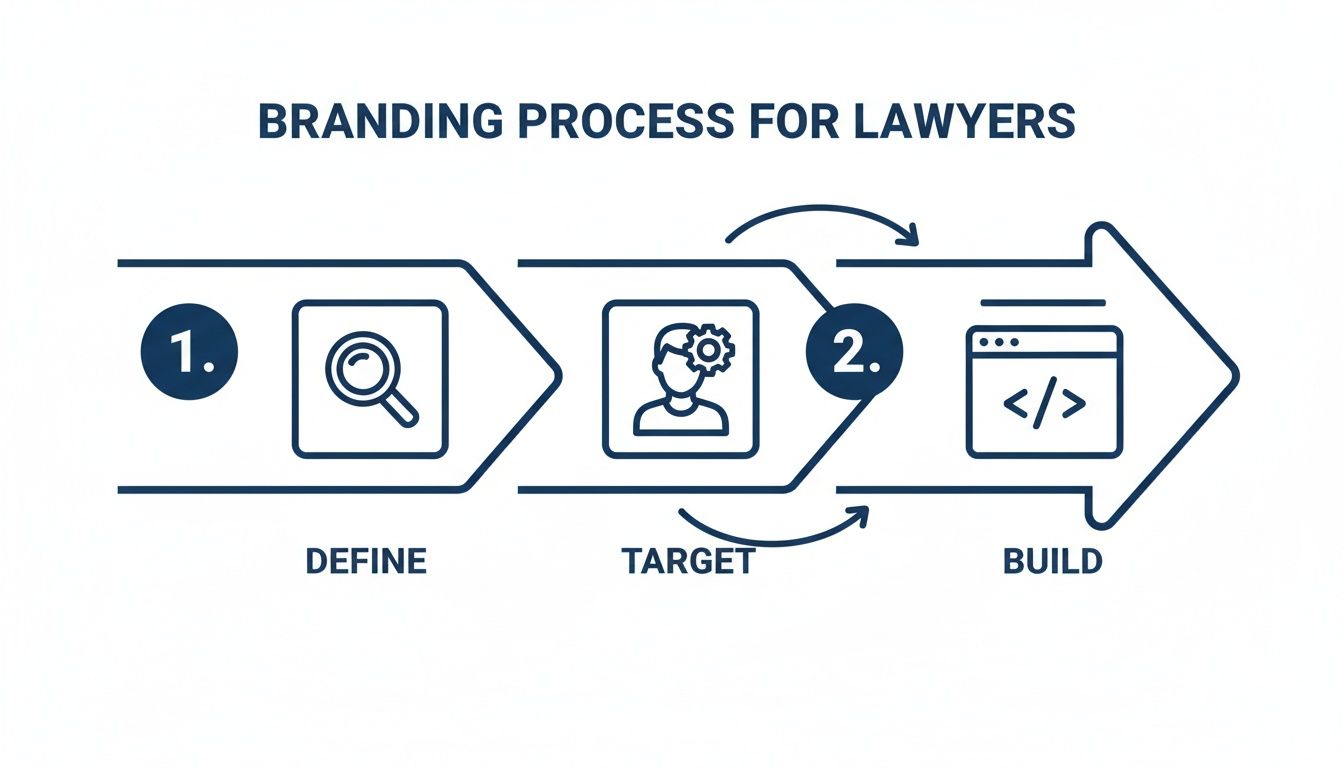
This just shows the logical flow: first, you define who you are. Then, you target the right audience. And finally, you build the assets that will represent your firm out in the world.
Creating Your Digital First Impression
Let’s be honest: your website is the new front door to your law firm. It has to be professional, intuitive, and—critically—accessible to everyone.
An ADA-compliant website isn't just about checking a legal box; it's a clear signal that your firm is committed to serving everyone in your community. For family lawyers, a great website is so much more than a digital brochure. It’s your most powerful client-attraction machine.
To get a much deeper look into what makes a law firm's site truly effective, our guide on web design for attorneys is packed with essential insights. Getting this foundational branding work right ensures every single marketing dollar you spend is targeted, effective, and helps build a reputation that will last for years.
Dominating Local Search to Attract Ready-to-Hire Clients

When someone's world is turned upside down by a family crisis, their first move is almost always the same: they pull out their phone and search for a lawyer "near me." For family law firms, the marketing battle isn't won on a national stage. It’s won block-by-block, right on the Google Map.
This is where mastering local search becomes your firm's most powerful client-generation engine.
The entire journey for finding legal help has moved online. We know that 57% of potential clients now start their search for an attorney on the internet. For a practice as personal as family law, that first page on Google isn't just a goal; it's a requirement for survival and growth. A meticulously optimized local presence is the bedrock of any marketing plan that actually works.
Your Google Business Profile Is Your Digital Handshake
Think of your Google Business Profile (GBP) as the digital front door to your practice. It's often the very first impression a potential client gets, and it needs to instantly communicate trust and competence. An incomplete or neglected profile suggests a lack of attention to detail—a quality nobody wants in their family lawyer.
Let's turn your GBP from a simple listing into a client magnet. Focus on these key areas:
- Complete Every Single Field: Don't skip anything. Fill out every section Google offers—services, hours, accessibility info, and a detailed business description packed with keywords like "divorce attorney in [Your City]" and "child support legal services."
- Get Granular with Services: Don't just list "Family Law." Break it down into the specific, painful problems people search for: ‘Child Custody Modifications,’ ‘High-Asset Divorce,’ ‘Spousal Support Agreements,’ and ‘Adoption Services.’ This is how Google connects you to the most urgent, high-intent searches.
- Use Real Photos: Get professional, high-quality photos of your office (inside and out) and your actual legal team. Real pictures of your attorneys build an immediate human connection that stock photos completely fail to deliver.
If you want to go deeper on this, we've put together a guide with proven Google Business Profile for attorneys tweaks that will help you own the local search results.
Uncovering What Your Local Clients Are Actually Searching For
Great local SEO is all about getting inside your client's head and knowing the exact phrases they’re typing into Google when they're in distress. Sure, "family lawyer" is a target, but it's incredibly competitive. The real gold is in the longer, more specific keywords that scream, "I need to hire someone now."
Your mission is to find the phrases that reveal a specific need in your city or county. Think about the language real people use when they need help.
| Keyword Category | Real-World Examples | What It Tells You (Client Intent) |
|---|---|---|
| Service + Location | child custody lawyer Los Angeles |
They have a specific problem and a defined location. This is a hot lead. |
| Urgent Need | emergency divorce consultation near me |
This person is in crisis mode and needs immediate legal advice. |
| Question-Based | how to file for legal separation in CA |
They're in the research phase. You can attract them with helpful content. |
You can use tools like Google's Keyword Planner to dig up these terms and see how many people are searching for them. Once you have your list, weave these phrases naturally into your website's service pages, your blog posts, and your GBP description.
Doing this sends a powerful signal to Google that you are the most relevant local authority for these family law issues. This alignment is what rockets you to the top of the local map, making sure your firm is the first one people see when they need you most.
Creating Content That Builds Unshakeable Trust
Let's be honest. When someone is searching for a family law attorney, they're not just looking for legal services—they're looking for a lifeline. Your content is where you prove you're the right person to provide it, building a genuine human connection long before they ever pick up the phone.
This isn't about churning out generic articles. It’s about providing clarity and compassion to people navigating one of the most uncertain times of their lives. Your content has to answer the urgent, real-world questions they're typing into Google late at night.
So, instead of a broad article on "Divorce Law," you need to get specific. Think about creating a detailed guide on "How to Protect Your Business During a Divorce in Texas" or "What Are My Rights if My Ex Won't Follow the Custody Agreement?" This kind of specificity doesn't just perform better in search; it immediately shows you get it.
From Blog Posts to Comprehensive Guides
A truly effective content strategy has multiple layers, designed to meet potential clients wherever they are in their journey. The foundation should be built on both consistent blog posts and more substantial, cornerstone guides.
- Topical Blog Posts: Think of these as your firm's pulse. They should tackle timely questions, break down recent changes in local law, or address common client fears. A post titled, "3 Things to Do Immediately After Being Served Divorce Papers," is infinitely more helpful and clickable than a generic overview of the divorce process.
- Cornerstone Guides: These are your firm's definitive resources—in-depth, authoritative pieces that cover a major topic from A to Z. A "Complete Guide to Child Custody in Our State," for example, can become a powerhouse asset that attracts links and cements your firm as the go-to authority.
The goal isn't just to produce content that ranks. It's to create resources that position your attorneys as the compassionate, steady leaders that clients desperately need. For a deeper look at building out this kind of strategy, our comprehensive guide on law firm content marketing offers a ton of actionable frameworks.
To really nail this, you need to map your content directly to what a potential client is thinking and feeling at each stage. This is where a content matrix comes in handy. It helps ensure you're creating the right piece of content, for the right person, at the right time.
Family Law Content Strategy Matrix
| Client Journey Stage | Client Mindset / Questions | Content Format | Example Topic |
|---|---|---|---|
| Awareness | "What are my rights?" "Can I afford this?" | Blog Post, FAQ, Short Video | "Understanding the Average Cost of Divorce in [Your City]" |
| Consideration | "Who is the best lawyer for my situation?" | Attorney Bios, Case Studies, Webinars | "Meet Our Attorneys: A Q&A on High-Asset Divorce" |
| Decision | "What's the next step?" "Why this firm?" | Detailed Service Pages, Testimonials | "Our Approach to Child Custody Negotiations" |
By thinking through this journey, you move from just creating content to strategically guiding a person from a state of crisis to a feeling of confidence in your firm.
The Untapped Potential of Video Marketing
While well-written articles are crucial, nothing builds trust faster than video. In a practice area as personal as family law, seeing and hearing an attorney speak can break down barriers in a way text simply can't. It puts a human face to the name on the website.
And don't worry, this doesn't require a Hollywood budget. Start with simple, authentic formats that deliver real value.
- Short Social Media Clips: Film 60-second videos answering one hyper-specific question. "What's the very first step in filing for legal separation?" These are perfect for sharing on Facebook or LinkedIn.
- Detailed Q&A Sessions: Record an attorney answering a list of frequently asked questions. This demystifies the legal process while showcasing their personality and empathetic communication style.
This approach humanizes your practice instantly. Research from the American Bar Association shows that 35% of law firms using social media have directly signed clients from their efforts. Platforms like Facebook and LinkedIn are no longer just for ads; they are vital channels for building trust with someone in the middle of an emotional crisis.
Your content is your 24/7 advocate. It works tirelessly to demonstrate your expertise, answer critical questions, and build a foundation of trust that makes a prospective client feel comfortable and confident enough to pick up the phone and call you.
Ultimately, a thoughtful content plan is the heart of modern marketing for family lawyers. It elevates your firm from being just another name in a directory to a trusted resource that clients actively seek out for guidance and support.
Using Paid Ads for Predictable Caseload Growth

While SEO and content marketing are building your firm’s long-term foundation, paid advertising is the engine for immediate and predictable lead flow. Think of it this way: when a potential client is in crisis, they're not casually browsing—they're searching for urgent help. Paid ads put your firm right at the top of the search results, exactly when they need you most.
This isn’t about just throwing money at Google. It’s about creating a reliable system that turns ad spend directly into consultations. Paid ads give you a level of control and speed that organic strategies simply can't match, letting you dial your lead volume up or down based on your firm’s capacity.
Targeting High-Intent Clients with Google Ads
The real magic of Google Ads is its ability to capture intent. You're getting in front of people who are actively looking for a solution to their problem right now. For family lawyers, this means bidding on keywords that signal a desperate need for legal counsel, not just idle curiosity.
Your focus should be on phrases that show someone is ready to hire:
- Urgent Service Keywords: Think "emergency custody lawyer [Your City]" or "divorce attorney consultation today."
- Specific Need Keywords: Get granular with terms like "contested divorce lawyer" or "spousal support legal advice."
- "Near Me" Searches: These are gold. They show immediate local intent and are usually performed on a mobile device by someone ready to make a call.
Your ad copy has to do more than list your services. It needs to connect with the client's emotional state. Using words like "guidance," "support," and "confidential consultation" builds immediate trust and gets them to make that critical first click.
Paid advertising in family law is an exercise in empathy. Your ad copy and landing page must immediately reassure a potential client that you understand their stress and can provide a clear path forward.
For a much deeper dive into mastering this platform, our complete guide on Google Ads for lawyers lays out advanced strategies for truly maximizing your return.
Capitalizing on Trust with Local Service Ads
Beyond traditional pay-per-click, Google’s Local Service Ads (LSAs) have become an absolute game-changer for family law firms. These ads show up above all other search results and come with a "Google Screened" badge—an instant stamp of credibility.
What makes LSAs so powerful is the pay-per-lead model. You only pay when a qualified prospect actually contacts you through the ad. This slashes wasted ad spend and is the perfect tool for grabbing the most valuable, ready-to-act leads in your specific service area.
Strategic Social Media Ads for Brand Awareness
While Google is great for capturing active searchers, platforms like Facebook and Instagram let you reach potential clients before they even realize they need an attorney. This isn't about direct lead generation; it's about building top-of-mind awareness so you're the first call they make.
Try running targeted campaigns aimed at specific life events or demographics:
- Target parents with young children in your county to build awareness around your custody and child support services.
- Reach individuals nearing retirement age to address the growing trend of "gray divorce."
The creative here shouldn't be salesy. Instead, be helpful. Offer a free guide on "5 Things to Consider Before a Divorce" or a short video explaining the mediation process. This positions your firm as a valuable resource, not just another ad.
In the US family law market, an estimated 56,970 lawyers are competing for cases. It’s an incredibly crowded field where just waiting for referrals is no longer a viable strategy. As recent family law statistics show, a multi-channel approach that combines targeted SEO and smart paid advertising is absolutely essential for standing out and achieving consistent growth.
When someone is looking for a family lawyer, they're often in one of the most stressful periods of their life. They're not just buying a service; they're searching for an advocate they can trust with their future. So, what’s the first thing they do? They go online and see what other people are saying.
In the emotionally charged world of family law, your online reputation isn't just a part of your marketing—it is your marketing.
That gut-check question, "Can I trust this person?", is answered long before they ever pick up the phone. And with 82% of consumers saying online reviews directly influence their choice of a lawyer, you simply can't afford to leave your reputation to chance. It's time to take control.
Encouraging Positive Reviews from Satisfied Clients
Here's a little secret: most happy clients are more than willing to leave you a review. They just need a gentle nudge and a process that doesn't feel like homework.
Timing is everything. The absolute best time to ask is right after you've secured a win for them, when their gratitude is at its peak. Don't wait weeks and send out a generic email blast; strike while the iron is hot.
Make it part of your case-closing workflow:
- Get Personal. The attorney who handled the case should send a personal email. Mention something specific and positive about their case. It shows you saw them as a person, not just a file number.
- Make It Insanely Easy. Give them direct links to your Google Business Profile and Avvo page. The goal is zero friction. If it takes more than two clicks, you've probably lost them.
- Frame It as Helping Others. Explain that their feedback is invaluable for other families navigating the same scary situation they just went through. This turns a simple review into an act of paying it forward.
If you're ready to build a real system around this, diving into a comprehensive guide on reputation management for attorneys can give you the repeatable frameworks you need.
Responding to Negative Feedback with Integrity
It’s going to happen. No matter how great you are, eventually, a negative review will pop up. Your reaction in that moment speaks volumes more about your firm's character than a dozen five-star reviews ever could.
Getting defensive or, worse, ignoring it is a massive red flag for potential clients. Never, ever get into a public back-and-forth.
Your job isn't to win the argument. It's to show everyone else watching that you are a reasonable, professional, and compassionate firm. Acknowledge their frustration, state that you regret their experience wasn't positive, and invite them to connect offline to discuss it. This protects client confidentiality while demonstrating that you take feedback seriously. To get more tactical on this, it's worth exploring insights on online reputation management for lawyers.
Your public response to a negative review isn't for the person who wrote it; it's for every future client who reads it. Show them you are a reasonable, professional, and caring advocate, even when faced with criticism.
Optimizing Your Intake to Convert Interest into Clients
So you've built a stellar reputation and the leads are coming in. Fantastic. But all that hard work is for nothing if potential clients hit a wall when they try to contact you.
A clunky, slow, or frustrating intake process will kill your conversions dead. You need a compassionate and hyper-efficient system that meets modern clients where they are.
These are no longer luxuries; they're expectations:
- Live Web Chat: Gives a visitor an immediate, low-pressure way to get answers without having to make a formal call.
- Online Scheduling: Let them book a consultation right from your website. No more phone tag.
- 24/7 Answering Service: A potential client in distress calling at 10 PM needs to reach a human, not a voicemail.
When you combine a proactive review-gathering strategy with a seamless intake process, your reputation stops being a passive asset and becomes your most powerful client-generation engine.
Answering Your Top Marketing Questions

Let's be honest—navigating the world of digital marketing can feel like a minefield, especially when your real focus is serving clients through some of the most difficult times of their lives. I've found that most family lawyers grapple with the same core questions about where to invest their limited time and money for the best return.
This section cuts through the noise. We'll tackle the tough questions around budgeting, the most frequent mistakes I see firms make, the real role of social media, and the critical importance of keeping everything above board. The goal is to demystify the process so you can make smart, strategic decisions that actually grow your firm.
How Much Should a Family Law Firm Budget for Marketing?
There's no magic number here. The right budget depends entirely on your firm's growth stage and how crowded your local market is. That said, a solid industry benchmark is to allocate between 2% and 15% of your gross revenue to marketing.
Where you fall in that range is all about your goals.
- Aggressive Growth (10-15%): If you're a newer firm or you’re trying to carve out a bigger slice of a hyper-competitive market like Southern California, you need to invest more heavily to build momentum and get your name out there.
- Established & Maintaining (2-5%): A practice with a strong referral engine and years of solid reputation can often maintain its caseload with a smaller, more focused investment.
The key is to stop thinking of this as an "expense." It's a direct investment in your future caseload. Your budget should be strategically split; SEO and content are your long-term assets, while something like Google Ads can bring in high-intent leads right now.
Instead of just spending, set a clear goal, like "increase qualified consultations by 20% in the next six months." Suddenly, your budget isn't just a number—it's a tool designed to hit a specific, tangible outcome.
What Are the Most Common Marketing Mistakes Family Lawyers Make?
So many well-intentioned firms fall into the same traps, burning through cash and, worse, alienating the very clients they want to help. Knowing these missteps is the first move toward building a strategy that works.
Most errors come from a fundamental misunderstanding of how people search for a lawyer today. The biggest mistake we see? A slow, clunky, outdated website that isn't mobile-friendly. That's an instant turn-off for the majority of people searching from their phones.
Other all-too-common pitfalls include:
- Ignoring Local SEO: Neglecting your Google Business Profile is probably the single costliest mistake a local firm can make. It’s the primary engine for local, ready-to-hire leads. Full stop.
- Publishing Generic Content: Writing articles that don't tap into the specific, emotional questions and deep-seated fears of your clients will never build trust or attract the right people.
- Flying Blind (No Tracking): If you aren't tracking your metrics, you have no earthly idea which marketing dollars are making the phone ring and which are just vanishing into thin air.
- Letting Reviews Run Wild: Allowing a handful of unhappy clients to control your online narrative can absolutely cripple your firm's credibility.
Avoiding these isn't rocket science. It just means treating your online presence with the same seriousness and data-driven approach you apply to your legal work.
Is Social Media an Effective Channel for Family Lawyers?
Yes, but not in the way most people think. Social media is not a direct lead-generation machine for family law. Its real power lies in building brand trust and humanizing your practice.
Think about it: potential clients aren't scrolling through Facebook hoping to find a divorce attorney. But you can bet they are researching lawyers they're considering, and your social media profiles are a huge part of that background check. It offers a crucial glimpse into your firm's personality, values, and professionalism.
Use platforms like Facebook and LinkedIn to:
- Share genuinely helpful blog posts and guides (no hard selling).
- Post authentic photos of your team to put a human face to the firm name.
- Share client testimonials (only with explicit, written consent, of course).
The objective isn't to sell legal services in a newsfeed. The goal is to build a professional, approachable, and trustworthy presence. That way, when someone does need your help, your firm is already a familiar and credible name. For a deeper dive, these actionable social media marketing tips for small business offer some great, practical guidance.
How Can We Ensure Our Marketing Is Ethically Compliant?
This is the absolute, non-negotiable foundation of everything. Always, always defer to your state bar's specific advertising rules, as they can vary dramatically from one jurisdiction to another.
That said, a few core principles are nearly universal and should be burned into your brain:
- Never Guarantee an Outcome: Don't use any language that could even be remotely interpreted as a promise of a specific result.
- Avoid Misleading Claims: Never create false or unsubstantiated expectations about your expertise or what you can do for a client.
- Clearly Label Advertising: Make sure all promotional materials are clearly marked as "Advertising Material" or whatever specific language your state requires.
- Handle Testimonials with Extreme Care: Ensure any client testimonial is truthful, not misleading, and that you have a signed, written consent form to use it.
Working with a marketing partner who lives and breathes the legal industry's ethical lines isn't a luxury—it's essential. It protects your clients, your reputation, and your license to practice.
At Case Quota, we build effective, compliant, and growth-focused marketing strategies exclusively for law firms. If you're ready to create a marketing plan that delivers predictable results, we invite you to explore our services and see how we can help your practice thrive. Learn more about our approach at https://casequota.com.