
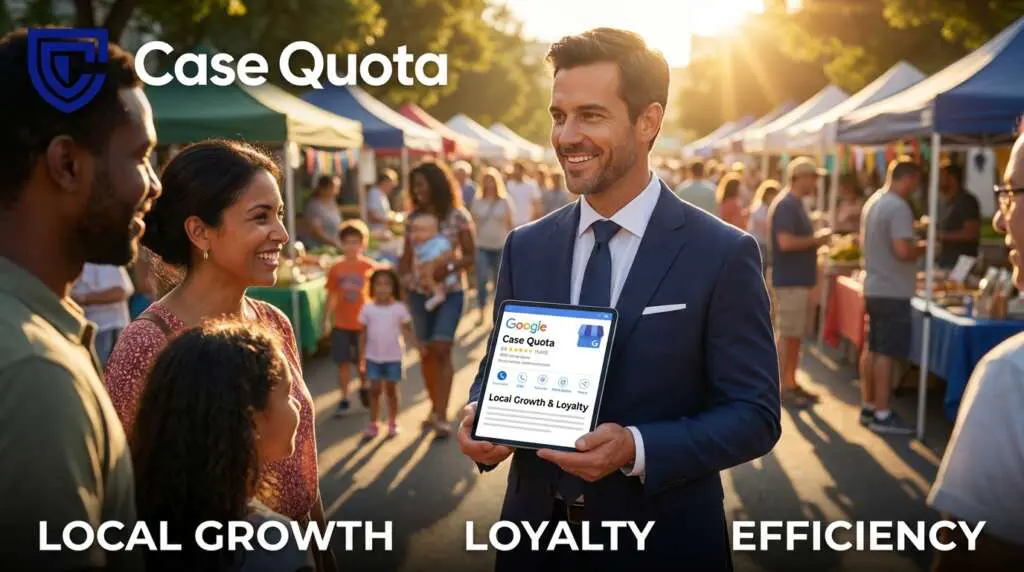
Local Marketing and Sales Growth for Small Businesses
Local marketing and sales growth for small businesses matters now more than ever.
Consumers prefer nearby businesses, so small firms can win with a clear local strategy.
For law firms, this is especially true, because local clients value trust, proximity, and proven results.
Search engines and maps reward relevance and proximity, which turns searches into consultations and leads.
This article explores three practical and measurable strategies that small firms can implement quickly.
First, community events help you build trust, generate referrals, and increase foot traffic.
Second, optimizing your Google Business Profile improves map visibility, local search rankings, and click-throughs.
Third, loyalty tactics keep clients returning, boost lifetime value, and encourage referrals.
Community events can include legal clinics, client workshops, local sponsorships, or pro bono sessions.
They create PR, build relationships, and provide direct opportunities for client intake and referrals.
For your Google Business Profile, claim and verify the listing, add accurate categories, hours, and photos.
Also, respond to reviews promptly, use posts to share updates, and track views with Insights.
For loyalty programs, design tiered rewards, personalize offers, and send timely re-engagement emails.
This playbook blends local SEO, review management, community outreach, and practical sales tactics.
It offers step-by-step checklists, KPIs to measure performance, and templates to speed deployment.
Read on to get actionable steps you can test this month, measure impact, and iterate confidently.
We include examples tailored to small law firms, with budgets and timelines.
You will find low-cost tactics and higher-investment options, with expected ROI estimates.
Because measurement matters, we show which KPIs to track and how to report them.
Start with one tactic, test for 30 to 90 days, and then scale the winning approach.

Community events remain one of the most effective tactics for local marketing and sales growth for small businesses. When you participate or sponsor events, you increase brand visibility, foster relationships, and drive foot traffic to your office or website. For small law firms this approach also builds trust and establishes authority in the neighborhood. Events turn passive awareness into active customer acquisition because people meet your team and ask questions face to face.
Start with clear goals and a simple budget. For example, host a legal clinic, run a know-your-rights workshop, or sponsor a charity run. Staff the event with one attorney and one client coordinator to manage intake. Then track results with sign-ups, calls, and consultations.
Promote events ahead of time with social posts, local ads, and Google Business Profile posts. HubSpot’s event marketing guide offers practical ideas and templates for promotion: HubSpot’s Event Marketing Guide. Also contact local chambers, neighborhood groups, and community calendars. These channels increase attendance and local press opportunities.
At the event focus on value, not the hard sell. Offer free short consultations, a brief workshop, or downloadable checklists in exchange for contact info. Use clear signage, friendly staff, and a tablet or QR code to capture leads. Then follow up within 48 hours with a personalized email and a clear next step. The SBA has marketing resources tailored to small businesses: SBA Marketing Resources.
Law firms must also respect ethics rules. Therefore avoid giving detailed legal advice in public settings. Instead provide general information and invite attendees to schedule private consultations. For examples of community outreach by legal aid groups see Coast to Coast Legal Aid: Coast to Coast Legal Aid. Marquette Law School also lists community legal resources and clinic models: Marquette Law School Legal Resources.
Measure foot traffic, lead count, conversion rate, and customer acquisition cost. Then compare costs to new client revenue and lifetime value. Start small, test one event type for 60 days, and scale what works. Community events deliver brand trust, referrals, and steady local growth when you execute them well.
| Tool | Key features | Benefits for small businesses | Impact on local SEO | Engagement metrics to track | Best practice tips |
|---|---|---|---|---|---|
| Google Business Profile | Listing with hours, photos, posts, Q&A, reviews, Insights | Boosts map visibility, increases local clicks, free channel for leads | Improves map pack presence and local keyword relevance | Views, searches, calls, direction requests, bookings | Claim and verify listing, keep NAP consistent, add photos, post events, respond to reviews |
| Review management software | Aggregates reviews, sends review requests, alerts, response templates | Grows review count, manages reputation, builds trust quickly | Higher ratings improve rankings and click-through rates | Review count, average rating, response time, sentiment | Ask after service, automate requests, respond fast to negative feedback |
| Social media analytics tools | Post scheduling, audience insights, engagement tracking, ad reporting | Builds local awareness, promotes events, drives traffic to site | Signals engagement and drives branded local searches | Impressions, engagement rate, CTR, local shares, event RSVPs | Geo-target ads, tag local partners, promote community events and offers |
| Google Analytics | Traffic sources, conversion tracking, UTM campaigns, behavior flow | Measures website performance, attributes leads, optimizes landing pages | Shows local search performance and conversion paths from GBP and social | Sessions by city, goal completions, acquisition cost, bounce rate | Set goals, use UTM tags, link with GBP and Ads for full attribution |
Local marketing and sales growth for small businesses: Google Business Profile optimization strategies
Optimizing your Google Business Profile is essential for local marketing and sales growth for small businesses. First, local search and maps drive discovery. Therefore, law firms must claim and optimize their profiles to capture nearby clients. This section lists concrete steps and quick wins you can implement today.
Claim and verify your listing
Claim the profile and verify ownership. Use the available verification option. Then confirm address, phone, and hours. Keep your name address and phone consistent across listings. Consistency reduces confusion and improves local SEO.
Complete every profile field
Add accurate categories, services, and a concise business description. Also list special hours and accepted payments. These details help Google match local queries to your firm. As a result, you increase map visibility and click-throughs.
Add high-quality images and cover photos
Images increase user trust and clicks. Therefore, upload clear office photos, team shots, and event pictures. Also follow image best practices. For detailed guidance see BrightLocal.
Encourage and manage reviews
Ask satisfied clients to leave reviews. Then respond promptly to all feedback. Positive reviews improve rankings and conversions. Meanwhile, professional responses show care and competence.
Use posts and updates regularly
Publish announcements, event notices, and offers. Posts keep your profile active and relevant. Also highlight community events and free clinics. HubSpot explains how local SEO and GBP posts work.
Leverage Q and A and messaging
Enable messaging if appropriate and allowed by local rules. Monitor the Q and A section daily. Answer frequently asked questions with clear, short responses. This improves both user experience and local rankings.
Track performance with Insights and Analytics
Use Google Business Profile Insights to see searches and requests. Then link data to Google Analytics for conversion paths. Also focus on metrics like direction requests, calls, and clicks. Moz’s local SEO primer explains why these metrics matter.
Ethics and privacy for law firms
Abide by bar rules when answering queries. Therefore, avoid case specific legal advice in public posts. Instead, provide general guidance and invite private consultations.
Quick checklist
- Claim and verify your profile
- Complete every field with consistent NAP
- Upload quality photos and event images
- Ask and respond to reviews quickly
- Post weekly updates and event notices
- Monitor Insights and link to Analytics
Optimize steadily, measure results, and iterate. Then you will improve map visibility, client acquisition, and local revenue.
CONCLUSION
Local marketing and sales growth for small businesses depends on consistent local visibility and relationships. This playbook shows three practical paths. Community events build trust. Google Business Profile optimization improves map visibility. Loyalty tactics increase repeat business.
Therefore start with a single tactic and measure clear KPIs. For example, track foot traffic, direction requests, calls, review count, and conversion rate. Then calculate customer acquisition cost and lifetime value. Also test offers for 30 to 90 days. Afterward scale the tactics that show the best ROI.
For law firms focus on trust and ethics when engaging the community. Host clinics or workshops, but avoid case specific advice in public. Instead provide general guidance and invite private consultations. Because legal services rely on reputation, reviews and local visibility directly affect consultations and retainers.
If you prefer expert help, Case Quota specializes in legal marketing for small and mid-sized law firms. They help firms dominate local markets with targeted SEO, reputation management, and paid media. Start small, measure often, and iterate. Collaborate with local businesses and referrals to amplify reach. Keep testing offers and messaging until you find repeatable wins. As a result you will build steady local momentum and predictable revenue.
Frequently Asked Questions (FAQs)
Can a small law firm run community events without breaching ethics rules?
Yes. However, avoid giving case specific legal advice in public settings. Provide general information, host workshops, and invite private consultations for detailed questions. Also collect consent before recording or storing contact details.
How much time will optimizing Google Business Profile take and will it help client acquisition?
Initial claiming and verification can take minutes to a few days. Then spend a few hours to complete every field, add photos, and set up services. Post updates weekly and monitor Insights to drive map visibility and local clicks. For photo tips see this guide.
How do I measure ROI from community events and local marketing campaigns?
Track foot traffic, sign-ups, calls, booked consultations, and conversion rate. Then calculate customer acquisition cost and compare it to lifetime value. Link Google Business Profile data to Google Analytics for full attribution. For local SEO KPIs and benchmarks see this resource.
What are simple, ethical ways to encourage client reviews?
Ask after a positive service interaction and provide a direct link to your profile. Automate a polite reminder once, but do not offer incentives that violate rules. Then respond quickly and professionally to all feedback to show care and build trust.
Do loyalty programs work for law firms, and how should I design one?
Yes, when tailored to professional services and ethical constraints. Offer annual case reviews, free checklists, or referral acknowledgements rather than discounts on legal fees. Test a tiered approach, measure repeat business, and adjust rewards based on client response.
How can I measure ROI for local events and community outreach?
Start with clear goals and a tracking plan. Track attendees, leads collected, consultations scheduled, conversions, and attributed revenue. Use unique sign up forms, QR codes, event specific UTM links, and a CRM tag to attribute leads. Calculate conversion rate from lead to client and compute customer acquisition cost by dividing event spend by new clients. Allow a 30 to 90 day attribution window. Run a short follow up survey to confirm source and capture qualitative feedback. Compare total cost to new client revenue and estimated lifetime value to decide whether to scale the event.
What ethics and compliance considerations should I follow for community outreach?
Abide by State Bar rules and privacy laws. Do not give case specific legal advice in public settings. Use clear signage and a verbal disclaimer that attendance does not create an attorney client relationship. Obtain consent before collecting contact information or recording. Train staff on intake scripts, confidentiality, and how to refer detailed questions to private consultations. Avoid solicitation practices and fee splitting that violate local rules. Keep secure records of attendees and consult your state bar ethics opinions before launching programs.