

Before you spend a single dollar on ads or a fancy content marketing plan, we need to talk about your digital storefront. Every successful lead generation strategy for a law firm is built on two things: a high-performance website and a meticulously optimized Google Business Profile.
These aren't just line items on a marketing checklist; they are your digital foundation. Think of them as the central hub where potential clients in Southern California will find you, size you up, and ultimately decide whether to pick up the phone. If this foundation is cracked, any advertising you build on top of it is destined to crumble.
Building Your Firm's Digital Foundation

Let's get this straight: this initial phase isn't about flashy animations or winning design awards. It's about raw function, building trust, and showing up where it counts.
Your website is your digital office. Your Google Business Profile (GBP) is your non-negotiable sign on the busiest digital street in your city. If your site is slow or your GBP is a ghost town, you’re hemorrhaging potential clients before they even know your name. A bad first impression online sends qualified leads running straight to the competition. It's that simple.
Quick Technical Check-Up for Your Website
Your firm's website is the absolute cornerstone of your marketing. To pull in leads, it needs to be fast, secure, and work flawlessly on a phone. You don't need to be a coding genius to spot the big problems. Run through this quick audit:
- Is it truly mobile-friendly? Over 60% of Google searches are happening on mobile. Pull up your site on your smartphone. Can you read the text without pinching and zooming? Are the buttons easy to tap with your thumb? If not, you have a major problem.
- How fast is it? People have zero patience. They expect a site to load in under three seconds. Anything slower, and they're gone. Use Google's PageSpeed Insights tool—it's free and will tell you exactly what's slowing you down.
- Is it secure? Look at your URL. It must start with "https://". That little "s" means you have an active SSL certificate, which encrypts data and tells visitors your site is safe. Modern browsers scream "INSECURE" at sites without one, and that’s an instant trust-killer.
These aren't just vanity metrics. They directly influence your Google rankings and, more critically, whether a potential client sticks around long enough to contact you.
The Bottom Line: A technically sound website isn't a "nice-to-have." It’s the price of entry for serious lead generation. Nailing down speed, mobile usability, and security can give you an immediate boost in both traffic and conversions.
ADA Compliance Isn't Optional
Beyond the nuts and bolts, your website has to be accessible to everyone, including people with disabilities. An ADA-compliant website is smart business. It opens you up to a wider pool of potential clients and, just as importantly, protects your firm from getting hit with a lawsuit.
This means doing things like adding alt text to your images so screen readers can describe them, making sure your site can be navigated with just a keyboard, and using color contrasts that don't make text impossible to read. It shows your firm is inclusive, which goes a long way in building a solid reputation. For a deeper dive, checking out some expert guides on accessible web design for attorneys is a great next step.
Your Google Business Profile Is Your New Homepage
For any attorney chasing local clients, your GBP is arguably more important than your website's homepage. It’s the first thing people see in Google Maps and the local "map pack" search results. It is your first impression.
Your mission is to fill out every single field. Don't skip anything. Be thorough, accurate, and strategic with your language.
Here's where to focus your efforts for maximum impact:
- Nail Your Primary Category: Be specific. Don't just pick "Law Firm." Choose "Personal Injury Attorney," "Family Law Attorney," or whatever best describes your core business.
- Write a Client-Focused Description: This isn't a legal brief. Talk about the problems you solve and who you solve them for. Naturally weave in keywords, like mentioning the specific types of cases you handle in Los Angeles or Orange County.
- List Every Single Service: Get granular. Instead of a single entry for "Family Law," break it out. Add "Divorce Representation," "Child Custody Agreements," and "Spousal Support Litigation" as individual services.
- Add Photos and Videos (Constantly): This is huge for building trust. Upload high-quality, recent photos of your office, your team in action, and even short 30-second videos introducing yourselves. It proves you're a real, active, and professional operation.
By getting these two foundational assets right, you build a powerful online presence that not only captures people already looking for you but also sets the stage for every other marketing play you'll make.
Dominating Local Search with SEO Content

With your digital foundation in place, it’s time to get aggressive. To consistently bring in high-intent prospects, you need to create content that shows up for the exact phrases potential clients are typing into Google. This is where a sharp, localized SEO content strategy separates the top-earning firms from everyone else.
Let's be clear: lead generation for attorneys is now a digital-first game. Research shows that around 57% of potential clients begin their search for legal help online. Firms that nail their SEO and land on that coveted first page of Google simply get more calls. It's that simple.
This means you have to go deeper than broad keywords like "personal injury lawyer." You need to get inside the heads of your clients and target the specific, localized terms they use when they're in trouble and need help now.
Finding Hyper-Local Keywords That Convert
Your potential clients aren’t thinking like marketers; they're thinking about their specific problem in their specific location. Your keyword research has to reflect that. The entire goal is to uncover the phrases that scream, "I am ready to hire an attorney."
So, instead of just targeting "estate planning attorney," you need to dig for more granular, high-intent variations. Think about the way real people talk and search when they're under pressure.
- Practice Area + Location Modifier: "Family law attorney Santa Monica" or "Workers comp lawyer Anaheim."
- Problem-Based + Location: "What to do after a truck accident in Irvine" or "Contested will probate lawyer Orange County."
- Question-Based Keywords: "How much does a DUI lawyer cost in Pasadena?" or "Do I need a lawyer for a rear-end collision in California?"
These longer, more specific phrases—what we call long-tail keywords—might have lower search volume, but the traffic they generate is pure gold. Someone searching for "truck accident lawyer downtown" is infinitely closer to making a call than someone who just searches for "legal advice."
Pro Tip: Let Google do the work for you. Start typing a primary service and location into the search bar and watch the autocomplete suggestions. These are real searches from real people, giving you a direct line into your audience's mind.
Building Authoritative Service and Location Pages
Your website's structure needs to be built around these hyper-local keywords. From my experience, the most effective approach is to create dedicated pages for each core service you offer and each specific city or neighborhood you serve.
A generic "Personal Injury" page just doesn't cut it anymore. You need separate, in-depth pages for "Car Accidents," "Slip and Fall Injuries," and "Motorcycle Accidents." Each of these pages should be a comprehensive resource on that specific topic, woven through with relevant local keywords.
For example, a page targeting "Car Accident Lawyer Long Beach" should detail:
- Common causes of car accidents in Long Beach.
- Specific intersections or highways known for being dangerous (e.g., the 710/405 interchange).
- Local laws or statutes relevant to car accident claims in the area.
- The exact steps someone should take after an accident in Long Beach.
This level of detail accomplishes two critical things: it signals to Google that your page is a highly relevant answer for that specific search, and it shows potential clients you genuinely understand their local context, which builds instant trust. For a complete overview of content strategies, check out our guide on https://casequota.com/law-firm-content-marketing/.
Answering Client Questions with Your Blog
Think of your blog as your top-of-funnel magnet. It's the perfect tool for capturing clients who are still in the research phase—the ones asking countless questions before they even think about hiring someone. Every single blog post should be a direct, valuable answer to a specific question your ideal client has.
What questions do you hear over and over in initial consultations? Turn those into blog topics. A post titled "How Is Fault Determined in a California Car Accident?" can attract someone weeks or even months before they’re ready to file a claim.
By consistently publishing helpful answers, you establish your firm as the go-to expert. Then, when that person is finally ready to hire an attorney, your firm is the first one that comes to mind. To take this a step further, you can even build a lead-generating automated SEO audit tool that provides instant value and captures contact information, blending great content with a direct path to a new lead.
Using AI to Run High-Performance Google Ads
https://www.youtube.com/embed/Rvx_-dnwIUU
Paid advertising delivers something every law firm craves: immediate visibility. While SEO is your long game for building authority, Google Ads vaults your firm to the top of search results the instant a potential client needs help. But let's be honest—without a sharp strategy, it can turn into a very expensive experiment with nothing to show for it.
The good news is that artificial intelligence has completely flipped the script on paid ads. We can now move beyond the old days of manual bidding and pure guesswork. AI-driven campaigns can zero in on users with the highest intent, optimize your ad spend in real-time, and deliver a much stronger return. For attorneys trying to generate leads in competitive markets, this isn't just a nice-to-have; it's essential.
The real magic is letting machine learning do the heavy lifting, analyzing thousands of signals to find the people actively looking to hire a lawyer right now.
Putting Performance Max to Work for Your Firm
Google’s Performance Max (PMax) is an incredibly powerful tool, especially for law firms. It uses machine learning to find potential clients across all of Google's platforms—YouTube, Display, Search, Discover, Gmail, and Maps—all from a single, unified campaign. Instead of you having to micromanage every bid and placement, you simply feed the AI your goals, budget, and creative assets (your ad copy, images, and videos). It takes it from there.
Think about it from the perspective of a Southern California personal injury firm. PMax can identify someone who searched "car accident lawyer near me," then later watched a YouTube video on filing an insurance claim, and finally checked Google Maps for law offices in their area. The AI connects these dots and serves your ad when it's most likely to convert.
To really get PMax humming, you have to give it high-quality information to work with:
- Audience Signals: You have to tell the AI who your ideal client is. Start by uploading a list of past clients. You can also create custom segments based on people who visited your competitors' websites or target users who've searched for specific legal terms.
- Compelling Ad Copy: Write clear, benefit-focused headlines and descriptions. Don't just list your services; focus on the problems you solve. Think "Get a Free Case Evaluation Today" or "Fighting for Maximum Compensation for Accident Victims."
- High-Quality Visuals: Use professional photos of your team and short, engaging videos. This isn't just for show—it helps your ads pop and builds a foundation of trust before they even click.
Structuring Your Campaigns for Maximum Impact
I see this mistake all the time: firms lump every single practice area into one giant, messy campaign. This kills your relevance and just burns through cash on clicks that go nowhere. The right way to do it is to structure your campaigns by practice area and, just as importantly, by geography.
A full-service firm in Los Angeles, for instance, should have totally separate campaigns for:
- "Family Law Los Angeles"
- "Criminal Defense Beverly Hills"
- "Estate Planning Santa Monica"
This granular approach lets you write hyper-relevant ad copy and build dedicated landing pages for each service. When someone searching for a divorce lawyer lands on a page that speaks directly to your family law experience, your conversion rate is going to be dramatically higher. This is the core of our strategy for AI-powered Google Ads and SEO campaigns.
A dedicated landing page is non-negotiable for paid ads. Sending traffic to your homepage is like throwing money away. Each landing page should have a clear headline, a simple contact form, and social proof like client testimonials.
The Critical Role of Negative Keywords
Targeting the right people is only half the battle. You also have to actively exclude the wrong ones. A solid negative keyword list is your single best defense against wasteful ad spend. This is simply a list of search terms that you tell Google not to show your ads for.
For a personal injury attorney, that list should definitely include terms like:
- "pro bono"
- "free legal aid"
- "jobs"
- "paralegal schools"
By blocking these terms, you ensure your budget is reserved for users who are genuinely looking to hire an attorney. This isn't a "set it and forget it" task, either. You should be in your Google Ads search terms report every week, hunting for new negative keywords to add to your list. To really get ahead, you can dive deeper with this ultimate guide to artificial intelligence in advertising.
Connecting with Clients Through Video and Social Proof
Your website and ads are your digital storefront, but modern clients want to see who's inside before they walk through the door. They're looking for the people behind the law firm, a human connection they can trust before ever making that first call. This is where a smart video and local social media strategy comes in, transforming your firm from just a name into a trusted community resource.
Building an authentic presence across different channels lets you connect with potential clients long before they even realize they need a lawyer. So when a crisis does hit, your firm is the one they remember and trust. It’s a shift from just capturing existing demand to actively building it.
The Impact of Short-Form Video
Let’s be clear: video isn't just a "nice-to-have" anymore. It's a fundamental part of a successful marketing plan, especially short-form video. Think YouTube Shorts, Instagram Reels, and even TikTok. These platforms are goldmines for capturing attention and showing off your expertise in a way that feels genuine and accessible.
The trick is to be helpful, not pushy. Your mission is to provide real value in 60 seconds or less. This isn't about a hard sell; it's about building authority and making your firm feel approachable.
Here are a few ideas to get you started:
- Quick Answers to Big Questions: Think about the top 3-5 questions you get in every new client call. Turn each one into a 60-second video. A family law attorney in LA could create a short video on, "What are the first three things you should do if you're considering divorce in California?"
- Demystify the Law: Take a complex legal concept and break it down. A personal injury lawyer could explain what "statute of limitations" actually means for someone who's been in a car accident.
- Show Your Human Side: Let people see what happens behind the scenes. Photos or short clips of your team at a local charity event or even just a "day in the life" post can do wonders to humanize your practice.
When you consistently put out content like this, you're not just running ads. You're educating your community and creating a library of valuable assets that work for you around the clock. For more in-depth strategies, check out our guide on creating effective attorney marketing videos.
Building Credibility with Local Social Proof
Beyond video, platforms like Facebook and LinkedIn are fantastic for engaging with your Southern California community. This is your chance to showcase the kind of social proof that really matters—the stuff that validates your expertise and shows you're invested locally. This is a core part of modern lead generation for attorneys.
Here’s a look at a professional LinkedIn company page that gets it right.
Notice how it combines a clear brand message with recent updates and community involvement. It’s not just a billboard; it’s a living profile that builds credibility.
Your social media should feel less like an advertisement and more like a conversation. You're aiming to build a genuine connection with people in your area.
A strong social media game isn't just about branding; it's a real lead generation machine. Recent data shows that 71% of lawyers have brought in new cases directly from social media. For 34% of them, LinkedIn was the most effective platform. You can dig into more of these legal marketing statistics on seoprofy.com.
So, what does this look like in practice? Share client testimonials (always with their explicit permission and in line with ethical rules), highlight great case results without sounding arrogant, and post about your team sponsoring a local little league or volunteering at a food bank. This creates a powerful story around your firm—one that says you’re not just competent, but you're also a pillar of the community people can trust.
Fine-Tuning Your Intake and Lead Qualification
Getting a lead is just the first step. The real challenge, and where many firms stumble, is turning that initial spark of interest into a signed client. I’ve seen it time and again: a top-notch marketing campaign generating leads, only to have them go cold because of a clunky or slow intake process.
Every single interaction—from the very first phone call to the follow-up email—is shaping a potential client’s opinion of your firm. A seamless intake system doesn’t just bump up your conversion rates; it sets the tone for a fantastic client experience from day one, showing you’re organized, on the ball, and professional.
Think about it: even your content strategy is designed to tee up these qualified leads. It's all about building trust before they ever pick up the phone.
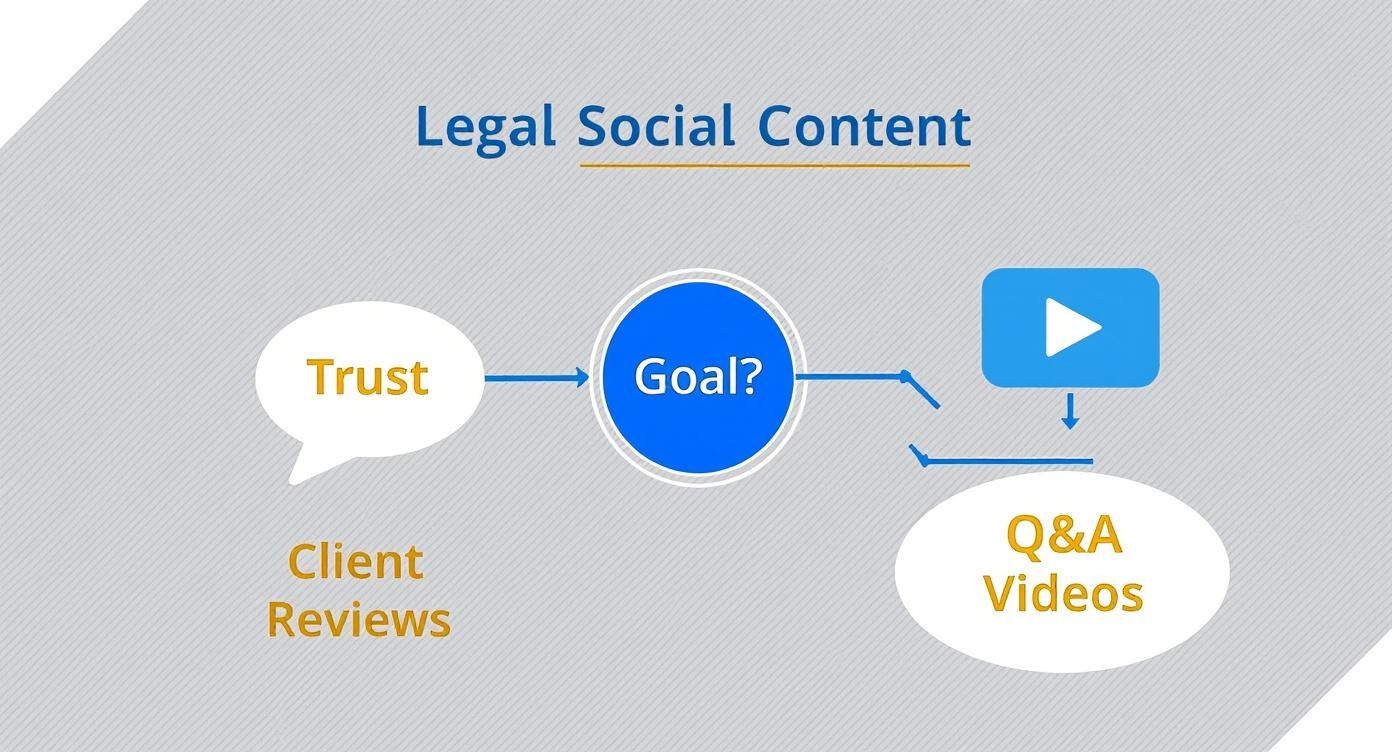
This flowchart really highlights how different types of content work together, warming up prospects so they’re primed and ready for your intake team when they finally reach out.
Mastering the First Point of Contact
In the legal world, speed is everything. When someone gets in touch, they're usually in a stressful, uncertain situation. A slow response doesn't just feel like bad service; it feels like you don't care.
A study I often quote found that firms responding to a web lead within five minutes are astronomically more likely to qualify them than those who wait even half an hour. In a market as competitive as Southern California, being first is often the difference between signing a case and losing it to the firm down the street.
Your team absolutely needs a clear, repeatable playbook for every inquiry, whether it's a call, an email, or a chat message.
- Phone Scripts: Give your intake specialists a script that prioritizes empathy first, then smoothly guides them to gather the essential details. The goal is to be structured, not robotic.
- Email Templates: Have a library of pre-written, but easily personalized, email templates for common questions. This ensures a quick, professional reply that acknowledges their message and tells them what's next.
- Web Chat Protocols: If you use a chat widget, set clear goals for response times. Train the staff managing it to know exactly when and how to move the conversation from chat to a scheduled consultation.
Using Smart Forms to Filter and Qualify
Let's be honest, not every person who contacts you is the right fit for your firm. That’s perfectly fine. The real goal is to quickly spot the high-potential cases and politely direct the others elsewhere. This is where smart intake forms are a game-changer.
Ditch the basic "Name, Email, Phone" form. A more detailed questionnaire on your site can do a lot of the initial legwork for you. It’s a core component of any serious plan for website optimization for law firms.
Try adding a few strategic questions:
- "Can you briefly describe your legal issue?" This helps you immediately route the inquiry to the right person.
- "When did the incident occur?" A simple question that can screen for statute of limitations problems right away.
- "Have you spoken with another attorney about this matter?" This gives you a clue about how serious they are and how far along they are in their search.
This kind of data empowers your team to prioritize follow-ups, putting their energy into the leads that are most likely to become paying clients.
Automating Follow-Up with a Legal CRM
Trying to track leads with a spreadsheet is a disaster waiting to happen. As your firm gets busier, it’s almost guaranteed that good leads will fall through the cracks. The solution here is a legal-specific Customer Relationship Management (CRM) platform like LawLytics or Clio Grow.
A CRM is your central command center for every potential client. It lets you:
- See the entire history of communication with a prospect.
- Set up automated reminders so no follow-up is ever missed.
- Assign new leads to specific attorneys or intake staff.
- Analyze your data to see which marketing channels are actually delivering the best cases.
For instance, you can create a workflow where a new lead from your website instantly gets a confirmation email, and at the same time, a task is created for an intake specialist to call them within 15 minutes. This blend of smart technology and solid process ensures no one is left hanging and dramatically increases your odds of signing the case.
Key Metrics for Attorney Lead Generation
Tracking the right Key Performance Indicators (KPIs) is essential for measuring the success of your marketing efforts and making data-driven decisions. This table outlines the most important metrics for law firms to monitor.
| Metric | What It Measures | Why It's Important for Attorneys |
|---|---|---|
| Cost Per Lead (CPL) | The average cost to generate a single new lead from a specific marketing channel. | Helps you understand the efficiency of your marketing spend and identify which channels (e.g., Google Ads vs. SEO) are most cost-effective. |
| Lead-to-Client Conversion Rate | The percentage of qualified leads that become signed clients. | This is the ultimate measure of your intake process's effectiveness. A low rate may signal issues with follow-up or qualification. |
| Cost Per Acquisition (CPA) | The total marketing cost to acquire one new client. (Total Spend / New Clients) | The most important bottom-line metric. It tells you exactly how much it costs to sign a new case, which is crucial for determining ROI. |
| Website Conversion Rate | The percentage of website visitors who complete a desired action (e.g., fill out a form, call). | A key indicator of your website's performance and user experience. Low rates can point to issues with site design, content, or calls-to-action. |
| Average Case Value | The average revenue generated per signed case. | Knowing this helps you determine how much you can afford to spend on your CPA while remaining profitable. |
| Lead Response Time | The average time it takes for your firm to respond to a new inquiry. | A critical factor in conversion. Shorter response times are directly correlated with higher success rates in a competitive market. |
By keeping a close eye on these numbers, you can move beyond guesswork and start making strategic adjustments to your marketing and intake processes that directly impact your firm's bottom line.
Common Questions We Hear About Attorney Lead Generation
As you can see, a modern playbook for generating legal leads has a lot of moving parts. Everything from your website's foundation and SEO content to AI-powered ads and your intake process has a job to do. Each piece is critical for attracting and signing the clients you actually want.
It's completely normal to have questions as you start connecting these dots. Based on our experience working side-by-side with countless law firms across Southern California, here are some straight answers to the questions that come up most often.
How Much Should My Firm Actually Spend on Marketing?
This is the big one, and the only honest answer is: it depends. A solo practitioner focusing on estate planning in a quiet suburb has a completely different financial picture than a multi-partner personal injury firm fighting for cases in downtown Los Angeles.
That said, a solid rule of thumb for most established firms is to earmark somewhere between 5% to 10% of gross revenue for all marketing efforts.
For firms that are just starting out or those in a serious growth spurt, that figure can easily climb to 15% or even higher. The number itself isn't what's important, though. What really matters is where that money is going. A good chunk of it should be flowing into channels with a clear, measurable return, like Google Ads and SEO, not just feel-good brand awareness campaigns.
Here's How We Look at It: Stop obsessing over a magic percentage. Instead, get laser-focused on your Cost Per Acquisition (CPA). If you know it costs you, on average, $1,000 in marketing to sign a case worth $10,000, you have a profitable and scalable engine. Your goal should be to pour as much fuel into that engine as you can, for as long as the math makes sense.
How Long Until SEO Starts Bringing in Real Leads?
Let's be clear: SEO is a long-term asset, not a quick hit. It’s not like paid ads, which can make the phone ring the same day you turn them on. Think of SEO as planting an orchard, not flipping a light switch.
If you're starting with a brand-new website, you should brace yourself for a six to twelve-month journey before you see a consistent stream of quality organic leads. For a firm with an existing website that's just now getting serious about SEO, you could start to see some positive traction in the rankings within three to six months.
What makes the timeline shorter or longer? A few key things:
- The Competition: Trying to rank for "personal injury lawyer Los Angeles" is a whole different ballgame—and a much longer one—than ranking for "probate attorney Temecula."
- Your Site's Health: If your website is a technical mess, those issues have to be cleaned up first. You can't build a skyscraper on a shaky foundation.
- Content Quality & Cadence: The speed of your results is directly tied to how consistently you publish genuinely helpful, authoritative content that actually answers your clients' most pressing questions.
SEO vs. Google Ads: Which One is Better for Lawyers?
This isn't an "either/or" situation. The most successful firms we see run a blended strategy where SEO and Google Ads work in tandem. They play two very different, but equally vital, roles in a healthy lead generation plan.
SEO is your foundation for long-term, sustainable growth. It’s how you build your firm’s authority online, earn trust with potential clients, and generate "free" traffic over the long haul. Once you secure a top ranking, a well-built page can bring you leads for years with very little ongoing cost.
Google Ads, on the other hand, is all about immediate visibility and precise control. It’s the perfect tool for getting your firm in front of people with high-intent keywords who need a lawyer right now. It's fantastic for quickly testing out a new practice area or turning up the volume on cases when you need them.
Here’s a simple way to break it down:
| Feature | Search Engine Optimization (SEO) | Google Ads (PPC) |
|---|---|---|
| Speed to Leads | Slower (Months) | Immediate (Hours to Days) |
| Cost Model | Upfront Investment in Time/Content | Pay-Per-Click (Ongoing Spend) |
| Longevity | Long-Term Asset | Stops When You Stop Paying |
| Trust Factor | High (Organic results are trusted) | Lower (Users know it's an ad) |
The smartest play is to use Google Ads for immediate cash flow and lead volume while your long-term SEO strategy builds a powerful, lead-generating asset in the background.
Can I Just Handle All This Marketing Stuff Myself?
Technically? Yes. With enough time, patience, and late nights, a motivated attorney or an in-house marketing coordinator can certainly learn the basics of SEO, content writing, and running Google Ads. There's a whole world of information out there.
The real question, however, is whether that’s the highest and best use of your time.
Effective digital marketing isn't a "set it and forget it" task. It demands deep expertise and constant attention. The ground is always shifting under your feet—Google pushes a major algorithm update, a new ad platform gains traction, and your competitors are always trying something new.
Running a competitive marketing campaign is a full-time job. Most attorneys find their time is infinitely more valuable when spent practicing law and taking care of their clients. Partnering with a specialist agency that lives and breathes legal marketing lets you focus on what you do best. It helps you avoid costly rookie mistakes and gets you results much faster, turning marketing from an expense into a strategic growth investment.
At Case Quota, we specialize in building these comprehensive, high-performance marketing systems for law firms. If you're ready to move beyond guesswork and implement a strategy that delivers measurable results, we can help. Schedule a consultation with our team to see how we can help you grow your firm.