

Imagine this for a moment: a potential client gets a glowing referral for your firm from a trusted colleague. They pull out their phone to look you up. Before they even see your website, they're met with a few lukewarm Google reviews. Right next to your name, a competitor boasts a solid five-star rating.
Just like that, the referral is lost. This isn't some rare, unlucky situation; it's the new reality for law firms. Your digital presence is your first handshake.
Why Your Firm’s First Impression Is Digital
These days, a law firm's online footprint is everything—it's your handshake, your resume, and your first impression all rolled into one. The era of coasting on word-of-mouth referrals alone is long gone. Today, even the warmest referral is immediately followed by a Google search. This shift makes proactive lawyer reputation management a non-negotiable part of your business strategy.

The numbers don't lie. A staggering 98% of potential clients now read online reviews before they even think about hiring an attorney. That single statistic makes it crystal clear: if you aren't managing what people see online, you're already behind. From Google Reviews to Avvo, prospective clients are using these platforms to vet you.
This isn't just about damage control. It's about reframing reputation management as a powerful engine for growth. Knowing how to build an online presence that truly reflects your firm's expertise is the only way to make that crucial first impression a great one.
The Modern Client's Digital Vetting Process
Before a potential client ever calls your office or fills out a form, they've already gone on a journey. They're sizing you up at multiple digital touchpoints, and each one can either build trust or send them straight to a competitor.
The table below breaks down this modern vetting process, showing just how much of the decision-making happens before you're even aware of the lead.
| Client Action | Digital Touchpoint | Impact on Firm's Reputation |
|---|---|---|
| Initial Search | Google Search for Firm/Attorney Name | Your firm's visibility and the overall sentiment of the search results page create the immediate impression. |
| Review Scan | Google My Business, Avvo, Yelp | Star ratings and review snippets are scanned in seconds. This is often the make-or-break moment. |
| Competitor Comparison | Local Pack, Legal Directories | Clients see your profile side-by-side with competitors. A stronger reputation wins the click. |
| Website Evaluation | Firm's Website | If reviews are positive, they'll check your site for professionalism, expertise, and clear contact info. |
| Social Proof Check | Social Media, News Mentions, Case Results | Clients look for broader validation of your firm's credibility and success in the community. |
This process shows that your online reputation is the gatekeeper to new business. A poor showing at any of these steps can shut the door on a prospect before you even knew they were there.
This playbook is designed to give you a clear path forward. We'll show you how to navigate the ethical lines of the legal field while building a digital footprint that wins clients before they ever pick up the phone.
Performing a Digital Reputation Audit
Before you can start fixing your firm's online reputation, you need to know exactly what you're up against. A thorough digital reputation audit isn't just a good idea; it's the mandatory first step. Think of it as the discovery phase of a case—you're gathering all the evidence to build a clear, data-backed picture of your firm's online footprint, uncovering both your strengths and, more importantly, your vulnerabilities.

The best way to start? Put yourself in a potential client's shoes. Open a private or "incognito" browser window to make sure your own search history doesn't taint the results. This gives you a raw, unbiased look at what people really see when they go searching for you or your firm.
From there, it's time to dig in. You'll need to methodically search for a whole range of terms, going way beyond just plugging in your firm's name.
Mastering Your Search Queries
To get the full picture, your audit has to cover every possible search angle. A potential client might not remember a partner’s exact name or the firm’s official title, so you need to be systematic.
Work through these query types:
- Firm Name Variations: Search your official firm name ("Smith & Jones Law Group") and any common shorthand people might use ("Smith & Jones Law").
- Individual Attorney Names: Run searches for every partner and associate. Think "attorney Jane Smith" or "lawyer John Jones."
- Practice Area + Location: This is critical. Search for combinations like "personal injury lawyer Los Angeles" or "estate planning Santa Monica" to see how you stack up against competitors.
- Common Misspellings: Don't skip this. Check for frequent typos of your firm's and attorneys' names. You'd be surprised what shows up.
As you go, document everything you find on the first couple of pages of Google. What's the general vibe? Are the top results positive profiles you control, neutral directory listings, or—worst-case scenario—scathing reviews?
A reputation audit isn't just about finding the bad stuff; it's about understanding the entire narrative. Your goal is to see your firm through a client's eyes and identify every single touchpoint that shapes their perception before they ever pick up the phone.
I know, this manual process can feel tedious, but the insights are priceless. If you want to speed things up and cast a wider net, you can always look into some of the best reputation management software on the market. These tools can automate monitoring across the web.
Your Practical Audit Checklist
A structured approach is the only way to make sure nothing slips through the cracks. Use this checklist as your guide to analyze every platform where your firm has a presence, from Google and Avvo to local business directories.
1. Review Analysis
- What’s your average star rating on key sites?
- How many total reviews do you have?
- What's the sentiment of recent reviews (positive, neutral, negative)?
- Are you responding to all of them? (Yes, even the good ones.)
2. Directory and Profile Accuracy
- Is your NAP (Name, Address, Phone Number) 100% consistent everywhere? Even small inconsistencies can tank your local SEO.
- Are attorney bios and headshots current on your website, LinkedIn, and Avvo?
- Are there any broken links pointing to your site from these profiles?
3. SERP Content Evaluation
- What content owns the first page for your firm's name?
- How much of that real estate do you actually control (e.g., your website, social media)?
- Are there any negative news articles, blog posts, or old forum discussions lurking in the results?
Finishing this audit gives you a concrete, actionable baseline. This isn't just an academic exercise; it's the foundation for your entire reputation strategy. For firms that want to go even deeper, specialized marketing audits and analysis can offer an even more detailed roadmap for growth and brand protection.
Building a Five-Star Review Engine, Ethically
I get it. A lot of attorneys are hesitant to ask for reviews. It can feel unprofessional, or even worse, like you're skirting state bar association rules. But that hesitation leaves your firm’s reputation completely up to chance, where one unhappy client's voice can easily overpower dozens of satisfied ones.
This isn't about begging for praise or cherry-picking your best cases. It's about building a systematic, ethical engine to generate authentic client feedback. When you create a process that gives every client a voice, you naturally build a more balanced and overwhelmingly positive online profile.
The Right Time and Way to Ask
Timing is everything. Ask too soon, and it feels transactional. Wait too long, and the client’s initial relief and gratitude have faded. The sweet spot is right after a positive milestone in their case.
This could be:
- Immediately after a successful case resolution. This is the absolute peak of client satisfaction.
- Following a really helpful phone call or meeting. When a client actually says, "Thank you so much, that was a huge help," that's your cue.
- At the conclusion of a specific project phase. For longer engagements like estate planning, this keeps the feedback fresh.
The ask itself should be gentle and completely pressure-free. You're not adding another task to their plate. You're giving them a chance to help others who are in the same stressful situation they just escaped.
A simple, compliant way to phrase it might be: "We're so glad we could achieve this outcome for you. If you have a moment, sharing your experience on Google could really help others navigate a similar journey. No pressure at all, but your feedback would be greatly appreciated."
Make It Effortless
The more hoops a client has to jump through, the less likely they are to leave a review. You need to remove every single bit of friction from the process. Don't just say, "Please review us." Send them a direct link to the exact page where they can leave the review.
You need to focus your efforts where they'll have the most impact. Over 60% of people turn to Google Reviews first when researching attorneys, making it the single most important platform for your firm. This isn't surprising, as other legal marketing statistics reports confirm that the overwhelming majority of potential clients start their search for a lawyer on Google. Prioritizing your Google Business Profile isn't just a good idea; it's the cornerstone of modern lawyer reputation management.
For a much deeper dive into getting the most out of this critical asset, check out our guide on proven tweaks for your Google Business Profile to dominate local search.
The Art of Responding to Every Single Review
Getting reviews is only half the job. How you respond is just as critical, because your replies are public signals about your firm's character and how much you care about your clients. Every review—good, bad, or indifferent—deserves a thoughtful response.
Responding to Positive Reviews
It’s easy to see a five-star review and move on, but that’s a huge missed opportunity. A simple "Thank you" is fine, but a great response does more.
- Acknowledge a specific point they made (without ever revealing confidential details).
- Use it as a chance to reinforce your firm's core values.
- Thank them by name if they included it.
For example:
"Thank you, Sarah! We're thrilled we could provide clarity and support during a challenging time. Our team is dedicated to client communication, and we're so glad that made a difference for you."
Responding to Negative Reviews
This is where most firms completely drop the ball. A defensive or argumentative response is a reputational disaster. Your goal here isn't to win an argument online; it's to demonstrate professionalism to the hundreds of prospects who will be reading your reply.
Stick to this simple framework:
- Acknowledge and Validate: Start by acknowledging their feedback and validating their frustration. "We are sorry to hear your experience did not meet your expectations."
- State Your Commitment: Briefly state your firm’s commitment to client service. "Our goal is always to provide clear and consistent communication."
- Take It Offline: This is the most important step. Never debate the specifics of a case in a public forum. Invite them to discuss it privately to protect confidentiality and actually resolve the issue. "We take feedback seriously and would appreciate the opportunity to discuss this with you directly. Please contact our office manager at [Phone Number]."
This approach shows you're accountable and proactive. It can turn a potential crisis into a public demonstration of your firm's integrity, moving the conflict out of the spotlight while signaling to everyone else that you take client satisfaction seriously.
Managing and Mitigating Negative Content
A single bad review can feel like a direct hit to your firm's integrity. It doesn't matter if it's from a genuinely unhappy client, a case of mistaken identity, or a flat-out fake—how you handle these moments defines your reputation online.
The first move isn't to fire back. It's to stay calm and figure out what you're dealing with. A real client with a real issue is an opportunity to show your character. A fake review is a digital attack that requires a completely different playbook.
Disputing Fake and Malicious Reviews
When you’re certain a review is fake, your only goal should be removal. Getting into a public argument with a fake profile is a losing game; it just gives the review more oxygen. Funnel that energy into the platform's dispute process instead.
Platforms like Google and Avvo have clear rules against spam, fake content, and conflicts of interest. To get a review taken down, you have to build a clean, simple case showing exactly how it violates their policies.
- Gather Your Evidence: Your client database is your best friend here. If the reviewer's name or the details they mention have no match in your records, you have your core piece of evidence.
- Flag the Review: Use the platform's built-in reporting tool. Keep it short and to the point. State which policy is being violated. A simple, "This individual was never a client of our firm," or "This review is from a disgruntled former employee, constituting a conflict of interest," is all you need.
- Be Persistent: Don't be surprised if an automated system rejects your first attempt. If you know you're right, resubmit the dispute. Keep a record of every interaction you have with the platform.
While you're waiting for the platform to act, a brief, professional public comment can be smart. Something like, "We take all client feedback seriously, but we have no record of this individual as a client of our firm." It signals to potential clients that the review is questionable without getting defensive.
This flowchart maps out the decision-making process for any new review that comes your way.
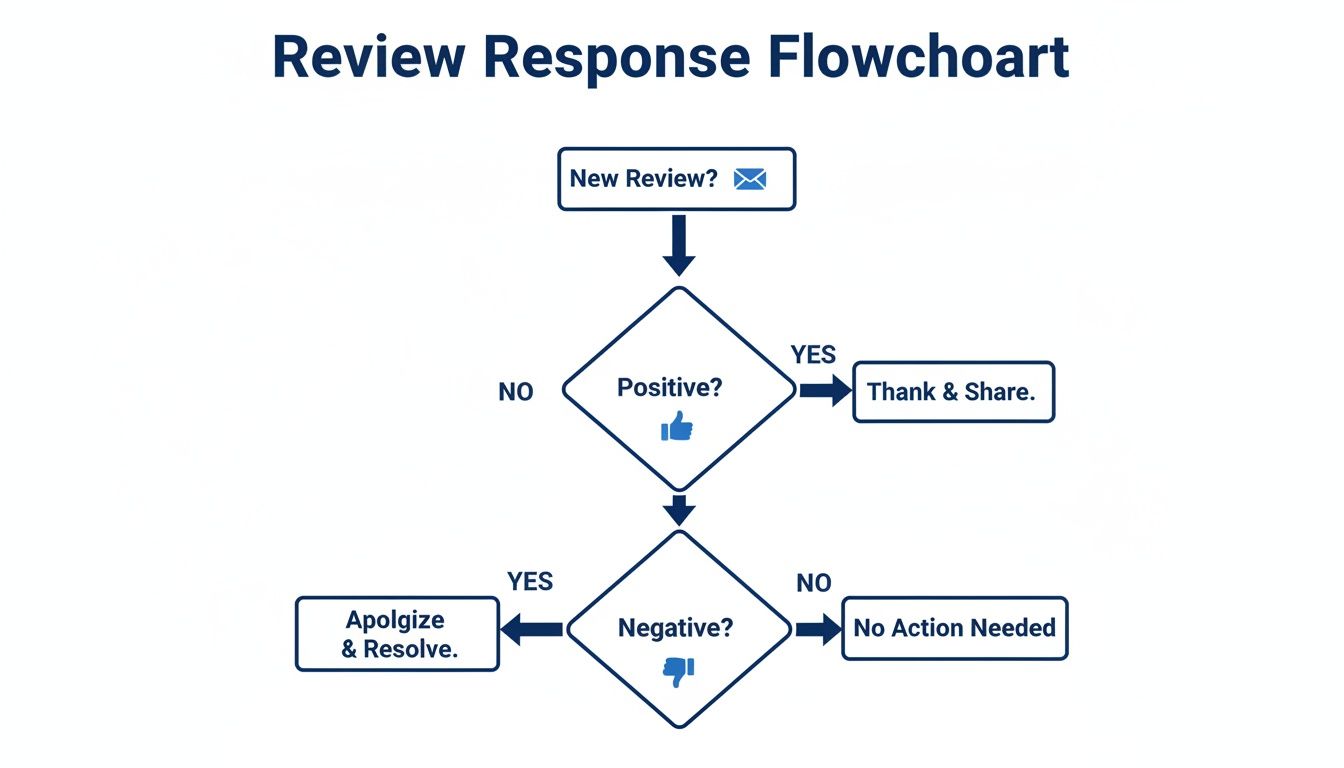
It’s a simple visual reminder: every review, good or bad, needs a specific, thoughtful response to protect your firm's good name.
Handling Legitimate Criticism Professionally
When a negative review comes from a real client, the stakes are much higher. Your response is a public performance, and potential clients are watching to see how you handle conflict.
Resist the urge to tell "your side of the story." You'll only come across as argumentative and, even worse, you could breach client confidentiality. The goal is to de-escalate the situation and show you handle disagreements with class.
Stick to a measured, three-step response:
- Acknowledge and Apologize: Start by acknowledging their feelings and apologize that their experience fell short.
- Reinforce Your Values: Add a brief sentence about your firm's commitment to client service.
- Move the Conversation Offline: This is the most important part. Give them a direct contact to discuss the issue privately.
For example: "Thank you for sharing your feedback. We are sorry to hear your experience did not meet expectations. Our firm is committed to providing the highest level of service, and we would appreciate the chance to discuss this with you directly. Please contact our office manager at your convenience."
This templated approach protects your firm, respects confidentiality, and shows you're accountable. It ends the public back-and-forth while showing a commitment to making things right. This is a core part of effective public relations for law firms, where perception is everything.
Building a Digital Fortress with SEO
Beyond just reacting to reviews, the best long-term strategy is to make negative content irrelevant by burying it. This is a proactive SEO play. It's all about creating and promoting so much high-quality, positive content that you control the entire first page of Google for your name.
When you do this, any negative articles or reviews get pushed to page two or three, where virtually no one ever looks.
This "digital fortress" is built from assets like:
- Optimized Attorney Profiles: Deep, well-written bios on your website, LinkedIn, Avvo, and other legal directories.
- Thought Leadership Articles: Blog posts and articles on your site and other reputable legal publications that showcase your expertise.
- Case Studies and Success Stories: Concrete examples of your firm's wins (always with client permission).
- Positive Media Mentions: Press releases and news features that highlight your firm's successes.
By consistently creating and promoting this kind of content, you stop playing defense. You start actively building the powerful, positive reputation you want potential clients to see first.
Building Your Reputation with Content and SEO
Real lawyer reputation management goes way beyond just reacting to reviews. It's about proactively taking control of the story being told about your firm online. Your best weapons in this fight are strategic content and search engine optimization (SEO), working in tandem to build a digital fortress of authority and trust.

Think of it this way: you're building a library of high-value content that answers your ideal clients' questions before they even have to ask. By consistently publishing authoritative blog posts, in-depth legal guides, and insightful case studies, you establish your attorneys as the go-to experts in their field.
This isn't just about showing off what you know; it's a powerful SEO play. Every single piece of quality content you create is another asset that can rank on Google, pushing any potential negative results further down the page and cementing your control over your firm's search presence.
Mastering Your Local Search Presence
For most law firms, the battle for new clients is won or lost on a local map. Your Google Business Profile (GBP) is the absolute centerpiece of your local SEO. A neglected or incomplete profile isn't just a missed opportunity—it's like leaving the front door of your office unlocked for competitors to walk right in.
You have to treat your GBP like a dynamic, living mini-website. This means going far beyond just listing your address and phone number.
- Fill Out Everything: I mean everything. Complete every section for services, attributes, accessibility info, and write a detailed business description loaded with keywords your clients actually use.
- Use Google Posts: Regularly share firm news, case results, and links to your latest blog articles. This signals to Google that you're active, relevant, and engaged in your community.
- Upload Quality Photos: Show off your office, your team, and professional headshots. A good photo gallery helps humanize your firm and builds instant trust.
- Turn on Messaging: Let potential clients message you directly from your profile. It's a low-friction way to capture leads who aren't quite ready to pick up the phone.
A meticulously managed GBP sends strong signals to Google that your firm is a prominent local authority, dramatically increasing your chances of landing in the coveted "Local Pack" map results.
Creating Content That Builds Authority
The purpose of your content is twofold: attract the right kind of client and establish your attorneys as undeniable thought leaders. This requires getting inside your client's head—what are their fears, questions, and pain points before they even realize they need to hire a lawyer?
Focus on creating pillar content around your core practice areas. For example, a personal injury firm could create the ultimate guide to navigating car accident claims in your state. This kind of comprehensive resource becomes a magnet for organic traffic and proves your expertise. Getting deep into the specifics of law firm content marketing is how you create pieces that don't just rank, but actually turn readers into clients.
Your content should feel like a digital consultation. When you generously share your knowledge, you build a foundation of trust that makes a potential client feel confident in choosing your firm when they're finally ready to make the call.
This investment pays off in real, measurable ways. For modern law firms, reputation management is now a revenue driver. Firms that actively manage their online presence see a 510% surge in review volume and achieve 88% positive reviews, which directly fuels client acquisition. According to a Martindale-Avvo survey of 800 U.S. attorneys, these intentional strategies are no longer optional for firms that want to thrive.
Leveraging Third-Party Validation
The content you create on your own site is the foundation, but validation from outside sources adds a layer of credibility you simply can't create yourself. This kind of social proof is incredibly persuasive to potential clients doing their due diligence.
Start looking for opportunities to earn this third-party validation:
- Media Mentions: Offer expert commentary to local news outlets on legal stories related to your practice.
- Speaking Engagements: Presenting at local business groups or community events positions your attorneys as true authorities.
- Guest Articles: Contribute insightful articles to respected legal publications or local business journals.
- Legal Awards and Recognitions: Don't be shy. Actively apply for and promote any awards or recognitions your attorneys earn.
Each one of these accomplishments becomes another positive asset you can promote on your website and social channels. More importantly, they often show up in search results for your firm's name, helping you dominate the conversation and build that bulletproof, positive narrative.
Your Top Questions Answered
When we talk about managing a law firm's reputation, a few key questions always come up. Attorneys are rightfully concerned about the ethics, the practical steps, and the time it takes to see real change. Let's tackle the most common ones we hear.
Can I Ethically Ask Clients for Online Reviews?
Yes, you can and you should. But you have to do it the right way.
Most state bar associations give the green light to solicit reviews, but there's one giant rule: you cannot offer anything of value in return for a review. No gift cards, no discounts on future work, nothing. It has to be a genuine, uncompensated opinion.
The key is to make your request neutral, not pushy. We find the best approach is to invite all clients to share their experience. This keeps you from looking like you're cherry-picking only the five-star outcomes. Frame it as a way for them to help someone else who's in the same tough spot they were.
Before you start any campaign to get more reviews, check with your state bar. The final word always comes from them. Take a few minutes to review your local rules on attorney advertising to make sure you're completely compliant.
What Should I Do If a Negative Review Is Fake?
First, take a breath and resist the urge to get into a public shouting match. Your goal is to get the review taken down, not to win an argument with a ghost.
Start by going through the platform's official channels. Report the review and flag it for violating their terms of service—common reasons are spam, the person was never a client, or it's a clear conflict of interest.
Next, look at your own records. The single most powerful piece of evidence you can have is proof that the reviewer’s name doesn't exist in your client database. While you're waiting for the platform to make a decision, you can post one single, professional response.
Something like this works well: "We take all client feedback seriously, but we have no record of this person as a client of our firm." It tells prospective clients the review is likely bogus without getting defensive. If the review is truly defamatory, it's probably time to talk to your own counsel about other options.
How Long Does Reputation Management Take to Show Results?
This isn't a one-and-done project; it’s an ongoing part of running your business. Think of it as a marathon, not a sprint. That said, you'll see different kinds of results on different timelines.
- Immediate Wins (Days to Weeks): You can change public perception almost overnight just by responding professionally to all your existing reviews. It immediately shows people you’re engaged and you care.
- Short-Term Gains (1-4 Months): A steady flow of new, positive reviews can start to move your average star rating within a few months. Fresh feedback quickly buries the impact of an old negative comment.
- Long-Term Impact (6-12+ Months): The heavier lifts, like using SEO and content to push down negative search results, take more time. You're often looking at 6 to 12 months of consistent work to really change what people see on Google when they search your name.
Consistency is everything. It's what builds the kind of lasting reputation that protects your firm and brings in high-quality cases for years.
At Case Quota, we build and protect the digital reputations of law firms across Southern California. If you're ready to take control of your online story, let's talk about a strategy that works for you.