

I've heard the question a hundred times from attorneys I've worked with: "Is social media just a bunch of noise, or does it actually matter?" The answer is simple. Social media is the new town square, the digital version of the local chamber of commerce mixer, and your clients are already there. Ignoring it is like having a beautiful office with no sign on the door.
Why Social Media Is Non-Negotiable for Modern Law Firms

For decades, law firm marketing was a predictable playbook: referrals, maybe a print ad in the local paper, and a solid reputation built over years. While that foundation is still valuable, the way potential clients find, research, and ultimately choose an attorney has been completely upended.
Today, your social media presence is your firm's digital handshake. It’s often the very first impression you make. This isn't about blasting ads into the ether. It’s a sophisticated tool for building real trust, showcasing your expertise, and putting a human face on your practice. You stop being a generic legal entity and become a team of approachable, knowledgeable people.
From Skepticism to Strategy
The legal community's shift from skepticism to strategic adoption is impossible to miss. What was once seen as a fringe activity is now a core part of a firm's business development. And the numbers don't lie.
One recent survey found that 85% of lawyers are now using social media in their marketing mix. More importantly, it’s working. That same study showed 71% of lawyers have brought in new cases from their social media efforts, with over 30% landing clients directly through these platforms. The proof is in: a smart social presence leads directly to firm growth.
The Core Benefits of a Social Presence
So, what does this actually mean for your practice and your bottom line? A well-planned social media approach delivers tangible benefits that old-school advertising just can't touch. You’re building an ecosystem where clients can find you, get to know you, and feel confident hiring you.
Social media allows law firms to move beyond being a service provider and become a trusted community resource. It's the difference between waiting for a client to have a problem and being the first person they think of when that problem arises.
Building a solid B2B social media strategy is the first step for any firm serious about its online presence. The key advantages boil down to these four pillars:
- Building Brand Authority: When you consistently share useful, insightful content about your practice area, you stop being just another lawyer and become the go-to expert.
- Generating Qualified Leads: Social platforms give you the power to target your ideal clients with incredible precision, ensuring your message lands in front of the right people at the right time.
- Humanizing Your Firm: People hire people, not logos. Sharing behind-the-scenes moments, attorney spotlights, and community involvement forges genuine connections that build lasting trust.
- Engaging with Your Community: Social media opens a direct line of communication. It's a place to answer questions, join local conversations, and build the kind of relationships that fuel word-of-mouth referrals for years to come.
Navigating the Ethical Minefield of Social Media
For most law firms, the biggest thing holding them back from social media isn't figuring out the tech—it's the nagging fear of accidentally crossing an ethical line. The web of state bar association rules and professional conduct guidelines can feel like a maze, but these rules weren't written to ban lawyers from the internet. They exist to make sure the integrity of the profession holds up in a new arena.
Think of these guidelines not as a cage, but as guardrails. They’re there to keep you and your clients safe, ensuring every interaction is professional, honest, and confidential. By getting a firm grip on these core principles, your law firm and social media can work together, both effectively and ethically.
Avoiding Accidental Attorney-Client Relationships
This is one of the easiest traps to fall into online. A potential client sends you a direct message, you offer some specific advice in a seemingly harmless exchange, and suddenly you’ve created an attorney-client relationship without even realizing it. That person now has an expectation of representation, and you're on the hook for all the duties that come with it.
The solution? Set crystal-clear boundaries. Your firm's social media profiles should have a disclaimer right on them, stating that online interactions do not create an attorney-client relationship. When someone slides into your DMs asking for specific advice, politely direct them to schedule a formal consultation instead of handing out answers on the platform.
Truthfulness and Advertising Disclaimers
Every single post, video, and comment your firm shares is a form of communication, which means it falls under attorney advertising rules. The absolute cornerstone of these regulations is truthfulness. You can't make promises, and you certainly can't guarantee outcomes.
Sharing a big case win is fine, for example, but you have to present it factually, without any puffery or embellishment. It’s critical to avoid any language that could create an unjustified expectation for the next person who sees it.
A common requirement in many states is to include a clear disclaimer on any content that could be seen as an ad. Simple phrases like "Advertising Material" or "This is an attorney advertisement" should be placed prominently wherever your state bar requires.
Getting this wrong can have staggering consequences. In one infamous case, a lawyer's social media posts about an ongoing trial were found to show a "reckless disregard" for influencing the jury. The result? A $43.8 million verdict was completely overturned, and a new trial was ordered. You can dig deeper into specific regulations by reviewing a guide to ethical attorney advertising.
The Unbreakable Rule of Client Confidentiality
This one is non-negotiable. The duty of client confidentiality is absolute, and it follows you onto every online platform. Even sharing "anonymized" details about a case can backfire if someone pieces together the information and identifies your client. It's a massive ethical breach waiting to happen.
The best practice is simple: Never discuss specific client matters on social media. Period.
To shield your firm, a comprehensive, written social media policy isn't just a good idea—it's essential. This internal document dictates how everyone, from senior partners to paralegals, behaves online. It is your single best defense against an accidental violation.
Your policy needs to cover:
- Confidentiality: A strict, zero-tolerance ban on discussing any client information.
- Disclaimers: A clear mandate on when and where to use advertising disclaimers.
- Professionalism: Firm guidelines on maintaining a professional tone that reflects your firm's values.
- Approval Processes: A simple system for who needs to review and sign off on content before it ever goes live.
Choosing Your Platforms for Maximum Impact
Trying to be everywhere on social media is a surefire way to burn out without seeing real results. A smart social media strategy for a law firm isn't about planting your flag on every platform; it's about showing up in the right places with the right message. Each network is its own world with a unique audience and unwritten rules of engagement.
Think of it like choosing a venue for a networking event. You wouldn't host a high-stakes corporate law seminar in a noisy coffee shop. You also wouldn't try to connect with local families at an exclusive, members-only business club. The same logic applies online. Your job is to pick the digital battlegrounds where your ideal clients are already spending their time.
And no matter where you engage, your ethical obligations follow you.
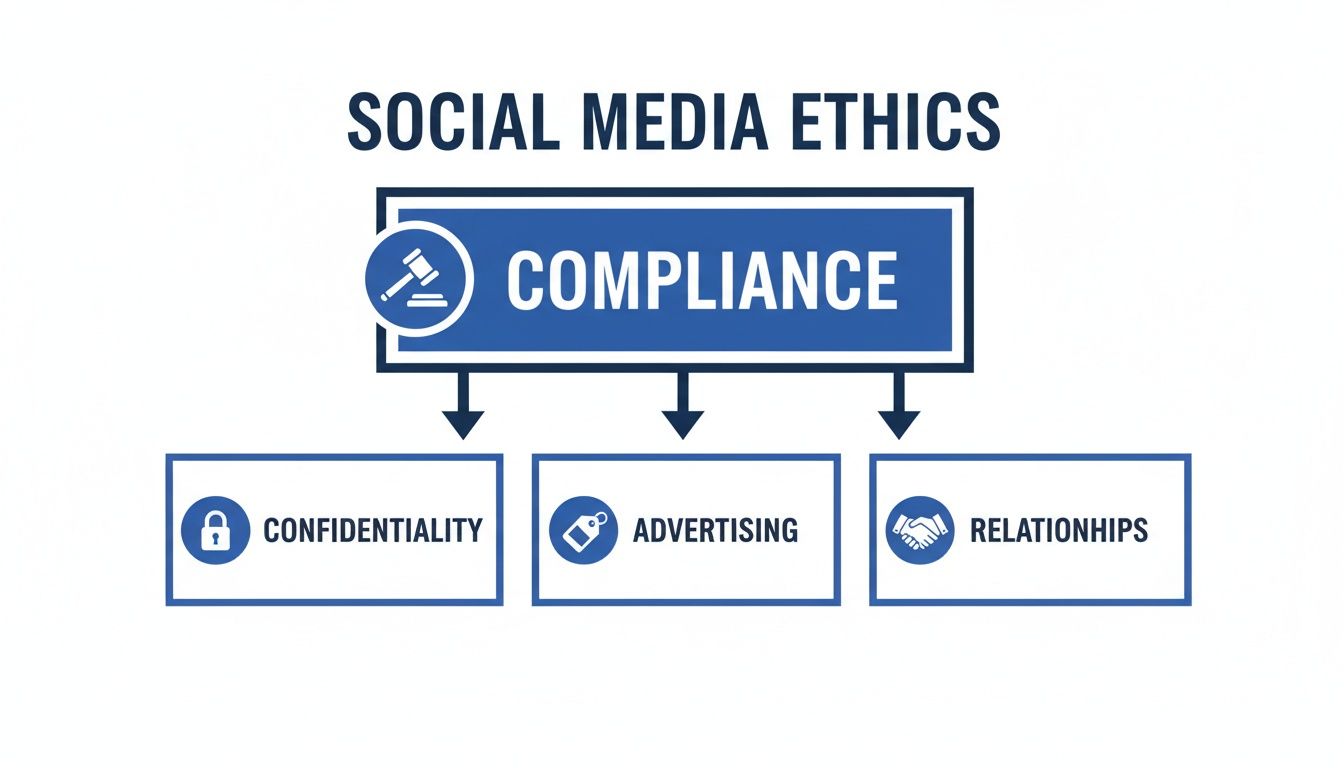
This visual is a great reminder that everything you do on social media must be built on a foundation of compliance. From there, you have to consider key duties like client confidentiality, advertising rules, and how you manage online relationships.
So, where should you focus your energy? Let's break down the major players and how they fit into a modern law firm's marketing plan.
Social Media Platform Strategy for Law Firms
Choosing the right platform is the first—and most critical—step. This table breaks down the main contenders to help you decide where to invest your firm's time and resources.
| Platform | Primary Audience | Best Use Case for Law Firms | Recommended Content Types |
|---|---|---|---|
| Professionals, business owners, corporate clients | B2B networking, thought leadership, talent recruitment, referral generation | In-depth articles, industry analysis, case studies, firm news, attorney spotlights, professional achievements | |
| Local community, general public (broad demographics) | Building local brand awareness, humanizing the firm, community engagement (for B2C practices) | Client testimonials (with consent), FAQs, local event participation, team photos, simple legal tips, community news | |
| Younger demographics (under 45), visually-driven users | Showcasing firm culture, building approachability, brand storytelling | "Meet the team" Reels, behind-the-scenes office tours, infographic carousels, quick legal explainer videos | |
| TikTok | Gen Z and Millennials (primarily under 35) | Top-of-funnel brand awareness, demystifying legal concepts, showing personality | Short, engaging clips (15-60 seconds), "day in the life" videos, myth-busting legal misconceptions, trend-based content |
| YouTube | Broad audience actively seeking information | Educational hub, establishing expertise, SEO for "how-to" legal questions | Detailed video guides, webinar recordings, client Q&A sessions, explainer videos on complex legal processes |
By matching your firm’s practice areas and goals to the right platform, you can stop shouting into the void and start having meaningful conversations with potential clients.
A Closer Look at the Top Platforms
H3 LinkedIn: The Digital Chamber of Commerce
LinkedIn is the undisputed heavyweight for professional networking, making it a must-have for almost any law firm. This is where you establish your attorneys as true thought leaders and connect with high-value clients, powerful referral sources, and even top-tier legal talent.
The audience here is all business. They want professional, insightful content that solves a problem or offers a new perspective. This is your stage for sharing deep-dive articles on legal trends impacting specific industries, celebrating firm milestones, and highlighting your team's professional wins. It's the perfect arena for practices focused on business law, IP, and complex corporate litigation.
H3 Facebook: The Community Bulletin Board
While LinkedIn is buttoned-up, Facebook is where you can roll up your sleeves and connect with your local community. Its massive user base makes it an incredibly powerful tool for building brand awareness and putting a human face on your firm, especially for consumer-facing practices like personal injury, family law, or estate planning.
The tone here should be more personal and community-driven. Forget the complex legal analysis; focus on helpful, relatable information. Share client success stories (always with permission!), answer frequently asked questions, and post about your firm’s involvement in a local charity run or event.
H3 Instagram and TikTok: The Visual Storytellers
These platforms are all about visuals and personality. For law firms, this is a golden opportunity to shatter the intimidating lawyer stereotype and show the real people behind the practice. This is where you build trust and approachability, one short video or compelling image at a time.
A few content ideas that crush it here:
- "Meet the Attorney" Reels: Short, fun videos introducing your team members.
- Quick Tip Videos: A 30-second clip explaining a simple concept, like "3 Things to Do After a Minor Car Accident."
- Behind-the-Scenes Content: Showcasing your firm's unique culture and community spirit.
The goal on platforms like TikTok and Instagram isn't to give formal legal advice. It's to build a memorable, accessible brand so that when someone does need legal help, your firm is the first one they think of.
H3 YouTube: The Educational Hub
If LinkedIn is where you publish the article, YouTube is where you host the seminar. This video-first platform is perfect for positioning your attorneys as educators and authoritative experts. It gives you a platform to create long-form content that answers your clients' most urgent questions in a detailed, easy-to-digest format.
For instance, an estate planning attorney could create a whole series on "The Basics of Setting Up a Trust," while a criminal defense lawyer might film a video explaining exactly what to expect at an arraignment. This content doesn't just build credibility—it also performs incredibly well in Google search results, catching potential clients right when they're looking for answers. To learn more, check out our complete social media marketing for attorneys guide.
The data backs this up. While 89% of law firms are active on social media, their results vary wildly. LinkedIn leads the pack with an 87% adoption rate, followed by Facebook at 62%. The real story is in the outcomes: in 2023, some firms generated over 3,000 leads from TikTok, while most saw fewer than five from X (formerly Twitter). It’s proof that a focused strategy on the right channels is what separates success from wasted effort.
Creating Content That Connects and Converts

Let’s get one thing straight: the primary job of your social media content isn't to sell legal services. Not directly, anyway. Its real purpose is to solve problems, answer questions, and build a rock-solid foundation of trust.
Think of each post, video, or article as a single brick you're laying for your firm's reputation. Each one is placed with the intent to show people you're not just an expert, but you're also approachable. The whole game is shifting your mindset from broadcasting ads to publishing genuinely helpful resources. Your ideal client isn’t scrolling through Instagram hoping to find a lawyer; they’re looking for answers. When you provide those answers freely, your firm becomes the obvious choice when they finally need to make that call.
The Value-First Content Philosophy
At the very heart of a winning social media strategy is the value-first content approach. This simply means every single thing you create should be useful to your audience, whether they ever hire you or not. It’s an investment in goodwill that establishes your attorneys as the go-to experts in their field.
For instance, a personal injury firm could post, "Hurt in an accident? Call us!" but that’s just noise. A much better post would be a short video titled, "3 Things to Do Immediately After a Fender Bender." The first is an ad. The second is a public service that builds real authority.
The goal is to become an indispensable resource. When you consistently provide useful information, you build a relationship with your audience long before they ever have a legal need, making your firm the first and only one they think of when that time comes.
Practical Content Ideas by Practice Area
General advice is one thing, but specific, actionable examples are what actually get results. The best content hits on the very specific anxieties and questions clients have in your niche.
Here are a few ideas to get the gears turning:
- For Personal Injury Firms: Put together a simple infographic or a carousel post showing the statute of limitations for filing a claim in your state. This is critical information people are actively searching for.
- For Estate Planning Attorneys: Start a series on "Why Young Families Need a Will." Each post can break down a different reason, like appointing a guardian or protecting assets. It makes a big, intimidating topic feel manageable.
- For Criminal Defense Lawyers: Film a clean, professional video explaining the real-world difference between a misdemeanor and a felony. You're demystifying the process and showing you can explain complex ideas clearly.
- For Family Law Practices: Write a quick Q&A post answering a common question like, "How is property divided in a divorce in our state?" It provides instant value and proves you know your stuff.
Notice the theme? Every example is about educating the audience, not making a hard sell. This is a cornerstone of effective law firm content marketing, where the goal is to inform first and build trust naturally.
Structuring Your Content for Maximum Engagement
How you present your expertise is just as important as what you're presenting. Nobody wants to read a dense legal brief on their social media feed. You have to break it down into bite-sized, engaging formats. To keep this process from becoming a headache, it's smart to explore social media management tools that help you schedule posts and track what's working.
Consider mixing up your feed with these formats:
- Short Video Clips: Perfect for explaining one concept in under 60 seconds.
- Infographic Carousels: Visually walk your audience through a multi-step process or a checklist.
- Client Testimonials (with consent): This is powerful social proof. Just make sure you get explicit, written permission and follow all bar association rules to the letter.
- "Ask Me Anything" (AMA) Sessions: Host a live video where you answer general, non-case-specific questions.
By using a variety of formats, you keep your feed from getting stale and appeal to different people. But the common thread is always value. Whether it’s a quick video, a graphic, or a live Q&A, your content has to connect with a real problem and point toward a helpful solution. Consistently delivering that expertise is what turns followers into actual consultations.
Balancing Organic Reach with Paid Advertising
So, you're creating great content. How do you actually get it in front of the right eyeballs? The answer isn't a simple choice between posting for free or paying for ads; it's about making them work together. This is where many firms get tripped up, but mastering this dynamic is what separates a passive social media presence from a powerful client-generation engine.
Think of your organic content as building your firm’s reputation on the ground. It’s the day-in, day-out work of sharing useful posts, celebrating firm wins, and talking with your community. It’s a long game. This strategy builds genuine trust and authority, creating an audience that actually wants to see what you post next. It doesn't have a line-item cost, but it demands a serious investment in time and creativity.
Paid advertising, on the other hand, is your megaphone. It lets you skip the slow, steady build of organic reach and beam your message directly to a hand-picked audience. It turns your social media page from a community bulletin board into a precision-guided marketing tool.
The Organic and Paid Flywheel
This isn't an either/or decision. Organic and paid are two sides of the same coin, and they work best in tandem. Your organic posts build a foundation of trust and a library of helpful content. Your paid ads then take that great content and put it in front of thousands of potential clients who look exactly like your best cases.
When you get this right, you create a powerful flywheel effect:
- Paid ads push new, interested people to your social media profiles.
- Those visitors see your high-quality organic content and decide you're worth following.
- Your organic audience gets bigger, giving your future free posts more reach from the start.
- You collect more data on what works, which makes your next paid campaign even smarter.
The Power of Precision Targeting
This is where paid social advertising leaves traditional marketing in the dust. The targeting capabilities are incredibly granular, allowing you to stop wasting money on broad, untargeted ads.
For instance, a family law attorney can target ads specifically to:
- People living in certain high-value zip codes.
- Users whose online behavior indicates they're considering divorce.
- Individuals in a specific age range and income bracket.
But the real magic weapon for law firms is retargeting. This lets you show ads only to people who have already visited your website. Think about it: they already know who you are. A well-timed retargeting ad is often the final nudge they need to pick up the phone and book a consultation.
How to Set a Smart Budget
You don't need a Super Bowl-sized budget to see results. You can start small, even with just a few hundred dollars a month, and focus on one specific goal. Maybe you want to drive traffic to a new blog post about a recent change in state law, or perhaps you want to get sign-ups for an estate planning webinar.
Once you see what's working, you can confidently and strategically increase your spend. It's a measured approach that ensures every dollar is backed by data. If you're just dipping your toes in, our complete guide on social media advertising for lawyers is the perfect place to start building your first campaign.
By combining the trust-building power of organic content with the laser-focus of paid ads, you create a complete system that both nurtures relationships and drives conversions.
Measuring Your Social Media Success and ROI
So, how can you be sure all this social media effort is actually helping your firm’s bottom line? It’s incredibly easy to get distracted by what we call "vanity metrics"—things like likes and follower counts. While those numbers might feel good, they don't pay the bills or prove your strategy is bringing in new clients.
To show real value, you have to focus on metrics that connect directly to your business goals. Think of it like a personal injury case. You don't just tell the jury your client was hurt; you show them the medical bills, the proof of lost wages, and the expert testimony. Your social media data is your evidence.
Moving Beyond Vanity Metrics
The trick is to track Key Performance Indicators (KPIs) that show a clear return on investment (ROI). These are the specific data points that tell the story of how people are interacting with your content and, more importantly, how they’re moving closer to becoming a client.
Instead of just counting likes, you need to measure actions that signal genuine interest and intent. A successful social media presence for a law firm isn't about being popular; it's about being effective.
The most critical shift in measuring social media is moving from "How many people saw our post?" to "How many people took a meaningful action because of our post?" This is the difference between broadcasting and business development.
By tracking the right data, you can finally prove the value of your efforts and make smart, informed decisions to fine-tune your approach over time.
Key Performance Indicators That Matter for Law Firms
Zeroing in on the right KPIs will completely change your understanding of what works. Here are the metrics that truly show the connection between your social media activity and new business.
- Website Clicks: This is simply the number of people who clicked a link in your bio or a specific post to visit your website. It's a direct signal of interest and the first step in getting a potential client off a social platform and into your firm's digital front door.
- Form Submissions: Using tracking tools, you can see exactly how many people filled out your website's contact form after coming from a social media channel. This is a high-value conversion—a direct lead in your inbox.
- Tracked Phone Calls: By setting up a unique phone number just for your social media profiles, you can attribute inbound calls directly to those efforts. This provides undeniable, black-and-white proof of ROI.
- Cost Per Lead (CPL): For any paid campaigns, this metric is vital. It calculates exactly how much money you spent to get one new lead, helping you understand just how efficient your ad budget really is.
Getting a handle on these numbers is essential. For a more detailed breakdown, you can explore different ways of measuring advertising effectiveness and apply those advanced principles to your social strategy. This data-driven approach allows you to stop guessing and start making strategic choices that consistently generate measurable results and grow your practice.
Of course. Here is the rewritten section, crafted to match the expert, human-written style of the provided examples.
Common Questions About Social Media for Lawyers
Even the best-laid plans run into real-world questions. When you start putting your social media strategy into action, a few common concerns always pop up. Let’s tackle them head-on so you can move forward with confidence.
How Much Time Should a Law Firm Dedicate Each Week?
For a small firm just getting started, 3-5 hours per week is a realistic and effective commitment. The key isn't to be everywhere all at once; it's about consistency. Three high-quality, engaging posts on your primary platform will always outperform ten rushed updates scattered across five different networks.
Think of it in manageable chunks:
- Planning (1 hour): Map out your topics and a rough content calendar for the week.
- Creation (2-3 hours): This is where you write the copy, create simple graphics, or record a few short videos.
- Engagement (1 hour): Respond to every comment, answer direct messages, and interact with other relevant accounts in your community.
As your firm and your online presence grow, you can scale this up or bring in a legal marketing partner to handle the day-to-day execution.
Can I Use Client Testimonials on Social Media?
Yes, but you have to walk this line very, very carefully. Before you even think about posting a client’s words, you must have their explicit, written consent. This isn't just a good idea; it's a non-negotiable first step.
The testimonial itself can't promise or guarantee a specific outcome for future cases. It's always smart to include a clear disclaimer like, "Results may vary based on your specific legal circumstances." And, of course, never share confidential case details.
A safer—and often more powerful—approach is to create anonymized case studies. Briefly outline the client's problem, your strategy, and the positive resolution you achieved for them. It demonstrates your expertise without walking an ethical tightrope.
The most common mistake law firms make on social media is treating it like a billboard. They just broadcast firm news or link to their latest blog post without ever starting a conversation.
Social media is a two-way street, not a monologue. The whole point is engagement. Ask questions in your posts. Respond to every single comment. Share useful information from others. Your goal isn't just to rack up followers; it's to build a community and establish relationships that turn into new client calls. Shifting your focus to genuine interaction will completely change your results.
At Case Quota, we specialize in turning your firm's social media from a simple broadcast channel into a powerful client-generation engine. Learn how our targeted strategies can help you build authority and grow your practice.