

Law firm social media isn't just about posting the occasional firm update. It’s a deliberate strategy that uses platforms like LinkedIn, Facebook, and Instagram to build your firm's authority, connect with potential clients, and, most importantly, generate new cases.
Think of it as a core part of a modern marketing plan—one that shifts your firm from just another name in a directory to a trusted voice in your community.
Why Social Media Is Non-Negotiable for Modern Law Firms
Not too long ago, a law firm's reputation was built on handshakes, word-of-mouth referrals, and maybe a booth at the local town fair. Today, that town square is online. Social media is now your digital storefront, community bulletin board, and a 24/7 networking event all rolled into one.
Ignoring it is like keeping your office doors locked during business hours. You're simply invisible to the people looking for you.
The real goal of law firm social media is to build trust long before someone needs to hire a lawyer. By consistently sharing valuable, easy-to-digest content, you stop being just another service provider and become a helpful guide. It’s a simple but powerful shift that shows the real people and expertise behind your firm's name.
Building Trust Through Transparency
The best social media feels like a conversation, not a billboard. It's your chance to answer common questions, demystify confusing legal processes, and show people what your firm stands for. When potential clients see your attorneys providing clarity and insight freely, they start to build a relationship with your brand. That digital trust is priceless.
This is a world away from traditional advertising, which can feel cold and impersonal. A well-run social media presence lets you:
- Showcase Your Expertise: Post about new developments in your practice area, share insights on common legal snags, and break down complex concepts into plain English.
- Humanize Your Brand: Introduce your team, celebrate a big win (ethically, of course), and share behind-the-scenes moments that reveal your firm's culture.
- Engage with Your Community: Jump into local discussions, share news relevant to your town or city, and connect with other local professionals.
The Tangible Business Impact
Beyond just building a brand, a smart social media strategy directly impacts your bottom line. It's a surprisingly effective tool for generating real leads and signing new clients.
To get a clearer picture of where firms are spending their time, let's look at the data.
Social Media Platform Adoption by Law Firms
A quick overview of the most popular social media platforms used by law firms, highlighting where the legal community is most active.
| Platform | Percentage of Law Firms Active |
|---|---|
| 77% | |
| 71% | |
| 45% | |
| 17% | |
| YouTube | 13% |
These numbers show a clear trend: law firms are overwhelmingly present on professional and community-focused platforms like LinkedIn and Facebook.
The data backs this up. An incredible 81% of law firms are active on social media, and they aren't just posting into the void. A full 71% of lawyers report generating new leads from these efforts, and over 30% have signed clients directly from social media.
Of course, this success doesn't happen in a vacuum. It requires integrating social media into a much larger marketing framework. For a complete picture, explore our guide on a modern law firm marketing strategy.
Social proof is one of the most powerful psychological drivers in marketing. When a potential client sees likes, comments, and positive reviews on your social media profiles, it acts as a digital referral, signaling that your firm is credible and trusted by others.
Ultimately, ignoring law firm social media means leaving a massive opportunity on the table. It’s where your future clients are asking questions, looking for recommendations, and deciding who to trust with their most serious legal problems. By showing up consistently and authentically, you make sure your firm is part of that crucial conversation.
Choosing the Right Platform for Your Practice
Jumping into social media for your law firm can feel like you’re being told to be everywhere at once. Don't fall for that. The real key isn’t being everywhere; it’s being exactly where your ideal clients are already spending their time. A one-size-fits-all strategy is just a surefire way to burn through your budget and your patience.
Think of each platform as a different room at a networking event. LinkedIn is the formal conference hall full of professionals. Facebook is the casual community block party. Instagram is the visually slick art gallery opening. Your firm's practice area tells you which room you need to own.
This decision path makes it crystal clear: you either get on social media and build trust that turns into leads, or you do nothing and miss the opportunity entirely.
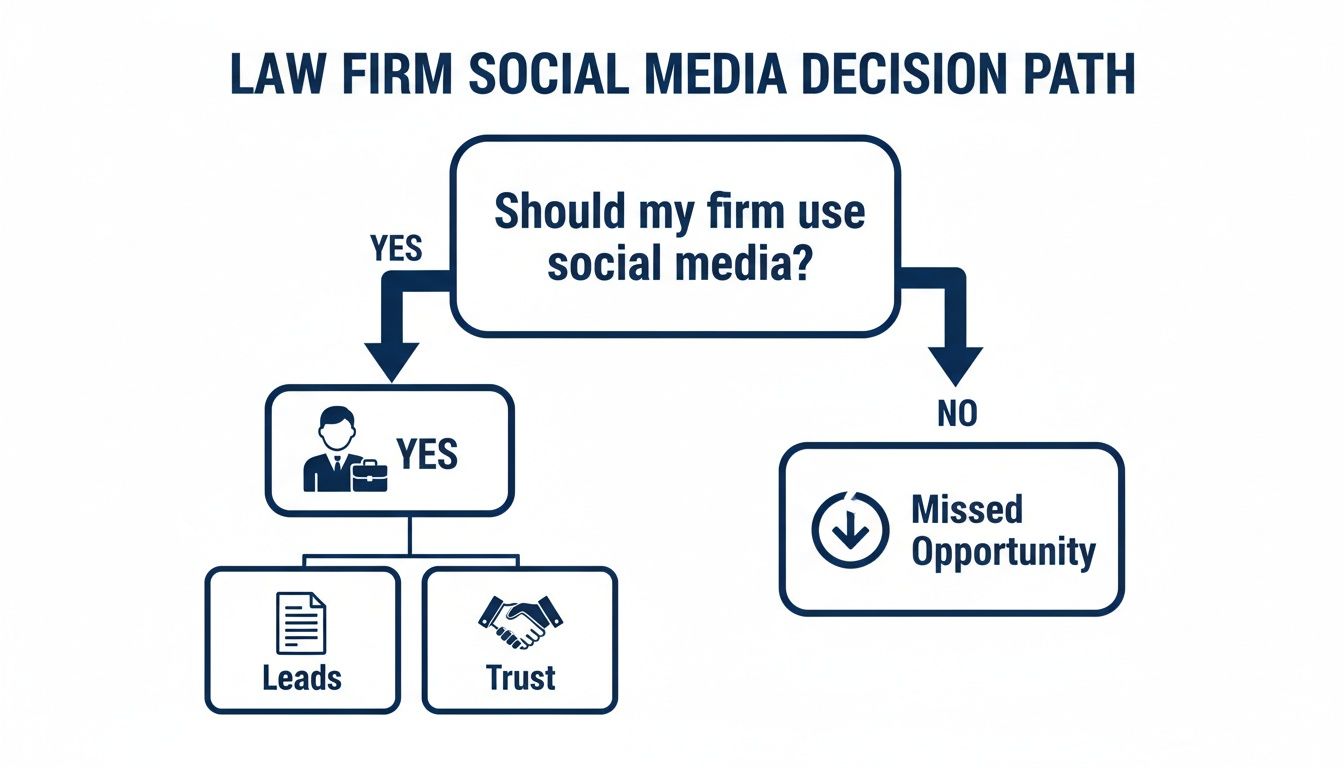
The flowchart doesn't lie. Intentional engagement leads to real results. Inaction? Well, that leads to your competitors getting the calls that should have been yours.
LinkedIn: The Professional Authority Hub
For any firm that serves other businesses (B2B)—think corporate law, IP, or complex commercial litigation—LinkedIn is non-negotiable. It's your digital headquarters. The platform is built from the ground up for professional networking, cementing your credibility, and generating the kind of high-value referrals that build a practice. The vibe is buttoned-up, and the audience expects you to deliver real substance.
Here, you're not just another lawyer. You're a thought leader. The goal is to become the go-to resource that executives and other attorneys think of first.
Content that kills it on LinkedIn:
- Detailed Case Studies: Post an anonymized breakdown of a successful M&A deal or a tricky commercial litigation win.
- Analysis of New Legislation: Explain how a new federal regulation will actually impact businesses on the ground.
- Articles on Professional Development: Share your hard-won insights on things like contract negotiation tactics or corporate risk management.
Plus, the numbers back it up. Engagement for the legal industry on LinkedIn averages a respectable 3.2%. And with 60% of its users aged 25-34, it’s a goldmine for connecting with the next generation of business leaders.
Facebook: The Community Engagement Powerhouse
If your firm serves individuals and families, you need to be on Facebook. I’m talking to the personal injury, family law, criminal defense, and estate planning attorneys. With its massive user base and incredibly powerful local targeting tools, it’s simply the best place to build a real community presence and connect with potential clients right in your zip code.
Facebook is where you get to take off the suit and tie and show the human side of your firm. It’s less about citing case law and more about being the helpful, approachable expert down the street.
Success on Facebook for a law firm isn't about selling. It's about becoming a valuable member of the community first and a lawyer second. Answer common questions, share local updates, and offer useful tips without asking for anything in return.
The real magic of Facebook is its advertising. You can dial in campaigns to reach people based on their location, age, and even specific life events, making sure your message lands in front of the exact people who need your help. If you're looking to run paid ads, our complete guide on Facebook advertising for lawyers is a must-read.
Instagram: The Visual Storytelling Stage
I know what you're thinking—Instagram? For a law firm? Absolutely. Its visual-first approach gives you a unique chance to humanize your brand and make intimidating legal topics feel accessible. For practice areas like personal injury, immigration, or even family law, it can be a surprisingly effective way to build an empathetic connection with your audience.
Think of Instagram as the place to tell your firm’s story with pictures and short videos. This is not the place for long-form legal articles. It’s for quick, digestible, and compelling content that people can absorb in seconds.
Content formats that work on Instagram:
- Infographics: Create a simple graphic that explains the 5 steps in a personal injury claim.
- Short "Reels" Videos: Film a 30-second video answering a common question like, "What should I do right after a car accident?"
- "Meet the Team" Posts: Post professional but friendly photos of your attorneys and staff to build that all-important familiarity.
- Client Testimonial Graphics: Take a powerful quote from a happy client (with their permission, of course) and put it on a branded background.
The entire game on Instagram is translating your expertise into a format that’s easy to understand at a glance. When you do that, you demystify the legal process and position your firm as the clear, trustworthy guide people need during a stressful time.
Navigating Ethical Minefields and Compliance
Let's be honest. For many attorneys, the biggest thing stopping them from diving into law firm social media isn't a lack of time or tech-savvy—it's fear. The web of State Bar Association rules and professional conduct guidelines can make social media feel like a legal minefield. It’s easy to imagine one wrong post putting your license on the line.
But that fear usually comes from a misunderstanding of the rules, not from an impossible risk.
Think of it this way: ethical rules aren't there to stop you from marketing your firm. They exist to make sure your marketing is truthful, accurate, and doesn't mislead the public. Once you grasp the core principles, you can build a compliant and incredibly effective social media strategy that brings in new clients without ever crossing an ethical line.
Avoiding Guarantees and Upholding Confidentiality
The most important rule is also the simplest: never promise a specific outcome. If your posts include phrases like "We'll win your case" or "Guaranteed to get you the maximum settlement," you're setting off major alarm bells. Instead of making promises, focus your content on your firm's process, your team's experience, and your unwavering commitment to your clients.
Client confidentiality is just as critical, and it extends directly to your social media feed. You can't post specifics about a case—even if you think you've made it anonymous—without getting explicit, written consent from the client. That celebratory "big win" post can easily become a violation if it contains enough detail for someone to identify the case.
Need a cautionary tale? Look at a recent case in Illinois. During a trial, plaintiffs' attorneys took to social media with misleading information about the case. The result? An appellate court reversed a staggering $43.8 million verdict, calling the lawyers' actions a "serious effort" to improperly sway the jury.
The Do's and Don'ts of Compliant Posts
To stay on the right side of the Bar, treat every single post as a form of official firm communication. Here’s a quick cheat sheet to guide you.
| Compliant Post (The Right Way) | Non-Compliant Post (The Wrong Way) |
|---|---|
| "Our team is proud to have helped a client navigate a complex business dispute, reaching a favorable resolution." (Vague, focuses on process) | "Just won a $2M verdict for our client against XYZ Corp. They never stood a chance!" (Specific, guarantees, disparages) |
| "Struggling with the probate process? Here are 3 common mistakes to avoid. #EstatePlanning" (Educational, helpful) | "Hire us for your probate needs and we'll get you your inheritance, guaranteed. Call now!" (Promises outcomes, overly solicitous) |
| **"Grateful for this client's kind words: 'They were professional and supportive.' Results may vary."* (Uses testimonial with a clear disclaimer) | "Another 5-star review! 'They got me a huge settlement!' We're the best PI firm in town." (No disclaimer, makes unsubstantiated claims) |
A simple but powerful rule of thumb: Educate, don't solicit. Your goal is to be a resource, not a high-pressure salesperson. Provide value, and the clients will follow.
Getting the nuances right is everything. For a deeper dive, check out our complete guide on how to handle ethical attorney advertising in California. The American Bar Association also has extensive guidelines that should be required reading. And for more on compliance, this guide on Social Media Marketing for Lawyers: Your Guide to Ethical Growth is an excellent resource.
Once you understand these rules, you can use social media with confidence, turning it from a source of anxiety into a powerful engine for ethical and sustainable growth for your firm.
Crafting Content and Ads That Convert

Just having a social media profile is table stakes. The real work—and the real results—begins when you fill those profiles with content and ads that grab attention and persuade potential clients to act. It’s the difference between hanging a shingle online and building a dynamic, case-generating machine.
Think of your strategy as having two engines working together. First, you have your organic content, the daily posts that build your firm's authority and give it a human personality. The second is your paid advertising, the precision tool you use to reach specific new audiences and drive immediate inquiries.
When these two engines are firing in sync, your law firm social media presence stops being a passive bulletin board and starts becoming an active client acquisition funnel.
Building Trust with Organic Content Pillars
Your everyday posts should be built on a foundation of value, not constant sales pitches. This is where you earn trust, answer questions before they're even asked, and establish your firm as the go-to resource in your practice area.
A strong organic strategy rests on a few key pillars:
- Educational Content: This is your bread and butter. We're talking short videos breaking down complex legal terms into plain English, simple infographics on the "5 Steps After a Car Accident," or posts demystifying the probate process.
- Behind-the-Scenes Content: Humanize your firm. Introduce your paralegals, celebrate a team member's work anniversary, or share a quick glimpse of your office preparing for a trial. This reminds people that behind the law, there are real, relatable people fighting for them.
- Community Engagement: Show you're part of the community, not just doing business in it. Share news about local events, congratulate other local businesses on their success, or post about your firm’s involvement in a charity 5k.
- Case Results and Testimonials (With Caution): Ethically sharing anonymized success stories or client testimonials (with explicit permission and all necessary disclaimers) provides powerful social proof. Always put client confidentiality and your Bar's advertising rules first.
This content mix creates a well-rounded, authentic presence that people actually want to follow. It’s a core piece of a much larger puzzle, which you can explore in our guide to law firm content marketing.
Your organic content is a long-term investment in your brand's reputation. Every helpful post you share is like making a small deposit into a trust fund with your future clients.
As you create this valuable content, don't forget the importance of protecting intellectual property rights to safeguard your firm's unique videos, graphics, and posts. It’s a crucial step in maintaining your professional integrity online.
Demystifying Paid Social Media Ads
While organic content builds your foundation, paid ads are the accelerator. Paid social advertising on platforms like Facebook and LinkedIn is like having a superpower: you can put your message directly in front of a hand-picked audience with incredible precision.
Imagine being able to show an ad for your estate planning services only to people in your county who are over 50 and have shown an interest in finance and retirement. That’s the kind of focus paid social delivers.
Local Targeting and Retargeting
For nearly every law firm, local targeting is the most powerful tool in the ad toolbox. You can draw a digital "geofence" around your city, county, or specific zip codes, ensuring every single ad dollar is spent reaching people who could actually walk through your door.
But it gets even better with retargeting. It’s a simple but brilliant concept:
- Initial Contact: A potential client visits your website's "Car Accident Services" page but leaves without contacting you.
- The Follow-Up: A day later, they're scrolling through Facebook, and a simple, helpful ad from your firm appears: "Still have questions about your car accident? We're here to help."
- Conversion: That timely, gentle reminder prompts them to click back to your site and finally make the call.
This isn't magic; it's a retargeting campaign. It works by showing your ads to people who have already raised their hand by visiting your site, which dramatically increases the odds they'll come back and convert into a lead.
The data backs this up. A full 71% of lawyers report generating new leads directly from these platforms. The ROI is there, too; Facebook leads the pack with an average 29% return on ad spend. For PI attorneys, the opportunity is huge, as 57% of law firms are already using a Facebook business page for community outreach and laser-focused advertising.
Measuring Success and Proving Your ROI
So, how do you prove your firm's social media efforts are more than just a feel-good PR exercise? It all comes down to moving past the "vanity metrics"—the likes, shares, and follower counts that look nice on a report but don't actually pay the bills.
Think of it this way: a "like" is someone giving you a friendly nod as they walk past your office. A website click or a phone call is someone opening the door, walking in, and asking for a consultation. You want to track the people walking through the door. We need to draw a straight line from your social media activity to tangible, bottom-line results that show a clear return on investment (ROI).
Key Performance Indicators That Actually Matter
To measure the real impact of your social media, you have to obsess over the Key Performance Indicators (KPIs) that signal a potential client is getting closer to hiring you. These are the numbers that prove social media is actively generating real business.
Start by tracking these essential metrics:
- Website Clicks: How many people are actually leaving Facebook or LinkedIn to check out your website? This is a huge sign that your content hooked them enough to make them want to learn more.
- Form Submissions from Social: By using simple tracking links (called UTM codes), you can see exactly how many people who came from a social media post went on to fill out your "Contact Us" or "Case Evaluation" form.
- Direct Calls from Social Profiles: Most platforms let you add a "Call Now" button. Tracking how many calls come directly from your profiles is one of the purest measures of success you can find.
- Engagement Rate: While it's not a direct lead, a high engagement rate (comments, shares, saves) is a vital early signal. It tells you your content is hitting the mark, which is the first step in building a pipeline of potential clients.
When you focus on these specific actions, you can start building an undeniable case for the value of your social media budget.
Connecting Social Activity to Client Inquiries
The real magic happens when you can connect the dots between a post you made on LinkedIn and a brand-new client showing up in your intake system. This isn't guesswork; it requires a combination of the platforms' built-in analytics and a powerhouse tool like Google Analytics 4 (GA4).
Every platform, from Facebook's Meta Business Suite to LinkedIn's Page Analytics, gives you a dashboard with basic data on post reach and clicks. This is your first stop to see what’s working and what isn’t on each specific network.
The most crucial step is setting up goal tracking in Google Analytics. This lets you attribute website conversions—like a form submission or a consultation request—back to the specific social media post or ad that sent the visitor to your site in the first place.
This process transforms your reporting from, "We got 50 likes on that post," to "Our LinkedIn post drove 15 qualified leads last month." That’s the kind of data that justifies marketing spend and proves your strategy is working. For a deeper dive into this, you can learn more about measuring advertising effectiveness in a more structured way.
Ultimately, proving ROI for your law firm's social media isn't about hoping for the best. It’s about setting up the right tracking, focusing on the metrics that drive growth, and creating crystal-clear reports that show how your online efforts are directly fueling client acquisition.
Your First 90 Days: A Social Media Starter Plan

Alright, let's be honest: diving into social media can feel like staring up at a mountain. Where do you even begin? This simple 90-day plan is your trail map, breaking the climb into manageable steps so you can build real momentum without getting burned out.
The goal here isn't overnight perfection. It’s about consistent, intentional action that lays the groundwork for long-term growth. Think of this as the blueprint for launching a law firm social media presence that actually works, right from scratch.
Phase 1: The Foundation (Weeks 1-4)
The first month is all about getting your digital house in order. Before you start shouting from the rooftops, you need to build a professional, fully-stocked home base on your chosen platforms. Don't stress about posting every day yet—just focus on creating a solid foundation.
By the end of this phase, anyone who stumbles upon your profile will instantly get who you are, who you help, and why you’re the credible authority they need. It’s all about nailing that first impression.
Here are your core tasks for the first month:
- Week 1: Pick your primary platform. If your firm is B2B-focused, that's likely LinkedIn. If you're a PI firm targeting local clients, Facebook is probably your best bet. Create your business profile and fill out every single field with professional headshots, a compelling bio, and accurate contact info.
- Week 2: Map out your initial content pillars. Aim for 3-4 core topics you can always talk about, like "Answering Common Legal Questions," "Meet Our Team," or "Local Community News."
- Week 3: Create and schedule your first four educational posts. The key here is real value. Answer the questions your ideal clients are already asking Google.
- Week 4: Do some recon. Find 10-15 relevant local accounts or industry-specific profiles to follow and start observing their conversations.
Phase 2: The Engagement (Weeks 5-8)
With your foundation poured and set, it's time to open the doors and start the conversation. This phase is a shift from setup to active participation. The goal is to post a little more frequently and start interacting with your community to build visibility and, more importantly, trust.
Building a social media presence is like building a reputation in a new town. You can't just hang a sign; you need to show up, introduce yourself, and join the conversation.
Key moves for your second month:
- Weeks 5-6: Up your posting cadence to 2-3 times per week. Start mixing in your educational content with some behind-the-scenes posts, like introducing a star paralegal or celebrating a team milestone.
- Weeks 7-8: Block out 15 minutes daily for engagement. That means leaving thoughtful comments—not just "great post!"—on content from other local businesses, referral partners, or professionals in your network.
Phase 3: The Growth (Weeks 9-12)
You've built the foundation and joined the conversation. Now you’re ready to expand your reach. This final phase is all about amplifying what's working and dipping your toes into new content formats. You'll use the data from the first two months to sharpen your strategy and scale up.
Your main objectives now are to test out video content, dig into your analytics to see which posts actually resonated, and create a sustainable content calendar for the future. This is what sets you up for consistent, data-driven success long after these first 90 days are over.
Got Questions? We’ve Got Answers.
When it comes to social media, most law firms run into the same handful of questions and concerns. Let's clear the air and tackle the most common ones head-on so you can move forward with confidence.
"Realistically, How Much Time Does This Take Each Week?"
Forget the idea of a magic number. A realistic, sustainable starting point is 3 to 5 hours per week. That’s it. Treat it like a recurring client meeting—block it off on your calendar and protect that time.
Here’s how that time breaks down into simple, manageable tasks:
- 1-2 hours: Plan and schedule your posts for the entire week. Get it done in one batch.
- 1 hour: Engage with your network. This means responding to comments, sharing content from colleagues, and being part of the conversation.
- 1 hour: A quick look at your analytics. What worked? What didn't? This isn't a deep dive, just a pulse check to see what’s connecting with your audience.
The goal at the beginning isn't to go viral; it's to build a consistent habit. Once you get into a rhythm, you'll be surprised how much you can get done in that same block of time.
"Can a Platform Like TikTok Actually Land a Real Case?"
Absolutely, but you have to change your mindset. A corporate firm probably isn't going to close its next big M&A deal from a 30-second video. But for a personal injury, criminal defense, or family law practice? TikTok is a goldmine for connecting with real people. It’s the perfect place to drop the legalese and show the human side of your practice.
Success on TikTok isn't about one video leading directly to one case. It's about building a brand that people know, like, and trust. When someone in your city finally needs legal help, your firm will be the first one that comes to mind.
Think about it: a single, helpful video that debunks a common legal myth can reach thousands of potential clients, building massive brand awareness that pays off in future calls and consultations.
"What Are the Biggest Mistakes We Need to Avoid?"
The number one mistake we see is inconsistency. Firms come out of the gate strong, posting every day, only to burn out and go completely silent for weeks. That kind of sporadic activity tells both potential clients and the platform's algorithm that you're unreliable.
The second biggest misstep is drowning your audience in legal jargon. Your followers aren't fellow attorneys; they're people facing stressful situations who need clear, simple answers. Always write to be understood, not to impress your law school professor. Approachability wins every time.
Ready to build a social media strategy that brings in the right clients without the guesswork? The team at Case Quota has been helping firms like yours grow for over 15 years. Learn more about our proven social media marketing services and let's get started.