

At its core, law firm SEO is the process of making your firm's website show up when potential clients are actively looking for a lawyer online. It’s how you get found on Google, turning your website from a digital business card into your most reliable source for high-value cases.
Why Law Firm SEO Is Your Most Critical Marketing Investment

Think of your law firm like a physical office. If you're tucked away on a quiet side street, you're invisible to the thousands of people walking down the main drag just one block over. That busy main street? That's Google's first page. Law firm SEO is the strategy that moves your office directly onto that prime real estate, putting your digital front door exactly where your ideal clients are looking for help.
This isn’t just about having a website—it’s about making that website work for you. For attorneys, especially in brutally competitive markets like Southern California, just getting noticed is half the battle. Old-school marketing like billboards or magazine ads is like casting a huge, expensive net and hoping someone who needs a lawyer someday sees it.
SEO is the complete opposite.
It’s a precision tool. It connects your firm with people who have an immediate, urgent legal problem. They aren't just browsing; they are typing phrases like “car accident lawyer in Los Angeles” or “estate planning attorney Santa Monica” into their phone right now.
The Power of Being Found First
The sheer numbers tell the story. Google fields over 8.5 billion searches every single day, owning 92.82% of the entire search market. And since 93% of all online experiences begin with a search engine, a law firm without a strong SEO game is effectively invisible to almost everyone looking for their services. You can dig into more digital marketing statistics for law firms to see just how big this opportunity is.
A targeted SEO strategy built specifically for the legal field delivers on critical business goals:
- It attracts high-intent leads: SEO targets keywords that signal someone is ready to hire an attorney, not just doing casual research.
- It builds authority and trust: Ranking at the top of Google signals that your firm is a credible, leading voice in your practice area.
- It drives real, measurable growth: Unlike a billboard, you can track exactly how your SEO efforts translate into calls, form fills, and new cases.
Your Website Should Be Your Best Employee
Ultimately, your website should be your firm's hardest-working employee, generating leads 24/7. But without SEO, it’s like having a brilliant salesperson with no phone, no email, and no way to meet people.
This guide will break down everything you need to know, from the nuts and bolts of local and technical SEO to building a content strategy that dominates your practice areas. We’ll give you a clear roadmap to turn your online presence from a static brochure into a powerful client-generating machine. This is how you stop fighting over price and start winning on expertise, ensuring your next best client finds you first.
The Three Pillars of a Winning Legal SEO Strategy

A powerful law firm SEO strategy isn't just one thing. It's a coordinated effort built on three core pillars that work together.
Think of it like building your firm’s office. You can’t put up walls without a solid foundation, and you can’t build a reputation in the community without a well-designed space that serves clients. Each piece supports the others to create a structure that stands strong and attracts business.
These pillars are Technical SEO, On-Page SEO, and Off-Page SEO. Understanding how they interlock is what separates a law firm with an invisible website from one that Google trusts, rewards, and puts in front of ideal clients.
Let's break down exactly what each pillar involves.
Pillar 1: Technical SEO – The Foundation
Technical SEO is the concrete foundation and steel frame of your digital office. It’s all the behind-the-scenes work that ensures search engines like Google can actually find, crawl, and make sense of your website.
If this foundation is cracked, everything you build on top of it is at risk. You wouldn't build a multi-million dollar practice on a shaky plot of land, right? The same logic applies here.
Key elements of a rock-solid technical foundation include:
- Site Speed: A slow-loading site frustrates potential clients and search engines. Fast load times are a direct ranking signal.
- Mobile-Friendliness: Most clients start their search for a lawyer on their phone. Your site absolutely has to work flawlessly on any device.
- Secure Connection (HTTPS): A secure site protects user data and is a baseline requirement for building trust with both visitors and Google.
- Clean URL Structure: Simple, logical URLs help search engines and users understand where they are on your site.
Without a solid technical base, even the most brilliant legal content might as well be invisible. For a much deeper look at these moving parts, check out our guide on website optimization for law firms.
Pillar 2: On-Page SEO – The Architecture And Content
Once the foundation is poured and stable, On-Page SEO comes into play. This is the internal architecture of your firm's digital presence—the content, the layout, and the structure of every single page.
This is where you showcase your expertise. It's how you craft practice area pages and attorney bios that directly answer your clients' most urgent questions. It involves diving deep into keyword research to understand precisely what potential clients are typing into Google, then creating high-quality, relevant content that gives them the answers they need.
Think of your main practice area pages as the impressive conference rooms and your blog posts as the well-stocked legal library. Each page has to be optimized to prove to Google that you are the definitive authority on topics like "Southern California personal injury claims" or "Los Angeles criminal defense."
Pillar 3: Off-Page SEO – Your Reputation In The Community
The final pillar, Off-Page SEO, is all about your firm's reputation across the digital world. It’s what other websites and people are saying about you.
A beautiful, well-built office on a solid foundation still needs good neighbors and a strong community presence to truly have value. In the digital world, this is achieved primarily through backlinks—which are simply links from other reputable websites pointing to yours.
Each high-quality backlink acts as a vote of confidence, signaling to Google that your firm is a trustworthy authority. These "votes" can come from:
- Legal directories like Avvo or Justia
- Features in local news publications
- Mentions from bar associations
This pillar is more critical now than ever. With organic search driving the lion's share of traffic at 59% (dwarfing paid ads at 14% and social media at 7%), proving your authority is non-negotiable. As AI continues to reshape search—with 47% of queries now showing AI Overviews—signals of trust like quality backlinks are what get you seen.
The Three Pillars of Law Firm SEO Explained
To bring it all together, here’s a simple table breaking down how these three essential components of a legal SEO strategy work.
| SEO Pillar | Key Activities | Primary Goal |
|---|---|---|
| Technical SEO | Site speed optimization, mobile-friendliness, security (HTTPS), creating a sitemap, and ensuring the site is crawlable. | Make it easy for search engines to find and understand your website's content, building a stable foundation. |
| On-Page SEO | Keyword research, writing high-quality practice area pages and blog posts, optimizing title tags, and internal linking. | Prove your expertise and authority on specific legal topics directly to both users and search engines. |
| Off-Page SEO | Earning backlinks from reputable sites, managing online reviews, and building citations in legal and local directories. | Build your firm's credibility and trust across the web, showing Google you are a recognized authority. |
Mastering how these three pillars support one another is the key to building a digital presence that doesn’t just exist, but actively drives new cases to your firm.
Dominating Local Search in Your Southern California Market
Let's be honest. For most law firms, the high-value clients aren't scattered across the country; they're right in your own backyard. This is where a sharp law firm SEO strategy stops being a vague marketing term and becomes a powerful, case-generating machine. Especially in the dog-eat-dog Southern California market, winning at local search isn't just a nice-to-have—it's essential for survival and growth.
Picture this: someone gets into a fender-bender in San Diego and urgently needs a personal injury attorney. They're not Googling "lawyers in the United States." They’re pulling out their phone and searching for "car accident lawyer near me" or "best injury attorney in San Diego."
Those searches are pure gold. They trigger Google's "Local Pack"—that box with three map-based results staring them in the face at the very top of the page. Landing a spot in that prime digital real estate makes your firm the most obvious, convenient, and credible choice for someone who needs help now.
Optimizing Your Google Business Profile
Your Google Business Profile (GBP) is the absolute cornerstone of your local SEO. Think of it as your digital front door. It’s the verified, organized information about your practice that you hand-feed directly to Google. An incomplete or sloppy profile is like having a misspelled sign on your office—it just looks bad, confuses potential clients, and kills trust before it even starts.
A fully-loaded, meticulously optimized profile is non-negotiable. It’s what Google uses to populate the Local Pack and Google Maps, and it's often the very first impression a potential client will have of your firm.
Here's where to focus:
- Fill Out Everything: Don't skip a single field. Get your precise practice areas, hours, and photos of your actual office and team in there. Accuracy is key.
- Pick the Right Categories: Be specific. Choose "Personal Injury Attorney" instead of just "Lawyer." This helps you show up for the searches that actually matter.
- Use High-Quality Photos: Professional shots of your office and attorneys aren’t just for show. They add a human touch and build instant credibility.
The Power of Consistent NAP and Citations
Beyond your own profile, Google acts like a detective, cross-referencing your firm's details across the web to confirm you're legit. It's looking for perfect consistency in your Name, Address, and Phone Number (NAP). If your NAP data is a mess across different online directories, it sends confusing signals to search engines and will absolutely drag down your local rankings.
Think of each consistent citation as a vote of confidence. When legal directories like Avvo, FindLaw, and your local Chamber of Commerce all list your firm's information identically, it tells Google your business is a real, established pillar of the community.
This painstaking consistency is what gives Google the confidence to put your firm at the top of the list for a local searcher.
Creating Content That Speaks to Your Community
To truly own your local market, your website content has to be local, too. Generic blog posts about federal law are useless to someone trying to navigate a specific local problem. Mastering Local SEO is all about making sure your firm is the answer when people search with local intent.
You need to create content that answers the questions your Southern California clients are actually asking. This proves to both clients and Google that you're the authority in your specific patch of turf.
Here are a few real-world examples:
- A blog post titled "What to Do After a Car Accident on the 405 Freeway."
- An FAQ page that walks through specific Los Angeles County probate court procedures.
- A guide to navigating DUI checkpoints in Orange County.
This is the kind of content that hits high-intent local keywords head-on and establishes your firm as the go-to resource. To push this even further, you need to understand how to leverage attorney reputation in your local marketing efforts.
When you combine a perfectly tuned GBP, rock-solid citations, a flow of positive reviews, and laser-focused local content, you’re not just hoping to get clients. You’re building a system to dominate the Local Pack and bring in a steady stream of high-value local cases.
Your Content Strategy for Attracting High-Value Clients
If your firm's SEO is the engine, then great content is the high-octane fuel that makes it roar past the competition. Without a steady supply of it, you're not going anywhere fast. A smart content strategy for law firm SEO isn't about just filling up pages with legal jargon; it's about systematically answering the urgent questions your ideal clients have, proving your authority, and making it dead simple for them to contact you.
The real goal is to build a digital library that establishes your firm as the go-to resource for your specific practice areas. This means ditching the generic, one-off blog posts and adopting a more structured approach that builds trust with every single click. One of the most powerful ways to do this is with the "hub and spoke" model.
The Hub and Spoke Model Explained
Imagine your main practice area page—say, "Los Angeles Criminal Defense"—as the solid hub of a wheel. This page needs to be a comprehensive, rock-solid overview of that legal field, targeting the broad, high-value search terms that matter most. It’s your cornerstone.
From that central hub, you build out "spokes"—these are individual blog posts, in-depth FAQs, and specific case studies that tackle very niche, related questions. The magic happens when each spoke links back to the hub, creating a tightly woven content ecosystem that signals deep expertise to Google.
For that criminal defense hub, your spokes might look something like this:
- Blog Post: "First Steps to Take After a DUI Arrest in California"
- FAQ Page: "Common Questions About California's Three-Strikes Law"
- Case Study: "How We Achieved a Case Dismissal for a Client in Santa Monica"
This structure tells search engines that your website has serious, authoritative knowledge on the subject, which is a massive ranking signal. More importantly, it ensures potential clients find exactly what they're looking for, whether they're just starting their search or are ready to hire. You can get a much deeper look at this in our complete guide to law firm content marketing.
Fueling Your Strategy with Keyword Research
To build spokes that actually get traffic, you have to know what your potential clients are typing into Google. Keyword research isn't about guesswork; it's about using data to find the exact phrases people use when they're in a jam and need a lawyer. By targeting these specific, high-intent queries, you meet clients at their precise moment of need.
Of course, once you know the keywords, understanding how to write SEO articles that consistently rank is what separates the firms that get leads from those that don't. The payoff for getting this right is enormous. Firms that truly invest in their content see incredible returns, with some business law practices reporting up to a 642% ROI over three years. It's no surprise that, on average, law firms dedicate 45% of their marketing spend to SEO, leading to benefits like a 22% annual lift in organic traffic for criminal defense firms and a visitor-to-lead conversion rate of 7.3%.
This infographic shows how the key pieces of a dominant local strategy—reviews, local content, and citations—all fit together.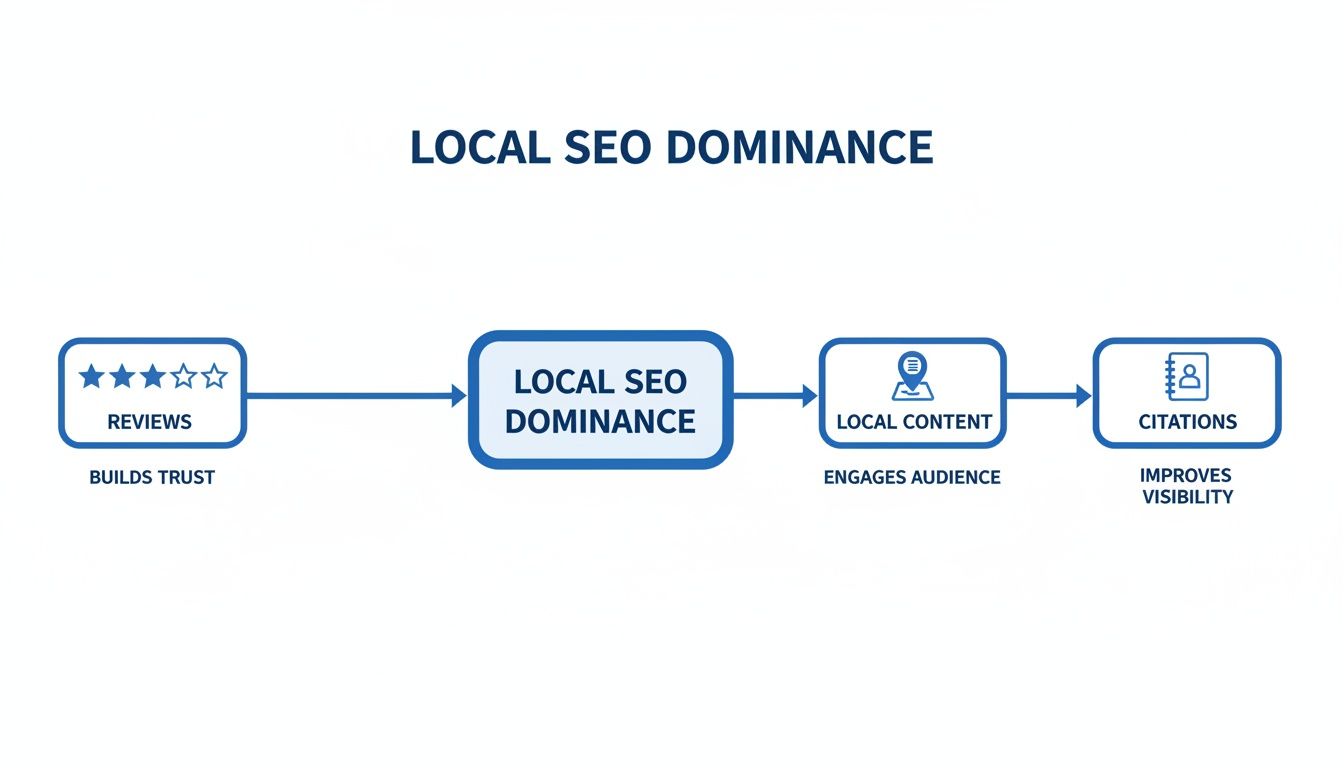
As you can see, these elements work in concert to build the kind of local presence that Google trusts and, ultimately, rewards with higher rankings.
Proving Your E-E-A-T and Ensuring Access for All
When it comes to legal content, Google holds it to a much higher standard. It's what they call "Your Money or Your Life" (YMYL) content, meaning bad information could have serious real-world consequences. Because of this, proving your credibility isn't just a good idea—it's a requirement. Your content must scream E-E-A-T (Experience, Expertise, Authoritativeness, Trustworthiness).
E-E-A-T is your digital proof of competence. It’s what tells Google—and potential clients—that your legal information is accurate, reliable, and comes from a legitimate expert in the field.
Building E-E-A-T isn't complicated, but it does require deliberate effort:
- Detailed Attorney Bios: Go beyond a headshot and a sentence. Showcase qualifications, bar admissions, and meaningful experience.
- Case Results: Publish detailed summaries of your successes (while always protecting client confidentiality) to demonstrate a winning track record.
- Cite Your Sources: Back up your claims by linking out to official legal statutes, government websites, and other authoritative sources.
Finally, your expertise has to be available to everyone. Making sure your website is ADA (Americans with Disabilities Act) compliant is both a legal necessity and a critical part of providing a good experience for all users. Simple things like using proper heading structures, adding descriptive alt text for images, and ensuring your site can be navigated with a keyboard open your doors to every potential client.
Measuring SEO Success with Metrics That Matter
Effective law firm SEO isn't about throwing money at the wall and hoping something sticks. It's a precise, data-driven discipline. To know if your investment is actually generating a return, you have to look past the flashy numbers and zero in on the key performance indicators (KPIs) that signal real business growth.
Too many firms get hypnotized by "vanity metrics." A big spike in website traffic might feel like a win, but if none of those visitors are actually potential clients in your service area, it does nothing for your bottom line. It’s like hosting a packed open house where nobody is actually looking to buy a home.
Moving Beyond Vanity Metrics
The only true measure of an SEO campaign's success is its ability to generate qualified leads and signed cases. Period. This means shifting your focus from broad, impressive-sounding numbers to the specific, actionable data points that tell the story of client acquisition.
Instead of asking, "How much traffic did we get?" the question needs to be, "How much qualified traffic did we get, and what did those people do once they got to our site?" This is the crucial difference between tracking activity and measuring results. A smart SEO strategy is obsessed with the metrics that matter.
The KPIs That Drive Law Firm Growth
To get a clear, honest picture of your SEO's health, you need to track a specific set of business-driving metrics. These are the numbers that show you what’s working, what isn’t, and how your online presence is translating into actual revenue for your firm.
Here are the essentials you should be watching like a hawk:
- Organic Keyword Rankings: Forget tracking your firm's name. You need to monitor your rank for high-intent, geo-targeted keywords like "Orange County personal injury attorney" or "Los Angeles probate lawyer." When you climb the ranks for these terms, you know more qualified people are seeing you first.
- Traffic to Key Practice Area Pages: Is traffic to your main "Car Accidents" or "Family Law" page going up? That's a powerful signal that your SEO is attracting the right kind of audience.
- Google Business Profile Actions: This is pure gold. Track how many people click the "Call" button, request directions to your office, or visit your site straight from your GBP listing. These are actions taken by people with an immediate need for a lawyer.
- Lead Conversion Rate: This is the big one—the most important metric of all. It tells you the percentage of website visitors who become actual leads by calling you or filling out a contact form.
Measuring the right KPIs is how you hold your marketing partners accountable. It completely changes the conversation from "we got you more clicks" to "we generated more qualified consultations," which is the only conversation that actually impacts your firm's growth.
A deep dive into measuring advertising effectiveness is non-negotiable for any firm serious about its marketing ROI.
Vanity Metrics vs. Business-Driving KPIs
Let’s clear up the confusion. The table below breaks down the difference between common distractions and the metrics that truly measure the success of your law firm SEO efforts.
| KPI | Why It's a Vanity Metric | What to Measure Instead (Business-Driving Metric) |
|---|---|---|
| Total Website Traffic | A high number is meaningless without context. It doesn't tell you if the visitors are potential clients or just random internet users from another state. | Organic traffic to specific practice area pages. This proves you're attracting visitors who are interested in the services you actually offer. |
| Keyword Rankings (for broad terms) | Ranking for a generic term like "lawyer" is nearly impossible and drives unqualified, nationwide traffic that will never convert. | Rankings for high-intent local keywords. This targets searches like "divorce attorney near me," which have a much higher probability of turning into a real case. |
| Impressions | This just means your site appeared in search results. It doesn't mean anyone clicked on it, or even saw it. It’s the digital equivalent of being a face in a crowd. | Click-Through Rate (CTR) and Google Business Profile actions (calls, directions). These metrics show active engagement from potential clients. |
By focusing on these business-driving metrics, you cut through the noise and get a clear, honest assessment of how your SEO investment is performing. This data-first approach empowers you to make smarter marketing decisions and, ultimately, build a reliable pipeline of high-value cases for your firm.
Your Questions About Law Firm SEO, Answered
Even with a solid plan, it's natural to have questions. Partners and firm administrators often ask us about the nuts and bolts of how this all works in the real world. Here are some of the most common ones we hear, with straight-up answers.
How Long Does This Stuff Actually Take to Work?
Let's be clear: SEO is a long game, not a lottery ticket. While you might see some small positive movements in a few weeks, you should expect it to take three to six months before you see a real, measurable impact on your rankings, traffic, and most importantly, your intake calls.
Think of it like building a reputation in your local legal community. It doesn't happen overnight. It takes consistent, high-quality effort to build the kind of authority that lasts. The timeline really depends on factors like how competitive your practice area is, the history of your website, and how aggressively we can tackle the campaign.
Is SEO a Better Bet Than Paid Ads?
This isn't an either/or question; they're two different tools for two different jobs. But for long-term value, SEO is the undisputed champion. Paid ads get you immediate visibility—you pay, you're at the top. The moment you stop paying, you disappear.
SEO, on the other hand, is about building a permanent asset for your firm. Every article you publish, every backlink you earn, adds to your site's authority. That authority keeps generating organic traffic and leads long after the initial work is done. A smart strategy often uses both: paid ads for quick wins while the SEO engine builds sustainable, long-term growth.
The real magic of SEO is that its benefits compound. The authority and trust you build over time create a reliable, low-cost stream of high-quality leads that paid advertising simply can't replicate on its own.
How Do I Find the Right SEO Partner for My Firm?
Choosing the right partner is probably the most critical decision you'll make. You need an agency that lives and breathes the legal industry, not a generalist. They should be able to walk you through actual case studies and show you real results from firms like yours.
They need to speak your language, focusing on the metrics that actually matter—qualified leads, signed cases—not just vanity numbers like website traffic. For a deeper dive, you can check out our guide on how to find the best attorney SEO partner.
Above all, demand transparency. A great partner will provide clear, regular reporting that ties their work directly to your firm's bottom line. No excuses, just data.
Ready to turn your website into your most effective source of new cases? At Case Quota, we build data-driven SEO strategies that help Southern California law firms dominate their local markets. Get in touch with us today.