

Over 60 percent of American legal clients turn to online resources before choosing an attorney. For small to mid-sized law firms in Southern California, strategic blog content can help you stand out amid a crowded market dominated by larger competitors. Discover practical steps to define your legal audience, select trending topics, and structure your posts for greater visibility and client trust.
Table of Contents
- Step 1: Define Your Target Legal Audience And Goals
- Step 2: Research Trending Legal Topics And Client Questions
- Step 3: Structure Compelling Blog Posts For Attorneys
- Step 4: Optimize Content For Legal Seo Best Practices
- Step 5: Review And Refine Posts For Accuracy And Engagement
Quick Summary
| Key Insight | Explanation |
|---|---|
| 1. Identify Your Target Audience | Understand who you want to reach and their legal needs for effective blog writing. |
| 2. Research Legal Trends | Stay informed about current legal issues to create relevant and engaging content. |
| 3. Structure Posts Effectively | Use the IRAC method to clearly present legal information and keep readers engaged. |
| 4. Optimize for Legal SEO | Integrate relevant keywords and improve technical aspects to enhance search visibility. |
| 5. Review for Accuracy and Engagement | Ensure content is accurate and engaging to build client trust and maintain professionalism. |
Step 1: Define your target legal audience and goals
Successful attorney blog writing starts with understanding exactly who you want to reach and what outcomes you seek. Identifying your target audience determines how you structure your content, select topics, and communicate your expertise.
To define your target audience, begin by examining your law practice’s specific focus. Are you a family law attorney handling divorces in Southern California? An employment lawyer specializing in workplace discrimination? Your blog content should speak directly to the precise legal challenges and questions potential clients in your practice area experience. Consider factors like demographics (age, income, location), legal needs, educational background, and typical concerns they might have when seeking legal representation.
Your blog goals should go beyond simply attracting readers. Aim to build trust, demonstrate your legal expertise, and provide genuine value that transforms casual readers into potential clients. Crafting authentic messages helps potential clients see you as a knowledgeable resource they can rely on during challenging legal situations.
Pro tip: Create a detailed client persona that includes specific characteristics, pain points, and motivations to help you write more targeted and compelling blog content.
Here’s a comparison of key elements to include in attorney blog client personas:
| Attribute | Why It Matters for Legal Blogs | Example Value |
|---|---|---|
| Demographics | Tailors content to reader profile | Adults aged 35-55, California |
| Legal Needs | Focuses topics on client concerns | Divorce, employee rights |
| Pain Points | Addresses urgent legal questions | Custody issues, discrimination |
| Preferred Language | Ensures content accessibility | Plain English, no jargon |
| Motivation to Hire | Highlights factors driving action | Seeking legal protection |
Step 2: Research trending legal topics and client questions
Researching trending legal topics is essential for creating compelling attorney blog content that resonates with potential clients. Emerging legal issues provide an excellent opportunity to demonstrate your expertise and address client concerns in real time.
Start by exploring current legal coverage across different practice areas. Exploring legal topic trends allows you to identify the most pressing questions and challenges your potential clients are facing. Pay attention to technological developments, legislative changes, landmark court cases, and industry specific regulations that might impact your clients. Look for sources like legal journals, professional association publications, news outlets specializing in legal reporting, and academic legal research platforms.

Consider creating blog content that breaks down complex legal concepts into accessible language. For instance, if you specialize in technology law, you might write about recent developments in artificial intelligence regulations or data privacy issues. If you focus on employment law, you could explore emerging workplace trends, remote work legal considerations, or recent discrimination case precedents. The goal is to position yourself as a knowledgeable resource who understands and can explain intricate legal matters in a way that helps potential clients.
Pro tip: Set up Google Alerts for key legal terms in your practice area and subscribe to specialized legal news feeds to stay continuously updated on the latest trends and developments.
Step 3: Structure compelling blog posts for attorneys
Crafting a well-structured blog post is crucial for capturing and maintaining your potential clients’ attention. Effective blog post formatting can transform complex legal information into engaging and readable content that speaks directly to your audience’s needs.
Adopt the IRAC method as a foundational framework for your legal blog posts. Legal argument structure provides a systematic approach to presenting legal information. Begin with a clear, attention grabbing introduction that outlines the specific legal issue. Follow this with a section that explains the relevant legal rules and principles in plain language. Next, apply these rules to a relatable scenario or case study that helps readers understand how the legal concept might impact their own situation. Conclude with a concise summary that provides clear takeaways and potentially suggests next steps.
Use descriptive headings and subheadings to break up your content, making it easy for readers to skim and find the information most relevant to them. Keep paragraphs short and focused, typically 3 to 4 sentences long. Incorporate real world examples, brief case studies, or hypothetical scenarios that illustrate your points. Your goal is to transform complex legal concepts into accessible, interesting content that demonstrates your expertise while providing genuine value to potential clients.
Pro tip: Write your blog post draft first, then go back and create compelling headings that tell a story and guide readers through your legal insights.
The following table summarizes effective blog structures for attorneys and their unique benefits:
| Structure Element | Description | Benefit for Legal Blog Readers |
|---|---|---|
| IRAC Method | Issue, Rule, Application, Conclusion | Provides clarity and logical flow |
| Case Examples | Real or hypothetical legal scenarios | Makes complex topics relatable |
| Descriptive Headings | Clear, skimmable subheadings | Improves readability and accessibility |
| Short Paragraphs | 3-4 concise sentences per paragraph | Keeps content engaging and easy to digest |
Step 4: Optimize content for legal SEO best practices
SEO for legal blogs requires a strategic approach that goes far beyond simple keyword insertion. Legal website optimization demands thoughtful integration of practice specific keywords and local search terms that potential clients actually use when seeking legal assistance.
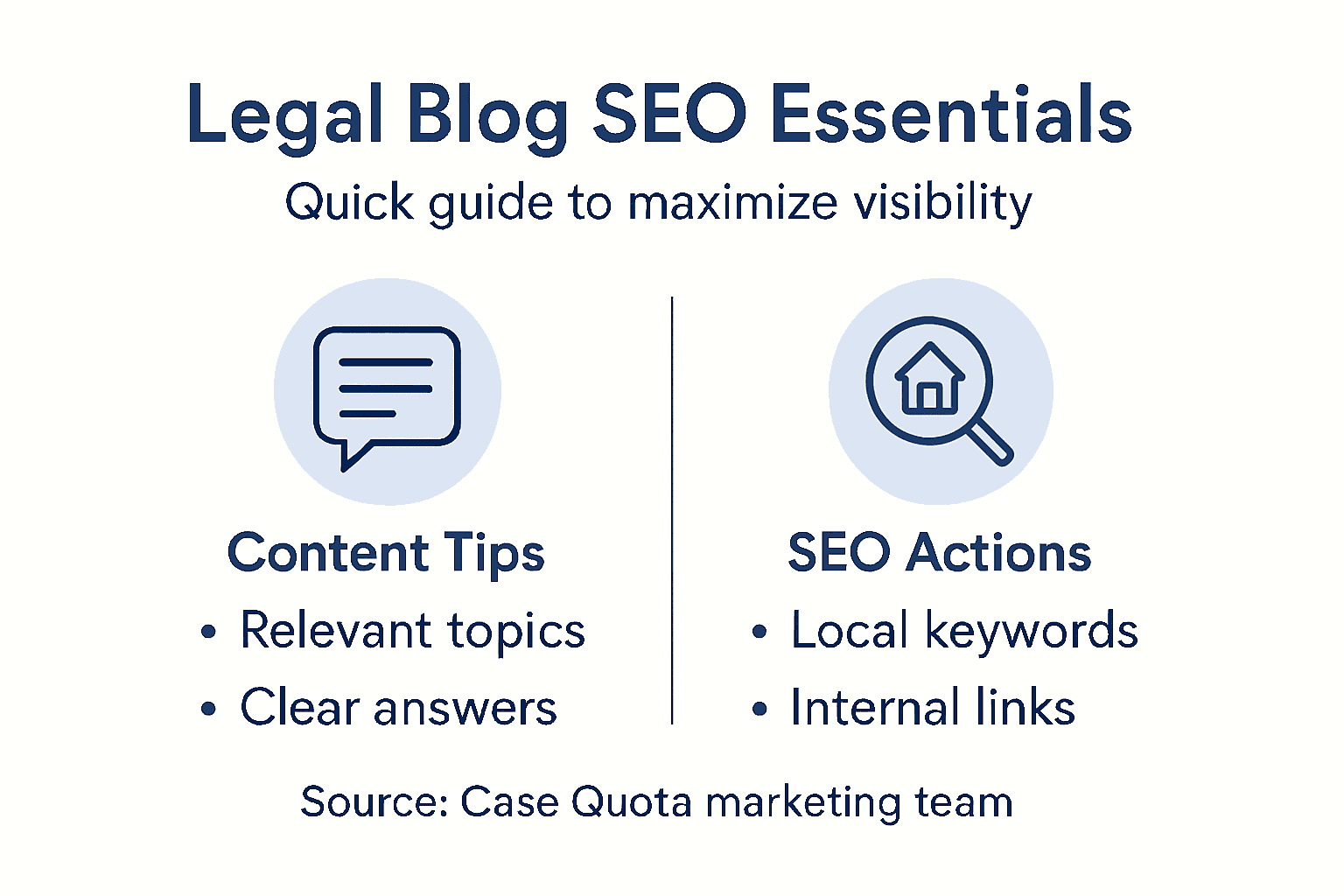
Focus on creating content that directly addresses your potential clients’ most pressing questions and concerns. Search engine optimization strategies for attorneys involve multiple technical and content related elements. Incorporate localized keywords specific to your practice area and geographic region. Optimize your meta titles and descriptions to clearly communicate the value of your legal services. Ensure your website loads quickly and functions smoothly on mobile devices, as these technical factors significantly impact search rankings. Use header tags strategically to break up content and signal important information to search engines. Include internal links to related blog posts and practice area pages to help search engines understand the context and depth of your legal expertise.
Prioritize creating high quality, original content that provides genuine value to readers. Instead of keyword stuffing, write comprehensive articles that comprehensively explore legal topics from your potential clients’ perspective. Incorporate frequently asked questions as potential blog topics, and use natural language that mirrors how people actually search for legal information online. Remember that search engines increasingly reward content that demonstrates expertise, authoritativeness, and trustworthiness in your specific legal niche.
Pro tip: Use Google Search Console to track which search queries are already bringing people to your website and create more targeted content around those specific legal topics and questions.
Step 5: Review and refine posts for accuracy and engagement
Refining your legal blog posts is a critical step that transforms good content into exceptional client communication. Legal blog post review requires careful human oversight to maintain professional standards and client trust.
Start with a comprehensive content review that checks several key elements. Verify every legal citation for accuracy and current relevance. Confirm that jurisdictional details are precise and up to date. High quality legal content demands rigorous editorial scrutiny to ensure clarity and professional integrity. Read your draft from a potential client’s perspective ask yourself whether the content answers their most pressing questions. Simplify complex legal terminology and ensure your language remains accessible while maintaining professional credibility. Check that your post provides actionable insights and clear takeaways that demonstrate your expertise.
Consider implementing a structured review process that goes beyond initial drafting. Update older posts with recent legal developments or landmark cases. Add interactive elements like comment sections or social media sharing options to increase reader engagement. Periodically review your blog’s performance metrics to understand which topics resonate most with your audience and refine your content strategy accordingly. Remember that consistent, high quality content builds trust and positions you as a thought leader in your legal practice area.
Pro tip: Create a personal editorial checklist with specific review criteria and always allow at least 24 hours between writing and final editing to approach your content with fresh eyes.
Elevate Your Attorney Blog and Attract More Clients Today
Are you ready to turn your attorney blog into a powerful client attraction tool? This article highlights the challenges legal professionals face when defining target audiences, researching trending topics, structuring engaging posts, and optimizing for SEO. At the heart of it lies the goal to build trust and demonstrate your expertise through authentic, high quality content that answers your clients’ most urgent questions.

Case Quota specializes in helping Southern California law firms overcome these exact hurdles with tailored digital marketing strategies designed to amplify your online presence. From SEO-optimized web design to AI-powered pay-per-click advertising and Google Local Services Ads, our solutions ensure your legal blog reaches the right people at the right time. Don’t let complex legal marketing tactics hold you back. Visit Case Quota to learn how our expert team and proven tools can fast-track your growth and secure your competitive edge. Act now to transform your content into a client-generating machine and watch your practice thrive.
Discover more about our approach on the Case Quota website and start crafting a legal marketing plan that converts readers into cases today.
Frequently Asked Questions
How can I define my target audience for my attorney blog?
To define your target audience, identify the specific legal areas you focus on, such as family law or employment law. Create a detailed client persona that outlines demographics, legal needs, and pain points to tailor your content effectively.
What legal topics should I write about on my blog to attract clients?
Research current legal trends and client questions relevant to your practice area to choose compelling topics. Focus on emerging issues, recent legislation, or common concerns to position yourself as a knowledgeable resource.
How should I structure my attorney blog posts for better engagement?
Use a clear structure like the IRAC method—Issue, Rule, Application, Conclusion—to present legal information cohesively. Incorporate descriptive headings and case examples that readers can easily relate to, improving engagement and understanding.
What are some SEO best practices I should follow for my attorney blog?
To optimize for search engines, include localized keywords and phrases that potential clients use when seeking legal assistance. Focus on creating high-quality, informative content and ensure your website loads quickly and is mobile-friendly to boost your visibility.
How can I review and refine my blog posts before publishing?
Conduct a thorough review of each post to verify legal citations and ensure clarity for your audience. Simplify complex terminology and check that your content provides actionable insights that resonate with potential clients, enhancing trust and authority.
Recommended
- 7 Best Examples of Content Marketing for Lawyers – Case Quota
- Role of Blog Content in Legal Marketing Success
- content marketing for law firm: Attract & Convert Clients
- SEO Legal Marketing: Complete Guide to Dominating Search Rankings for Law Firms – Case Quota
- Role of Tax Attorney – Why Expert Guidance Matters