

To have a shot at proving retaliation, you need to connect three dots for a judge or jury: you did something the law protects, your employer hit you with a negative consequence, and there’s a clear line connecting the two.
Simply put, you have to show they punished you because you stood up for your rights.
The Building Blocks of a Retaliation Claim
Feeling like you have a target on your back at work after speaking up is an awful, isolating experience. But before you start gathering every email and text message, you need to understand what a court actually looks for.
Think of a solid retaliation claim as a three-legged stool. If any one of the legs is missing, the whole thing collapses. Understanding this framework is the first step in moving from a feeling of being wronged to building a structured, provable case.
What It Takes to Build a Case
Every retaliation case that succeeds is built on the same foundation. It’s crucial to know these elements so you can evaluate how strong your own situation might be.
Here’s a quick-reference guide to the three essential pillars every retaliation claim needs.
The Three Pillars of a Workplace Retaliation Claim
| Legal Element | Definition | Common Examples for Clients |
|---|---|---|
| Legally Protected Activity | An action taken by an employee that is shielded from employer punishment under laws like Title VII, the ADA, or the FMLA. | Reporting harassment to HR, participating as a witness in an internal investigation, requesting a disability accommodation, or complaining about unpaid overtime. |
| Adverse Employment Action | Any negative or harmful action by the employer that would likely discourage a reasonable employee from making a complaint. | Getting fired or demoted, being passed over for a promotion, receiving a sudden bad performance review, being moved to a worse shift, or being excluded from important meetings. |
| Causal Connection | The "because of" link. This is the evidence that connects the protected activity to the adverse action. | A manager telling you "things would be better if you hadn't complained," a demotion that happens just a few days after you filed an HR report, or a sudden pattern of nitpicking your work after you served as a witness. |
Here's the critical part: You don't actually have to prove your original complaint (about discrimination or harassment, for example) was 100% correct. The law protects your right to raise the issue in good faith. The entire focus is on whether your employer punished you for exercising that right.
This isn't just a niche issue; it's become a massive problem in the American workplace. Back in 1997, retaliation claims made up just 22.6% of all charges filed with the EEOC. Fast forward to 2021, and that number has exploded. Retaliation now accounts for nearly 60% of all charges, making it the single most common complaint employees raise. This disturbing trend highlights why it’s so important to get your facts straight from the very beginning. For more on related legal industry trends, you can read about effective marketing strategies for employment law firms.
Building an Evidence-Rich Case Timeline
Once you have a handle on what legally constitutes retaliation, it's time to shift gears. A gut feeling that you're being targeted won't be enough to build a case—you need proof. This is where a detailed, meticulously organized timeline becomes your single most important tool.
Think of your timeline as the story of your case. It connects the dots, showing a clear line from the moment you engaged in a protected activity (like reporting harassment) to the negative treatment you faced afterward. Every email, every performance review, every weird comment will find its place here, building a powerful, factual account for an attorney or a government investigator to follow.
This flowchart breaks down the three essential pieces you need to prove retaliation. Your timeline is what will weave them all together.
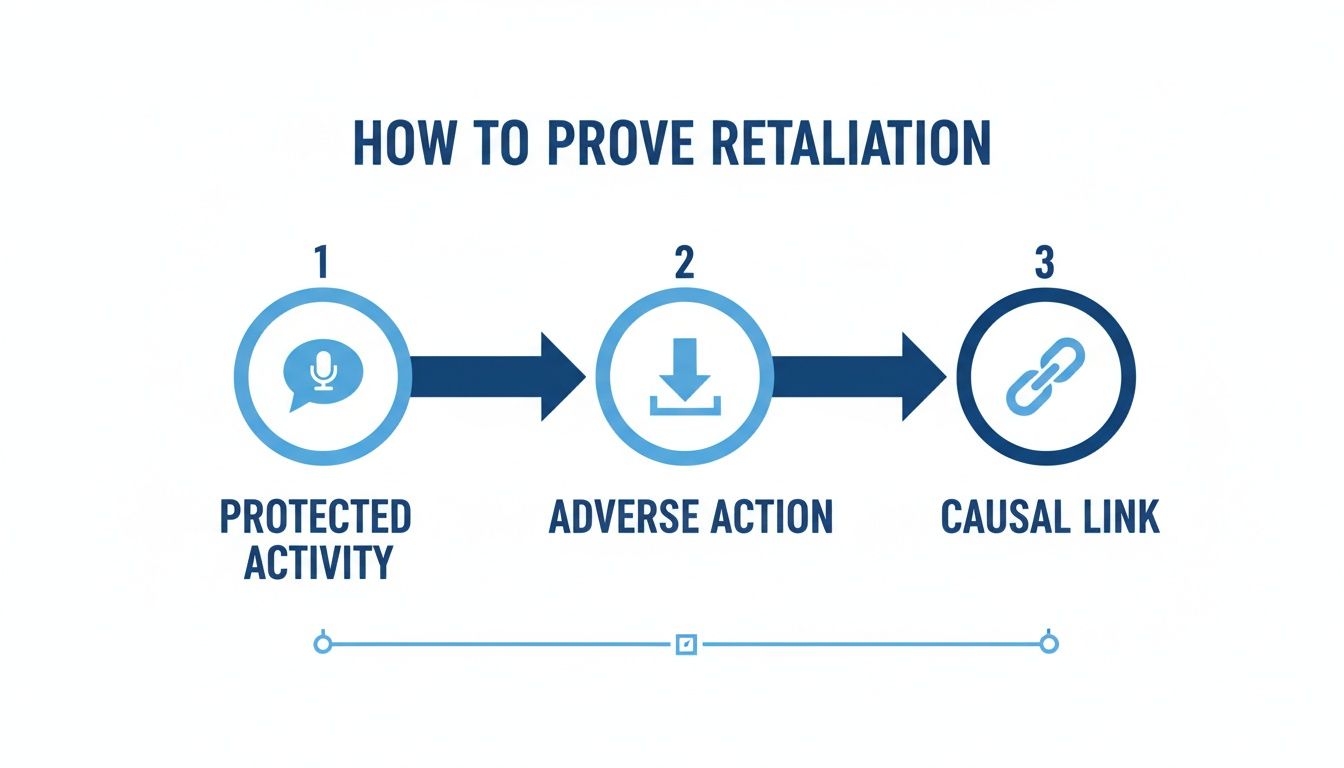
As you can see, the whole case rides on proving that link between your complaint and how your employer responded.
Start with the Protected Activity
Your timeline begins with one event: the protected activity. Pinpoint the exact date, time, and how you did it. Was it a formal email to HR? A verbal complaint to your manager during a one-on-one? Get as specific as you possibly can.
From that day forward, your timeline will capture everything that happened next. Don't second-guess yourself at this stage. Something that seems minor now, like being left off a meeting invitation, could become part of a clear pattern of retaliatory behavior later on.
Gather Your Digital and Physical Evidence
Evidence is everywhere in a modern office, but you have to know what to look for and how to preserve it legally. The goal is to collect documents that show a clear "before and after" picture—how you were treated changed after you spoke up.
Your evidence-gathering mission should include:
- Emails and Internal Messages: Look for a shift in tone from your manager, an uptick in micromanagement, or assignments designed to make you fail. Don't forget messages on platforms like Slack or Microsoft Teams—they're just as valuable as emails.
- Performance Reviews: A sudden nosedive in your performance ratings after years of solid reviews is a classic red flag. Collect every evaluation you can find, past and present, to highlight the contrast.
- Your Personnel File: You have a legal right to request a copy of your personnel file. It can be a goldmine, containing manager's notes, disciplinary write-ups, or other documents you never even knew existed.
- Witness Information: Make a private list of colleagues who saw the mistreatment or who could vouch for your strong work ethic before all this started.
A critical piece of advice: Never, ever use company computers or email to forward evidence to your personal accounts. Your employer can track this. If you can, print physical copies or take clear photos of your computer screen with your personal phone. Trying to delete evidence—even if you're worried your employer will—can destroy your credibility.
Staying on top of this documentation is more important than ever. Recent data shows that workplace discrimination, harassment, and retaliation claims have spiked to 14.7 issues per 1,000 employees, a nine-year high. This often means employers are acting rashly and without proper documentation, which can be a huge advantage for you if you've kept careful records. You can read more about the rise in workplace harassment and retaliation claims on HR-Brew.com.
Maintain a Detailed Personal Journal
Hard evidence like emails and performance reviews tells one part of the story. Your personal journal tells the rest. It provides the human context and captures the things that don't leave a paper trail, like snide remarks or being excluded from team lunches. The key is to keep it "contemporaneous"—that means writing things down as they happen, not weeks later.
For every single entry, make sure you note:
- Date and Time: Be precise.
- What Happened: Stick to the facts. Describe the event objectively.
- Who Was Involved: List everyone who was there and their job titles.
- Direct Quotes: As best as you can remember, write down exactly what was said.
A well-kept journal turns that vague feeling of being targeted into a concrete log of hostile behavior. When you combine this narrative with your collected documents, you're not just feeling retaliated against—you're building the proof. This methodical approach is a key part of how attorneys build winning cases, a topic we explore in our guide on law firm content marketing.
Connecting the Dots: Proving the Retaliation

This is where the rubber meets the road. Connecting your protected activity (like filing a complaint) to the negative action your employer took is how a retaliation claim is either won or lost. Lawyers call this the causal link, and it’s what you need to convince an investigator or jury that what happened to you wasn't just bad luck—it was punishment.
Without this connection, all you have are two unrelated events. With it, you have a powerful story of illegal retaliation. Most of the time, this isn't built on a single piece of "gotcha" evidence but on weaving together different threads that reveal your employer's true motives.
The Power of the Clock
The single most convincing piece of evidence is often temporal proximity—a fancy legal term for how close in time the negative action occurred after you spoke up. The tighter the timeline, the more suspicious it looks.
Think about it. If you send a detailed email to HR about harassment on Monday and get slapped with a surprise performance improvement plan on Friday, that’s a huge red flag. Courts get it. They understand that such a quick turnaround strongly suggests the company was reacting to your complaint.
Now, a long delay doesn't automatically sink your case, but it does mean you’ll have to work harder to connect the dots. If you were demoted six months after you participated in an internal investigation, you'll need solid evidence of what was happening during that time to keep the link from going cold.
A retaliatory motive isn't always enough if your employer can argue they would have made the same decision anyway for a legitimate reason. This is why building a complete, detailed picture is so critical to dismantling their defenses before they can even build them.
When Timing Isn’t a Smoking Gun
Let's be real: smart employers know not to retaliate immediately. They often wait for a plausible excuse—a "legitimate reason"—to make their move. When that happens, you have to dig deeper and look for other clues.
You can build a powerful case by showing things like:
- A Pattern of Hostility: Did your manager suddenly start giving you the cold shoulder right after you filed your report? Document every snub, every meeting you were suddenly excluded from, and every nitpicky comment that never happened before.
- Applying Rules Unevenly: Did a coworker make a similar mistake but get a slap on the wrist while you got written up? Proving you were treated more harshly than others in the same boat is a classic way to show their stated reason is a sham.
- Changing Stories: Has your boss given you two or three different reasons for why you were disciplined? When they can't keep their story straight, it often means the real reason is the one they can't say out loud.
This is especially important because retaliation isn't always a dramatic firing. It can be subtle, like a negative performance review that contradicts years of glowing feedback or a "reassignment" to a dead-end project. Sadly, the fear of these reprisals is a huge problem; it's estimated that 75% of employees who experience discrimination never report it. You can see more real-world examples from Setyan Law to understand the different forms it can take.
Tearing Down Their "Legitimate Business Reason"
You have to think one step ahead. Your employer will absolutely claim they had a legitimate, non-retaliatory reason for their actions. "Poor performance," "restructuring," or "violating company policy" are the greatest hits. Your job is to prove that this reason is just a pretext—a convenient cover story for illegal retaliation.
You can take their excuse apart by using the evidence you've gathered to ask pointed questions:
- The "Poor Performance" Excuse: Was this so-called poor performance ever mentioned before you complained? If you have a file full of positive reviews, their sudden concern about your work will look very suspicious.
- The "Restructuring" Excuse: Did this "restructuring" somehow only eliminate your specific role? If everyone else's job is safe, their argument gets a lot weaker.
- The "Policy Violation" Excuse: Is this a policy that other people break all the time without consequence? If so, they're not enforcing a rule; they're targeting you.
By systematically dismantling their official story with your timeline, documents, and witness statements, you expose retaliation as the real driver. This methodical approach doesn't just counter their defense—it turns their own excuses into more proof against them.
One of the most critical forks in the road for any retaliation case is deciding where to report it. This isn't just a procedural step; it's a strategic decision that can completely change the trajectory of your client's claim. Your job is to lay out the two main paths—going to internal HR or filing a formal charge with a government agency—and help them understand the real-world consequences of each.
Each option has its own set of risks and rewards. Walking your client through this choice with care is essential to protecting their legal rights and putting them in the strongest possible position to win.
The Internal HR Complaint: A Calculated Risk
On the surface, taking a retaliation complaint to Human Resources seems like the most straightforward option. And sometimes, it is. In a company with a genuinely healthy culture, a well-documented internal report might actually trigger a fast, fair investigation and solve the problem, especially if the retaliation is coming from a single bad manager.
But let's be realistic—that's often not how it plays out.
Filing an internal complaint puts the employer on high alert. It gives them a crucial head start to begin building their defense against your client. We've seen it time and time again: the company uses that window to "paper" the employee's file with bogus performance issues, creating a convenient, pretextual reason for a termination that suddenly looks legitimate. For most employees, complaining to HR feels like telling the principal about a bully, only to find out the principal and the bully are best friends.
It's absolutely crucial to brief clients on their employee rights during HR investigation. This knowledge helps them document every interaction and spot red flags when the company's internal process starts to go sideways.
Filing with the EEOC or a State Agency
The other path is to bypass the internal route and go straight to an external agency, like the U.S. Equal Employment Opportunity Commission (EEOC) or a state-level equivalent (often called a Fair Employment Practices Agency, or FEPA). This move formalizes the dispute immediately and puts the employer on official, legal notice.
Going this route has a few massive advantages:
- It Checks a Required Box: For most federal discrimination and retaliation claims, you must file a charge and exhaust your administrative remedies before you can ever set foot in a courtroom. Skipping this step is a fatal error that will get a future lawsuit thrown out.
- It Stops the Clock: The filing date of the charge officially freezes the statute of limitations. These deadlines are unforgiving and can be as short as 180 days from the retaliatory act. An internal HR complaint does not pause this clock.
- It Kicks Off an Official Investigation: While the EEOC can be notoriously slow, having a neutral government body investigate can add serious credibility to your client's claim. It also opens the door to agency-led mediation, which can lead to a settlement without litigation.
Deciding between these two very different channels requires weighing the specific circumstances of your client's case.
Internal HR vs External Agency Reporting: A Strategic Comparison
This table breaks down the key strategic differences between reporting retaliation internally to HR and filing a formal charge with an agency like the EEOC.
| Consideration | Internal HR Reporting | External Agency Filing (EEOC/FEPA) |
|---|---|---|
| Speed & Resolution | Potentially faster for simple issues but can drag out complex ones without resolution. | Slower process, but provides a formal, structured investigation and mediation path. |
| Legal Protection | Creates a clear "protected activity," but gives the employer time to prepare their defense. | Officially establishes the claim and is a prerequisite for a lawsuit (exhaustion of remedies). |
| Statute of Limitations | Does not stop the clock on the legal deadline to file an official charge. | The filing date officially "tolls" (pauses) the statute of limitations. |
| Employer Reaction | May resolve the issue quietly or may trigger more sophisticated, harder-to-prove retaliation. | Puts the employer on formal legal notice, often prompting them to involve their own attorneys immediately. |
| Ideal Scenario | The company has a proven, trustworthy HR department and the issue is isolated. | The retaliation is severe, the company has a history of ignoring complaints, or the client is preparing for litigation. |
Ultimately, helping your client make the right call here is one of the first and most important services you can provide.
The bottom line is that while an internal complaint might solve the problem, an external charge with the EEOC or a state agency is what preserves your client's right to sue. It is an essential, non-negotiable step if litigation is even a remote possibility. Attorneys can find more insights on growing their client base in our overview of attorney lead generation.
Anticipating Your Employer's Next Move (and Avoiding Common Pitfalls)

Winning a retaliation case isn't just about lining up your facts. It’s about getting inside your employer’s head and dismantling their arguments before they even make them.
A smart employer will never admit they retaliated. Instead, they’ll build a plausible-sounding story to justify their actions—a story designed to make them look reasonable and you look like the problem. Understanding their playbook is half the battle.
At the same time, it’s shockingly easy to unintentionally weaken your own case. I've seen strong claims fall apart because of a few avoidable mistakes. Knowing what these traps are is the first step to sidestepping them entirely.
Common Excuses Employers Use to Justify Retaliation
When you know what’s coming, you can build a counter-narrative that pokes holes in their logic. Employers almost always recycle the same handful of arguments to explain away why you were demoted, disciplined, or fired.
Your mission is to gather evidence that exposes these reasons as a pretext—a cover story for their real, illegal motive. Here are the greatest hits you can expect to hear:
- "Poor Performance." This is the go-to defense. The company will suddenly claim your work quality nose-dived, conveniently right after you complained. Your best defense? Your own track record. Pull out past positive performance reviews, awards, or even simple emails from your boss praising your work before you engaged in protected activity.
- "Business Necessity or Restructuring." You’ll be told your position was eliminated due to a legitimate reorganization or budget cuts. The key is to show how you were singled out. Can you prove only your role was cut? Or that you weren't considered for other open jobs you were qualified for? Even better, did they hire someone new shortly after to do your old job under a different title?
- "Violation of Company Policy." They might dust off an old, obscure rule and claim you broke it. To fight this, you need to show they’re applying the rule unfairly. Dig for examples of other employees who violated the same policy but faced a much lighter punishment—or none at all.
An employer’s best defense is arguing they would have made the same exact decision for legitimate reasons, even if you’d never said a word. Your entire case hinges on proving their stated reason is a lie. This makes your evidence of pretext absolutely critical.
Critical Mistakes That Can Tank Your Retaliation Case
While your employer is busy crafting their narrative, the last thing you want to do is hand them the script. Many solid retaliation claims are damaged not by the employer's strategy, but by the employee's own missteps.
A successful outcome often depends as much on what you don’t do as what you do. For example, staying professional under pressure is crucial, as your conduct can influence not just the case, but your future career. For legal professionals, managing public perception is a big part of the job, a topic we explore further in our guide to attorney reputation management.
Actions to Avoid at All Costs
Navigating a hostile work environment is incredibly stressful. I get it. But letting your emotions get the best of you can have devastating legal consequences. You have to stay disciplined.
Here are the most damaging mistakes I see people make:
- Waiting Too Long to Act: The deadlines for filing a claim—known as statutes of limitations—are incredibly strict. In some cases, you have as little as 180 days. If you miss that window, you lose your right to sue forever.
- Using Hostile or Unprofessional Language: Never vent your frustrations in work emails, texts, or Slack. Every angry message is a gift to your employer. They will use it to paint you as insubordinate or difficult, creating a brand new, "legitimate" reason to fire you.
- Discussing Your Case with Coworkers: It’s tempting to look for allies, but it's a huge risk. Your colleagues could be pressured to testify against you, or your words could easily be twisted and used out of context. Keep it confidential.
- Deleting Potential Evidence: Do not delete emails or messages, even if you think they make you look bad. This is called spoliation of evidence, and it can destroy your credibility with a judge and lead to serious legal penalties.
- Recording Conversations Illegally: Before you hit record on your phone, know your state's laws. Many states require everyone in the conversation to consent. An illegal recording is useless in court and could even get you hit with criminal charges.
By thinking ahead about your employer’s defenses and steering clear of these common pitfalls, you put yourself in the driver's seat. You get to control the narrative and build a case that's strong enough to withstand whatever they throw at it.
As a retaliation case starts to take shape, the same questions always seem to pop up. These aren't just minor details; they cut right to the core of what it takes to build a winning argument. Getting these concepts right can be the difference between a strong, compelling claim and one that fizzles out before it even gets started.
This is where having an experienced guide is so critical. Let's walk through some of the most common—and most important—questions I hear from employees navigating this difficult process.
Direct vs. Circumstantial Evidence: What’s the Difference?
In a perfect world, you'd have a smoking gun—a leaked email from your boss that says, "Fire her because she filed that harassment complaint." That’s direct evidence, and it’s about as rare as a unicorn. Employers are almost never that careless.
This is why nearly every single retaliation case is built on circumstantial evidence. Don't let the name fool you; it isn't "weaker" evidence. It just means we have to connect the dots to paint a clear picture for a judge or jury.
Think of yourself as a detective. One clue on its own might not prove much, but when you line them all up, the conclusion becomes undeniable. Some of the most powerful pieces of circumstantial evidence include things like:
- Suspicious Timing: You get demoted one week after reporting discrimination. It’s a classic for a reason.
- Sudden Performance Problems: After years of glowing reviews, you’re suddenly hit with a "performance improvement plan" right after you backed a coworker’s complaint.
- Witness Accounts: A colleague overheard your manager complaining about "troublemakers" right after you went to HR.
A successful case is all about weaving these threads together until the only logical explanation left is that your employer punished you for speaking up.
How Close Does the Adverse Action Need to Be to My Complaint?
This is easily one of the most critical questions. While there's no official stopwatch, the legal concept of temporal proximity is huge. In simple terms: the closer the negative action is to your protected activity, the stronger the argument for retaliation.
If you’re fired just a few days after participating in an internal investigation, that timing alone is incredibly persuasive. It creates a powerful, immediate link that’s hard for an employer to explain away.
But what if it’s been months? A long delay can weaken the connection, but it doesn’t automatically kill your case. You just have to bridge that gap with other evidence.
For example, maybe the formal termination came six months later, but you can show a pattern of being isolated, given impossible tasks, and nitpicked for tiny errors that started the very day after your complaint. Or, you might find evidence that your manager was just waiting for the first plausible excuse to let you go.
Can I Have a Claim If My Original Complaint Was Wrong?
Yes, absolutely. This is a point that surprises a lot of people, but it’s a fundamental pillar of anti-retaliation law. The law is designed to protect the act of complaining in good faith, not whether you were ultimately proven right.
To be protected, you only need to have a "reasonable" and "good faith" belief that what you were reporting was illegal, like harassment or discrimination. You don’t need to be a lawyer or have airtight proof.
The focus of a retaliation case shifts entirely to your employer's reaction. The question isn't whether the original discrimination happened; it's whether your employer punished you for having the courage to raise the issue. If you're trying to figure out your next steps, our guide on finding an employment law attorney near you is a great place to start.
What Should I Do If I’m Offered a Severance Agreement?
If a severance agreement lands on your desk after you’ve been retaliated against, treat it like a trap. The single most important piece of advice is: do not sign anything without having it reviewed by an attorney.
Why? Because buried in that paperwork will be a "release of claims" clause. By signing, you are legally forfeiting your right to sue the company for anything that happened during your employment—including the retaliation you just experienced.
An experienced lawyer can evaluate the strength of your retaliation claim and use it as leverage. They can often negotiate a much larger severance package. And if the company won’t budge, they’ll advise you to reject the lowball offer and move forward with a formal charge. It's also wise to understand the administrative side of a lawsuit, including the basics of how to file court documents.
At Case Quota, we connect employees facing illegal workplace conduct with the skilled legal advocates they need. Our job is to make sure that when someone’s rights are on the line, they can find the expert representation required to fight back. To see how we help law firms grow, visit us at https://casequota.com.