

Getting personal injury clients isn’t about finding a single magic bullet. It’s about building a powerful, multi-channel system that combines a rock-solid digital presence with smart outreach. The real winners master a few key areas: a high-converting website, dialed-in local SEO, strategic paid ad campaigns, and a referral network that keeps feeding them cases.
Think of it as creating an ecosystem where potential clients find you, trust you, and reach out, no matter where they’re looking.
Building Your Digital Foundation

Before you can even think about consistently signing new cases, your firm needs to be a digital powerhouse. This goes way beyond just having a basic website. We’re talking about an online ecosystem designed from the ground up to convert visitors into clients.
Your website is your digital storefront, and for most people, it’s the very first impression they’ll have of your firm. If it’s slow, a nightmare to navigate, or looks broken on a phone, you’re bleeding potential cases without even knowing it.
The goal here is to build an authoritative online hub that doesn’t just attract visitors, but actually convinces them that your firm is the only choice before they even pick up the phone. This isn’t optional; it requires a few non-negotiable elements.
Essential Website Components
A high-performing law firm website has to do more than just list your practice areas. Its real job is to build instant trust and push visitors to take the next step.
Here’s what’s non-negotiable:
- Clear Calls-to-Action (CTAs): Big, obvious buttons like “Get Your Free Case Evaluation” or “Call Us 24/7” need to be everywhere. Don’t make people hunt for a way to contact you.
- Mobile-First Design: Let’s be real—most people are searching for a lawyer on their phone, probably right after an accident. Your site has to work flawlessly on any device, period.
- Trust Signals: You need to show, not just tell. Plaster your site with client testimonials, big case results, and professional attorney bios to build immediate credibility.
- Blazing-Fast Speed: A slow website is the number one reason people leave. Every page should load in under three seconds. Anything longer, and you’re just handing clients to your competition.
The Power of Your Google Business Profile
For local searches, your Google Business Profile (GBP) is often the very first interaction a potential client has with your firm. It’s an absolute goldmine if you treat it right.
Optimizing it is one of the highest-impact things you can do. Make sure every single field is filled out with accurate information, upload high-quality photos of your team and office, and, most importantly, actively manage your reviews. A well-maintained GBP is a local client magnet, driving calls and website clicks straight from Google Search and Maps.
Your digital assets aren’t just marketing tools anymore; they are critical business infrastructure. In a legal market valued at over $57.3 billion, firms that embrace technology like online scheduling and digital intake forms get 51% more client leads and generate 52% more revenue. Learn more about personal injury law statistics.
To lay the groundwork for effective online client acquisition, you first need a solid digital foundation. Here’s a quick look at the core components.
Your Law Firm’s Digital Foundation
| Component | Primary Goal | Key Features |
|---|---|---|
| Website | Convert visitors into leads by building trust and authority. | Mobile-first design, fast load speed, clear CTAs, testimonials, case results. |
| Google Business Profile | Dominate local search results and drive direct calls/visits. | Complete & accurate info, high-quality photos, consistent positive reviews. |
| SEO Content | Attract organic traffic from people searching for legal help. | Practice area pages, blog posts, location-specific content, FAQs. |
| Social Media Presence | Build community trust and showcase firm personality. | Regular updates, attorney bios, client success stories, community involvement. |
With these core digital assets fortified, you’ve built the solid base you need for all your other client acquisition strategies to succeed. You might be interested in our unique approach to building a strong brand identity.
Dominating Search Results with Legal SEO

When someone gets hurt in an accident, their world gets turned upside down. Confused and in pain, one of their very first moves is to pull out their phone and start searching on Google. Being the first law firm they see at that critical moment is the single most powerful way to build a pipeline of high-value cases.
This is where a sharp Search Engine Optimization (SEO) strategy becomes your firm’s most valuable player.
SEO isn’t some quick fix or a bag of tricks. It’s the long-game foundation for real, sustainable growth. While paid ads get you traffic today, a solid SEO strategy builds an asset that pays you back for years. Over time, nothing delivers a better return on investment. Ranking for a high-intent keyword like ‘car accident lawyer in Los Angeles’ creates a consistent, low-cost stream of people who need your help right now.
For more on this, check out some great insights on SEO ROI for law firms.
A winning SEO campaign really comes down to mastering three core areas. Get these right, and you’ll not only climb the search rankings but stay there.
The Three Pillars of Legal SEO
You can think of legal SEO as a three-legged stool. If one leg is weak, the whole thing topples over.
- On-Page SEO: This is everything a potential client sees on your website—your content, headlines, and overall structure. It’s all about creating pages that directly and comprehensively answer the questions people are searching for.
- Technical SEO: This is the “under the hood” stuff. It includes all the behind-the-scenes elements like site speed, mobile-friendliness, and security that help Google’s bots find, crawl, and understand your site.
- Off-Page SEO: This refers to building your firm’s authority and reputation online, mostly by earning high-quality backlinks from other respected websites. It’s like getting a vote of confidence from a trusted colleague.
Creating High-Value Practice Area Pages
Your practice area pages are your digital storefronts. They are, without a doubt, your money pages. When someone searches for a “slip and fall attorney,” you need your slip and fall page to pop up first. To do that, these pages have to be comprehensive, authoritative, and built to convert visitors into clients.
Don’t just give a textbook definition of a truck accident. Go deeper. Explain the common causes of truck accidents in your state, outline the specific local statutes that apply, and—most importantly—showcase real case results you’ve achieved for similar clients. This kind of deep, localized content shouts to Google that you are the expert on this topic in your city.
Pro Tip: Keyword placement still matters. Make sure your target phrase (e.g., “Miami Brain Injury Lawyer”) appears in the page title, the main H1 heading, and naturally within the first 100 words of your text.
Answering Your Future Clients’ Questions with a Blog
While your practice area pages target people who are ready to hire an attorney, a strategic blog attracts those who are a step behind—the ones still in the research phase. The best source of content ideas? The questions you get asked every single day.
Think about the conversations you have during initial consultations and turn those answers into detailed, helpful blog posts.
You could write posts on topics like:
- “How Long Do I Have to File a Personal Injury Claim in California?”
- “What Are the First 5 Things I Should Do After a Car Accident?”
- “How to Get an Accident Police Report in [Your City]”
Each article establishes your expertise and builds trust long before a potential client even thinks about picking up the phone. You’re providing immense value with no strings attached, making your firm the obvious and only choice when they’re finally ready for legal help. You can learn more about this approach in our guide on how to leverage content to attract ideal clients. This is how you stop being just another lawyer and become a trusted resource in their time of need.
Driving Immediate Leads with Paid Ads
While a rock-solid SEO strategy is the long-term engine for your firm’s growth, you can’t always afford to play the waiting game. Sometimes you need to know how to get personal injury clients right now.
This is where a sharp, targeted paid advertising strategy, especially with Google Ads, becomes your best friend.
Paid ads rocket your firm straight to the top of the search results, putting you in front of someone actively looking for an attorney. That kind of speed comes at a price, though. The personal injury space is notoriously competitive, and a single click can easily cost hundreds of dollars. The goal isn’t just to spend money—it’s to spend it smarter than everyone else and maximize every dollar.
Mastering Keyword Intent and Ad Copy
Winning with paid ads starts with getting inside the head of a potential client the moment they start typing. You have to laser-focus on high-intent keywords, which are the phrases that signal someone is ready to hire a lawyer, not just browse for information.
It’s the difference between these two searches:
- Low Intent: “what to do after car accident”
- High Intent: “car accident lawyer near me free consultation”
The first person is in research mode. The second person is looking for a lifeline. Your budget needs to be overwhelmingly dedicated to these high-intent, bottom-of-the-funnel keywords.
Once you have their attention, your ad copy needs to speak directly to their urgency. Use powerful, action-driven headlines that build trust and offer a clear, immediate next step.
A/B testing your ad copy isn’t just a good idea; it’s non-negotiable. Constantly pit different headlines and descriptions against each other to see what truly connects. A seemingly tiny 0.5% bump in your click-through rate can slash your cost per lead over time.
The Make-or-Break Role of Landing Pages and Negative Keywords
Getting the click is only half the battle. Where you send that traffic is arguably even more important. A huge mistake is sending paid traffic to your firm’s homepage. Don’t do it.
Instead, every campaign needs its own dedicated landing page. Running ads for truck accidents? They go to a landing page built only for truck accident cases.
These pages must be clean, lightning-fast, and obsessively focused on one single goal: conversion. They need a bold headline that matches the ad, compelling social proof like client testimonials, and a can’t-miss contact form or phone number.
Just as important is telling Google who not to show your ads to. This is done with negative keywords. For example, a PI firm would add terms like “pro bono,” “free legal aid,” or “car repair shop” to their negative keyword list. This one simple step can save you thousands of dollars on wasted clicks from people who were never going to become clients in the first place.
This level of detailed management is why many firms find success by working with a certified Google Partner agency.
Turning More Leads into Signed Cases
Bringing in a steady flow of leads is a massive win, but let’s be honest—that’s just the start of the race. The real test is your firm’s ability to turn a curious inquiry into a signed retainer. This is exactly where so many firms unknowingly bleed potential revenue, not because the leads were weak, but because their intake process was broken.
Think about it from the potential client’s perspective. Their first call to you is a moment of immense stress, pain, and vulnerability. The way your team handles that first touchpoint sets the entire tone. Speed, genuine empathy, and efficiency aren’t just corporate jargon; they are the absolute pillars of an intake system that actually converts.
This funnel shows a simplified journey from first contact to a signed case.
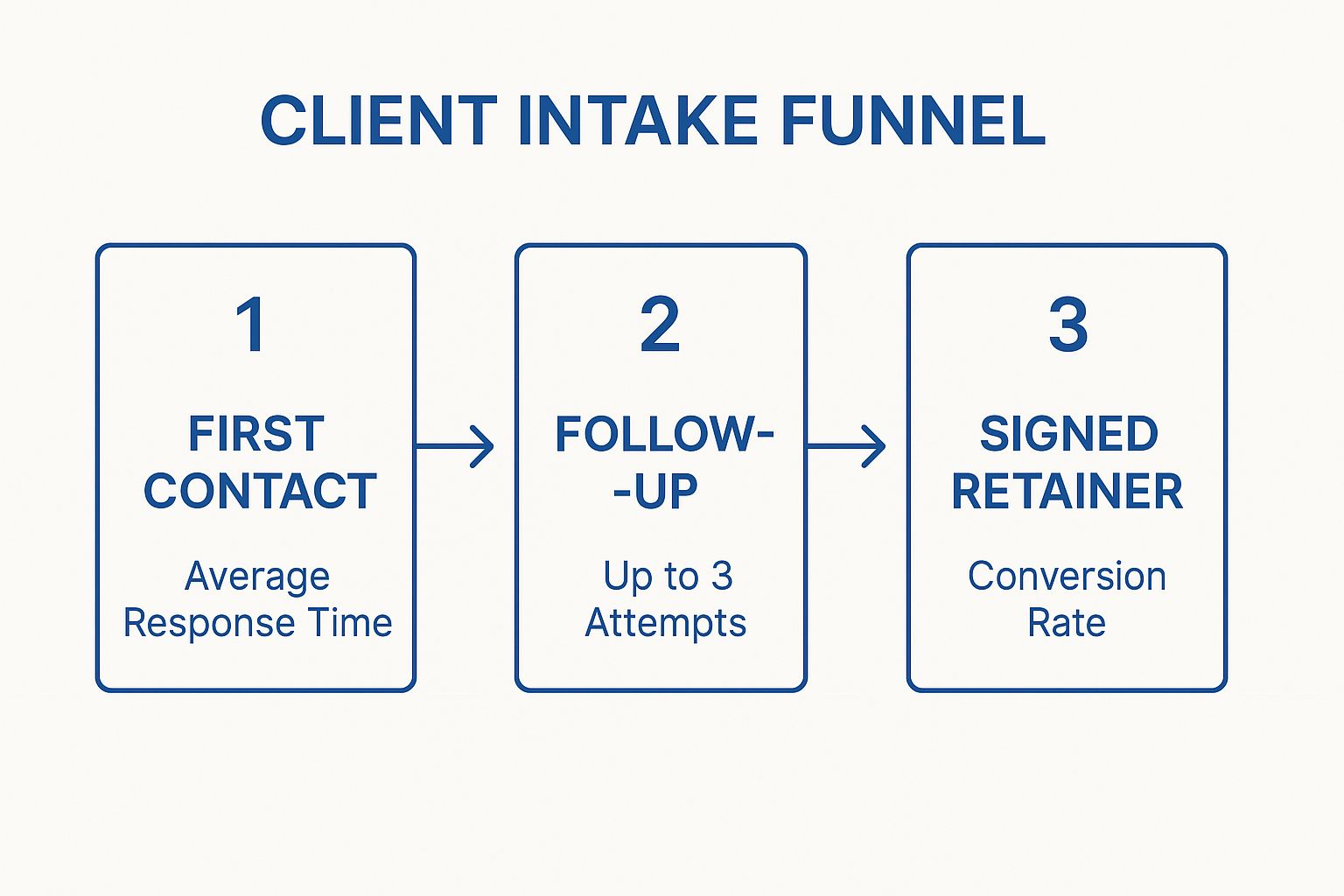
Look closely at those drop-off points. They’re a stark reminder of why a structured, persistent follow-up system is non-negotiable if you want to maximize the return on your marketing spend.
Optimizing Your Intake Process
Every single lead is a race against the clock. The hard truth is that the law firm that responds first, wins the case. It’s that simple. If you’re letting web form submissions marinate in an inbox for hours or sending after-hours calls straight to voicemail, you’re essentially gift-wrapping new clients for your competition.
It’s time to tighten things up.
- Get a Real CRM: A Customer Relationship Management (CRM) tool like Lawmatics or Filevine is not optional in today’s market. It automates your follow-up, tracks every single touchpoint, and makes it nearly impossible for a good lead to fall through the cracks.
- Train for Real Empathy: Your intake specialists can’t just be script-readers. They need to be trained to listen, show true compassion, and make a distressed caller feel like they’ve finally found someone who understands and can help.
- Build a Follow-Up Cadence: Very few leads are ready to sign on the first call. You need a systematic process—a strategic mix of calls, emails, and text messages spread out over several days—to nurture those who are hesitant or still weighing their options.
Here’s a sobering statistic: personal injury firms convert only about 7% of their leads into consultation appointments. That’s half the 14% average across all legal fields. But there’s a silver lining. Once a PI lead is qualified, firms convert them in an average of just three days. You can see more legal industry conversion statistics to see how you stack up.
A fine-tuned intake process can bridge that initial conversion gap, turning your firm into a client-signing machine. We’ve compiled a checklist to help you identify and fix the weak spots in your current system.
Intake Process Improvement Checklist
This checklist provides a framework for evaluating and enhancing every step of your firm’s lead conversion journey.
| Action Item | Impact Area | Implementation Tip |
|---|---|---|
| Implement 24/7 Answering | Lead Capture | Use a legal-specific answering service to ensure no call goes unanswered, day or night. |
| Set a 5-Minute Response Goal | Speed & Conversion | Automate an initial text/email response to web forms and time your team’s first live call. |
| Develop Intake Scripts | Consistency & Quality | Create scripts focusing on empathy and key qualifying questions, but train staff to be flexible. |
| Deploy a CRM | Organization & Follow-Up | Choose a CRM that automates follow-up sequences (emails, texts, call reminders). |
| Conduct Regular Training | Staff Performance | Role-play difficult calls and review recorded conversations to provide constructive feedback. |
| Track Key Metrics | Data-Driven Decisions | Monitor lead sources, contact rate, appointment set rate, and sign-up rate to identify issues. |
By systematically addressing each of these areas, you move from a reactive intake desk to a proactive conversion engine.
The Power of an Immediate Response
In the intake game, a rapid response is your single greatest weapon. A potential client filling out your web form at 2 AM isn’t just browsing—they’re in the middle of a crisis and are desperate for reassurance.
Set an aggressive goal for your team: respond to every single inquiry, no matter the source, within five minutes.
Yes, it’s ambitious, but it’s what it takes to win. This might require a 24/7 legal answering service or setting up automated text messages that immediately acknowledge their submission and promise a callback shortly.
That instant reply accomplishes two critical things: it validates the potential client’s decision to reach out, and more importantly, it stops them from hitting the “back” button and calling the next firm on the Google results page. If you want to dive deeper, you can explore our complete guide on how to improve your law firm’s client intake system. Turning your intake process into a well-oiled machine is how you guarantee your marketing dollars are never, ever wasted.
Building a High-Value Referral Engine

Sure, SEO and paid ads are the workhorses of client acquisition, but let’s be honest: some of your absolute best cases will walk through the door because someone sent them to you. The problem is, most firms treat these referrals like a lucky break instead of what they really are—a predictable, high-value engine for growth.
Building a referral pipeline isn’t a passive activity. It’s about being intentional. You have to pinpoint the right people, make the first move, and then consistently nurture those relationships so your firm is the only one they think of when a need arises.
Identifying Your Key Referral Partners
When lawyers hear “referrals,” their minds usually jump straight to other attorneys. While those are definitely part of the equation, a truly powerful network goes much deeper. You need to connect with the professionals who meet accident victims long before they ever think to Google a lawyer.
Think about it: who are the trusted advisors your ideal clients are already talking to?
- Medical Providers: Chiropractors, physical therapists, and orthopedic specialists are ground zero. They see the injuries firsthand and are in a perfect position to recommend legal help when a patient is getting stonewalled by an insurance company.
- Auto Body Shops: Mechanics and shop owners are on the front lines. They’re dealing with people moments after a collision. A simple question like, “Is the insurance company giving you the runaround on these repairs?” opens the door for a referral.
- Other Professionals: Don’t forget about financial advisors or even insurance agents (who don’t handle PI). They frequently have clients dealing with the financial chaos that follows a serious accident.
Nurturing Mutually Beneficial Relationships
Making the initial connection is just the starting line. The real secret to a steady flow of personal injury clients is keeping up a consistent, value-driven conversation. This is so much more than sending out a generic holiday card once a year.
You have to make it a two-way street.
Offer to do a “lunch and learn” at a local chiropractor’s office on how patients should document their injuries for claims. If you have a client with back pain from a slip-and-fall, send them to a physical therapist you trust. It’s simple: when you give referrals, you get them back.
Building a referral network is really about cultivating professional friendships. People do business with people they know, like, and trust. A quick coffee meeting or a simple monthly email keeps you top-of-mind and turns a business transaction into a real relationship.
By actively managing these connections, you can transform referrals from random luck into a reliable cornerstone of your firm’s growth. For a visual of how this fits into the bigger picture, check out this overview of a client acquisition funnel to see how different marketing channels work together.
Of course. Here is the rewritten section, crafted to sound like an experienced human expert and match the provided style examples.
Your Top Questions About Finding PI Clients, Answered
Even with the best strategy laid out, I know you still have questions. It’s only natural. The gap between a plan on paper and the real-world execution is where most firms get stuck. So, let’s clear the air and tackle the big questions I hear from attorneys every single day.
What’s a Realistic Marketing Budget, Really?
This is always the first question, and the only honest answer is: it completely depends on your city and how aggressively you want to grow.
If you’re trying to make a splash in a shark tank like Los Angeles or New York City, a serious Google Ads campaign can easily run $20,000 to $50,000 a month just to get in the game. But in a smaller city or a less saturated market, you could make a real dent with $5,000 to $10,000.
Here’s a good rule of thumb I give to my clients: start with a budget you can comfortably burn for six months without needing a single case to close from it. That might sound scary, but it gives your campaigns enough runway to gather data, learn what works, and actually start producing a predictable cost per case.
How Long Until My Phone Actually Starts Ringing?
This one is all about managing expectations. Different marketing channels work on completely different timelines, and pulling the plug too early is one of the most common mistakes I see.
Let’s get realistic:
- Paid Ads (Google, Facebook): You can get leads in the door almost immediately—sometimes within the first few days. The real work, however, is in the refinement. It usually takes a solid 1-3 months of tweaking and testing to get your targeting dialed in and your cost per lead down to a number that makes sense for your firm.
- Search Engine Optimization (SEO): SEO is a marathon, not a sprint. You’re building a long-term asset. You might see some small signs of life in 3-4 months, but it’s going to take 6-12 months of consistent, high-quality work to see those coveted first-page rankings for the keywords that bring in the big cases.
I always tell people to think of it this way: Paid ads are like renting. You get a place to live tomorrow, but the moment you stop paying rent, you’re out on the street. SEO is like buying a house. It takes a bigger upfront commitment, but you’re building equity in an asset that will pay you back for years.
Where Should I Put My Money First?
The smartest play isn’t about picking one channel over the other. It’s about building a strategic mix that gets you what you need now while building for the future. Your starting point really depends on where your firm is today.
I see it fall into two main camps:
- The New Firm That Needs Cases Yesterday: You need a one-two punch of paid ads and hardcore referral networking. Paid ads will get leads flowing immediately, while hitting the pavement with networking can land you a few high-quality cases from other attorneys right away.
- The Established Firm Ready for Market Dominance: Your foundation should be a powerhouse SEO and content strategy. You then layer paid ads on top to strategically target high-value case types (like truck accidents) and play defense by bidding on your own firm’s name to keep competitors out.
At the end of the day, a balanced portfolio always wins. Use paid advertising to feed the firm’s immediate hunger for cases, but relentlessly invest in SEO to build the sustainable, long-term case pipeline that will fuel your growth for years to come.
At Case Quota, this is what we do. We build these powerful, balanced marketing systems that get results for personal injury firms. If you’re tired of guessing, let’s talk. Visit us at https://casequota.com to see how we build strategies that drive real, measurable growth.