

Google UCP updates (Cart, Catalog, Identity Linking) and FAQ rich results deprecation in Google Search
Google UCP updates (Cart, Catalog, Identity Linking) and FAQ rich results deprecation in Google Search are shifting the rules of engagement for professional services websites. Because Google is embedding commerce primitives into search, law firms must reassess how they attract and convert client leads from organic results. As a result, SEO for legal practices will require closer alignment with retail-grade infrastructure and structured data. Moreover, this change signals a strategic pivot in how search treats transactional intent and knowledge signals.
These developments matter for law firms in two ways. First, Google’s Universal Commerce Protocol introduces Cart and Catalog capabilities that serve live product-like data to AI agents, which can influence how legal services appear in assistant-driven answers. Second, the deprecation of FAQ rich results removes a common way firms gained additional real estate in search snippets, which affects visibility and clickthrough rates. Therefore, firms should treat these shifts as a platform change, not a short campaign tweak.
Practically, law firm marketers must focus on structured content, semantic relevance, and conversion endpoints. For example, firms should audit their structured markup, strengthen service pages with clear action paths, and prepare systems to surface member or client-specific benefits when identity signals exist. In addition, firms should monitor Merchant Center and native commerce features because Google may reuse those onboarding paths for broader agentic interactions.
This introduction previews a deeper analysis of technical implications, content strategy adjustments, and measurement priorities. Consequently, the article explains what UCP means for legal search performance, why FAQ deprecation matters for snippets and trust signals, and which tactical steps firms should prioritize next. Finally, readers will get a pragmatic checklist to protect lead flow and to capture AI-driven referral opportunities.
UCP Capabilities: Google UCP updates (Cart, Catalog, Identity Linking) and FAQ rich results deprecation in Google Search
Google’s March updates turn UCP into operational infrastructure. As a result, marketers and technical teams must map commerce primitives to search and AI interactions. Below we break down the three capabilities and explain what they mean for SEO in legal services.
Cart capability
What it does
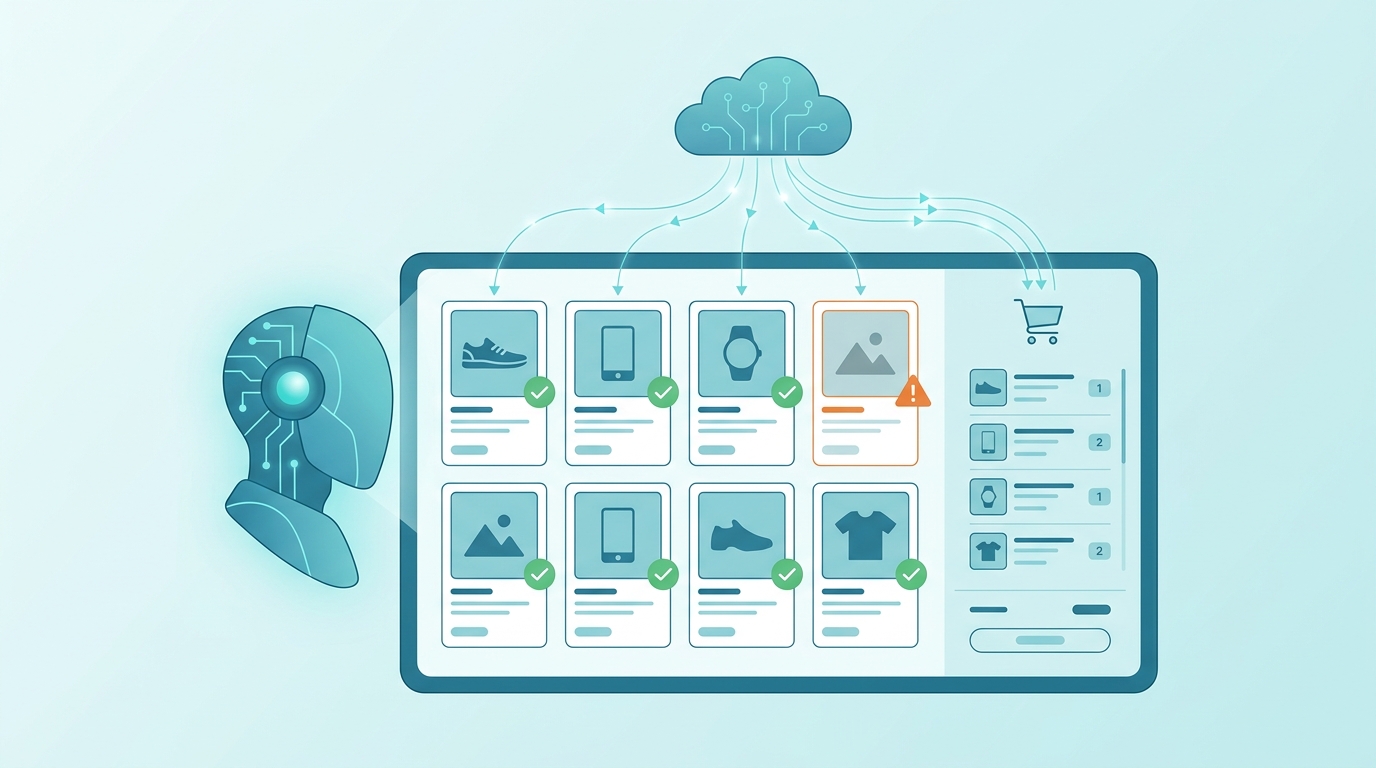
Cart lets AI agents add multiple items to a single shopping basket in one operation. Therefore, it supports pre-purchase exploration and basket building before checkout. In short, Cart brings multi-item transactions to assistant-driven shopping.
Technical notes
- Cart supports server side basket management via UCP endpoints.
- It integrates with Merchant Center flows and the native_commerce attribute for checkout prompts.
- Retailers can present basket state to agents using live APIs.
How Cart affects search and SEO for law firms
- Law firms do not sell physical products. However, Cart signals change how search surfaces transactional intent.
- Consequently, AI agents may favor pages with clear, structured service items and pricing endpoints.
- Firms should therefore expose service variants and packages using structured data and clear call to action links.
Practical actions
- Audit service pages for structured pricing markup.
- Use clear, machine-readable endpoints for contact, booking, and paid consultation flow.
Catalog capability
What it does
Catalog lets agents query real-time product details at query time. Thus, Catalog replaces static feeds with live inventory and variant data. Google’s draft Catalog spec enables accurate price and availability answers from merchant systems.
Technical notes
- Catalog queries return up-to-date variants, prices, and stock.
- It differs from static product feeds because it queries live data during the user interaction.
- Google announced simplified onboarding via Merchant Center to scale adoption (source).
How Catalog impacts law firm SEO
- Services behave like catalog items when agents ask about availability, pricing, or packages.
- Therefore, firms should model services with structured schemas to improve snippet accuracy.
- Moreover, legal practices must keep public-facing data current to avoid stale AI responses.
Practical actions
- Publish service variant details in structured JSON-LD.
- Maintain accurate availability and pricing metadata on service pages.
Identity Linking capability
What it does
Identity Linking uses OAuth 2.0 to connect shopper accounts to UCP-enabled platforms. As a result, linked identities carry loyalty pricing and member benefits into AI-mode checkouts. For example, Identity Linking preserves member discounts, as with Nike’s membership model when linked through UCP.
Technical notes
- Identity Linking is already part of UCP’s stable release.
- It relies on OAuth flows and tokenized authorization to pass loyalty context to agents.
- Stripe, Salesforce, and other platforms plan UCP integrations to support these flows (source, source).
How Identity Linking matters for law firms
- Law firms rarely use retail loyalty. However, client portals, retained client pricing, and subscription services function like loyalty programs.
- Consequently, firms should plan how identity signals map to private pricing and member benefits.
- Without identity linking, client-specific benefits may not surface in AI-driven answers.
Practical actions
- Map client account attributes to public content and API endpoints.
- Ensure secure OAuth flows for any client portal that informs public-facing responses.
Strategic takeaway for SEO
- UCP is becoming infrastructure; Google is embedding commerce primitives into Merchant Center and AI modes.
- Therefore, law firms must treat structured data and real-time endpoints as core SEO assets.
For additional context on Google’s UCP expansion, read the Merchant Center and industry coverage at these sources: source, source, and source.
FAQ Rich Results Deprecation and Google UCP updates (Cart, Catalog, Identity Linking) and FAQ rich results deprecation in Google Search
Google removed FAQ rich results from its search pages in 2026. Consequently, law firms lost a visible snippet that once boosted clickthrough for Q and A content. However, the removal affects visibility more than ranking. Therefore, firms must rethink how they use FAQ content for SEO and conversions.
What changed and why it matters
Google stopped showing FAQ rich results to simplify search and to support evolving AI interactions. As a result, FAQ markup no longer yields the extra SERP real estate many firms relied on. Nevertheless, Google still recommends clear content structure. For background, see Google Search Central coverage of past FAQ changes and analysis.
How FAQ rich results deprecation affects law firm SEO
- Firms may see lower organic clickthrough rates for pages that previously showed FAQ snippets.
- AI driven assistants may no longer surface FAQ snippets directly from SERPs.
- However, FAQ content still feeds AI models and other platforms that use structured data.
- As a result, firms that remove FAQ content risk losing context for answers in AI interactions.
Practical strategies for adapting content
- Convert FAQ pages into structured, authoritative resource pages. Therefore, combine questions with deep answers and examples.
- Use clear headings and schema types such as QAPage and Article to keep content machine readable. Moreover, structured JSON LD still helps other search engines and AI tools.
- Optimize for featured snippets and People Also Ask. Consequently, craft concise answers at the top of each section to maximize snippet eligibility.
- Improve on page signals that drive clicks. For example, add compelling meta descriptions, trust indicators, and prominent calls to action.
- Segment public and client facing content. In other words, keep detailed client portal answers behind login. Then publish generalized guidance for public queries.
Technical and measurement adjustments
- Keep FAQ structured data even if Google hides the rich result. Because other platforms and future updates may use it, preserve the markup.
- Monitor organic traffic and clickthrough rates closely. Therefore, track changes by page and query, and test alternative snippets.
- Use server side APIs to expose authoritative answers for AI agents. In addition, prepare to map client identity signals to private endpoints where necessary.
Quick checklist for law firm SEO teams
- Retain and audit FAQ markup regularly.
- Repurpose FAQ content into long form resources and service pages.
- Optimize headings for featured snippets and People Also Ask.
- Strengthen meta titles and descriptions to reclaim clicks.
For commentary and further reading on the deprecation and its implications, see analysis. By adapting content structure and measurement, law firms can protect lead flow and remain visible to both traditional search users and AI agents.
Comparison: Google UCP updates (Cart, Catalog, Identity Linking) vs Legacy Search Features
| Feature | Description | SEO and UX Impact for Law Firms |
|---|---|---|
| UCP Cart | Multi-item basket API for AI agents. Integrates with Merchant Center and native_commerce. | Raises assistant-driven transactional visibility. Firms must expose service packages and machine-readable pricing. |
| UCP Catalog | Live catalog queries for variants, pricing, and stock at query time. Draft specification. | Reduces stale answers. Therefore, firms must keep service availability and pricing current. |
| Identity Linking | OAuth 2.0 account linking that carries loyalty and member pricing into AI mode. Stable release. | Surfaces client-specific benefits. Consequently, firms should map client accounts to pricing and portal endpoints. |
| FAQ rich results (Legacy) | SERP snippet using FAQ schema. Deprecated in Google Search. | Removes extra SERP real estate and may lower CTR. However, FAQ content still feeds AI context. |
| Static product feeds (Legacy) | Periodic uploads that snapshot product data. | Risks stale data and wrong assistant answers. Therefore migrate to live APIs when possible. |
| Traditional service pages (Legacy) | Standard pages with descriptions, contact forms, or static pricing. | Remain conversion anchors. Also, add structured JSON-LD and clear action endpoints for agents. |
Actionable next steps for law firms
- Audit service pages for structured JSON-LD and machine endpoints.
- Convert FAQs into long form resources and structured QAPage markup.
- Plan OAuth mapping for client portals and retainer pricing.
- Monitor CTR and snippet changes after schema updates.
Related keywords and semantic phrases: UCP protocol, Cart capability, Catalog capability, Identity Linking, FAQ rich results deprecation, law firm SEO, Google Search changes.
CONCLUSION
Google’s recent moves change how law firms must approach search. UCP updates make Cart, Catalog, and Identity Linking part of operational infrastructure. As a result, search now blends transaction primitives with knowledge signals. Moreover, the FAQ rich results deprecation removes a familiar SERP visibility lever. Therefore, firms must treat structured data and real-time endpoints as core SEO assets rather than optional extras.
Practical priorities are clear. First, standardize structured JSON-LD across service pages. Second, convert standalone FAQs into longer resource pages that answer intent and show authority. Third, map client identity and portal signals to private endpoints where appropriate. Finally, monitor CTR, snippet visibility, and AI-driven referral metrics closely to catch changes early.
Actionable checklist
- Audit and normalize service schema and pricing metadata.
- Repurpose FAQ content into authoritative articles and QAPage markup.
- Prepare OAuth mapping for client portals and retained-pricing scenarios.
- Track organic clickthrough rate and assistant-driven referrals weekly.
For law firms that need a guided approach, Case Quota helps translate these technical shifts into market advantage. Case Quota specializes in legal marketing and implements advanced SEO, content, and technical strategies used by Big Law. Learn more at Case Quota.
In short, this is a platform shift not a short campaign change. Consequently, firms that invest in structured data, real-time endpoints, and content redesign will protect lead flow and capture AI-driven referrals.
Frequently Asked Questions (FAQs)
What are the Google UCP updates (Cart, Catalog, Identity Linking) and FAQ rich results deprecation in Google Search?
Google announced UCP features and removed FAQ rich results. Cart lets AI agents build multi-item baskets. Catalog provides live queries for variants, price, and stock. Identity Linking passes loyalty and account context via OAuth. FAQ rich results no longer show in SERPs, so FAQ markup no longer yields extra snippet. For background see this article and this blog post.
How will these changes affect law firm SEO?
UCP focuses on transactions and live data, however law firms sell services. Consequently, AI agents may prefer machine-readable service packages. Identity Linking makes client portals more relevant because linked identity can surface private pricing. FAQ deprecation reduces visible SERP real estate, therefore firms should rely less on snippet-driven CTR and more on authoritative pages and conversion signals.
Should law firms keep FAQ pages and schema?
Yes. Keep FAQ content, however repurpose it. Convert short Q&A into long resources and QAPage or Article schema. Moreover maintain JSON-LD because other platforms and future Google updates may use it. For guidance, preserve structured data even if Google hides the rich result.
What technical priorities should firms implement now?
Focus on clean structured JSON-LD, clear pricing and service variants, and machine endpoints for booking or contact. Map client portal attributes and plan OAuth flows where client-specific pricing exists. Also prepare server-side APIs for authoritative answers. Finally, use platforms that handle UCP complexity when relevant.
How should firms measure impact and protect lead flow?
Track page-level organic clicks and CTR, monitor assistant-driven referrals, and log API calls that serve AI agents. Test meta titles and descriptions to regain clicks. Moreover run A/B tests for restructured FAQ pages and measure form fills and calls. If you need help executing these changes, consult a legal marketing specialist.