

Google Ads Campaign Structures for DTC Ecommerce
Google Ads campaign structures for DTC ecommerce determine whether your ad spend becomes revenue or wasted clicks.
If you structure campaigns poorly, the algorithm learns the wrong signals. Therefore this guide shows proven structures, decision rules, and examples you can apply today.
You will learn when to start with two campaigns: Search and Shopping. Also, you will learn when Performance Max helps or hurts. For many DTC brands, PMax can over-index recycled traffic. Therefore start with a foundation before adding complex formats.
We cover product segmentation and asset group design so your campaigns prioritize high-margin items. Because targeting is driven by active search intent, Search campaigns often capture the best purchase signals. However, Shopping creates visual intent that boosts conversion rate. As a result, you will know how to balance budgets across formats.
We also explain when fewer campaigns beat many. Running five campaign types without sufficient data fragments learning. Therefore this guide offers a compact, scalable structure for growing DTC ecommerce accounts. It explains asset group themes like bestsellers, bundles, and seasonal offers.
Follow this article for step-by-step templates, examples, and checklist items you can copy. By the end, you will have a playbook to improve ROAS and scale profitable net new revenue. Now let us dive into campaign blueprints and tactical setups.
This article targets marketers, ecommerce founders, and agency teams. It blends technical setup with decision rules for bidding, budgets, and measurement. Read on to reduce wasted spend and increase sustainable customer acquisition. Let’s get practical now.
Core Google Ads campaign structures for DTC ecommerce
Start simple. For most direct to consumer brands, two campaign types create a clean, testable foundation. Search and Shopping capture active demand and clear purchase intent. From there, you can layer in other formats as data and goals allow.
Why begin with Search and Shopping
- Search targets active search intent. Therefore it finds people already looking for your product or category.
- Shopping shows product visuals and price, which often increases click quality and conversion rate.
- Because targeting is driven by intent, Search and Shopping together cover both discovery and purchase-ready users.
Recommended starting structure
- Campaign A: Search
- Branded and generic ad groups
- Smart bidding once conversion data exists
- Campaign B: Shopping
- Merchant feed segmented by high margin, bestsellers, and new releases
- Priority settings used sparingly
This two campaign approach limits noise in the algorithm. As a result you avoid the learning inefficiencies that happen when you run too many campaign types without enough data. Running five campaign types too soon fragments learning and wastes budget.
Product segmentation and asset groups
- Segment by product themes not by broad audiences
- Build asset groups for bestsellers, bundles, seasonal offers, and new releases
- Avoid a single asset group covering dozens of items
One common problem is a single Performance Max campaign with one asset group for forty items. That setup lacks prioritization and can spend on low margin items. In contrast, theme based asset groups signal Google which SKUs matter.
Where Performance Max fits and when to skip
Performance Max can scale cross channel reach. However PMax can also over index recycled traffic for advertisers who run heavy Meta activity. For that reason, some marketers choose to not run PMax at all. As Heather Campbell says, “And here’s a secret: Sometimes, I never run PMax at all.”
When you do test PMax, follow best practices on asset variety and audience signals. See practical tips and case examples in this Performance Max guide: Performance Max Campaigns Best Practices and this analysis of pros and cons: Performance Max Pros and Cons.
Decision rules and facts to follow
- Fact: Targeting is driven by active search intent. Therefore prioritize Search for demand capture.
- Fact: A consolidated, broad account without product level segmentation creates algorithm noise.
- Fact: Before changing settings, run a product segmentation exercise to establish a clear foundation.
Jennifer McDonald summarizes the challenge this way: “One campaign, one budget, and your entire product line targeting a broad audience – just like Meta taught you.” Let that critique guide you. Instead, structure for prioritization and measurable learning.
This compact structure gives you control, better signal, and faster learning. As a result you improve ROAS and scale profitable net new revenue.
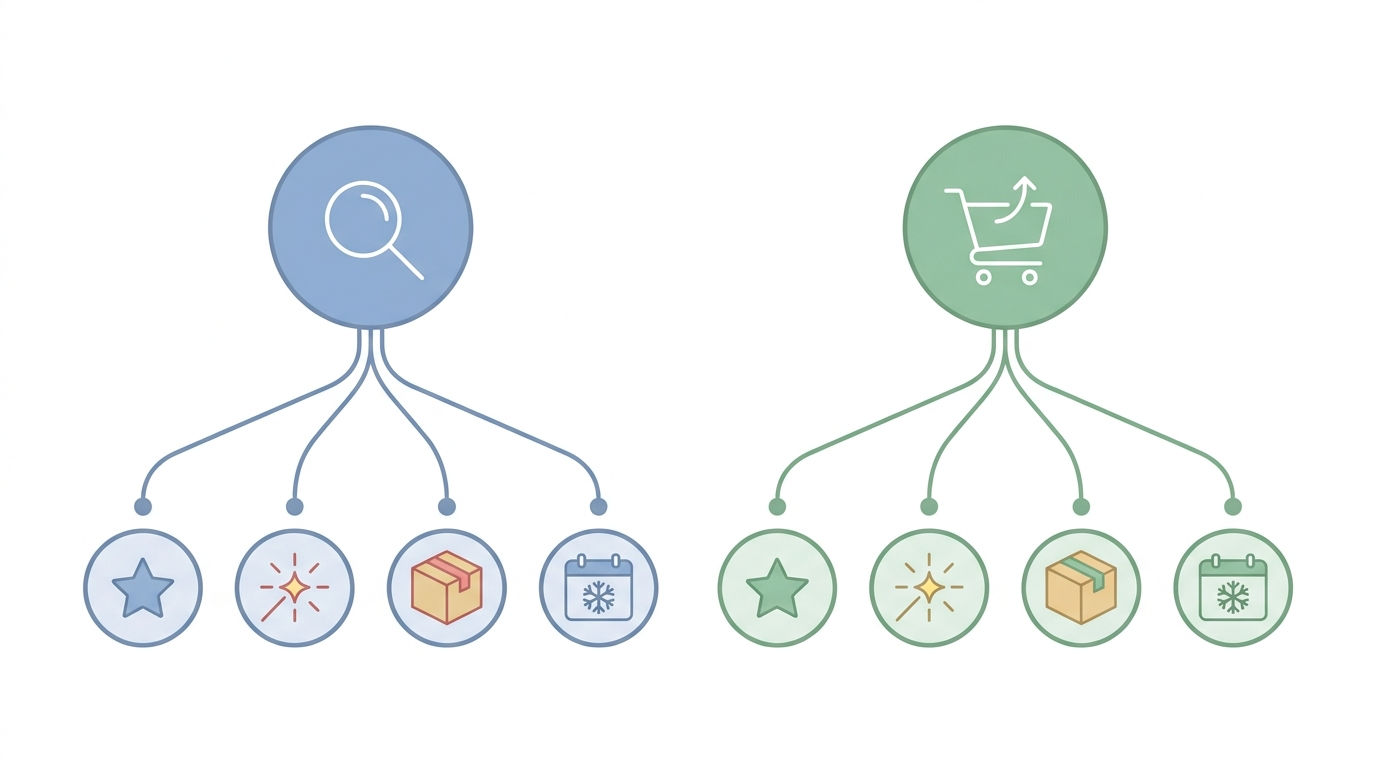
Campaign type comparison for Google Ads campaign structures for DTC ecommerce
Use this table to allocate budget and choose formats. It summarizes purpose, needs, and revenue impact.
| Campaign type | Campaign purpose | Data requirements | Efficiency considerations | Ideal use cases | Impact on net new revenue |
|---|---|---|---|---|---|
| Search | Capture active demand and purchase intent | Low to medium conversions needed for Smart Bidding | High efficiency for demand capture; prioritize branded queries | Immediate purchase intent, brand protection, and demand capture | High impact on net new revenue because it reaches buyers |
| Shopping | Show product images, price, and drive catalog purchases | Requires clean Merchant feed and product segmentation | Efficient for SKU level conversion; use prioritized feeds | Bestsellers, new releases, and seasonal products | Strong impact on net new revenue through visual intent |
| Performance Max (PMax) | Cross channel scaling and automation | High conversion history and diverse assets help performance | Can over-index recycled traffic; lacks SKU prioritization if broad | Use for scale only after segmentation and testing | Variable impact; may spend on low margin SKUs without control |
| YouTube | Build brand and upper funnel awareness | Requires engaging creative and longer test windows | Less efficient for direct conversions; higher CPAs | Product storytelling, new releases, and awareness cohorts | Indirect impact; supports future search and shopping performance |
| Meta ads | Interest and behavior based discovery and retargeting | Requires audience signals and creative variety | Efficient for creative testing; may recycle existing customers | Prospecting, retargeting, and retention offers | Can drive incremental revenue, but sometimes recycles traffic |
Advanced Google Ads campaign structures for DTC ecommerce
This section covers product segmentation, asset groups, and seasonal campaigns. It focuses on technical steps you can implement. Therefore use these tactics to improve signal quality and bidding efficiency.
Product segmentation exercise
Run a product segmentation exercise before changing bids or structure. Because segmentation creates clearer signals, the algorithm spends more wisely. Follow these steps:
- Pull a 90 day data set including revenue, margin, conversion rate, and ROAS.
- Group SKUs into tiers: bestsellers, high margin, new releases, loss leaders, and slow movers.
- Tag SKUs by theme such as bundles, seasonal, or subscription.
- Map each tier to a campaign role and budget allocation. For example, give bestsellers higher priority and margin targets.
- Reassess weekly for new releases and seasonal shifts.
This process prevents a consolidated, broad account from creating algorithm noise. As a result you get faster, cleaner learning.
Building asset groups around product themes and Smart Bidding
Asset groups should reflect product themes not audience membership. Therefore build groups like bestsellers, bundles, and new releases. Use these guidelines:
- Create one asset group per theme. Keep each group focused and small.
- Supply diverse creative assets: hero images, short videos, and copy variants.
- Link SKUs directly to feed items for Shopping and PMax tests.
- Set Smart Bidding only after you have stable conversion data per asset group.
- Use Advantage+ style signals to improve automation, but monitor SKU-level spend.
Avoid a single PMax campaign with one asset group covering dozens of SKUs. That setup lacks prioritization and can spend where margins are weak. For Performance Max best practices, see this guide: Performance Max Campaign Best Practices. Also review trade offs here: Performance Max Pros & Cons.
Seasonal campaigns as additive layers
Seasonal campaigns should add incremental capacity. Do not replace your core campaigns. Follow a checklist:
- Launch seasonal asset groups two to four weeks before peak demand.
- Use separate budgets for seasonal tests so core ROAS remains stable.
- Tag seasonal SKUs in the feed for quick audience and bid rules.
- Create urgency creatives and clear landing pages per seasonal theme.
- Wind down gradually; keep learnings and creatives for next year.
Seasonal layers let you capture short windows of high intent. As a result, you avoid disrupting long term learning.
Practical rules and signal hygiene
- Prioritize Search and Shopping as the foundation. They capture active search intent.
- Limit the number of campaign types until you collect reliable data.
- Monitor SKU level ROAS and reallocate budgets weekly.
- Document naming conventions and GA/GCLID rules for consistent reporting.
These advanced strategies convert organizational knowledge into cleaner signals. Consequently you improve Smart Bidding performance and scale profitable net new revenue.
In summary, creating effective Google Ads campaign structures for DTC ecommerce is a crucial step towards maximizing your advertising spend and achieving sustainable growth. Start with a solid foundation using Search and Shopping campaigns to capture both discovery and purchase-ready consumers. By avoiding over-complicated setups, like running multiple campaign types prematurely, you reduce data fragmentation and increase your chances of learning efficiently and rapidly.
Emphasizing product segmentation and well-defined asset groups, you ensure that your campaigns reflect the unique needs of your SKUs, such as bestsellers or high-margin products. Seasonal campaigns add the ability to tap into time-sensitive consumer interests while preserving core campaign learnings. Techniques like these transform how marketers use tools like Smart Bidding and Performance Max, adapting strategies for better results.
Equipped with these strategies, you can achieve a balance between immediate sales and long-term profitability. For small and mid-sized companies, especially law firms, adopting high-level marketing strategies akin to those used by Big Law firms is often challenging but necessary. Case Quota bridges this gap by offering expert marketing services tailored to elevate your market position. They equip law firms with insights and tools otherwise available only to much larger organizations, allowing you to compete more efficiently and effectively.
Consider integrating these strategies into your Google Ads campaigns for better ROI and scalable growth. If you seek guidance or wish to leverage more sophisticated marketing techniques, visit Case Quota to explore how they can empower your growth journey.
Frequently Asked Questions (FAQs)
What is the best starting structure for Google Ads campaign structures for DTC ecommerce?
Start with two campaigns: Search and Shopping. Search captures active search intent. Shopping shows product visuals and price. This approach reduces learning fragmentation. Therefore you get cleaner signal and faster optimization.
How should I run a product segmentation exercise and build asset groups?
Follow a short process:
- Pull 90 day data for revenue, margin, conversion, and ROAS.
- Group SKUs into bestsellers, high margin, new releases, loss leaders, and slow movers.
- Tag SKUs by theme such as bundles and seasonal offers.
- Create one asset group per theme and link SKUs to the feed.
This Product segmentation and Asset groups approach improves Smart Bidding and Advantage+ automation.
When is Performance Max appropriate?
Use PMax only after you complete segmentation and collect consistent conversion data. Otherwise PMax can over-index recycled traffic. As Heather Campbell said, sometimes running PMax is not necessary. Test PMax conservatively and monitor SKU level spend.
How should I allocate budgets across campaign types?
Prioritize Search and Shopping as your foundation. Then allocate a smaller, controlled budget to experiments like PMax or YouTube. Reallocate weekly based on SKU level ROAS. Also keep a test budget so learning does not disrupt core performance.
What metrics and routines reduce algorithm noise and improve measurement?
Measure SKU level ROAS and conversion rate. Use consistent naming and GA/GCLID rules. Run weekly checks on feeds and asset groups. Finally, limit the number of campaign types until you collect reliable data.