

Marketing for a family law firm isn't just about running ads. It’s about connecting with people during some of the most stressful, emotionally charged moments of their lives—divorce, custody battles, adoptions. Your marketing needs to be a blend of smart digital tactics like SEO and paid ads and foundational strengths like a rock-solid reputation and a seamless client intake process.
The goal is simple: be the first, most trusted voice they find when they need help the most.
Laying Your Digital Foundation in a Crowded Field
Long gone are the days of relying solely on referrals. Today, the game is won or lost online. Think about it: 96% of people looking for legal help start their search on Google. If you don't have a strong digital presence, you're practically invisible. The first step is to stop thinking tactically and start thinking strategically. A great starting point is Developing a Comprehensive Marketing Strategy For Your Law Boutique.
We can boil the entire process down to three core stages: understanding your client, building your online hub, and then driving the right people to it.
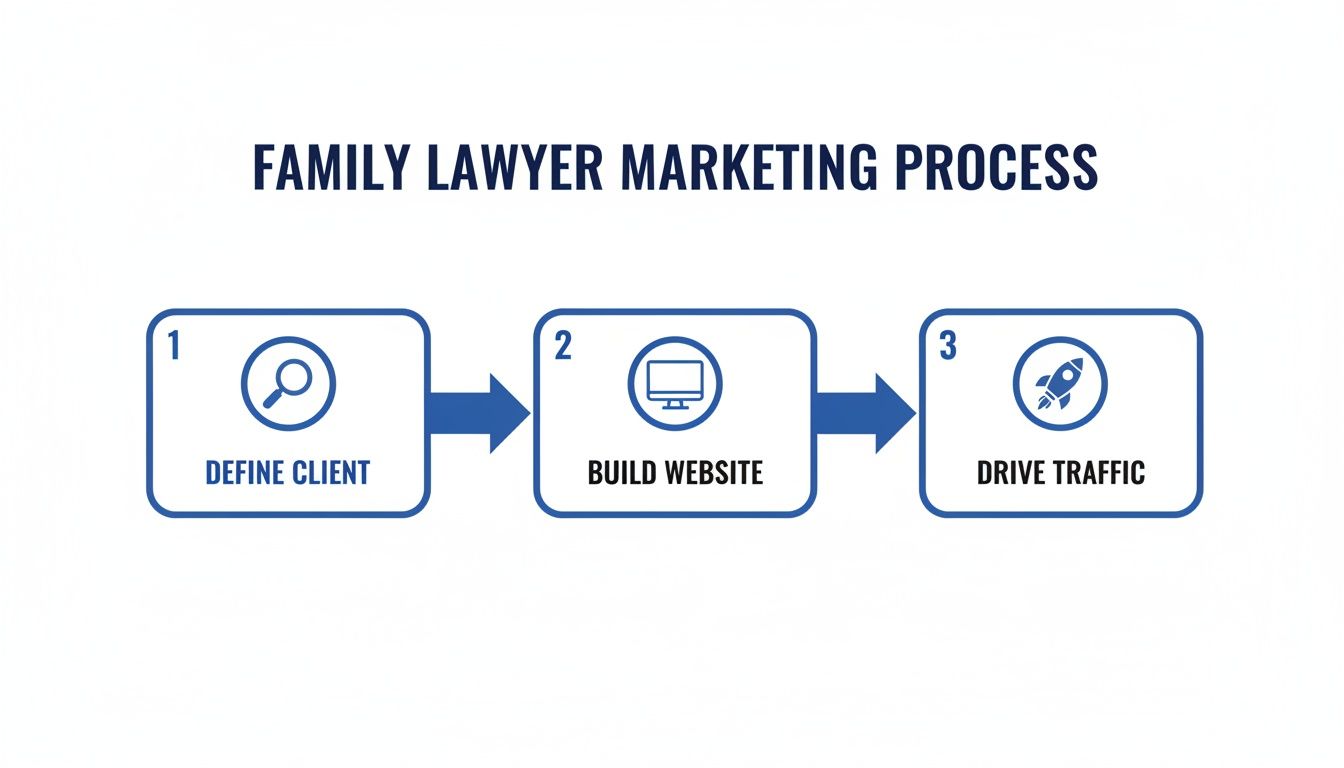
The market itself is making this digital-first approach a necessity. As of 2025, the U.S. has 56,771 family law firms, but that number has been shrinking by 0.5% each year. At the same time, divorce rates are falling. This creates a hyper-competitive environment where fewer clients are chasing a piece of the $13.1 billion industry pie.
The firms that are winning are the ones going all-in on digital. Reports show firms dedicating 65% of their marketing spend online are seeing a staggering 526% ROI from SEO alone within three years. The proof is in the numbers.
To give you a clear overview, here are the essential pillars that make up a successful digital strategy for any family law practice.
Core Digital Marketing Pillars for Family Lawyers
| Pillar | Key Action | Why It Matters for Family Law |
|---|---|---|
| Ideal Client Profile | Go beyond demographics to understand emotional triggers and specific legal scenarios. | Connects your firm's messaging with the client's immediate fears and goals, building instant trust. |
| Website & SEO | Build a fast, secure, mobile-friendly, and ADA-compliant site optimized for local search. | Your website is your virtual front door. It must be easy to find and use for clients in crisis. |
| Content Marketing | Create helpful blogs, videos, and FAQs that answer your clients' most urgent questions. | Establishes your authority and provides genuine value before they even pick up the phone. |
| Paid Advertising | Run targeted Google Local Service Ads and PPC campaigns focused on high-intent keywords. | Captures clients at the exact moment they are actively searching for a family lawyer. |
| Reputation Management | Actively manage and solicit reviews on Google, Avvo, and other legal directories. | Social proof is critical. Positive reviews are often the deciding factor for a potential client. |
These pillars aren't just a checklist; they're an integrated system. A strong website amplifies your ads, great content fuels your SEO, and a stellar reputation makes every other effort more effective.
Define Your Ideal Client—Not Just Their Demographics
One of the biggest mistakes I see firms make is defining their target audience as "people getting divorced." That’s far too broad. To be effective, you have to get into the heads of the real people behind the search query.
Think in terms of specific, high-stakes scenarios:
- The High-Net-Worth Individual: This client isn't just worried about the divorce; they're terrified of losing the business they built from scratch. Their concerns are asset protection, complex valuations, and financial settlements. Your messaging must speak to preserving their legacy.
- The Concerned Parent: For them, nothing matters more than their children. Their search terms are things like "best child custody lawyer," "how to get full custody," or "co-parenting plan." Your content needs to show empathy and expertise in protecting their kids' best interests.
- The Person in Crisis: This individual needs an emergency protective order now. They are looking for speed, accessibility, and immediate action. Your website and ads must communicate that you can help them right away.
When you understand these distinct needs, you can craft marketing that speaks directly to their fears and offers a clear solution.
Your Website: The Digital Hub You Can't Afford to Neglect
Your law firm’s website is not just a digital business card. It’s your virtual office, your 24/7 receptionist, and your most powerful tool for attracting new cases. This is no place to cut corners.
A poorly designed or slow website is the digital equivalent of a messy, disorganized office. It shatters the very trust you need to build with a vulnerable client seeking a steady hand to guide them.
A few elements are absolutely non-negotiable. First, your site must be mobile-responsive. Most frantic searches for a lawyer happen on a smartphone. Second, it needs to be ADA-compliant. This ensures everyone can access your services, which is not only the right thing to do but also a legal requirement that protects your firm from liability.
Building a site that converts requires deep expertise in both legal marketing and web development. You can dive deeper into this with our guide on the essentials of web design for attorneys. Getting these foundations right is the first and most important step in building a marketing machine that brings in clients.
Winning Local Search to Connect With Ready-to-Hire Clients
When someone searches for "divorce attorney near me," they aren't just browsing. They're in the middle of a crisis and looking to hire someone, now. For a family lawyer, mastering local search isn't just another marketing task—it's the single most direct way to connect with people in your community who desperately need your help.

This is where your marketing strategy gets laser-focused. Winning in local search means dominating the Google Map Pack and the organic results right below it. It’s about making your firm the obvious, immediate choice for clients in your specific service area.
Your Google Business Profile Is Your Digital Storefront
Think of your Google Business Profile (GBP) as your firm’s front door online. It's often the very first impression a potential client gets. Just claiming your profile and walking away is a huge mistake; you need to treat it as an active, dynamic marketing channel.
The data backs this up. Businesses with a complete GBP are a staggering 70% more likely to attract location visits. And optimization means more than just having the right address and phone number.
To turn your GBP into a real client-generating machine, dig into these areas:
- Detail Your Services: Don’t just put "Family Law." Get specific. List out everything you do, like "High-Net-Worth Divorce," "Child Custody Mediation," "Spousal Support Negotiation," and "Prenuptial Agreements."
- Use Google Posts: Share firm news, link to your latest blog posts, and post other quick updates. This tells Google your profile is active and gives potential clients fresh content to see.
- Own the Q&A Section: Don't wait for people to ask questions. Proactively add common ones you hear all the time—"Do you offer free consultations?" or "How much does a divorce cost?"—and then answer them yourself. It lets you control the narrative and deliver immediate value.
A well-maintained profile doesn't just help you rank higher; it builds trust before a prospect even gets to your website. For a deeper dive, check out our guide on proven Google Business Profile tweaks for attorneys.
Building Local Authority with Citations and Reviews
Beyond your GBP listing, Google scours the web for other signals that confirm your firm's location and legitimacy. This is where two things become absolutely critical: citations and client reviews.
A citation is simply an online mention of your firm’s name, address, and phone number (NAP). The key here is consistency. Your NAP has to be identical everywhere, from legal directories like Avvo and FindLaw to the local chamber of commerce website. Mismatched information creates confusion for search engines and will tank your local rankings.
Client reviews are today's word-of-mouth referral. In family law, where trust and discretion are everything, glowing reviews are the social proof that can make or break a potential client's decision.
You need to make asking for reviews a standard part of your process when closing a case. A steady stream of recent, positive feedback tells both clients and Google that your firm is active, reputable, and trusted in the community. It's no surprise that over 64% of prospects rely on reviews when choosing their lawyer.
On-Page SEO for Hyper-Local Targeting
Finally, you have to bring this local focus back to your own website. The best way to do this is by creating location-specific service pages. Instead of having one general "Child Custody" page, build out separate pages for each city or even neighborhood you serve.
Imagine a potential client seeing titles like these in their search results:
- "Pasadena Child Custody Lawyer"
- "Glendale Divorce Attorney for Business Owners"
- "Spousal Support Representation in Santa Monica"
Each of these pages needs unique content that speaks to that specific area. Mention local courthouses, reference community landmarks, or discuss local rules to show you're not just a generic firm but a true local expert. This strategy gets you ranking for incredibly specific, high-intent searches, connecting you directly with the clients right in your backyard.
Creating Content That Builds Authority and Earns Trust
When it comes to family law, your content strategy has to be about more than just keywords and search rankings. People aren't just looking for a lawyer; they're in the middle of a deeply personal crisis, searching for a calm, authoritative voice to guide them through the chaos. Your blog posts, videos, and FAQs are often your very first chance to be that guide and start building the trust needed to win their case.

This is especially true in a field where word-of-mouth has always been king. While a massive 96% of people now start their search for an attorney online, that fundamental need for a human connection hasn't gone anywhere. A Nielsen survey found that 92% of us still trust a friend's recommendation over any ad.
But the digital world is where that trust is now vetted. More than 80% of potential clients will dig through at least four reviews, and an overwhelming 72% want to get on the phone with a real person, not an automated system. Juris Digital's analysis confirms this—people are using the internet to find a human they can rely on.
Answering the Questions They Are Afraid to Ask
Forget broad topics like "divorce law." Your best content ideas are hiding in plain sight—they're the same anxious, specific questions you hear in your consultations every single day. These are the thoughts that keep your ideal clients up at night.
When you create content that speaks directly to these raw, hyper-specific concerns, you're doing more than just SEO. You’re showing you get it. This is the heart of effective family lawyer marketing: demonstrating empathy through your expertise.
Think about content that hits home:
- Financial Fears: "Can My Spouse Empty Our Bank Account During a Divorce?" or "How Do I Protect My Business If I'm the Primary Owner?"
- Child-Centric Concerns: "A Guide to Co-Parenting Apps for High-Conflict Divorces" or "What Are My Rights if My Ex Wants to Move Out of State with Our Kids?"
- Procedural Uncertainty: "What Really Happens at Your First Mediation Session?" or "How Is Spousal Support Actually Calculated in California?"
This isn't just about attracting clicks. This kind of content pre-qualifies your leads by proving you've already navigated the exact storm they're facing.
Diversifying Your Content Formats for Maximum Impact
Not everyone takes in information the same way. A long, detailed blog post is perfect for someone methodically researching their options. But for someone in a moment of panic, a short, reassuring video can be a lifeline. The trick is to deliver your expertise in multiple formats.
A single piece of well-researched content can be the foundation for an entire campaign. By repurposing your core ideas, you extend your reach and reinforce your message across different platforms, meeting clients wherever they are most comfortable.
Let’s take one core topic—asset division—and see how you can spin it into a multi-channel asset:
- In-Depth Blog Post: Start with a 2,000-word cornerstone piece, "The Complete Guide to Dividing Marital Assets in Southern California."
- Short Explainer Videos: Chop it up into 90-second videos for social media, each tackling a single question like, "Is My Inheritance Considered a Marital Asset?"
- Downloadable Checklist: Create a one-page PDF, "10 Documents You Need to Gather for Asset Division," and offer it on your site to capture leads.
- FAQ Page Snippet: Pull out the most common questions and add clear, concise answers to your website’s main FAQ page.
This approach squeezes every drop of value from your hard work. You can dive deeper into structuring these campaigns in our complete guide to law firm content marketing. By building a library of genuinely helpful resources, your firm stops being just another service provider and becomes an indispensable resource for your community.
Using Paid Ads for Immediate and Targeted Lead Generation
SEO and content marketing are fantastic long-term plays, building your firm’s authority over time. But paid advertising? That delivers what you need right now: immediate visibility.
When a potential client is frantically searching for an "emergency child custody attorney," they aren't thinking about next month. They need help today. Paid ads on platforms like Google and Bing put your firm directly in their path at the exact moment of their crisis.

This sheer urgency is why paid ads work so well for family law. The niche boasts a seriously impressive conversion rate of around 7.52%, blowing many other legal practice areas out of the water.
Since 2016, Google Ads has become a powerhouse for law firms, letting you zero in on the 48% of clients who hire an attorney within just three days of starting their search. For firms chasing more mature, affluent demographics, it's also worth looking at Bing Ads, which often presents a less crowded and more cost-effective battlefield.
Crafting Ad Copy That Converts in a Crisis
Your ad copy is not the place for dense legal jargon. Think of it as a lifeline. The best ads I've seen speak directly to a person's emotional state, offering a clear, immediate, and reassuring solution. The entire goal is to make them feel understood and confident that clicking your ad is the first step toward regaining control.
Here are a few angles that consistently work well:
- Focus on Urgency: "Facing an Immediate Custody Issue? Get a Confidential Consultation Today."
- Highlight Discretion: "Protect Your Assets. Confidential Divorce Representation for Business Owners."
- Offer a Clear Next Step: "24/7 Helpline for Domestic Violence Cases. Call Now for a Free Case Review."
Notice how each one hits a specific pain point and gives a direct, no-nonsense call to action. That’s how you turn a panicked searcher into a qualified lead. If you want a full playbook on setting these up, our guide to Google Ads for lawyers is the perfect place to start.
AI-Powered Bidding and Hyper-Local Targeting
Forget the old days of just bidding on keywords. Modern ad platforms are much smarter. AI-powered tools, like Google's Smart Bidding, can automatically adjust your bids in real-time to maximize conversions, taking a massive amount of guesswork off your plate.
The real power of paid ads for family lawyers lies in precision. You can target specific zip codes, income brackets, and even life events to ensure your message reaches only the most relevant audience, dramatically improving your ROI.
This is where you need to get granular with hyper-local campaigns. A single campaign targeting "Los Angeles" is far too broad and a waste of money. You'll get much better results by setting up distinct campaigns for smaller communities like "Pasadena," "Santa Monica," or "Glendale." This lets you write ad copy that actually mentions their community, creating a much stronger connection right off the bat.
Finally, every ad you run must point to a dedicated landing page. Sending traffic to your homepage is a cardinal sin of paid advertising. A proper landing page should mirror the ad's message, have a simple contact form right at the top, and display your phone number prominently. It’s designed for one thing and one thing only: getting that person to contact you.
As a next step, exploring tools like chatbots for marketing can add another layer to your strategy, engaging potential clients instantly, 24/7.
Perfecting Your Intake Process to Convert More Leads
Getting a steady stream of leads is a huge win, but it's only half the battle. You can pour money into the most brilliant family lawyer marketing strategy on the planet, but it all falls apart if your intake process is leaky. This is the critical moment where marketing dollars turn into actual revenue, and every single detail matters.
The journey from a curious, often distressed, lead to a signed client hinges on the experience you provide from that very first phone call or email. A slow response, a missed call, or an impersonal, robotic interaction will send them straight to the next firm on their Google search list.
Mastering the First Impression with Empathetic Communication
Let’s be honest: when someone reaches out to a family law firm, they're usually in the middle of a deeply personal crisis. Your intake team is the first human connection they have with your firm, and that interaction has to be handled with both skill and genuine empathy. This isn't just customer service; it's the very beginning of a relationship built on trust.
You need to train your team to be more than just information-gatherers. They need to be active, compassionate listeners.
- Scripted Empathy: Don't leave this to chance. Give your team opening lines that immediately show understanding. Something as simple as, "It sounds like you're going through a very difficult time. I'm here to listen and see how we can help," can make all the difference.
- Active Listening: A great technique is to have them repeat back the caller's main concerns. For example, "So, if I'm hearing you correctly, the most pressing issue right now is securing that temporary custody arrangement. Is that right?" This shows you're actually hearing them.
- Kill the Legal Jargon: Insist that all communication is in plain, simple language. A confused potential client is one who will not sign on.
Every missed call is a potential case handed directly to your competition. In family law, urgency is paramount, and a caller who reaches a voicemail is already dialing the next number on their Google search list.
The solution is simple but non-negotiable: ensure a live person answers every single time. Whether you use a dedicated in-house receptionist or a top-tier 24/7 legal answering service, this one investment can radically improve your conversion rates.
Streamlining Your Intake with Technology
A compassionate team is your foundation, but technology provides the structure to ensure no lead ever falls through the cracks. The right tools can turn your intake process from a reactive scramble into a proactive, organized system.
A Customer Relationship Management (CRM) system built specifically for law firms is an absolute must-have. Think of it as the central brain for all your leads. It tracks every interaction—from the initial phone call to the final follow-up email—preventing that classic office chaos of "who spoke to this person last?" and ensuring consistent, professional communication.
Consider integrating these tools to create a seamless experience:
- Online Scheduling: Embed a tool like Calendly right on your website. This empowers potential clients to book a consultation instantly, which eliminates the frustrating game of phone tag and captures their commitment while motivation is high.
- Automated Follow-up: For leads that don't book right away, a simple automated email or text message sequence can keep your firm top-of-mind. A message sent 24 hours later saying, "We're still here to help when you're ready to talk," can be incredibly effective.
Optimizing this critical handoff from marketing to consultation builds a reliable engine for growth. If you’re looking to fill that pipeline, explore our proven strategies for effective attorney lead generation to keep your finely-tuned intake system busy.
A well-structured intake process ensures every lead is handled efficiently and empathetically. The following checklist breaks down the key stages and actions to turn more inquiries into retained clients.
Client Intake Optimization Checklist
| Stage | Action Item | Recommended Tool/Method |
|---|---|---|
| Initial Contact | Ensure 24/7 live call answering. | In-house receptionist or a legal answering service (e.g., Answering Legal). |
| Data Capture | Use a standardized intake form. | Law firm CRM (e.g., Clio Grow, Lawmatics) or dedicated intake software. |
| Screening | Qualify leads against firm criteria. | Pre-defined checklist for intake staff; automated questionnaires. |
| Scheduling | Offer instant online booking for consultations. | Calendly, Acuity Scheduling, or a CRM's built-in scheduler. |
| Follow-Up | Automate reminders and follow-up sequences. | Email/SMS automation within your CRM or a tool like Mailchimp. |
| Onboarding | Send engagement letter & new client forms digitally. | E-signature software (e.g., DocuSign) and client portal. |
By systematically implementing these steps, you build a powerful and repeatable process that not only captures more leads but also reinforces your firm's reputation for professionalism and care from the very first touchpoint.
Common Questions About Marketing a Family Law Practice
Navigating digital marketing can feel like a minefield, especially when you’re already juggling a full caseload. We get a lot of the same questions from family law attorneys, so we’ve answered the most common ones here.
The goal is to cut through the jargon and give you straightforward advice you can use to invest your firm’s time and money wisely.
How Much Should a Family Law Firm Budget for Marketing?
This is the big one, and the honest answer is: it depends entirely on your goals.
For an established firm that just wants to maintain its current market position and keep leads flowing steadily, a budget of 2-5% of gross revenue is a solid benchmark. This covers the essentials needed to stay visible and competitive.
But if you’re aiming for aggressive growth—maybe you want to break into a new practice area or go head-to-head with the top firm in your city—you'll need to invest more firepower. For that kind of push, a budget in the 7-15% range is much more realistic.
Your marketing budget isn't an expense; it's a direct investment in predictable growth. Every dollar should be accountable, with clear metrics tracking your cost-per-acquisition (CPA) and return on investment (ROI). This is what separates guessing from growing.
Brand new firms often need to start even higher to gain initial traction and carve out a space in a crowded market. A smart budget always diversifies, blending long-term assets like SEO with immediate lead sources like Google Ads.
What Is the Most Important Marketing Channel for a Family Lawyer?
If you have to pick just one place to focus your limited time and resources, make it Local SEO. It’s not even a close call.
The vast majority of your potential clients are typing phrases like "divorce attorney near me" or "child custody lawyer in [Your City]" into Google. Your number one job is to show up when they do.
Dominating the Google Map Pack is the most direct way to get a consistent stream of high-quality local leads. Getting there isn't a one-and-done task; it’s an ongoing effort that involves several key pieces:
- An obsessively optimized Google Business Profile with detailed services, regular posts, and a well-managed Q&A section.
- A constant flow of new, positive client reviews to build trust and social proof.
- Consistent local citations on important directories like Avvo and FindLaw to cement your local authority.
- Hyper-specific service pages on your website (e.g., "Pasadena Divorce Lawyer") to catch those targeted, high-intent searches.
Paid ads get you results today, but Local SEO builds the sustainable, long-term asset that will feed your firm for years to come. It’s the digital foundation of a modern family law practice.
Should I Handle My Firm’s Marketing Myself or Hire an Agency?
Going the DIY route is possible, especially if you’re just starting out and have more time than money. You can definitely manage your own Google Business Profile, ask for reviews, and write a blog post now and then. These are great first steps.
But let’s be real. Effective family lawyer marketing requires deep, specialized knowledge in technical SEO, paid media, conversion optimization, and the nuances of legal marketing ethics. The learning curve is incredibly steep, and mistakes are expensive—both in wasted ad spend and lost opportunities.
A specialized legal marketing agency brings battle-tested systems, sophisticated tools, and a team of experts to the table. This frees you up to do what you’re best at: practicing law and serving clients. The choice boils down to a simple value calculation: is your time better spent trying to become a marketing expert, or is it better spent on billable hours generated by the new clients an agency can bring in?
Ready to stop guessing and start growing? At Case Quota, we specialize in building data-driven marketing systems that deliver a predictable flow of high-quality leads for family law firms. We handle the complexities of SEO, paid ads, and web design so you can focus on winning cases. Learn how we can help your firm by visiting us at https://casequota.com.