

In today’s competitive legal landscape, relying solely on reputation and traditional referrals is no longer enough to sustain and grow a thriving practice. A modern, proactive approach to estate planning attorney marketing is essential for connecting with clients at their precise moment of need. The decision to plan an estate is deeply personal and often delayed, making the establishment of trust and consistent visibility paramount to your firm’s success. Potential clients are not just looking for a lawyer; they are searching for a trusted advisor to guide them through one of life’s most significant financial and personal undertakings.
This comprehensive guide cuts through the noise and generic advice. We will deliver eight powerful, actionable marketing strategies specifically tailored for estate planning attorneys. These methods are designed to build that critical trust, enhance your online and offline visibility, and create a sustainable pipeline of high-value clients for your practice. Forget vague theories; this article is a practical playbook.
You will learn how to implement proven tactics that attract, engage, and convert your ideal clients, from dominating local search results to cultivating a robust referral network. Each strategy is broken down into clear, actionable steps you can start using immediately. Whether you’re looking to refine your existing marketing efforts or build a new plan from the ground up, these insights will help you secure your firm’s future by empowering you to help more clients secure theirs. Let’s dive into the strategies that will define your growth.
1. Educational Content Marketing & Thought Leadership
Effective estate planning attorney marketing goes beyond traditional advertising; it’s about building trust long before a potential client ever needs to sign a retainer. Educational content marketing achieves this by providing genuine value upfront. This strategy involves creating and distributing free, high-quality information that answers the pressing questions your ideal clients are searching for online. By demystifying complex topics like trusts, probate, and powers of attorney, you position yourself not just as an attorney, but as a trusted authority and indispensable resource.
This approach builds a foundation of credibility. When a family is ready to make critical decisions about their future, they will turn to the expert who has already guided them with clear, helpful, and accessible information through blog posts, detailed guides, or explanatory videos.

Why This Strategy Works
Estate planning is a deeply personal and often intimidating process. Potential clients are hesitant to engage an attorney until they feel they have a basic understanding of their needs. Your educational content serves as a crucial bridge, helping them move from uncertainty to informed action. By addressing their concerns with empathy and expertise, you build a relationship based on trust, making your firm the logical choice when they are ready to hire legal counsel. This method attracts highly qualified leads who are already educated on the importance of your services.
Actionable Implementation Steps
- Target Long-Tail Keywords: Focus your content on specific questions people are actually asking. Instead of a broad topic like “wills,” create an article titled, “What Happens If You Die Without a Will in California?” This captures high-intent search traffic.
- Develop Cornerstone Content: Create an in-depth, comprehensive guide (5,000+ words) on a major topic like “The Complete Guide to Revocable Living Trusts in California.” This single piece can become a primary traffic source and establish your firm as a definitive authority.
- Simplify Complex Concepts: Avoid dense legal jargon. Use analogies, real-world scenarios, and simple language to explain concepts like asset protection or probate administration. For example, explain a trust by comparing it to a protective box for assets.
- Gate Premium Resources: Offer a detailed downloadable checklist or an exclusive e-book in exchange for an email address. This tactic helps you build a valuable email list for future nurturing and is a key part of a successful estate planning attorney marketing funnel.
- Keep Content Current: Estate planning laws change. Schedule an annual review of your most popular content to update it with new legislation or regulations. This not only provides accurate information but also signals to Google that your content is fresh and relevant, boosting its SEO ranking.
2. Local SEO and Google Business Profile Optimization
For most estate planning clients, proximity and convenience are critical factors when choosing an attorney. Local SEO is the practice of optimizing your firm’s online presence to appear prominently in geographically-specific searches, like “estate planning attorney near me” or “trust lawyer in San Diego.” This strategy ensures that when local families need your expertise, your firm is the first one they find, especially within Google’s coveted “Map Pack.”
A well-optimized Google Business Profile (GBP) is the cornerstone of this approach. It acts as a digital storefront, providing potential clients with your location, hours, services, and, most importantly, social proof through client reviews. Dominating local search means capturing high-intent leads who are actively seeking legal services in their immediate area, making it a non-negotiable part of any modern estate planning attorney marketing plan.
Why This Strategy Works
Estate planning is an inherently local service. Clients want to meet with their attorney in person, making “near me” searches incredibly valuable. By optimizing for local SEO, you tap into a stream of motivated potential clients who are past the initial research phase and are ready to engage. A strong local presence builds immediate trust and authority, signaling that your firm is an established and integral part of the community. This visibility directly translates into more phone calls, website visits, and qualified consultations from your ideal local clientele.
The infographic below highlights the key performance indicators that demonstrate the effectiveness of a focused local SEO campaign.
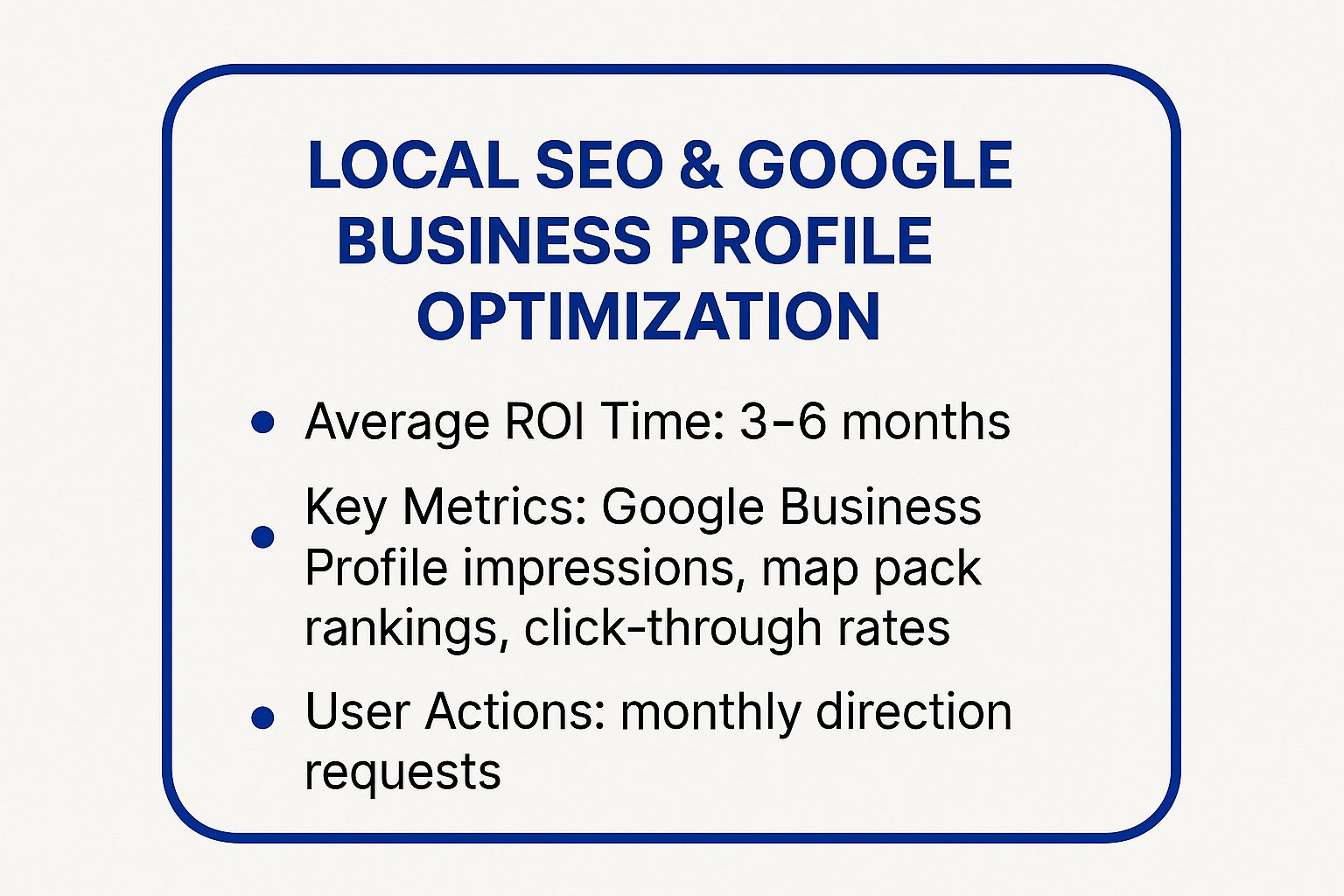
As the data shows, consistent effort in local search optimization can yield tangible results within just a few months, with key metrics like map rankings and direction requests serving as direct measures of increased client interest.
Actionable Implementation Steps
- Optimize Your Google Business Profile: Fill out every section completely. Use high-quality photos, list all specific services (e.g., “Revocable Living Trusts,” “Probate Administration”), and ensure your name, address, and phone number (NAP) are consistent everywhere online.
- Create Location-Specific Service Pages: Develop dedicated pages on your website for each city or significant neighborhood you serve, such as “La Jolla Estate Planning Lawyer.” Tailor the content to address local concerns and include the location name in titles, headers, and body text.
- Generate and Respond to Reviews: Actively solicit reviews from satisfied clients. Respond to every single review, both positive and negative, within 24 hours. A thoughtful response to criticism can be more powerful than a dozen positive reviews.
- Build Local Citations and Backlinks: Get your firm listed in local directories like the local Chamber of Commerce, bar associations, and community websites. Sponsoring a local charity event can often result in a valuable backlink from a trusted local domain.
- Post Weekly GBP Updates: Use Google Posts to share firm news, educational tips, or legal updates. This signals to Google that your profile is active and relevant, which can improve your ranking in the local map pack.
3. Strategic Referral Network Development
One of the most powerful and consistent lead sources for an estate planning practice is a well-nurtured professional network. This strategy involves building mutually beneficial relationships with complementary professionals like financial advisors, CPAs, insurance agents, and real estate professionals. These partners regularly encounter clients at key life moments who desperately need your services, making their referrals incredibly high-quality and pre-qualified.
Rather than just asking for business, this approach focuses on creating a symbiotic relationship where you provide value to your partners and their clients. By positioning yourself as a trusted legal resource for their network, you become an indispensable part of their client service team, leading to a steady stream of ideal clients for your firm. In fact, many successful firms report that 30-50% of their new business comes directly from financial advisor partnerships.

Why This Strategy Works
Trust is the currency of estate planning, and a referral from a client’s existing trusted advisor is the ultimate vote of confidence. When a financial planner or CPA recommends your firm, they are transferring their established credibility to you. This immediately overcomes the initial skepticism and hesitation that often accompanies a cold search for an attorney. These leads arrive at your door with a built-in level of trust, making them easier to convert and more likely to appreciate the value of comprehensive planning. This method is a cornerstone of effective estate planning attorney marketing because it generates warm, high-intent leads consistently.
Actionable Implementation Steps
- Target the Right Partners: Focus on building relationships with fee-based financial advisors and CPAs who serve high-net-worth clients. Their business model aligns with providing holistic, value-based advice rather than selling products.
- Provide Reciprocal Value: Offer to present at a partner’s client appreciation event or host a joint webinar. You can also provide them with co-branded educational materials, like an estate planning guide, that they can share with their clients.
- Create a Seamless Referral Process: Develop a simple intake form or a dedicated contact person for referrals. Make it incredibly easy for your partners to send clients your way and assure them their clients will receive expedited, white-glove service.
- Communicate and Follow Up: Keep your referral partners informed. Send them quarterly email updates on relevant law changes that might affect their clients. After a referral, provide feedback on the outcome (with client permission) to close the loop and show appreciation.
- Join Professional Networking Groups: Actively participate in local chapters of organizations like the Financial Planning Association (FPA) or state-level CPA societies. This puts you directly in the room with your ideal referral partners.
4. Educational Seminar and Workshop Marketing
Educational seminars and workshops transform abstract legal concepts into tangible, accessible information, allowing attorneys to connect directly with their community. This strategy involves hosting free or low-cost events, both in-person and online, to educate potential clients on estate planning fundamentals, such as trusts, wills, and healthcare directives. By presenting valuable information without an immediate sales pitch, you establish your firm as a generous and knowledgeable pillar in the community.
This approach creates a powerful, high-touch marketing experience. Attendees get to meet you, hear your voice, and ask questions in a low-pressure environment, which is far more personal than a website or a brochure. It’s an opportunity to build genuine rapport with dozens of qualified prospects at once, significantly shortening the traditional client acquisition cycle.
Why This Strategy Works
Estate planning decisions are driven by a need for trust and personal connection. Seminars allow you to demonstrate expertise and empathy simultaneously, addressing attendees’ fears and misconceptions in real-time. This face-to-face (or screen-to-screen) interaction builds a level of trust that digital marketing alone often cannot. When an attendee sees firsthand how you simplify complex topics and care about their family’s future, they are far more likely to book a consultation, often converting at rates between 15-25%. This tactic is a cornerstone of a well-rounded estate planning attorney marketing plan because it attracts motivated individuals who are actively seeking solutions.
Actionable Implementation Steps
- Choose Relevant, Compelling Topics: Frame your seminars around common pain points. Titles like “The 5 Biggest Estate Planning Mistakes Parents Make” or “How to Protect Your Home from Medi-Cal” are more compelling than “Estate Planning 101.”
- Partner with Community Pillars: Collaborate with financial advisors, local libraries, retirement communities, or country clubs to co-host events. This gives you instant access to an established and relevant audience, lending third-party credibility to your firm.
- Provide a Clear Call-to-Action: End every presentation with a specific next step. Offer a no-obligation consultation, perhaps with a limited-time incentive like a waived consultation fee for attendees who book within 48 hours.
- Automate Follow-Up: Use an email marketing system to send a thank-you message, a link to the presentation recording, and a clear call to schedule a meeting within 24 hours of the event. Nurture those who don’t book immediately with a drip campaign of related educational content.
- Optimize for Both In-Person and Virtual: Host workshops at convenient times (lunch hours, early evenings) and locations. Simultaneously, offer a webinar option to capture 3-5 times more attendees who prefer the convenience of joining from home, expanding your reach significantly.
5. Niche Market Specialization and Targeting
Instead of casting a wide net, a powerful estate planning attorney marketing strategy involves focusing on a specific, underserved niche. Niche marketing means tailoring your services, messaging, and outreach to a distinct demographic or psychographic segment with unique legal needs. By specializing, you transform your firm from a general provider into the definitive expert for a particular group, such as business owners, LGBTQ+ families, or physicians.
This targeted approach allows for hyper-relevant messaging that resonates deeply with your ideal client’s specific concerns and aspirations. When a potential client sees that your entire practice is built around solving their exact problems, the choice to hire you becomes simple and immediate.
Why This Strategy Works
Generalist estate planning attorneys compete with everyone; niche specialists compete with almost no one. Specialization builds immense authority and allows you to command premium fees because you offer expertise that general practitioners cannot match. Potential clients in your niche perceive you as the only logical choice, as you understand their world, their language, and their distinct challenges, whether it’s navigating complex business succession or planning for a non-traditional family structure. This focus simplifies your marketing efforts, making them more effective and cost-efficient.
Actionable Implementation Steps
- Identify a Viable Niche: Research your local market to find underserved groups with specific needs. Consider high-net-worth individuals, blended families, medical professionals, or families with special needs children. Ensure the market is large enough to sustain your practice.
- Develop Niche-Specific Services: Go beyond standard wills and trusts. If you target business owners, offer integrated succession planning. For special needs families, become an expert in Special Needs Trusts and ABLE accounts.
- Create Targeted Content: Write blog posts, guides, and webinars that address the unique pain points of your niche. For example, create “An Estate Planning Guide for LGBTQ+ Couples in California” or “The CEO’s Playbook for Asset Protection.”
- Network Strategically: Connect with other professionals who serve your niche. Partner with financial advisors who work with high-net-worth clients, or join organizations like state medical associations to connect directly with doctors.
- Use Resonant Language: Tailor your website copy and marketing materials to speak directly to your audience. For example, a firm focusing on farmers would use language that reflects an understanding of agricultural assets and family farm succession. Firms like Gen & Compass, which specializes in LGBTQ+ estate planning, exemplify this by creating a welcoming and knowledgeable brand for their community.
6. Client Testimonial and Video Marketing
In the sensitive field of estate planning, trust isn’t just a bonus; it’s a prerequisite. Client testimonial and video marketing provides an authentic, human-centric way to build that trust before a potential client ever picks up the phone. This strategy involves capturing the genuine experiences of satisfied clients on camera, allowing them to explain the peace of mind they gained and why they chose your firm. Beyond testimonials, this approach includes educational videos and attorney introductions that put a face to the name, demystifying the legal process and making your practice more approachable.
Video content powerfully conveys emotion and sincerity in a way that text cannot. By distributing these videos across your website, social media channels, and email newsletters, you create multiple touchpoints for prospects to connect with your firm’s values and see proof of your impact on real families. This is a cornerstone of modern estate planning attorney marketing that transforms abstract legal services into tangible, relatable outcomes.
Why This Strategy Works
Estate planning decisions are deeply personal and often fraught with emotion. Prospective clients are looking for an attorney they can trust with their family’s future, not just a legal technician. Video testimonials offer powerful social proof, showcasing real people who have navigated the process successfully with your guidance. This peer validation is often more persuasive than any self-promotional copy, directly addressing the viewer’s anxieties and demonstrating that your firm provides not just legal documents, but genuine peace of mind.
Actionable Implementation Steps
- Script Guiding Questions: Instead of asking for a generic review, guide clients with specific questions like, “What was your biggest worry before starting the estate planning process?” and “How did our firm help alleviate that specific concern?” This elicits more compelling and detailed stories.
- Keep Videos Concise: Aim for testimonial videos that are 60 to 90 seconds long. This is the sweet spot for maintaining viewer engagement on social media and website landing pages.
- Optimize for Search and Accessibility: Upload videos to a branded YouTube channel and optimize titles and descriptions with relevant keywords. Always include closed captions to make your content accessible to all viewers, including those watching without sound.
- Integrate Videos Strategically: Embed client testimonials directly on relevant service pages and your homepage, not just in a separate gallery. Placing a video next to a call-to-action can significantly increase conversion rates.
- Create “Meet the Attorney” Videos: Record a short, professional video introducing yourself and your firm’s philosophy. This helps humanize your practice and builds an immediate personal connection with website visitors.
- Leverage Short-Form Video: Create short, 15-30 second clips from longer educational videos or testimonials for use on social media platforms like Instagram Reels or LinkedIn. These can drive traffic back to your website or full-length content.
7. Email Nurture Campaigns and Marketing Automation
The decision to create an estate plan is rarely an impulse buy; it is a considered process that can take weeks, months, or even years. Email nurture campaigns recognize this long sales cycle by building and maintaining a relationship with potential clients over time. This strategy uses marketing automation to deliver a systematic sequence of valuable, educational emails to prospects who have shown initial interest, such as by downloading a guide or subscribing to your newsletter.
This consistent, gentle communication keeps your firm top-of-mind without being overly aggressive. By providing ongoing value and demonstrating expertise directly in their inbox, you build the trust necessary for a prospect to take the final step and schedule a consultation when they are ready. It’s a critical component of a modern estate planning attorney marketing strategy that turns cold leads into warm, qualified appointments.
Why This Strategy Works
Estate planning is a significant life decision, and prospects require time to process information and gain confidence before committing. An automated email nurture campaign acts as a virtual guide, answering their questions, addressing common misconceptions, and reminding them of the importance of planning. This methodical approach ensures no lead falls through the cracks and positions your firm as the helpful authority they already know and trust, significantly increasing the likelihood they will choose you over a competitor when the time is right.
Actionable Implementation Steps
- Develop a Welcome Sequence: Create an automated 5-7 email series for new subscribers. The sequence should introduce your firm, provide foundational estate planning knowledge (e.g., Will vs. Trust), and end with a soft call-to-action to schedule a free introductory call.
- Segment Your Email List: Not all clients are the same. Segment your list by specific needs or demographics, such as “Parents with Minor Children,” “Business Owners,” or “Nearing Retirement.” This allows you to send highly relevant content that speaks directly to their unique concerns.
- Maintain an 80/20 Content Ratio: Structure your emails to be 80% educational and only 20% promotional. Focus on providing value, such as tips for choosing a guardian or explanations of new tax laws, to build credibility before asking for their business.
- Use Behavior-Triggered Emails: Set up automations that send specific emails based on user actions. For example, if someone downloads your “Guide to Special Needs Trusts,” trigger a follow-up sequence that provides more detailed information on that specific topic.
- Focus on a Single, Clear CTA: Each email should have one primary goal and one clear call-to-action (CTA), such as “Read Our Latest Blog Post,” “Watch Our Webinar,” or “Schedule Your Consultation.” This avoids overwhelming the reader and increases conversion rates.
8. Paid Digital Advertising (Google Ads & Facebook/Meta Ads)
While organic strategies like content marketing build long-term authority, paid digital advertising delivers immediate visibility and a predictable stream of qualified leads. This approach uses platforms like Google Ads and Meta (Facebook and Instagram) to place your firm directly in front of potential clients at the exact moment they are seeking help or fit the demographic profile of someone who needs your services. It allows you to bypass the slow build of SEO and generate consultations right away.
Google Ads captures high-intent individuals actively searching for terms like “living trust attorney near me,” while Meta ads build awareness by targeting users based on life events (e.g., recent marriage, birth of a child, approaching retirement) and interests. This two-pronged approach is a cornerstone of modern estate planning attorney marketing, complementing long-term efforts with immediate, measurable results.
Why This Strategy Works
Estate planning is a needs-based service, and paid ads excel at connecting you with people who have an immediate need. When someone searches on Google for an estate lawyer, their intent to hire is incredibly high. You can meet them at that critical decision-making point. Social media ads work differently by creating demand and nurturing awareness, reaching individuals who may not be actively searching but are in a life stage where estate planning becomes a priority. This combination ensures you capture both active searchers and passive prospects.
Actionable Implementation Steps
- Start with Google Local Service Ads (LSAs): These ads appear at the very top of search results and feature a “Google Screened” badge, which builds instant trust. They are often more cost-effective than standard search ads, as you pay per lead rather than per click.
- Create Dedicated Landing Pages: Never send ad traffic to your homepage. Create a specific landing page for each campaign (e.g., one for wills, one for trusts) with a clear call to action, such as “Schedule a Free Consultation.” This focus significantly increases conversion rates.
- Use Precise Keyword Targeting and Negative Keywords: On Google Ads, use phrase and exact match keywords like “[estate planning lawyer Los Angeles]” to avoid irrelevant clicks. Add negative keywords like “free,” “DIY,” and “pro bono” to filter out searchers not looking to hire an attorney.
- Leverage Meta’s Life Event Targeting: On Facebook and Instagram, create ad campaigns targeting users who have recently gotten married, had a child, or are approaching retirement age. These life events are powerful triggers for seeking estate planning services.
- Implement Retargeting Campaigns: Install a tracking pixel on your website to run ads targeting visitors who did not convert on their first visit. Showing these warm leads testimonials or a special offer can bring them back to your firm when they are ready to act.
Estate Planning Attorney Marketing Strategies Comparison
| Marketing Strategy | Implementation Complexity 🔄 | Resource Requirements ⚡ | Expected Outcomes 📊 | Ideal Use Cases 💡 | Key Advantages ⭐ |
|---|---|---|---|---|---|
| Educational Content Marketing & Thought Leadership | High (requires legal & content expertise) | Medium-High (time, ongoing updates) | Long-term authority & qualified leads (6-24 months) | Educating prospects before hiring; SEO improvement | Builds trust, cost-effective, repurposable content |
| Local SEO and Google Business Profile Optimization | Medium (requires technical SEO skills) | Medium (maintenance & updates) | Faster local ranking improvements (3-6 months), higher conversions | Targeting local clients ready to hire, small geographic areas | Captures high-intent local searches, free business profile |
| Strategic Referral Network Development | High (relationship building & management) | Low-Medium (networking & communication) | Pre-qualified leads with 40-60% conversion, sustainable pipeline | Building partnerships with complementary professionals | High conversion rates, lower acquisition costs, trust-based leads |
| Educational Seminar and Workshop Marketing | Medium-High (event planning & public speaking) | Medium-High (prep, venues, marketing) | Moderate conversion (15-30% consultations), lead generation | Engaging multiple prospects at once; demonstrating expertise | Builds rapport, multiplatform content reuse, lead nurturing |
| Niche Market Specialization and Targeting | Medium (requires niche expertise & research) | Medium (specialized content & networking) | Higher conversions, premium fees, stronger referral networks | Serving specific demographic/psychographic groups with tailored needs | Reduced competition, premium pricing, targeted marketing |
| Client Testimonial and Video Marketing | Medium-High (production & compliance) | Medium-High (video production costs) | Increased conversions (up to 80%), stronger emotional connection | Building trust via social proof; enhancing online engagement | High engagement, shareable content, SEO benefits |
| Email Nurture Campaigns and Marketing Automation | Medium (setup & content creation) | Low-Medium (automation tools subscription) | Consistent lead nurturing with 5-10% conversion over time | Long decision cycles requiring consistent contact | High ROI, personalized at scale, measurable analytics |
| Paid Digital Advertising (Google & Facebook Ads) | Medium-High (ongoing campaign management) | High (ad spend plus management time) | Immediate leads with scalable budget, but costly per lead | Quick visibility and lead generation in competitive markets | Fast results, highly targetable, measurable ROI |
Building a Lasting Legacy: Integrating Your Marketing for Long-Term Success
You have explored a comprehensive suite of strategies, from establishing thought leadership with educational content to capturing immediate client interest with targeted digital ads. The path to growing a successful estate planning practice is not paved with a single, magic-bullet tactic. Instead, true, sustainable growth is achieved by building an interconnected marketing ecosystem where each component strengthens the others. This integrated approach transforms disjointed efforts into a powerful, client-generating engine.
The most potent insight from this guide is the principle of strategic integration. Your educational blog posts and guides are not just content; they are the fuel for your Local SEO, establishing the topical authority that Google rewards. The trust you build through your seminars and workshops directly feeds your strategic referral network, giving your partners confidence when they send clients your way. Similarly, your email nurture campaigns can re-engage leads that came from a paid ad but weren’t ready to commit, maximizing the return on every dollar you spend. This synergy is the cornerstone of effective estate planning attorney marketing.
From Individual Tactics to a Cohesive System
Viewing your marketing as a system rather than a checklist of isolated tasks is the mindset shift that separates thriving firms from those that merely survive. A potential client might first encounter your practice through a helpful article about creating a living trust (Content Marketing). Impressed, they might then see your firm appear in the Google Local Pack when searching for local attorneys (Local SEO). Later, they could be retargeted with a compelling video testimonial on social media (Video Marketing & Paid Ads), which finally prompts them to sign up for your newsletter, entering your automated follow-up sequence (Email Nurturing).
Each touchpoint builds upon the last, creating a seamless journey from awareness to consultation. This multi-channel validation establishes trust and credibility far more effectively than any single strategy could alone.
Your Actionable Roadmap to Growth
To avoid feeling overwhelmed, focus on a phased implementation. Do not try to launch all eight strategies at once. Instead, create a realistic, tiered plan for your firm.
- Phase 1 (The Foundation): Start with the two most critical pillars. First, optimize your Google Business Profile to capture existing local demand. Second, begin developing your strategic referral network. These two strategies provide the quickest path to new, high-quality consultations and lay the groundwork for future success.
- Phase 2 (Building Authority): Once your foundational elements are in place, introduce educational content marketing. Start with one high-value blog post or guide per month. Simultaneously, launch a simple email nurture campaign to stay top-of-mind with new contacts you acquire.
- Phase 3 (Scaling and Amplification): With a solid base of content and a growing email list, you can now amplify your reach. Begin hosting educational seminars or webinars to connect with your community directly. At this stage, you can strategically introduce paid digital advertising to drive traffic to your best content or seminar registration pages, ensuring your expertise reaches a much wider, targeted audience.
This methodical approach ensures each new marketing channel is built on a solid foundation, creating a resilient and scalable system. Mastering this kind of integrated estate planning attorney marketing is more than just a client acquisition strategy; it is an investment in the long-term legacy of your practice. By consistently providing value and building genuine connections across multiple platforms, you are not just selling a service. You are positioning your firm as an indispensable, trusted advisor in your community, creating a practice that will flourish for decades.
Ready to implement a sophisticated, integrated marketing system without the steep learning curve? The team at Case Quota specializes in executing the advanced strategies discussed in this article, from creating ADA-compliant websites to launching AI-powered advertising campaigns tailored specifically for estate planning attorneys. Visit Case Quota to learn how our expertise can help you build your firm’s lasting legacy.