

Attorney Facebook advertising is a potent tool for law firms, letting you tap into a stream of high-quality leads by targeting potential clients based on their life events, behaviors, and demographics. It’s a completely different animal from search ads. While Google captures existing demand, Facebook lets you create it, building your firm’s authority long before a person even realizes they need a lawyer.
Why Facebook Ads Are a Client Magnet for SoCal Attorneys
Too many attorneys I speak with in Southern California still write off Facebook as a place for vacation photos and political arguments. That’s a massive—and costly—misconception.
Yes, Google Ads are fantastic for snagging people who are actively looking for a lawyer right now. But Facebook gives you a unique, proactive edge. It allows you to get in front of potential clients based on real-life events, often before they’ve even thought about seeking legal help.
Think about the information people freely share on the platform. Someone who just updated their relationship status to "separated"? That’s a prime audience for a family law attorney. A person whose online activity shows a passion for motorcycles and who happens to live near a notoriously dangerous intersection in Orange County? That’s a potential personal injury client in the making.
This is the real power of attorney Facebook advertising. You move beyond simple keywords and into the realm of actual human behavior.
Tapping into Proactive Client Generation
Instead of just sitting back and waiting for someone to type "personal injury lawyer near me" into Google, you can introduce your firm as a helpful resource much, much earlier in their journey. This builds immediate trust and plants your name in their mind, making you the first call they make when they're finally ready to act.
- Build Authority Early: You can run ads with valuable content, like a quick video explaining the first three things to do after a car accident or a simple guide to the California probate process. This positions you as the go-to expert.
- Intercept Client Need: You’re reaching people who are going through a life event that often requires legal help, but they haven't started the formal search. This gives you a massive first-mover advantage over competitors who are only focused on SEO and search ads.
- Cost-Effective Reach: Honestly, reaching these "pre-aware" audiences on Facebook can often be cheaper than duking it out for hyper-expensive keywords on Google, especially in the cutthroat Southern California market.
For a Southern California law firm, ignoring Facebook is like refusing to put a sign on your office door. You're missing out on a constant stream of local individuals who fit the exact profile of your ideal client. The platform’s targeting capabilities are simply too precise to overlook.
To get a clearer picture, let's look at some typical performance metrics. The numbers show that with the right strategy, Facebook can deliver real, measurable results for law firms.
Facebook Advertising Performance Snapshot for Legal Services
| Metric | Average Performance | What This Means for Your Firm |
|---|---|---|
| Cost Per Click (CPC) | $3.50 – $7.00 | Significantly lower than many competitive legal keywords on Google, allowing for more website traffic on the same budget. |
| Cost Per Lead (CPL) | $75 – $250+ | Varies by practice area, but can be highly profitable for high-value cases like personal injury or family law. |
| Click-Through Rate (CTR) | 0.8% – 1.5% | A good CTR indicates your ad creative and targeting are resonating with the audience you've defined. |
| Conversion Rate (Lead Form) | 5% – 12% | Shows the percentage of people who click your ad and then complete a lead form, a strong indicator of ad quality. |
These averages demonstrate that Facebook isn't just a "branding" play; it's a direct-response channel capable of driving tangible leads when executed properly.
A Strategy Beyond Likes and Shares
Let’s be clear: effective legal marketing on Facebook has nothing to do with getting likes. It’s about one thing—generating qualified leads that turn into profitable cases. This demands a sharp strategy that marries laser-focused targeting with compelling, compliant ad creative.
To truly make this work, you need high-impact visuals, which is why a smart approach to crafting Facebook Video Ads is so critical. For Southern California attorneys, this all ties back to building a powerful digital footprint. A stellar online reputation amplifies your advertising and builds the client trust you need to close cases. You can see exactly how attorney reputation impacts local marketing in our comprehensive 2025 playbook.
When you get this right, Facebook stops being a social network and becomes a predictable client acquisition machine for your firm.
Before you even think about running a single ad, you have to get your house in order. Trying to launch a Facebook advertising campaign without a solid technical foundation is like building a case on hearsay—it’s going to collapse, and you'll waste a lot of time and money in the process.
This initial setup isn’t just a box to check. It’s the non-negotiable groundwork for running compliant, effective, and—most importantly—measurable campaigns for your firm.
Creating a Professional Business Page
Your firm's Facebook Business Page is your digital storefront. It’s often the very first impression a potential client in Southern California gets of your practice. A sloppy or incomplete page signals disorganization and can kill trust before you even have a chance to build it.
Think of it as the online equivalent of your office lobby. It needs to be professional, welcoming, and easy to navigate.
A properly optimized page is the central hub for all your advertising. It must include:
- Complete Contact Information: Your firm’s address, phone number, and a direct link to your website need to be front and center. No excuses.
- A Clear "About Us" Section: Cut the jargon. Briefly explain who you are, what you stand for, and which clients you serve in the local community.
- Practice Area Highlights: Use the "Services" tab to clearly list your core practice areas—Personal Injury, Family Law, Estate Planning, etc.—with a short, simple description for each.
- Professional Imagery: Use a high-resolution firm logo for the profile picture. For the cover photo, a professional shot of your team or office works far better than a generic stock photo.
This entire process is about building a simple, effective path from finding a potential client to converting them.
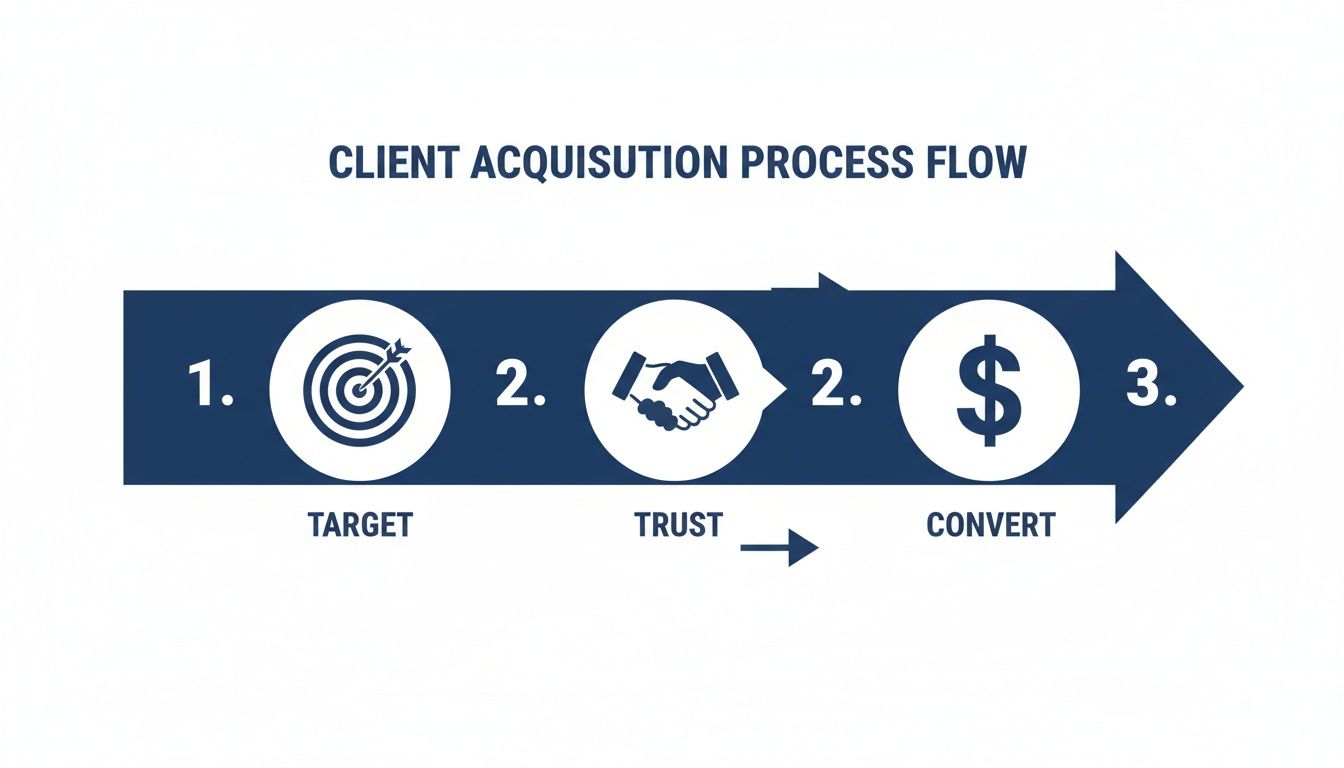
As you can see, a solid foundation is what makes it possible to effectively target the right audience, build their trust, and ultimately turn them into a signed case.
Setting Up Your Business Manager and Ad Account
I still see attorneys trying to run ads from their personal Facebook profiles. It’s a rookie mistake. For any serious law firm, using Facebook Business Manager (now called Meta Business Suite) is absolutely essential.
It’s a central dashboard that keeps your personal life completely separate from your firm's advertising. This is critical for both privacy and professional compliance. It also lets you securely grant access to team members or an outside marketing agency without ever handing over the keys to your entire digital kingdom.
Inside Business Manager, you'll create your Ad Account. This is where your campaigns are built, your billing information is stored, and all your performance data lives.
Pro Tip: When you set up that Ad Account, double-check that your time zone and currency are correct. You cannot change these later, and getting them wrong creates massive accounting and reporting headaches down the line. It's a five-second check that can save you hours of frustration.
To build a strong foundation, it's essential to understand the various 10 Types of Facebook Advertising available. Knowing the difference between formats like video ads, lead ads, and carousels will inform your strategy from day one. Additionally, for a deeper dive into growing your firm's online presence, explore our guide on https://casequota.com/social-media-marketing-for-attorneys/.
Installing the Meta Pixel and Verifying Your Domain
This is the most critical technical step, period. The Meta Pixel is a small piece of code you install on your website, and it's the brains of your entire advertising operation.
It tracks what users do after they click your ad. Did they visit your site? Which pages did they look at? And most importantly, did they fill out your contact form and become a lead?
Without the Pixel, you’re flying blind. You’ll have no idea which ads are actually generating cases, making it impossible to calculate your true return on ad spend. It also unlocks powerful strategies like retargeting, which lets you show specific, follow-up ads to people who have already visited your website but didn’t convert.
Finally, you must verify your firm's domain within Business Manager. This is a simple process that proves to Meta that you own your website. It’s a required step for accurate conversion tracking and enhances your account's security. Get these foundational pieces right, and you’ll ensure every dollar you invest in advertising is working as hard as it possibly can.
Find Your Next Client With Laser-Focused Audience Targeting

This is where your attorney Facebook advertising stops being a megaphone and starts becoming a scalpel. You can have the most brilliant ad in the world and a flawless campaign setup, but it all means nothing if the wrong people see it. Honestly, getting the audience right is the single most important thing you can do to generate qualified, high-value leads for your Southern California law firm.
Forget about casting a wide net. That's a waste of money. Winning on Facebook means meticulously layering different targeting options to build an incredibly specific profile of your ideal client. We're going way beyond basic demographics like age and location and digging into the subtle signals—behaviors, life events, and interests—that indicate a real need for your legal help.
Facebook is far more than just a social network for lawyers; it's a client acquisition machine. A staggering 57% of law firms use it every single day for promotion, leaving Twitter in the dust at 33%. This isn't just for show. Over 30% of firms report signing clients who came directly from social media, proving its power in building trust and filling your case pipeline.
Your Three Core Audiences
First things first, you need to get comfortable with the three foundational audience types inside Facebook Ads Manager. Each one has a specific job to do in your client acquisition strategy.
- Saved Audiences: This is your starting point, your foundation. You build these audiences by hand, combining demographics, interests, and behaviors. The magic here is in the layering—getting more and more specific with each criterion you add.
- Custom Audiences: These are your warmest leads, period. Custom Audiences are built from your own data. Think client email lists, people who have visited your website (thanks to the Meta Pixel), or users who've engaged with your Facebook page.
- Lookalike Audiences: This is how you scale intelligently. You give Facebook a "source" audience (like a Custom Audience of your best past clients), and its algorithm goes out and finds new people who share similar traits. It's one of the most powerful tools in the entire platform for finding brand new, high-quality prospects.
These aren't mutually exclusive. The best campaigns weave them together, guiding potential clients from that first moment of awareness all the way to a signed retainer.
Targeting Playbooks for SoCal Practice Areas
Generic targeting is a death sentence in the crowded Southern California market. You need a custom-built approach for every practice area you serve.
Scenario: Personal Injury Attorney
Imagine a PI firm in Los Angeles. Instead of just targeting the whole city, they could get surgical:
- Location: Target a 15-mile radius around their office, but then exclude zip codes with lower median incomes to pre-qualify for higher-value cases.
- Interests: Layer on interests like "motorcycles," "Harley-Davidson," or specific "cycling clubs."
- Behaviors: Add a behavior layer for "commuters" or people whose location data shows they frequently travel through notoriously dangerous intersections.
This combination doesn't just find people in the right area; it finds people with a higher-risk lifestyle who are geographically desirable, making the ad feel incredibly relevant.
Scenario: Family Law Attorney
Now, let's take a family law practice in Orange County. The strategy shifts from hobbies to life events:
- Demographics (Life Events): Directly target users whose relationship status recently changed to "Separated" or "Divorced."
- Demographics (Parents): Focus on "Parents with adult children (18-26)" or "Parents with grown-up children" for cases likely to involve complex asset division or spousal support.
- Interests: Sprinkle in interests like "divorce support groups" or "co-parenting" resources.
By focusing on life events, you're not just guessing who might need a lawyer. You're reaching people at the exact moment their circumstances change, making your message timely and incredibly relevant.
Advanced Retargeting and Lookalike Tactics
Once you start getting traffic to your website, you unlock a whole new level of targeting power. This is where you can see a truly massive return on your ad spend.
Surgical Website Retargeting
Your Meta Pixel lets you create a Custom Audience of everyone who visited your website in the last 90 days. But don't stop there. Get granular.
- Create an audience of people who viewed your "Car Accidents" page but did not reach your "Thank You" page after submitting a form.
- Serve that specific group a follow-up ad with a video testimonial from a past car accident client. The message is direct: "Still have questions? See how we helped [Client Name]."
Scaling with Lookalike Audiences
For most firms, the Lookalike Audience is a goldmine.
- Source: Upload a clean list of your best 500-1,000 past clients—the ones from your most valuable cases.
- Action: Ask Facebook to create a 1% Lookalike Audience based in California. The algorithm will identify the top 1% of users in the state who most closely mirror the characteristics of your best clients.
- Result: You've just created a large, cold audience that is statistically primed to be a great fit for your firm.
By systematically building, testing, and refining these audiences, your Facebook ads transform from a hopeful expense into a predictable engine for new cases. To get a wider view on this, you should check out our guide on social media advertising for lawyers.
Designing Ads That Convert Without Breaking Bar Rules
Crafting a great Facebook ad for your law firm is a tightrope walk. You need copy and visuals that stop the scroll and get someone to click, but you're also shackled to a strict set of state bar rules governing every single word.
This is where so many Southern California attorneys trip up.
They either play it so safe their ads are bland and invisible, generating zero leads, or they push the creative envelope a little too far and find themselves in ethical hot water. The secret is knowing that compliance and conversion aren't opposing forces—they have to work together.
Your goal is to build an ad that not only ticks every ethical box but also connects with your ideal client on a human level, positioning your firm as the credible, trustworthy authority they desperately need.
Navigating State Bar Advertising Rules
Before you even think about writing ad copy, you have to burn the core principles of attorney advertising ethics into your brain. The specific language might differ, but the spirit of the rules in California is the same everywhere: protect the public from misleading or false claims.
These rules don't care if it's a TV spot, a billboard, or a Facebook ad. For social media, the most common landmines involve guaranteeing outcomes, creating unrealistic expectations, or simply forgetting to add the required disclaimers.
Keep a close eye on these areas:
- No Promised Outcomes: You can't, under any circumstances, guarantee a result. Phrases like "We'll win your case" or "Get the maximum settlement" are huge red flags. Ditch them immediately.
- Verifiable Claims: If you make a statement about your firm's track record, it better be factually accurate and provable. Claiming you've "recovered millions for clients"? You need the records to back it up.
- Clear Disclaimers: Most states, including California, require you to clearly label your content as an ad. Something as simple as "Advertising Material" at the beginning or end of your copy is often all you need.
The golden rule of compliant ad copy is simple: Focus on your process, not on promises. Talk about your experience, your team's dedication, and how you guide clients through a confusing legal system. This builds trust without making promises you can't keep.
For a deeper dive into the specifics, especially for California firms, it's essential to review the official guidelines. You can get a much clearer picture by reading our guide on navigating Rule 7.2 for ethical attorney advertising.
Ad Formats That Build Trust and Drive Leads
Staying compliant doesn't mean your ads have to be boring. In fact, the right format can communicate your firm's value powerfully and ethically. The most successful attorney Facebook advertising campaigns almost always use a mix of formats to connect with potential clients.
Video Testimonials (with consent)
Nothing beats a real client sharing their story. It’s authentic social proof that humanizes your firm in a way no slick graphic ever could.
- Compliance Check: You must have explicit, written consent. The testimonial has to be truthful and can't imply a guaranteed outcome for others. It’s smart to include a disclaimer like, "Results may vary depending on your particular facts and legal circumstances."
Carousel Ads for Practice Areas
This format is perfect for showcasing everything your firm does in one clean, swipeable ad. Each card can feature a different practice area—personal injury, workers' comp, employment law—with its own image and link to the right landing page.
- Why It Works: It lets you educate potential clients on the full scope of your services without being overwhelming. It's an incredibly efficient way to appeal to multiple audience segments at once.
Educational "Explainer" Videos
Think short, valuable, direct-to-camera videos that answer a burning legal question. A 60-second clip on "What Are the First 3 Steps After a Car Accident in California?" delivers immediate value and positions you as an expert.
- Benefit: This approach makes you a helpful guide, not just another salesperson. You're building trust and goodwill, making your firm the first one they'll call when they're ready to hire.
Crafting Compliant and Compelling Ad Copy
The ad copy is your chance to connect with a person's problem and frame your firm as the solution. The trick is to use empathetic, client-focused language that completely avoids guarantees and hyperbole.
Let's look at a non-compliant ad versus one that's both compliant and effective for a personal injury firm.
| Non-Compliant Ad Copy (Avoid) | Compliant & Effective Ad Copy (Use) |
|---|---|
| "Injured in an accident? We'll get you the biggest check guaranteed! Our expert lawyers win every case. Call now for a free consultation and see how much money you can get!" | "Injured in an accident? Navigating the legal process alone can be overwhelming. Our experienced team is here to guide you every step of the way. Learn how we fight for our clients. Contact us for a free, no-obligation case evaluation. This is an advertisement." |
See the difference? The second one works because it taps into the client's actual emotional state ("overwhelming") and frames the firm's role as a trusted guide ("guide you every step of the way"). It makes a powerful impression without making a single empty promise, keeping it persuasive and ethically sound.
Budgeting Smart and Measuring What Matters
Let’s talk money. A killer attorney Facebook advertising strategy is just a theory without a smart budget and a clear-eyed view of what success actually looks like. So many firms either underspend and never get meaningful data or spray money in all the wrong places, leading to the false—and expensive—conclusion that "Facebook ads don't work."
The truth is, they work incredibly well when you treat the financial side with a deliberate plan. Your budget isn't just a number; it's the fuel for your entire client acquisition engine.

Setting a Realistic Law Firm Ad Budget
Your starting budget comes down to two main things: your practice area and your specific turf within Southern California. The ad battlefield in downtown Los Angeles is a completely different world from Riverside or the Inland Empire.
A personal injury firm in a hyper-competitive market like L.A. needs a much more aggressive budget to get any traction compared to an estate planning attorney in a quieter community. For most SoCal firms just getting their feet wet, a starting point between $50 to $100 per day is a solid place to begin.
This initial investment lets you run meaningful tests, gather data, and figure out which audiences and ad creatives are actually moving the needle. Once you find that winning formula, you can scale your spending with confidence.
Your initial budget's goal isn't to sign ten new clients in week one. It's to buy data. You're investing in learning exactly what your local market responds to, and that knowledge is the most valuable asset you can have.
Think of it this way: a small, laser-focused budget that brings in five qualified leads is infinitely more valuable than a huge budget that gets you hundreds of useless clicks from people who will never become clients.
Choosing Your Bidding Strategy
Facebook gives you a few ways to bid for ad placements, and picking the right one means aligning your ad spend with your firm's actual goals. The platform’s AI is getting smarter every day, but understanding your options gives you crucial control.
- Highest Volume (Lowest Cost): This is the default setting and, honestly, the best place to start. You tell Facebook you want leads, and it goes out to get you the most results it can within your daily budget. It’s perfect for gathering that initial performance data quickly.
- Cost Per Result Goal: Here, you tell Facebook the average cost you're willing to stomach for a new lead. This is great for keeping your Cost Per Lead (CPL) stable once you know your numbers, but be careful—set it too low, and you'll choke off your reach.
- ROAS Goal (Return On Ad Spend): This is a more advanced play for firms that have a solid handle on their average case values. You can tell Facebook to maintain a specific return, and it will optimize ad delivery to hit that target.
For most law firms starting out, sticking with Highest Volume is the way to go. It lets the algorithm do its job and gives you a clear performance baseline to work from.
Moving Beyond Vanity Metrics
This is the most important part of the entire process, so read it twice. Likes, comments, and shares feel good, but they don't keep the lights on. To truly know if your advertising is working, you have to obsess over the Key Performance Indicators (KPIs) that directly tie back to your firm's revenue.
The legal industry actually performs surprisingly well on the metrics that matter. Data shows legal services on Facebook see an average conversion rate of 10.53%, with the average cost-per-lead (CPL) coming in at just $18.17. This tells us that with the right targeting, high-quality leads are absolutely within reach.
These are the numbers that should live on your dashboard:
- Cost Per Lead (CPL): This is your most critical top-of-funnel metric. It tells you exactly how much you're paying for a single person to raise their hand and fill out your contact form.
- Lead-to-Consultation Rate: Of all those leads coming in, how many actually schedule a consultation? This is your lead quality gauge. A low rate here often means your ad's message is attracting the wrong crowd.
- Consultation-to-Client Rate: What percentage of those consultations result in a signed retainer? This KPI measures the effectiveness of your intake process and the final quality of your leads.
- Return on Ad Spend (ROAS): This is the ultimate bottom line. If you spend $3,000 on ads and that generates $15,000 in revenue from new cases, your ROAS is 5x. That’s the goal.
Tracking these numbers lets you follow the money from the first ad click all the way to a signed client. For a deeper dive, check out our guide on measuring advertising effectiveness for your firm. When you focus on these business-centric KPIs, you stop treating Facebook ads as an expense and start building a predictable, profitable system for growth.
Your Top Questions About Facebook Ads, Answered
Diving into Facebook advertising for the first time can feel like navigating a minefield, especially for attorneys who are rightfully concerned about compliance, wasting money, and getting real results. Having run these campaigns for countless Southern California law firms, we’ve heard every question in the book.
These aren't just hypotheticals. They're the critical questions that stand between a frustrating expense and a powerful client acquisition channel. Let's clear the air with some straight answers based on what actually works right here in our competitive SoCal market.
What’s a Realistic Starting Budget?
There’s no magic number that works for everyone, but a solid starting point for a solo attorney or a smaller firm in Southern California is usually in the $1,500 to $3,000 per month range. That's enough to get the platform's algorithm learning and give you the data you need to make smart decisions.
Now, if you're in a hyper-competitive space like personal injury in Los Angeles, you'll likely need to invest more to get meaningful traction. The real key is starting with a test budget you're comfortable with, focusing laser-tight on just one or two of your key practice areas, and being ready to scale up once you find a winning combination of ads and audiences.
Remember, the strategy behind the spend is far more important than the amount itself. A smaller, highly targeted budget will consistently outperform a large, unfocused one every single time. It's about precision, not just volume.
Can This Actually Bring in High-Value Cases?
Absolutely. People often think of Google Ads for capturing someone actively searching for a lawyer right now. That's true, and it's powerful. But Facebook is different—it excels at creating demand and getting your firm in front of potential clients before they even know they need you. This is a game-changer for high-value cases.
Think about it this way:
- For Personal Injury: We can target users based on interests and online behaviors that suggest a higher-risk lifestyle. When an accident does happen, your firm is the first one they think of.
- For Estate Planning: We can reach people based on key life events like "newly married," "new parents," or even "recently moved," alongside factors like age and income.
The best approach here isn’t a hard sell. It’s about building trust and authority over time with educational content—think free guides, helpful checklists, or short videos. High-value clients are earned, and Facebook’s content-friendly format is the perfect place to do it.
How Do I Make Sure My Ads Follow Bar Rules?
Compliance is everything. It's the foundation of your entire strategy, and it's non-negotiable. Your first move should be to pull up your state bar’s advertising guidelines and read the digital media section—twice.
The big rules are generally consistent: you cannot make guarantees or promise a specific outcome. Any ad copy that sounds like "We'll win your case!" is an immediate red flag and strictly forbidden. Everything you say must be truthful and not remotely misleading.
You'll also need a clear disclaimer, something as simple as "This is an advertisement," and you must identify the responsible attorney or firm. Don't even think about using actors to play clients unless you explicitly disclose it. When in doubt, always have your ad creative and copy reviewed by legal counsel before it goes live.
Should I Send Ad Traffic to My Homepage or a Landing Page?
Always, always send paid traffic to a dedicated landing page. Sending users from a specific ad to your general homepage is one of the most common and costly mistakes a firm can make. Your homepage is built to explore, with dozens of links and distractions. That's a recipe for a low conversion rate.
A proper landing page has one job and one job only: to get the visitor to take the single action you want, whether that's filling out a form or calling your office. The message and design must be a direct continuation of the ad they just clicked. If your ad is for DUI defense, the landing page better be about DUI defense, not your firm's entire list of practice areas. This creates a seamless, focused experience that makes a potential client feel understood and far more likely to convert.
At Case Quota, we specialize in navigating these complexities for Southern California law firms. We build and manage compliant, high-performance Facebook advertising campaigns that connect you with the clients you want. If you're ready to grow your practice with a proven strategy, learn more at https://casequota.com.