
Let's get one thing straight. Google Ads is fantastic for snagging clients who are actively looking for a lawyer right now. But Facebook? That's where you connect with potential clients before they even realize they need you.
This isn't about chasing clicks. It's about building authority and becoming the first name they think of when legal trouble arises. You're turning their casual social media scroll into a powerful lead-generation channel for your firm.
Why Your Law Firm Needs Facebook Ads

Too many attorneys dismiss Facebook as a platform for retail brands, completely overlooking the massive local audience spending hours there every week. The strategy here isn't the same as Google. It's a strategic play to build rock-solid brand recognition and trust within your community, long before someone needs to hire a lawyer.
The goal is simple: when they or a friend have a legal problem, your firm is the only one that comes to mind. You get there by consistently showing up in their feed with valuable, helpful content that proves your expertise without being pushy.
Reaching Clients Where They Already Are
The sheer scale of Facebook makes it impossible to ignore. With more than half of all Americans on the platform regularly in 2025, you can bet a huge chunk of your local client base is there. For ads in the legal space, the average cost-per-click (CPC) is often just $1 to $3, with a click-through rate (CTR) of around 1.61%.
While that CTR is a bit below the all-industry average, it represents an incredibly affordable way to start building serious brand awareness.
This gives you the power to:
- Target hyper-specific demographics like age, location, and even life events. Think "newly engaged" for family law or "recently moved" for a real estate practice.
- Build powerful retargeting lists of people who have already visited your website, keeping your firm in front of an already-warm audience.
- Educate your community with content that answers their legal questions, positioning you as the go-to resource, not just another advertiser.
The real power of attorney advertising on Facebook lies in its ability to create demand, not just capture it. You're building a relationship with potential clients, so when the time comes, your firm is the obvious choice.
Beyond Immediate Conversions
Think of Facebook as the modern-day billboard or local newspaper ad, but with laser-focused targeting and results you can actually measure. While some campaigns will absolutely generate direct leads, the primary win is establishing long-term authority in your market.
This approach perfectly complements your other digital marketing. To see how it fits into a bigger growth plan, check out these other law firm advertising ideas that can amplify your social media campaigns.
Ultimately, Facebook gives you a stage to tell your firm’s story, showcase what you know, and build a pipeline of future clients. They won't just see you as an ad—they'll see you as a trusted advisor.
Navigating Attorney Ad Rules and Ethics
Let's get one thing straight: running Facebook ads for a law firm isn't like boosting a post for a local pizza shop. One wrong move here can land you in serious hot water, and I’m not talking about a disapproved ad. I’m talking about state bar sanctions that could put your entire practice at risk.
This is, without a doubt, the most critical part of the entire process. The rules of professional conduct don’t just vanish online. They apply to every single social media ad you run, just as they do to a billboard or a TV spot.
The real challenge is threading the needle between compelling marketing and your ethical duties. Every state bar has its own rulebook, but the core principles are universal: protect the public from advertising that's false, misleading, or creates an unjustified expectation. Ignoring this isn't just a marketing fumble; it's a professional gamble you can't afford to lose.
Avoiding Common Ethical Traps
The most common mistake I see lawyers make is running ads that promise a specific outcome. You might be the best attorney in the state, but you can't guarantee a result. The line between showing confidence and making a prohibited promise is incredibly thin, and crossing it is easy if you're not careful.
For example, an ad that screams, "We guarantee a win on your PI case!" is a red-flag violation. It's an empty promise that sets a dangerous precedent.
A much smarter—and safer—approach is to focus on your experience and your process.
Here’s what that looks like in practice:
- Non-Compliant: "Get the maximum settlement you deserve. We never lose."
- Compliant: "We have a track record of handling complex injury claims and fighting for our clients' best interests."
See the difference? The second one highlights your firm's competence and dedication without making a promise you legally can't keep. It shifts the entire conversation from a guaranteed win to your proven ability to fight for your clients.
The Power of Disclaimers and Clear Language
Disclaimers aren't just fine print; they're a requirement. Most state bar associations mandate specific language to identify your posts as "Advertising Material." This isn't optional. It’s about transparency and managing expectations from the very first click.
Your ads, and the landing pages they link to, need to be clearly marked. And don't bury it. It needs to be obvious.
Common practice is to place it:
- At the top or bottom of your ad copy right there in the Facebook ad.
- Clearly in the header or footer of any landing page they click through to.
Remember, the person seeing your ad probably isn't a lawyer. Your language has to be clear, direct, and free of confusing jargon. The goal is to inform, not to create false hope.
Facebook's Policies Meet Professional Conduct
On top of your state bar's rules, you have to play by Meta's rules, too. Facebook is incredibly sensitive about certain types of ads, especially those that make sensational claims or use "before-and-after" imagery. This is a huge deal for personal injury or med mal attorneys.
A classic example of what not to do? An image of a mangled car wreck next to a picture of a giant settlement check. Facebook’s algorithm will likely flag and reject ads like that for being overly aggressive or promising life-altering results.
The good news is that ethically compliant ad copy often performs better on the platform anyway. You reduce the risk of getting your ad account shut down while building genuine trust with potential clients.
The rules can be a maze, and they vary by jurisdiction. For a much deeper look into how these principles work in the real world, our guide to ethical attorney advertising in California offers specific insights that are valuable for any lawyer, anywhere. Staying informed is your best defense against both platform rejections and ethical complaints.
Building Your Technical Foundation for Success
Before you spend a single dollar on your first Facebook ad, you have to get the technical backend right. This is non-negotiable. I've seen countless attorneys make the expensive mistake of just hitting the “Boost Post” button on their firm’s page. It’s the digital equivalent of trying to argue a case without knowing the law—a surefire recipe for wasted money and a whole lot of frustration.
To get serious, professional returns from your advertising, you need a much more robust setup.
Your first move is to step up from your personal profile or a basic business page and into Meta Business Manager. Think of this as your firm's central command center. It gives you enhanced security, lets you manage all your assets (like your page and ad account) in one place, and unlocks the advanced tools you'll need for real campaign management. It also neatly separates your personal Facebook activity from your professional advertising, which is a must for both compliance and your own sanity.
Installing Your Data-Gathering Tools
Once you’re set up in Business Manager, the next critical step is installing the Meta Pixel and setting up the Conversions API (CAPI). These are essentially small snippets of code that you or your web developer will place on your law firm's website. They act as the eyes and ears of your ad campaigns, connecting the actions people take on your site directly back to the ads they saw on Facebook.
This goes way beyond just tracking clicks. These tools are designed to monitor the meaningful actions that tell you a potential client is genuinely interested.
- Page Views: See exactly which pages—like your “Practice Areas” or “Case Results”—are grabbing the most attention from your ad traffic.
- Time on Site: Figure out if visitors are actually reading your content or just bouncing away immediately.
- Form Submissions: This is the big one. The Pixel can track every single time someone fills out your "Contact Us" or "Free Consultation" form.
- Phone Calls: You can even track clicks on your website's phone number, which is a huge signal of a high-intent lead.
By collecting this data, you're not just watching the numbers. You're actively teaching Facebook's powerful algorithm what a qualified lead looks like for your specific practice. It’s a step most lawyers unfortunately skip, leaving them to guess why their ads just aren't converting.
Key Takeaway: The Meta Pixel and CAPI transform your advertising from a guessing game into a data-driven strategy. They give the algorithm the feedback it needs to find more people who are likely to become your clients, maximizing your ad spend.
Why This Technical Setup Drives Better Results
Properly setting up tools like the Facebook Pixel is what allows you to precisely measure your cost per lead and actually optimize your campaigns. When the Pixel tracks key actions—like a form submission or a consultation request—it feeds that information back to Facebook's algorithm. The algorithm then gets smarter, learning to target users who are more likely to convert.
This turns your ad spend into a predictable client acquisition machine. In 2025, this kind of data-driven approach is no longer optional; it's how successful firms justify their marketing budgets and refine their ad strategies.
This infographic shows that this technical work fits into a larger compliance workflow that you need to nail down from the very beginning.
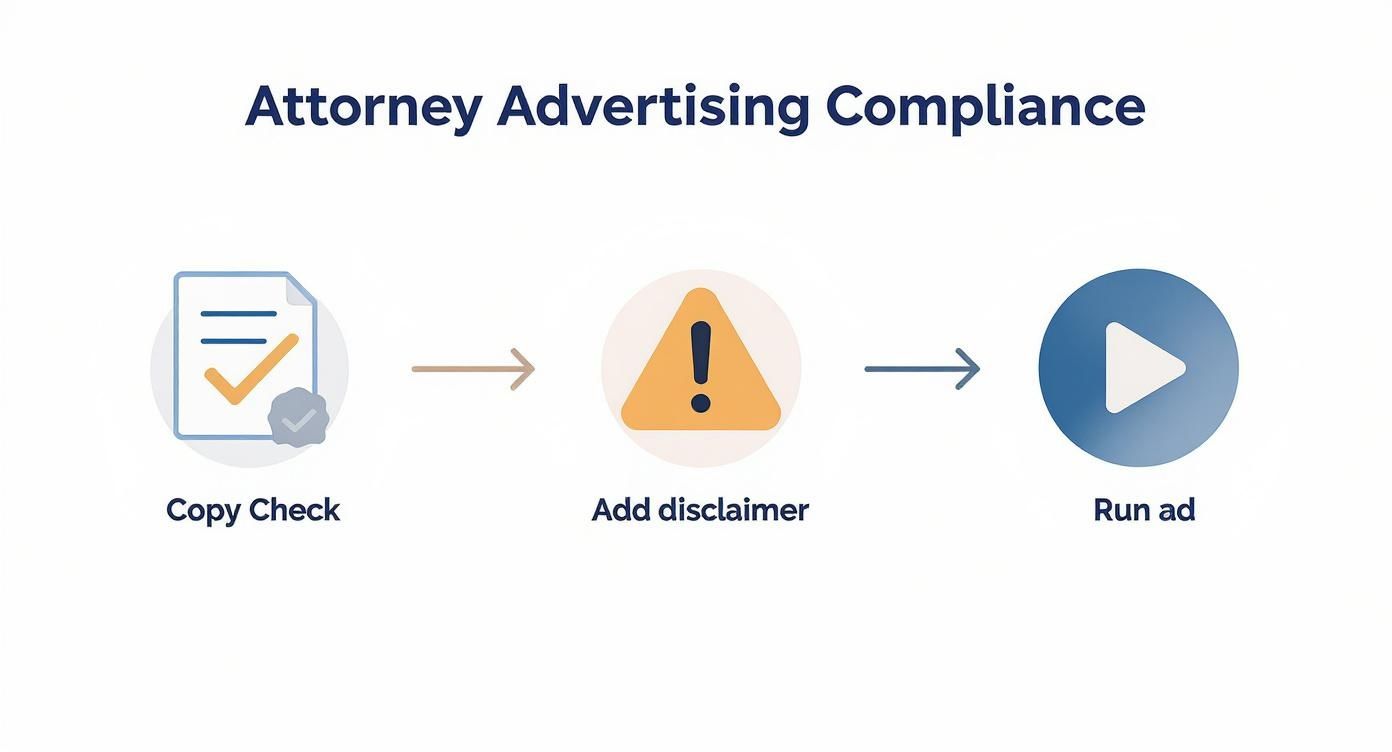
As you can see, the process starts with reviewing your ad copy and adding the right disclaimers before you even think about running the ad. It's a workflow designed to protect your firm at every stage.
Of course, tracking conversions is only half the battle. Your website has to be built to turn that hard-won traffic into actual leads. You can learn more about this crucial element in our guide on https://casequota.com/website-optimization-for-law-firms/.
To really build out a solid technical foundation and ensure you’re continuously improving, it's a good idea to get familiar with the best Facebook analytics tools for marketers. These platforms can give you much deeper insights than Meta's native reporting, helping you spot trends and find new opportunities to get better results over time. With this foundation in place, you’re ready to move on from the "how" to the "who" by defining your target audience.
Finding High-Quality Clients with Smart Targeting
Okay, with the technical groundwork laid, let's dive into what truly makes or breaks an attorney's Facebook ad campaign: getting your ads in front of the right people.
You can have the most ethical, brilliantly designed ad in the world, but it’s completely worthless if it’s being shown to people who have no need for your services. This is the exact spot where most firms stumble. They fall back on overly broad targeting that just burns through cash and generates a ton of irrelevant clicks.
Effective targeting is all about precision. It means going way beyond basic location and age settings to really dig into the three core audience types that will fuel your campaigns: Saved, Custom, and Lookalike.
Each one serves a very distinct purpose. Mastering how to use all three is what separates the firms that see a real return on their ad spend from those who just watch their budget disappear.
Let's break them down.
Layering Interests and Behaviors with Saved Audiences
A Saved Audience is your starting point. It’s where you build an audience from scratch using Meta’s massive collection of demographic, interest, and behavioral data. While you'll always start with location—targeting your specific city, county, or state—the real magic happens when you start adding layers to filter down to the right people.
Imagine you're a business litigation attorney. Just targeting your entire city is a waste of money. You need to reach actual business owners.
Here's how you could layer your targeting to do just that:
- Demographics: Target users who list their job title as "Small Business Owner."
- Interests: Add people who have shown interest in pages related to "Entrepreneurship," Inc. Magazine, or business software like QuickBooks.
- Behaviors: You can even target users based on their role as an admin of a Facebook Business Page.
This multi-layered approach cuts through the noise of the general population. It makes sure your ad about shareholder disputes is seen by people who actually have shareholders.
Another example? A real estate attorney could target users who have the life event "Recently Moved" or show clear interests in platforms like Zillow and Realtor.com.
The Untapped Power of Custom Audiences
This is where your advertising starts getting really, really smart. A Custom Audience is built from your own data—people who have already interacted with your firm in some way. This is, by far, your warmest audience because they've already shown they're interested.
The most valuable source for this is your website traffic, which is tracked by the Meta Pixel you installed earlier.
By creating a Custom Audience of website visitors, you can run retargeting campaigns that keep your firm top-of-mind. This strategy is incredibly effective because you're no longer advertising to a cold audience; you're speaking to people who already know who you are.
Think about this common scenario: someone lands on your "Contact Us" page but never fills out the form. They were obviously interested but got distracted. With a Custom Audience, you can create a specific ad that shows only to people who visited that page but didn't convert, gently nudging them to take that next step.
Other powerful Custom Audiences can be built from your email list or even a list of your past clients.
Unlocking Growth with Lookalike Audiences
Lookalike Audiences are the secret weapon for scaling your campaigns profitably. This is where you essentially hand your best data over to Facebook's AI and tell it, "Go find me more people just like these."
You can create a Lookalike Audience from any Custom Audience you've built.
For instance, you could upload a list of your 100 best past clients. Facebook will then analyze the thousands of data points associated with those individuals—their demographics, interests, online behaviors, and more—to build a brand new, much larger audience of people who "look like" them.
This process creates an incredibly efficient engine for client acquisition.
- You provide the source: A high-quality list, like "all clients who signed a retainer in the last year" or "all website visitors who submitted a contact form."
- Facebook finds the patterns: Its algorithm identifies all the common threads connecting the people in your source list.
- It builds a new audience: It then finds millions of other users on its platform who share those same characteristics, creating a fresh, high-potential audience for you to target.
This approach is a cornerstone of any effective law firm lead generation strategy because it automates the prospecting process. Instead of manually guessing who your next client might be, you're using real data from your past successes to find them.
When you combine these three audience types, you create a complete funnel that attracts new prospects, nurtures warm leads, and constantly finds more people just like your best clients.
Creating Ads That Build Trust and Get Clicks
Alright, we’ve handled the technical setup. Now comes the creative part, and it’s where many firms stumble. Winning with attorney advertising on Facebook boils down to one principle: build trust, don't just chase a click.
The aggressive, hard-sell tactics you see elsewhere will completely fall flat here. Remember, your potential clients are scrolling through photos of their kids and community updates. Your ad needs to feel like a helpful resource, not a jarring commercial break.
The goal is to project both authority and empathy. You do this by picking ad formats and writing copy that speaks directly to someone’s biggest problem, offering a real glimpse of a solution without ever making an unethical promise. It’s a delicate balance, but it’s the key to turning a casual scroller into a qualified lead.
Choosing the Right Ad Format
The format you choose is just as important as the words you write. A simple image with text can work, sure, but video and multi-part carousel ads almost always outperform them. Why? Because they let you tell a more complete story.
Here are a few options I've seen work incredibly well:
- The Educational Video: Think short and sharp—a 60-second video where an attorney busts a common myth in their practice area. For a family lawyer, this could be "3 Things You Must Know Before Filing for Divorce in California."
- The Carousel Ad: This format lets you use multiple images or videos in one ad, like a mini-slideshow. A probate attorney could use it to walk someone through the key stages of the probate process, with each card explaining a different step.
- The Client Testimonial Video: Nothing builds trust faster than a real story from a happy client. A short, authentic video where a client describes their positive experience can be more persuasive than anything you could write about yourself.
The common thread here is using formats that let you educate and inform. Firms are leaning heavily into video and Reels on Facebook for a reason. These formats are perfect for nurturing long-term engagement, not just pushing for a quick click. Unlike Google Ads, which catches people actively searching for legal help, Facebook is more about building brand awareness and retargeting potential clients before they even know they need you.
Crafting Compelling Headlines and Ad Copy
Your ad copy has to do three things, and it has to do them fast: hook the reader, position your firm as the solution, and offer a clear next step.
First, forget the legalese and stuffy corporate speak. Write like you're talking to a real person who is stressed out, confused, and looking for a lifeline.
Start with a hook that hits their pain point directly. Instead of a generic headline like "Expert Personal Injury Lawyer," try something like, "Injured in a Car Wreck? Don't Talk to the Insurance Company Alone." This immediately connects with their reality and offers a critical piece of advice.
Next, briefly explain how you help. This isn't the time to list your awards; it's about showing your value. Something like, "We help accident victims navigate the complex claims process to protect their rights." This statement is clear and positions you as an advocate. It's a core principle of good law firm content marketing—always focus on the client's problem, not just your own credentials.
Pro Tip: Always lead with empathy. Your copy should sound like it comes from a human who gets what they're going through. A simple phrase like "We understand how stressful this is" can make all the difference.
Finally, you need a strong but low-commitment call-to-action (CTA). "Call Now for a Consultation" often feels too aggressive for someone just browsing their newsfeed.
Try these softer, value-driven alternatives:
- "Download Our Free Guide to the Divorce Process"
- "Learn More About Your Rights"
- "Watch Our Video on What to Do After an Accident"
These CTAs offer immediate value and start building a relationship on the right foot. If you're looking for inspiration, check out these powerful Facebook Lead Ad examples that nail the balance between engagement and professionalism. Combine the right format with thoughtful, client-first copy, and your ads will do more than just get clicks—they'll start building the trust that wins cases.
Of course. Here is the rewritten section, designed to sound like it was written by an experienced human expert.
Your Burning Questions About Facebook Ads for Lawyers, Answered
Jumping into Facebook advertising for the first time brings up a ton of questions. How much is this going to cost? What’s the biggest landmine I need to avoid? Is there an easy button? I get it.
Let's cut through the noise and tackle the most common questions I hear from law firms. The goal here is to give you direct, no-fluff answers so you can get started on the right foot and avoid those rookie mistakes that drain your budget.
How Much Should a Law Firm Actually Budget for Facebook Ads?
There's no single magic number, but for a small or mid-sized firm just dipping their toes in, a budget between $500 to $2,000 a month is a realistic starting block. This gives you enough runway to gather some meaningful data and start figuring out what’s actually moving the needle.
Of course, your "ideal" budget is a moving target. It really boils down to your practice area and where you're located. A personal injury attorney battling for attention in downtown Los Angeles is going to have a much higher ad cost than an estate planning lawyer in a quiet suburb. That’s just the reality of the market.
My best advice? Stop thinking about a fixed monthly budget and start obsessing over your Cost Per Lead (CPL). Figure out what you're willing to pay for one good, qualified lead, then build your budget backward from there. Start small, watch your CPL like a hawk in Ads Manager, and only pour more fuel on the fire when you have a campaign that's predictably profitable.
What’s the Single Biggest Mistake Lawyers Make with Facebook Ads?
This one is easy. The most common—and by far the most expensive—mistake is treating Facebook like it’s Google. Far too many attorneys run ads that scream, "Car Accident? Call Us Now!" and then can't figure out why their campaign is a total dud.
Think about the user's mindset. People scrolling through Facebook are catching up with family, looking at vacation photos, or checking in on community news. They're in a passive, social headspace. They are not actively searching for a lawyer at that exact second. Your aggressive, demanding ad feels like a telemarketer interrupting dinner.
The only way to win on this platform is to provide value first. You have to earn the right to ask for a consultation.
Here’s what a value-first approach looks like in the real world:
- Shoot a short video breaking down the three things everyone must do right after a car accident.
- Offer a free PDF guide that demystifies the divorce process in your state.
- Run an ad that points to a blog post answering a super common question you get from clients.
This strategy positions your firm as a helpful, authoritative resource, not just another billboard. The critical error is asking for the call before you've built any trust. You build that trust one piece of helpful content at a time.
Is It Better to Boost Posts or Use Ads Manager?
Let me be crystal clear: you should always use Meta Ads Manager. That little blue "Boost Post" button on your firm's page is tempting because it's so simple, but it's a trap for anyone serious about getting a return on their ad spend. It was designed for ease of use, not performance, and it handcuffs you from the start.
Boosting a post gives you pathetically basic targeting options, almost no creative control, and zero meaningful ways to track what matters. You're basically just spraying money at a vaguely defined audience and hoping something sticks.
Ads Manager, on the other hand, is the professional-grade control panel. It unlocks everything you actually need to run a successful campaign. This is where you can:
- Track actual conversions (like form fills and calls) with the Meta Pixel.
- Build powerful Custom and Lookalike audiences to retarget interested prospects and find more people just like them.
- A/B test your ad copy and images to find out what truly resonates with your ideal client.
- Dive into detailed analytics to make smart decisions with your money.
Boosting posts is a gamble. Using Ads Manager is a strategic, ROI-focused investment. For any law firm that wants to generate real cases from their advertising, it’s not even a choice.
At Case Quota, we specialize in creating targeted, compliant, and effective social media campaigns that connect law firms with high-quality clients. If you're ready to move beyond boosting posts and build a real lead generation engine, we can help. Learn more about our approach at https://casequota.com.