

AI visibility: Why firms must audit tech SEO for AI-driven search
AI visibility is now the core metric for legal and professional services websites. As AI agents index, synthesize, and cite pages, firms must ensure machines can find and extract facts within strict time limits. Because these agents often skip client-side JavaScript, server-side rendering and crawlable infrastructure matter more than ever. Therefore, your tech SEO audit must move beyond human search patterns and focus on machine access and extraction.
This introduction maps the problem and sets the priorities. It explains why AI-driven search changes how you measure performance. It also previews the technical checklist in this article so you can act immediately.
Key shifts at a glance
- AI agents fan out dozens of parallel subqueries per prompt, so pages must present fast extractable facts.
- Many AI crawlers visit deep pages roughly once a month, so stale or hidden content risks permanent invisibility.
- Client-side rendering often fails for training bots; server-side rendering or pre-rendered HTML is essential.
- Robots directives behave differently across bots, so review robots.txt and server logs frequently.
Why legal and other firms must care now
Legal pages often contain dense facts, citations, and precedent links. However, if an AI agent cannot read those facts quickly, it will not cite your work. As a result, your organic presence in AI-driven answers will collapse, even if human impressions remain steady. Because long tail and eight-plus word queries are surging, you must prioritize deep-page accessibility. This is both a technical and strategic task.
What to expect in this guide
You will get an actionable tech SEO audit checklist focused on logs, crawlability, and extractable facts. You will learn how to structure content and infrastructure so AI agents can crawl and extract facts in under 200 milliseconds. Finally, you will see how to use server logs and targeted fixes to preserve AI visibility as machine-driven search grows.
Designing for AI visibility: server-side rendering and fast facts
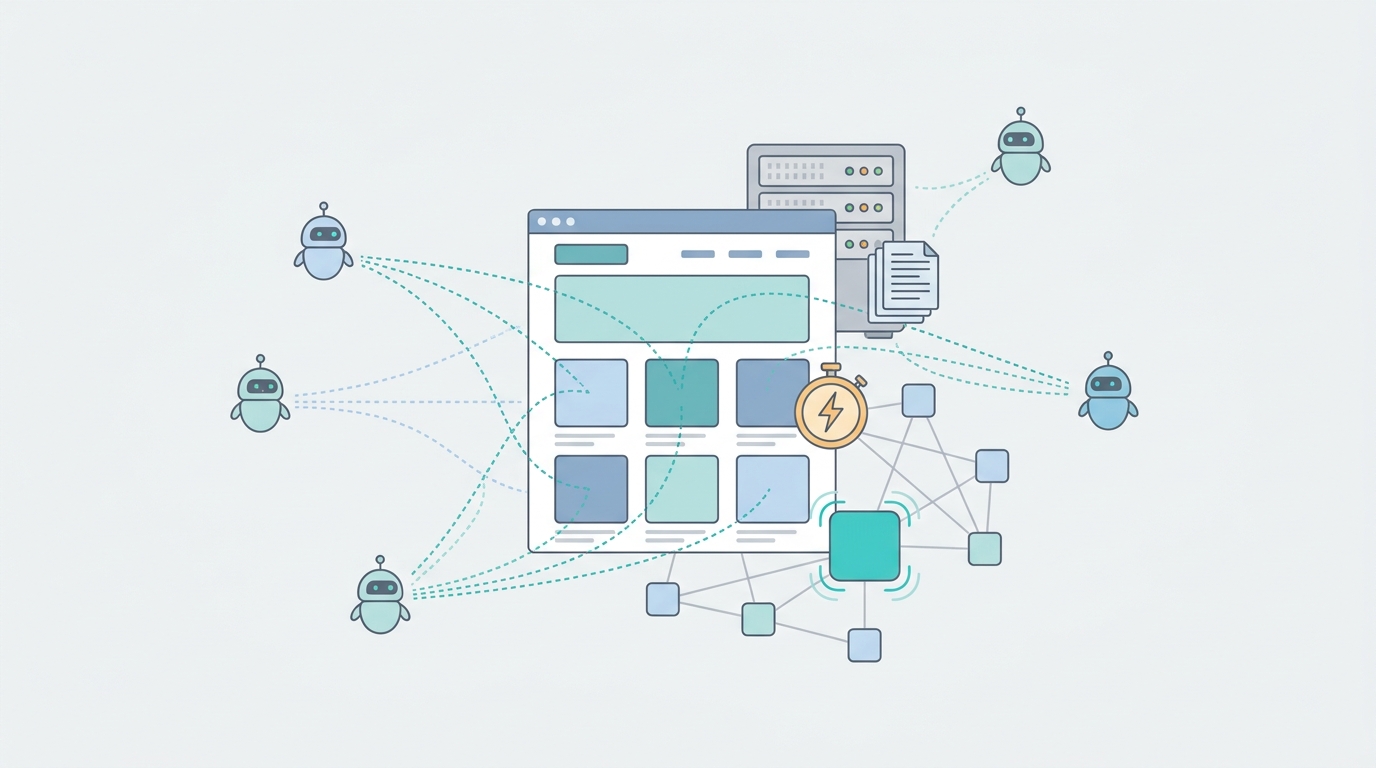
Structure every page so an AI agent can fetch and extract facts in under 200 milliseconds. Because many AI crawlers do not render JavaScript, server-side rendering is the universal solution. Therefore, prioritize pre-rendered HTML or server-side frameworks for critical pages.
Start with these technical actions
- Serve fully rendered HTML for deep pages and priority content.
- Use edge caching and a CDN to lower time to first byte. For example, consider Cloudflare to reduce latency.
- Precompute structured snippets and facts as plain HTML so agents can read them without interaction.
Actionable content structure rules
- Lead with extractable facts in the top 200ms view. Consequently, put key data in the first visible DOM nodes.
- Use semantic HTML elements and schema microdata to signal facts. However, do not rely on JavaScript to inject those facts.
- Keep page load independent from user interaction. If information only appears after clicks, it will not exist for these crawlers.
Use server logs to validate delivery
Logs prove what machines actually saw. As JetOctopus notes, “The machines are searching. The question is how quickly you can see what’s actually happening.” Therefore, integrate log analysis into your cadence. Tools like JetOctopus Log Analyzer make this step reproducible and fast.
Internal linking and AI visibility for deep pages
Internal linking elevates deep pages so AI agents can find them. If a page requires more than four clicks, elevate it. The fix is internal linking that reduces click depth and increases crawl priority.
Practical internal linking checklist
- Audit your site for deep pages that drive citations.
- Create hub pages that summarize and link to those deep pages.
- Ensure each hub is reachable within four clicks from a major index page.
- Use XML sitemaps to list priority URLs but treat them as a supplement, not a substitute.
Performance and crawl schedule
AI agents often visit deep pages about once per month. Therefore, keep critical pages fresh and lightweight. Use server-side rendering to guarantee content delivery. Google documents JavaScript and SEO behavior at Google, which supports server-side approaches for consistent indexing.
Final tactical tips
- Measure render time for key DOM nodes and optimize to hit under 200ms.
- Prioritize pages crawled by training bots but not user bots; these are high priority.
- Regularly review robots.txt because it remains a primary lever for controlling crawler access.
Following these steps improves AI visibility, preserves citation potential, and protects your organic presence as machine-driven search expands.
AI visibility: AI crawler behaviors and best practices
This table compares common AI crawlers and shows technical requirements and optimizations. Use it to tailor tech SEO and preserve AI visibility.
| Crawler Name | JavaScript Rendering | Robots.txt Respect | Visit Frequency | Optimization Tips |
|---|---|---|---|---|
| ChatGPT (web browsing) | No; does not reliably execute JavaScript | Varies by implementation; may follow site rules | Irregular; on-demand or sparse | Serve server-side rendered HTML; expose facts in top DOM; add schema markup |
| Perplexity (PerplexityBot / Perplexity-User) | No | PerplexityBot respects robots.txt; Perplexity-User may ignore it | Monthly for training bots; user bots vary | Use robots.txt to manage training crawlers; serve pre-rendered content; monitor logs |
| Claude (Anthropic) | No | Generally respects robots directives | Sparse; periodic | Provide plain HTML facts; use semantic HTML and schema; reduce click depth |
| Gemini (Google-backed) | Partial; uses Google Web Rendering Service for some pages | Generally respects robots.txt like Google | Follows Google crawl schedules; more frequent for high-priority pages | Ensure server-side rendering for key pages; optimize Core Web Vitals; use XML sitemaps |
| Googlebot | Yes; executes JS via rendering service | Respects robots.txt | Frequent for indexable content; varies by priority | Use server-side rendering for critical facts; keep pages lightweight; monitor GSC API |
Notes
- AI crawlers do not consistently render JavaScript; server-side rendering is the safest approach.
- PerplexityBot respects robots.txt, but Perplexity-User does not.
- The fix: Elevate your deep pages with internal links so they are reachable within four clicks.
Using server logs and technical fixes to preserve AI visibility
Why server logs matter for AI visibility
Server logs record exactly what bots requested and what they received. Because AI crawlers often visit deep pages just once per month, logs show which pages machines saw. As JetOctopus reminds us, “The machines are searching. The question is how quickly you can see what’s actually happening.” Therefore, logs are your primary source for diagnosing phantom impressions and crawl gaps.
Detect phantom impressions and crawl issues
- Identify pages that training bots crawl but user bots never reach. These are high priority.
- Look for 200 responses that return stripped or client-side rendered content. If facts only load via JavaScript, the bot saw nothing.
- Track user agent strings to separate training bots from user bots. For example, PerplexityBot behaves differently than Perplexity-User.
- Note visit frequency. AI agents often visit deep pages roughly once a month, so you must correlate crawl timestamps with content changes.
Actionable technical fixes
- Serve fully rendered HTML to bots. Consequently, switch critical templates to server-side rendering or pre-rendering.
- Reduce time to first byte with a CDN and edge caching. For instance, evaluate Cloudflare to cut latency.
- Expose extractable facts near the top of the DOM so agents can parse them in under 200 milliseconds.
- Harden robots.txt and monitor its effects because it remains your primary lever for crawler access.
Analyze with JetOctopus tools
Use log analysis platforms to automate detection and alerts. For example, JetOctopus Log Analyzer helps you parse large logs quickly. Visit the product page at JetOctopus Log Analyzer to learn more. Also, configure JetOctopus Alerts at JetOctopus Alerts to trigger notifications for dropped pages or sudden crawl changes.
Cross-check with industry guidance
Research supports logs as an SEO tool. See Search Engine Journal’s coverage on log file analysis for practical advice. Additionally, follow Google’s JavaScript SEO guidance to confirm rendering behavior.
Quick operational checklist
- Export logs weekly and filter by AI training user agents.
- Flag pages where bots received empty or interactive-only content.
- Prioritize fixes for pages crawled by training bots but never hit by user bots.
- Add alerts for spikes in 4xx or 5xx responses from known AI crawlers.
Regular log analysis plus targeted technical fixes will preserve and grow your AI visibility. As a result, you secure citation potential and keep machine-driven impressions from becoming phantom traffic.
Conclusion: Secure AI visibility with Case Quota
AI visibility is now a business imperative for legal firms. Without machine-readable facts, automated systems will not cite your pages. Therefore, tech SEO audits must prioritize bots as first-class users.
Adopt server-side rendering, shallow click paths, and extractable snippets. In practice, pre-render deep pages and minimize DOM render time. Moreover, lead with facts that parse in under 200 milliseconds.
Use server logs to detect phantom impressions and crawl gaps. JetOctopus and similar tools help automate detection. As a result, you can prioritize fixes that matter.
Case Quota helps small and mid-sized law firms implement these advanced strategies. They combine technical audits, log analysis, internal linking, and content restructuring to drive market dominance. Visit Case Quota to learn how they tailor AI visibility strategies for legal practices.
Their process focuses on measurable outcomes. For example, they map deep pages, enforce four-click reachability, and ensure server-side delivery. Consequently, firms convert machine-driven impressions into real clients.
Finally, adopt a monthly cadence for audits and alerts. This keeps your AI visibility durable as agents evolve. With Case Quota you get both strategy and operational execution. Start now. Act today for competitive advantage. Schedule a consultation this month. Begin today.
Frequently Asked Questions (FAQs)
What is AI visibility and why does it matter for legal firms?
AI visibility means machines can find and extract facts from your site. Because AI crawlers index and cite content, visibility affects citation and referral traffic. Legal firms should care because dense case facts and precedents often live on deep pages. If an AI agent cannot read those facts, your pages will not appear in machine-generated answers. Therefore, prioritize server-side rendering, clear semantic HTML, and shallow click depth to retain visibility.
How can I test whether AI crawlers extract facts from my pages?
First, check server logs for AI user agents. Next, confirm bots receive fully rendered HTML instead of interactive-only content. Use a log analysis tool like JetOctopus Log Analyzer to automate detection. Also, simulate crawlers with curl and headless requests. Finally, measure DOM render timing and aim to expose key facts within 200 milliseconds.
What quick technical fixes restore crawlability and AI visibility?
– Serve pre-rendered HTML or use server-side rendering for critical pages.
– Move extractable snippets into the top DOM nodes.
– Reduce time to first byte with a CDN and edge caching.
– Harden robots.txt to control training crawlers while monitoring effects.
These steps address JavaScript rendering gaps and make facts reachable to AI agents.
Do canonical tags, noindex, or LLM.txt affect AI crawlers?
No. Canonical tags and noindex directives do nothing for many AI bots. Likewise, LLM.txt has no broad effect. However, robots.txt remains a primary lever. Therefore, use robots directives and logs to manage access and to detect phantom impressions or ignored rules.
How often should firms run tech SEO audits for AI-driven search?
Audit monthly to match typical AI crawl schedules. Because many training bots visit deep pages about once per month, a monthly cadence catches regressions early. Also, set alerts for spikes in 4xx or 5xx responses from AI crawlers. Finally, prioritize pages crawled by training bots but not user bots; those pages often yield the highest citation value.
If you follow these practices, you make your legal content machine-readable. As a result, you preserve citations and convert machine-driven impressions into client leads.