

AI-driven SEO KPIs and executive reporting for law firms
AI-driven SEO KPIs and executive reporting must change because search is changing. AI Overviews and machine answers create a zero-click environment. As a result, click metrics alone no longer tell the whole story. Law firm marketers must measure influence, visibility, and financial outcomes. This introduction explains why and what to track.
Search behavior evolved rapidly. A randomized field experiment found a 38% drop in organic clicks when AI Overviews appear. Zero-click searches rose dramatically on queries with AI answers. Moreover, top desktop CTRs fell in many informational queries. Therefore, firms that focus only on ranking and clicks see shrinking signals. However, some brands grew organic revenue by targeting high-intent pages. That shows measurement can shift from volume to value.
Executive reporting must speak the language of revenue. Translate impressions and brand mentions into pipeline, revenue influenced, customer acquisition cost, and return on investment. CFOs and CMOs care about cash flow and efficiency, not average position. Consequently, SEO teams should map keyword clusters to stages of client intent and value. Then attribute influenced deals to content and technical work. This approach makes the case for budget and for strategic shifts.
For law firms the stakes differ. Liability, verifiability, and reputation matter more than ever. Therefore identity markup, clear organization data, and verifiable citations help protect firms and improve machine trust. In the sections that follow we outline AI-aware KPIs, executive reporting templates, and technical fixes. Read on to learn how to reframe SEO as a revenue-driving, risk-aware marketing function.
AI-driven SEO KPIs and executive reporting: Changing SEO Landscape in an AI-Overview World
The rise of AI Overviews has rewritten how users interact with search engines. As a result, traditional KPIs like click-through rate impressions and organic click volume no longer paint the full picture. A randomized field experiment found a 38% drop in organic clicks on queries where AI Overviews appeared (source). Moreover zero-click searches jumped from 54% to 72% in those same queries according to follow-up analyses (source). Therefore SEO teams must read these signals differently.
For law firms the shift feels immediate and practical. Firm pages that once earned calls from informational queries now compete with a single machine answer. Consequently top-four desktop click-through rates have declined for many informational topics. In practice a search for estate planning or personal injury guidance may yield an AI Overview that summarizes the law firm landscape. Users then get an answer without leaving the search page. Thus organic traffic metrics fall even when public visibility rises.
Zero-click growth does not mean SEO is dead. However it does demand new measurement tactics. Teams should track impressions in AI features branded mentions and inclusion in answer boxes. Google Search Console shows impressions from AI Search features and can be a primary data source. At the same time treat impressions as influence metrics and map them to business value. For example one ecommerce brand saw overall organic sessions drop but organic revenue rose after shifting to high-intent pages and improving conversion. That outcome shows how focusing on intent and conversion lifts ROI even in a lower-click world (source).
Finally reporting must change to reach executives. CFOs want dollars not positions. Therefore translate impressions and AI Overview placements into pipeline revenue influenced customer acquisition cost and return on investment. Because law firms sell high-value services measure leads quality phone calls consult requests and influenced cases. Then present attribution models that tie content clusters to stages of client intent. In short AI-driven SEO KPIs and executive reporting must evolve from traffic counting to revenue mapping and reputation protection.
AI-driven SEO KPIs and executive reporting: Metrics Law Firms Should Track
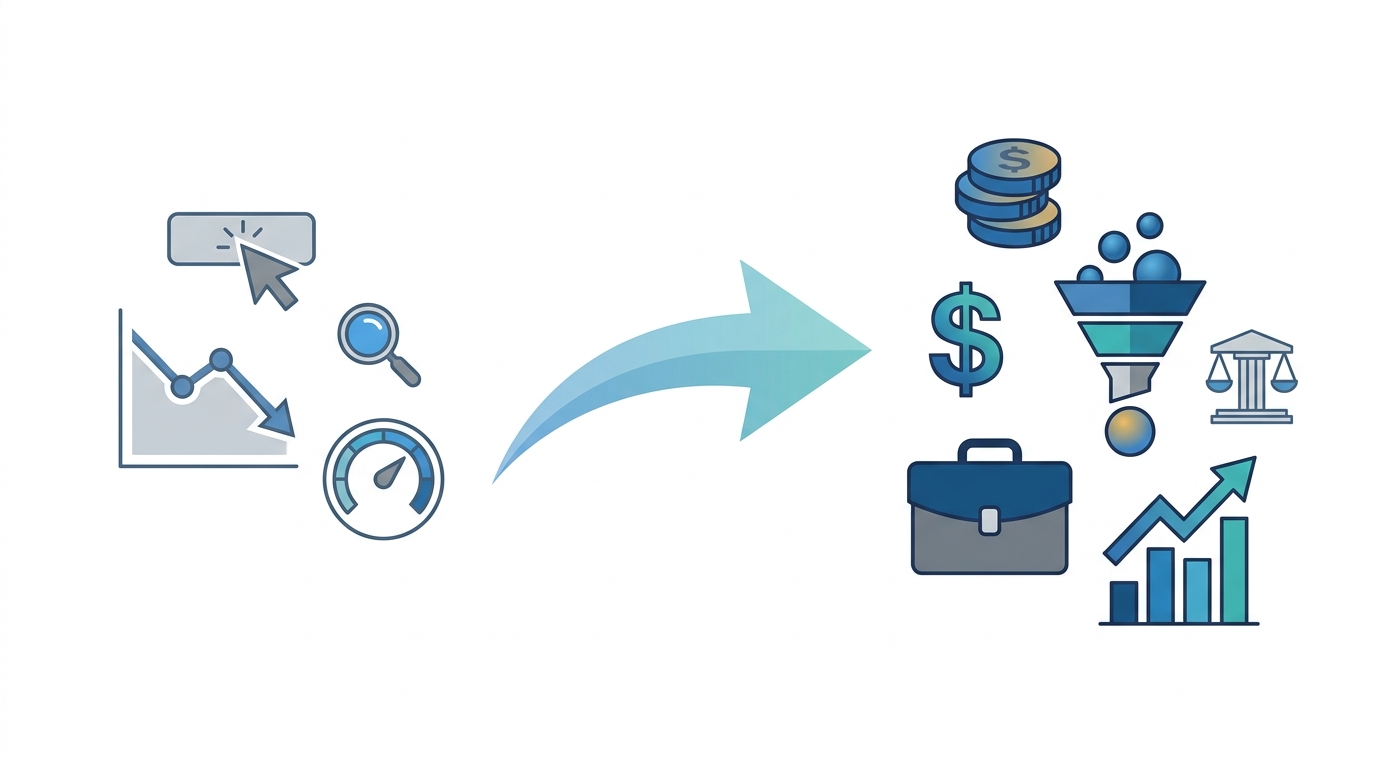
Law firms must track metrics that speak to revenue and risk. Executive audiences want dollars and defensible outcomes. Therefore SEO teams should move beyond clicks and rankings. The list below prioritizes financial outcomes and machine-visible signals.
-
Pipeline value influenced by organic search
-
What to measure: estimated pipeline from organic leads, value per lead, and deal velocity. Because law services have high lifetime value, a few cases can justify large investments.
-
Why it matters: executives ask how SEO contributes to the firm’s revenue. Present dollarized impact to secure budget. For example, “Organic search delivered $420,000 in pipeline at a $38 customer acquisition cost.”
-
-
Customer acquisition cost for organic leads
-
What to measure: total SEO spend divided by organic leads that convert to clients. Then calculate CAC per practice area.
-
Why it matters: CAC shows efficiency and compares SEO to paid channels. Therefore use CAC to prioritize high-return content and high-intent keywords.
-
-
Return on investment and revenue influenced
-
What to measure: revenue attributed and revenue influenced by content, divided by SEO costs. Use multi-touch attribution for long legal sales cycles.
-
Why it matters: ROI reframes SEO as an investment. Consequently leaders can compare SEO to other marketing programs.
-
-
Brand visibility and inclusion in AI features
-
What to measure: appearances in AI Overviews answer boxes and featured snippets, plus branded mention share. Track share of voice for the firm across queries.
-
Why it matters: “In a zero-click environment, visibility and brand mentions in AI Overviews and featured snippets are the metrics that capture influence your analytics can’t see.” Therefore visibility can drive offline searches and direct inquiries.
-
-
Impressions from AI search features and Search Console data
-
What to measure: impressions reported in Google’s gen AI performance reports and Search Console. Also monitor Merchant Center baseline visibility for product or service listings.
-
Why it matters: impressions in these features represent machine-level influence. Use the Google developer reporting tool to extract AI feature impressions and trends. See here for guidance.
-
-
Lead quality signals and contact events
-
What to measure: consult requests, phone call durations, form submissions, and booking rates from organic referrals. Then score leads by case value.
-
Why it matters: quality matters more than quantity. As a result track higher-intent conversions to show real business impact.
-
-
Conversion rate of high-intent pages
-
What to measure: conversion rate for pages optimized for consults or case intake. Also track microconversions like phone clicks and chat starts.
-
Why it matters: one ecommerce case saw traffic drop while revenue rose by focusing on high-intent pages and improving conversion. That shows optimization can offset lower overall clicks. See here for a similar tradeoff.
-
-
Reputation, verifiability, and identity markup
-
What to measure: presence of Organization schema, accuracy, citation links, and third-party verifications. Also monitor AI mentions for factual accuracy.
-
Why it matters: AI systems favor verifiable businesses. Moreover legal risk increased after courts treated AI Overviews as platform speech. Therefore firms must ensure machines can confirm their identity.
-
Practical reporting tips
- Map metrics to the funnel: align keyword clusters to awareness, consideration, and decision stages. Then attach dollar values to each stage.
- Use multi-channel attribution: because prospects cross channels, include assisted conversions and influenced deals in reports.
- Present a one-page executive summary: lead with pipeline revenue, CAC, and ROI. Then provide a diagnostic appendix with impressions and AI feature placements.
External resources for implementation
- Google gen AI performance reports overview
- Research on no-click measurement
- Zero-click and AI search statistics
These metrics convert SEO activities into financial outcomes. As a result law firm leaders see value. Therefore update dashboards to reflect influence and revenue, not just clicks.
Traditional SEO KPIs vs AI driven SEO KPIs and executive reporting
The table below contrasts old traffic metrics with revenue oriented KPIs. Use it to reframe reports for partners and executives.
| Traditional KPI | What it measures | Limitation in AI overview world | AI driven executive KPI | What it measures | How it ties to revenue |
|---|---|---|---|---|---|
| Click through rate (CTR) | Share of searchers who click a result | Falls when AI Overviews answer queries directly | Revenue influenced by organic visibility | Estimated revenue tied to organic presence | Converts visibility into dollar impact |
| Organic click volume | Session counts from search | Drops with zero click growth, so volume misleads | Pipeline value from organic leads | Estimated case value and pipeline | Shows potential closed revenue |
| Keyword rankings | Position on SERPs | Position no longer equals clicks or influence | Customer acquisition cost for organic | Cost per acquired client from SEO | Compares efficiency to other channels |
| Impressions and featured snippet presence | Number of times content appears | Impressions may not produce clicks, yet show influence | Brand visibility and mentions in AI features | Frequency of brand appearing in AI answers | Drives offline searches and direct inquiries |
| Micro conversions | Clicks, time on page, forms | Metrics lose signal as pages get fewer clicks | Conversion rate of high intent pages | Consult requests and booking rates | Directly links content to new clients |
| Citation and identity signals | Schema and verifiable citations | AI favors verifiable businesses, so risk matters | Reputation and verifiability score | Presence of identity markup and third party confirms | Protects firm and preserves revenue opportunities |
Use this table to plan dashboards. Then lead reports with pipeline CAC and ROI. Finally, attach diagnostic detail on impressions and AI feature placements.
Conclusion: AI-driven SEO KPIs and executive reporting for law firms
AI-driven SEO KPIs and executive reporting must become central to every law firm’s marketing strategy. Because search now often answers without clicks, firms must measure influence and revenue, not just traffic. Consequently reports should lead with pipeline, CAC, and ROI to win budget and strategic support.
Traditional metrics still matter for diagnosis. However they no longer move the C-suite alone. Therefore translate impressions, AI Overview placements, and brand mentions into estimated pipeline and revenue influenced. Then show CAC per practice area and ROI for content programs. This approach reframes SEO as an investment, not a cost.
Firms also face new reputation and legal risks. For example courts now treat AI Overviews as platform speech, which raises liability and verifiability stakes. As a result identity markup and accurate citations become both safety measures and ranking assets. Because machines prefer verifiable businesses, technical work supports both trust and visibility.
Case Quota helps law firms operationalize these changes. As a specialized legal marketing agency, Case Quota brings Big Law strategies to small and mid sized firms. They design reporting that ties SEO to cash flow and competitive positioning.
Start by updating dashboards and stakeholder narratives. Lead with financial outcomes, then layer diagnostic SEO signals. If you adopt advanced metrics now, you gain a measurable advantage in a zero click world. Therefore move from counting clicks to proving value.
Act now because budget cycles favor measurable programs. Contact your marketing lead and ask for a revenue centered SEO dashboard.
Frequently Asked Questions (FAQs)
Why are traditional SEO metrics like CTR and organic clicks less effective now?
Traditional metrics measure user clicks and position. However, AI Overviews often answer queries without clicks. A field study found a 38 percent drop in organic clicks where AI Overviews appear. As a result, zero click searches can rise dramatically. Therefore, click volume and raw CTR no longer show influence. Track impressions in AI features and brand mentions instead. Then map those signals to business outcomes.
How should law firms measure SEO ROI in an AI driven world?
Start by tying SEO activity to dollar outcomes. Measure pipeline value from organic leads and revenue influenced by content. Next, calculate customer acquisition cost for organic clients per practice area. Use multi-touch attribution because legal sales cycles involve many touches. Also, report conversion rates on high intent pages like consult forms and booking pages. Finally, present CAC and ROI up front to the executive team.
What immediate impacts does AI make on day to day SEO work?
AI changes visibility and the data you can use. For example, a single AI answer can reduce page clicks while still increasing brand exposure. Consequently, teams must optimize for machine readability and verifiability. Implement identity markup and structured data so machines confirm who you are. Because liability and accuracy now matter, firms must monitor AI mentions for errors and correct them.
How can a firm protect itself from AI misinformation and legal risk in search?
Begin by auditing what AI already says about your firm. Then add Organization schema and verifiable citations to core pages. Monitor AI Overviews and featured snippets for factual errors. If you find mistakes, escalate corrections through publisher channels and claim ownership of your verified identity. Courts treat some AI outputs as platform speech, so accuracy and verifiability are now legal and reputational safeguards.
What are best practices for executive SEO reporting?
Lead with three numbers: pipeline, CAC, and ROI. Provide a one-page executive summary that shows dollar impact. Then include a diagnostic appendix with impressions, AI feature placements, and high intent conversion rates. Use short narratives to explain shifts because “numbers without narrative are forgettable.” Finally, update dashboards each budget cycle to keep SEO tied to financial planning.