
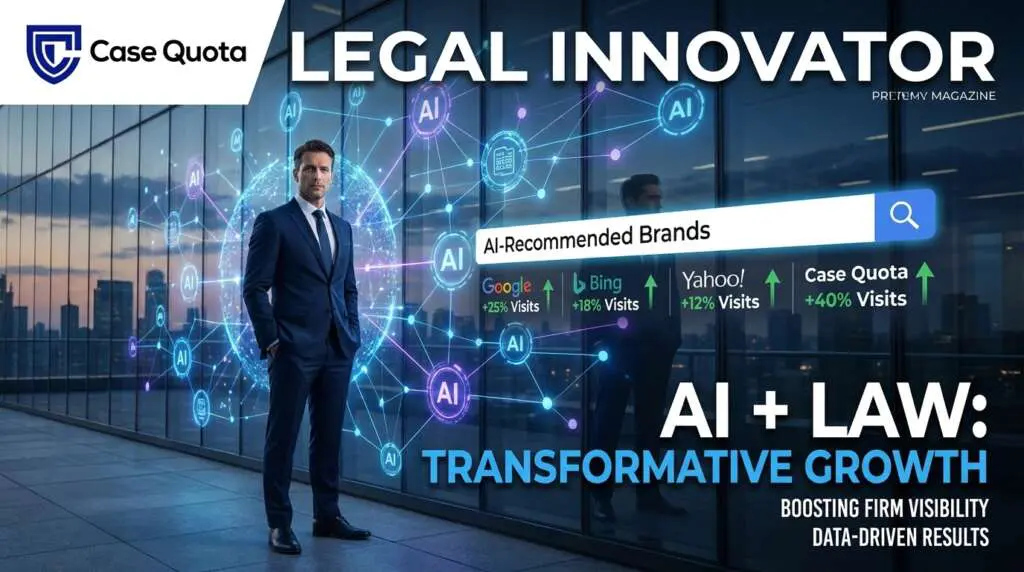
AI-recommended brands: How They Boost Law Firm Advertising Success
AI-recommended brands are reshaping paid search and PPC for law firms. As AI powered recommendation engines surface brand names, firms gain more branded searches and direct clicks. Because these recommendations influence discovery, law firms can capture higher intent traffic faster.
In an AI first search landscape, data matters more than ever. Similarweb reports show recommended brands were 2.5 times more likely to receive a site visit within seven days. Therefore, firms that align paid search with AI visibility can unlock measurable gains in engagement and lead volume. For example, users who found a site after an AI suggestion viewed about 12 pages and stayed near 11.8 minutes. This suggests deeper interest and better conversion potential.
Key advantages of embracing AI-recommended brand strategies include
- Increased branded search volume leading to more qualified prospects
- Longer pages per visit and higher time on site which supports conversion
- Better paid search efficiency because ads appear alongside AI influenced discovery
- Improved lead quality as AI nudges users toward trusted names
This introduction sets an analytical and promotional tone. It frames AI-recommended brands as a practical lever for law firms to expand paid search ROI. Continue reading for tactical steps, data interpretation, and campaign examples that deliver predictable results.
How AI-recommended brands improve PPC for law firms
AI-recommended brands change how potential clients discover legal services. Because AI tools surface trusted names, paid search campaigns can capture that surge in intent. Law firms that pair paid search with AI visibility convert more prospects into leads. As a result, firms see stronger branded search signals and higher lead volume.
Why this matters
- Brands appearing in AI recommendations were 2.5 times more likely to receive a site visit within seven days. This data point comes from Similarweb and highlights immediate discovery benefits.
- Among users who visited a recommended brand, 55.9 percent of traffic came from branded searches, which shows searchers often follow up after an AI mention.
- Users who arrived via a ChatGPT-influenced search viewed roughly 12 pages and stayed about 11.8 minutes. By contrast, other visitors viewed 6.5 pages and stayed about 5.6 minutes. These metrics suggest deeper engagement and stronger conversion potential.
Integrating AI-recommended brands into paid search strategy
- Protect and amplify branded assets
- Bid on your brand terms and variants to ensure ad presence when AI drives branded search.
- Use extensions and sitelinks to surface high-value pages.
- Monitor branded queries and update ad copy to reflect AI-driven discovery.
- Map the AI to traditional search flow
- Treat AI recommendations as a top-of-funnel signal that feeds traditional search.
- Coordinate bids and landing pages so paid search catches users who move from AI to Google or other engines.
- Track assisted conversions and multi-touch paths to measure true impact.
- Optimize for AI visibility and branded search
- Increase domain authority for trust signals because AI systems favor reputable brands.
- Produce concise answer pages and clear contact CTAs so users convert after AI discovery.
- Test high-intent landing pages aimed at returning visitors who search your firm by name.
Tactical recommendations and measurement
Measure both immediate and downstream effects. For example, track seven-day lifts in branded search and compare pages per session. Likewise, use multi-channel attribution to capture AI’s role in the conversion path. As Matt G. Southern reported in Search Engine Journal, Similarweb’s data shows how AI tools can alter referral and search patterns, so adjust your PPC reporting accordingly.
Caution and interpretation
Note that the data only shows a correlation, not that AI directly caused longer visits. However, when a user searches a brand after an AI recommendation, it indicates that AI and traditional search often work together. Therefore, law firms should treat AI-recommended brands as a measurable lever. When used with disciplined bidding and landing page optimization, it can increase visibility, engagement, and lead volume.
AI-recommended brands performance comparison
| Metric | AI-Recommended Brands | Non-Recommended Brands |
|---|---|---|
| Relative likelihood of a site visit within seven days | 2.5x | Baseline (1x) |
| Branded search share of traffic | 55.9% | Not reported |
| Pages per visit | 12.0 | 6.5 |
| Average time on site | 11.8 minutes | 5.6 minutes |
| Data scope | US desktop activity; finance travel beauty categories | US desktop activity; finance travel beauty categories |
Notes and sources
- These figures come from Similarweb research and reporting by Search Engine Journal. See the Similarweb study for details.
- Related coverage and interpretation are available at Search Engine Journal.
- Note that the data shows correlation, not proof that AI directly caused longer visits. However, when users search a brand after an AI suggestion, AI and traditional search often work together.
Implications for law firms
- Because branded search rises after AI recommendations, protect and bid on brand terms.
- Therefore optimize landing pages for returning visitors to convert higher-intent traffic.
- Use multi touch attribution to capture AI driven assists and measure true ROI.
This table gives clear, data driven evidence that AI-recommended brands produce larger engagement metrics. Law firms can use these signals to prioritize branded PPC and landing page optimization.
Branded visibility and AI-recommended brands placements
AI-recommended brands amplify branded results and SEO relevance for law firms. Because AI tools often surface trusted names, firms that secure branded visibility gain more site visits and better engagement. As a result, paid search and organic strategies work together to capture users who move from an AI suggestion to traditional search.
Why branded visibility matters now
- Brands recommended by AI were 2.5 times more likely to receive a site visit within seven days. Therefore, AI placements act as an early discovery signal that feeds search intent. See the Similarweb study for full details: Similarweb Study.
- Among users who visited a recommended brand, 55.9 percent of traffic came from branded searches. This shows that AI prompts often lead to explicit brand queries.
- Engagement metrics rose significantly. For example, AI influenced visitors viewed 12 pages on average and stayed about 11.8 minutes. By contrast, other visitors viewed 6.5 pages and stayed roughly 5.6 minutes. These figures suggest higher intent and more time for persuasion.
How AI placements increase site visits and lead volume
-
Increase discovery and follow up searches
- AI suggestions introduce your firm to potential clients. Consequently, those users often follow up with a branded search.
- Therefore ensure your paid search presence and landing pages match the expectations set by AI mentions.
-
Lift the value of branded search and SEO
- Because branded results attract higher intent, teams should protect brand keywords in PPC auctions.
- At the same time optimize your SEO to present clear answer pages that AI and users prefer.
-
Improve engagement through content design
- Create multi page journeys with clear next steps. As a result users stay longer and consume more content.
- Use contact prompts and streamlined intake forms to convert returning visitors.
Tactical checklist for law firms
- Audit brand availability across AI platforms and search engines.
- Bid on brand variants and competitor comparisons to capture intent transitions.
- Build concise pages that answer common legal questions and include clear conversion paths.
- Track seven day lifts in branded traffic and monitor pages per session to measure AI impact.
Measurement and interpretation
Measure both assisted and last click conversions. Likewise use multi touch models to reveal AI driven assists. Matt G. Southern and others have highlighted Similarweb findings in Search Engine Journal, so treat the data as directional and evidence based: Search Engine Journal. Note that the data shows correlation, not causation. However, when users search a brand after an AI recommendation, it indicates that AI and traditional search often work together.
In summary, AI recommended brands expand discovery, lift branded search, and amplify engagement. Therefore, law firms that prioritize branded visibility and coordinated PPC strategies can increase site visits and lead volume.
CONCLUSION
AI-recommended brands offer law firms a measurable path to higher visibility and lead volume. Similarweb data shows a 2.5 times uplift in site visits within seven days. Because branded searches accounted for 55.9 percent of followup traffic, those searches matter.
Visitors who followed AI suggestions viewed about 12 pages and stayed 11.8 minutes. By contrast, other visitors averaged 6.5 pages and 5.6 minutes. Therefore firms can expect deeper engagement from AI-driven discovery.
Use branded search bidding, focused landing pages, and SEO that improves AI visibility. Additionally, monitor branded results and SEO signals. Coordinate paid search with organic and AI placements to capture multi touch journeys. Track seven day lifts, pages per session, and assisted conversions to prove impact.
For firms without the resources to build this capability in-house, partner with experts. Case Quota helps small and mid sized law firms adopt Big Law strategies. They deliver AI aware paid search, branded results optimization, and conversion centered landing pages.
Note that the data shows correlation, not definite causation, so test carefully. However, when AI and traditional search align, firms gain measurable engagement and better lead quality. Adopt a test and scale approach to improve ROI over time. Start with small, measurable pilots.
Frequently Asked Questions (FAQs)
What are AI-recommended brands?
AI-recommended brands are companies that AI systems surface as trusted options. ChatGPT and other recommendation engines suggest these names during user interactions. As a result, users may follow up with branded search queries. In short, AI recommendations act as discovery cues that feed traditional search.
How can AI-recommended brands improve PPC and branded search performance?
AI-recommended brands can lift paid search results and branded visibility. For example, Similarweb found recommended brands were 2.5 times more likely to get a site visit within seven days. Also, 55.9 percent of followup traffic came from branded searches. Because users who followed AI suggestions viewed about 12 pages and stayed 11.8 minutes, engagement rose sharply. Therefore law firms can expect higher intent visits and better conversion opportunities.
What practical steps should law firms take to capture AI driven intent?
- Protect your brand terms in PPC auctions and bid consistently.
- Align landing pages with the tone and answers AI sets.
- Improve SEO so concise answer pages appear in AI training and outputs.
- Audit visibility across AI platforms and search engines regularly.
- Track multi touch paths to connect AI mentions to leads.
How should firms measure the impact of AI placements on leads and engagement?
Measure short and medium term signals. Track seven day lifts in branded search volume. Monitor pages per session and average time on site. Use assisted conversion and multi channel attribution to capture AI driven assists. In addition, run A B tests to validate causation versus correlation.
What are the limitations and risks to consider?
Note the data is correlational not causal. Also Similarweb data focused on US desktop and select industries. Therefore test on your market and device mix. Be mindful of privacy rules and platform changes, and adapt campaigns accordingly.