

AI-driven local search and evolving social media dynamics: a critical wake up call for multi location law firms
AI-driven local search and evolving social media dynamics are rewriting how potential clients find and choose legal services. For multi location law firms, this shift demands new strategy and faster execution than traditional SEO. Because discovery now moves from intent to AI agent to immediate action, firms must adapt quickly.
Maps, reviews, local content, location data, and engagement all feed AI decision layers. As a result, appearing in AI summaries matters more than ranking on page one. Social channels influence trust and shape the decision making phase for legal services. However, social signals are fragmenting across niche communities and new platforms.
Therefore, firms need consistent local presence and authentic reputation management at scale. Because many firms operate hundreds or thousands of locations, the challenge is operational. This is why a phased 90 day AI ready plan matters for enterprise GEOs. It helps align maps, reviews, content signals, and brand trust across sites.
In short, the stakes are high and the window to adapt is short. So read on to learn tactical steps and AI first local visibility best practices. Action now preserves market share and converts social interest into measurable local leads. Multi location firms that ignore AI mediated discovery risk losing clients to faster, AI optimized competitors.
AI-driven local search: how AI aggregates signals for local visibility
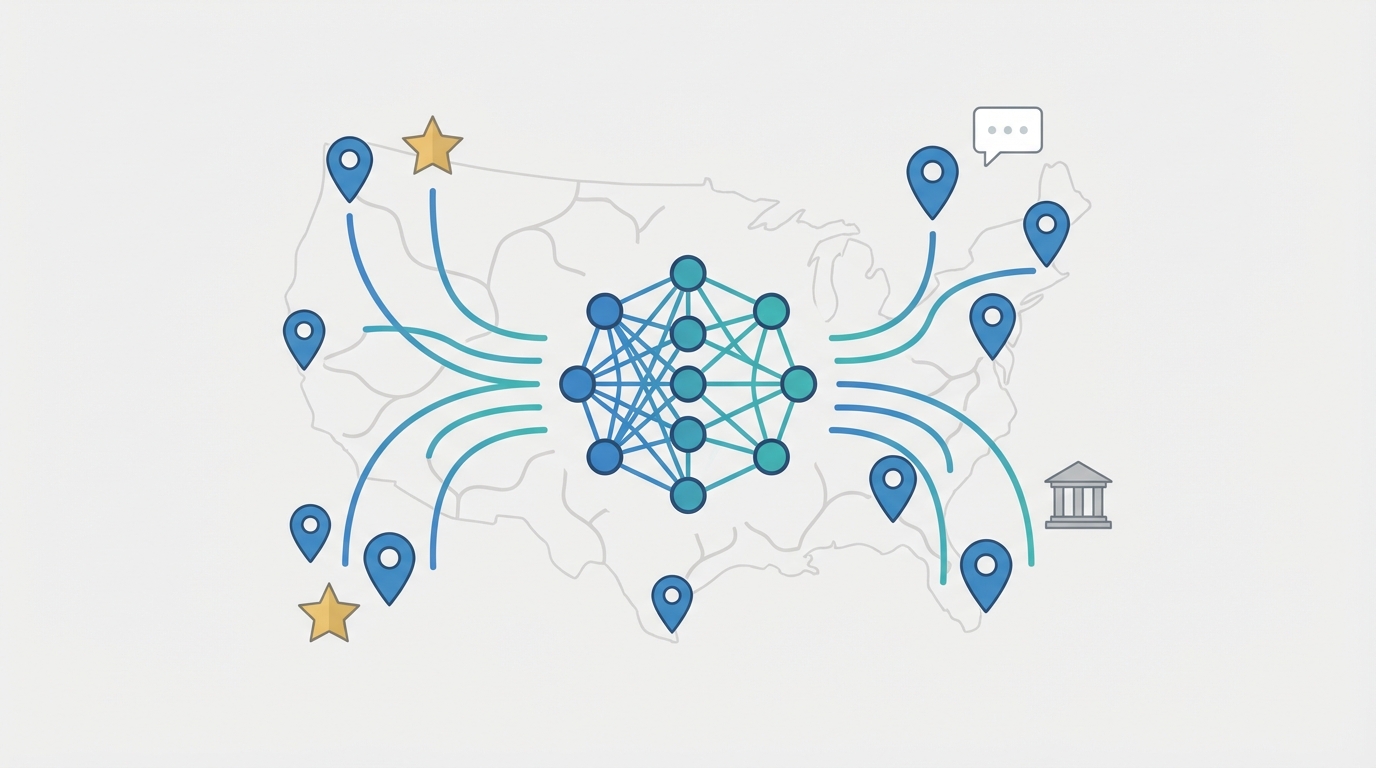
AI-driven local search changes how multi-location law firms win local clients. AI models now aggregate maps, reviews, content, location data, engagement, and brand trust to rank local outcomes. As a result, firms that optimize only for keywords will fall behind. Therefore, your local marketing strategy must focus on signal quality and scale. Because hundreds of locations mean hundreds of signal sets, a centralized approach matters.
Key elements AI systems evaluate include
- Maps and local listings accuracy, because location consistency reduces friction and increases AI confidence
- Reviews and sentiment, since rating trends influence recommendations and conversion likelihood
- Local content relevance, including practice area pages and neighborhood pages that match intent
- Location data signals such as precise coordinates, hours, and service areas that feed geospatial models
- Engagement signals from clicks, calls, bookings, and social interactions that indicate real world intent
- Brand trust and authority, measured across citations, backlinks, and local partnerships
For multi-location law firms this means practical shifts in tactics. First, centralize your location data repository. Second, ensure each office has a verified, complete listing. Third, capture and respond to reviews at scale. For example, a firm with 250 offices can deploy templated review workflows to drive faster responses and legal-practice specific follow ups. Meanwhile, rich local pages for specific practice areas—for example personal injury in Phoenix—help AI link intent to the nearest qualified office.
Leveraging location data and local content for decision moments
Location data is no longer passive. Instead, it powers intent mapping and AI agent routing. For instance, precise service area polygons help AI decide which office to recommend. Therefore, use structured data and normalized address formats. In addition, feed your canonical location dataset into tools and platforms that display and syndicate listings.
Practical use cases for law firms
- Reputation at scale: Aggregate reviews from Google and directories and prioritize responses by severity. This improves conversion and local trust
- Call and lead routing: Use location data plus practice tags to route leads to the right office, reducing handoffs and increasing conversion
- Local content templates: Create scalable templates for common legal queries and adapt them per location. For example, workers compensation pages tailored by state increase relevance
- Competitive gap analysis: Monitor maps and review share to find underperforming markets and reallocate paid media budgets
Tools and signals to monitor
- Verified Google My Business and performance reports via Google Search Console: Google Search Console
- Enterprise location management and AI signal aggregation platforms such as Uberall: Uberall
In summary, AI-driven local search forces multi-location law firms to treat location data, reviews, and local content as first class assets. As a result, firms that build centralized workflows and scalable content systems will win more decision-making moments and convert AI-led discovery into steady local leads.
Evolving social media dynamics and the shift to AI mediated discovery
Social networks no longer act only as broadcast channels. Instead, they feed AI agents that summarize and route intent. As a result, law firms must rethink content, community, and credibility. Because social media signals now migrate into search results and AI summaries, firms should treat social posts as structured inputs. In addition, behavior fragmentation across platforms reduces the value of any single channel. Therefore, a broader strategy that favors signal consistency matters more than ever.
Trust in platforms and why it matters
Trust in platforms has declined, and this affects legal marketing. For instance, broad studies show waning user trust in social posts. See the Pew Research Center findings for details. Consequently, law firms can no longer rely on platform reach alone. Instead, they must build trust through verified profiles, transparent reviews, and documented expertise. Because legal decisions carry high stakes, credibility signals matter more than flashy content.
AI summaries, niche communities, and behavior fragmentation
AI systems aggregate posts, comments, shares, and engagement to create summaries. They also surface niche communities that match specific legal needs. For example, a user seeking landlord tenant advice may encounter AI-curated threads from local neighborhood forums. Meanwhile, traditional feeds lose prominence. Therefore, firms should pursue targeted micro community engagement and local expert positioning. In addition, firms should map where intent surfaces across platforms and communities.
Expert perspective and actionable implications
Ana Martinez of Uberall captures the change clearly. She wrote that AI determines which local businesses get discovered. See Uberall for her perspective. As a result, multi-location law firms must provide the AI layer with reliable signals. For example, firms should feed AI with structured local content, precise location data, and verified review histories.
Practical adaptations for law firms
- Convert posts into structured assets because AI favors clear, factual inputs
- Engage niche communities and local groups to gain contextual signals
- Syndicate authoritative content to directories and local sites to boost trust
- Monitor social mentions and surface high intent interactions to lead-gen systems
- Use AI tools to summarize social performance and extract actionable leads
In short, the old social media playbook is out. Firms that adapt will show up in AI summaries and decision moments. Consequently, they will convert fragmented social intent into reliable local leads.
| Element | Traditional tactics | AI driven tactics | Advantage | Challenge | Practical application for multi location law firms |
|---|---|---|---|---|---|
| Discovery Process | Search then compare then decide. Rankings drive traffic. | Intent to AI agent to action. AI aggregates signals before a click. | Faster matching of intent to local office. | Opaque ranking logic and signal interpretation. | Route leads to the nearest qualified office via AI. |
| User Engagement | Likes and shares drive visibility. Engagement is surface level. | Clicks calls reviews and micro interactions feed models. | Signals reflect real intent and improve conversion. | Requires data instrumentation across channels. | Tag interactions by location and practice area to train AI. |
| Trust and Credibility | Brand control and content drive trust. Reviews act as social proof. | AI assesses sentiment review velocity and citation signals. | More granular credibility signals per location. | Negative reviews can scale quickly across AI summaries. | Prioritize review response workflows and citation management. |
| Platform Dependency | Heavy dependence on individual platform algorithms and reach. | Dependency shifts to AI models and aggregated signals. | Better cross platform outcomes when signals align. | You must maintain consistent canonical data across endpoints. | Use centralized location management to keep listings synced. |
| Content Strategy | Publish location pages and blog posts. | Produce structured local content and Q A for AI agents. | AI can match structured responses to queries instantly. | Scale personalization across hundreds of locations. | Implement templates and localization rules at enterprise scale. |
| Outcome Optimization | Focus on organic rank and PPC performance. | Optimize for AI summaries maps and conversation outcomes. | Higher intent matches and lower wasted spend. | Measuring attribution is more complex with AI layers. | Track AI driven KPIs and map them to revenue per location. |
In conclusion, AI-driven local search and evolving social media dynamics are reshaping how multi-location law firms reach, engage, and convert potential clients. Traditional methods no longer suffice in an ecosystem where AI aggregates signals before potential clients even click. For law firms, this means adapting strategies to ensure they are noticed during AI-mediated discovery processes that prioritize intent and actionable insights.
A strategic, forward-thinking approach is essential. Law firms must harness AI to aggregate maps, reviews, and local content to project credibility and enhance visibility across their locations. This shift allows them to optimize every point of engagement, ensuring that presence and reputation stand strong amidst fragmented behavior and platform migration.
Case Quota, a specialized legal marketing agency, stands ready to assist firms in navigating this new landscape. Known for delivering ‘Big Law’ strategies tailored to the needs of small and mid-sized law firms, Case Quota helps practices achieve market dominance even among rapidly changing digital terrains Case Quota. By embracing AI and evolving social media tactics, law firms can secure sustained growth and remain competitive.
Ultimately, those firms willing to embrace these technologies will not only preserve their market share but will enhance their capability to convert social media interest into robust local leads. This contemporary approach, detailed in the phased 90-day plan, ensures each location is AI-ready, fortifying their place in legal service consideration.
Frequently Asked Questions (FAQs)
How do we implement AI-driven local search for a multi-location law firm?
Start with a canonical location dataset and verify every listing. Then, add structured data and normalized addresses to feed AI systems. Next, create scalable local pages and practice area templates. In addition, route calls and leads by combining location data with practice tags. Finally, pilot a phased 90 day rollout to test signals and iterate. This approach reduces manual fixes and scales signal quality across hundreds of locations.
Will social media changes reduce our marketing returns?
Not necessarily. Because social media signals migrate into search results and AI summaries, social content still matters. However, you must shift from pure reach tactics to credibility and context building. Therefore, prioritize niche community engagement, verified profiles, and content that answers legal intent. As a result, you will preserve influence across fragmented platforms and capture AI-mediated decision moments.
How should we handle trust issues and declining platform confidence?
Focus on transparent proof points and reputation management. For instance, highlight verified reviews, lawyer bios, third party citations, and local case studies. In addition, respond to reviews quickly and resolve concerns in public threads. Because 41 percent of adults distrust social posts often, demonstrating consistent, factual signals helps AI and users trust your firm more.
How do we adapt strategy across hundreds of offices without losing control?
Centralize governance and automate repetitive tasks. Use a single source of truth for location data and push updates to listings. Then, deploy content templates that local teams can customize. Meanwhile, automate review collection and templated responses to preserve tone and compliance. Finally, measure pilot markets first, and scale what works to avoid wasted effort.
What measurable benefits should we expect from AI and social strategy changes?
Track local leads, phone calls, appointment rate, and conversion by location. Also monitor review velocity, AI visibility in maps and summaries, and average response times. In addition, map these metrics to revenue per office. Consequently, you will see clearer attribution and improved ROI when signals align across maps, reviews, content, and engagement.