

Closing the Accountability Gap in Enterprise SEO for Law Firms
In today’s world where digital visibility is a key driver of success, many law firms find themselves hindered by an accountability gap in enterprise SEO. This gap emerges when there’s a mismatch between responsibility and control, especially prevalent in large organizations where different teams contribute to SEO outcomes but none hold full accountability for the results. For law firms aiming for SEO dominance, closing this gap is not just important—it’s critical.
The accountability gap can significantly impact a law firm’s ability to achieve high search rankings. SEO results hinge on optimization across multiple domains such as content, user experience, engineering, and legal compliance. Yet, these areas often operate in silos, leading to fragmentation and misalignment. Without central ownership, the risk of underperformance increases as opportunities for enhanced visibility slip through the cracks.
Understanding why this accountability gap is crucial for law firms involves recognizing that search engines are evolving. They now incorporate AI-driven algorithms that demand seamless coordination across departments. Law firms can no longer afford fragmented approaches if they wish to maintain an edge in digital landscapes.
Thus, establishing a Center of Excellence can serve as a game-changing strategy. By promoting shared accountability and coordinated efforts, law firms can redefine SEO ownership. This approach ensures that all departments work harmoniously towards common visibility goals, reinforcing the law firm’s presence in a competitive market. This is not just about optimization—it’s about transforming organizational structures to support lasting SEO success.
Defining the accountability gap in enterprise SEO
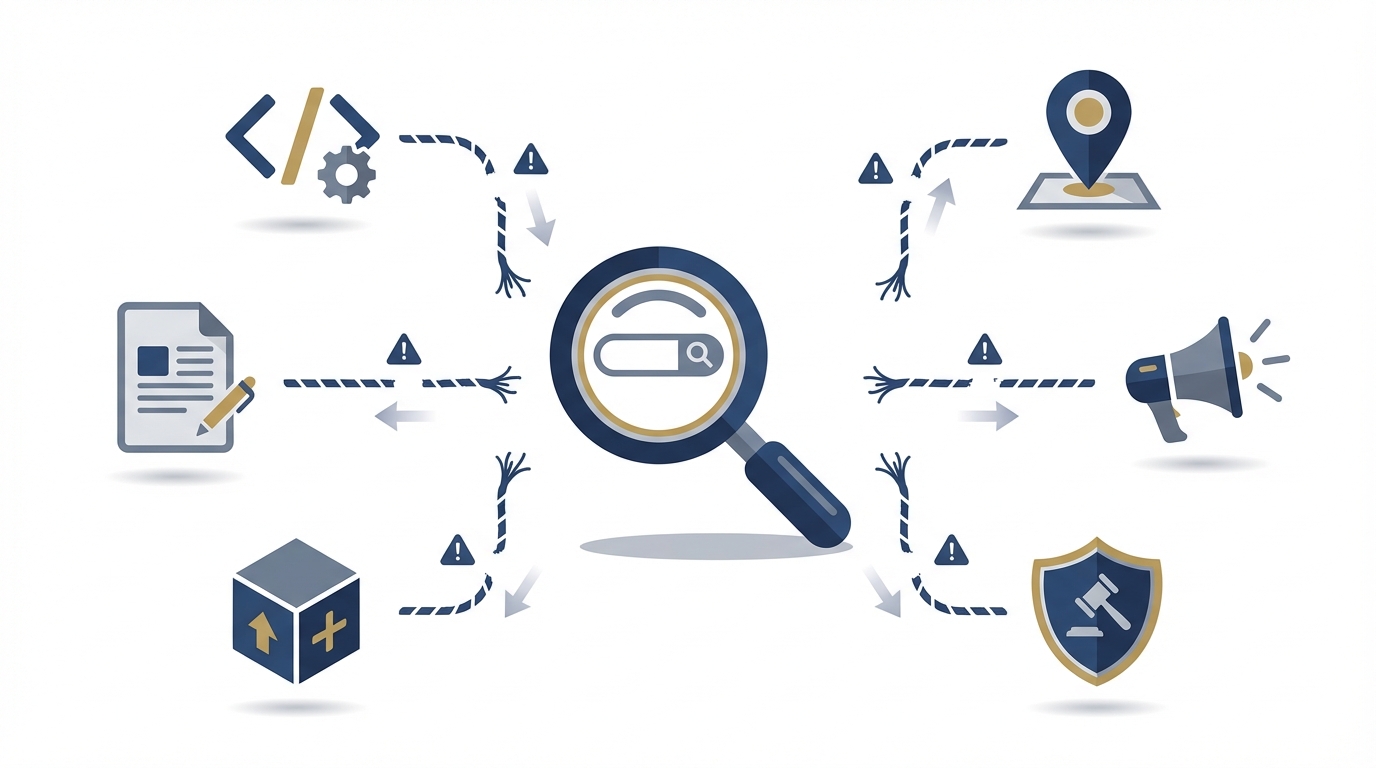
The accountability gap in enterprise SEO appears when responsibility and authority diverge. Large law firms often assign SEO to marketing. However, the decisions that truly move search results sit in engineering, product, content, legal, and local markets. As a result, SEO is measured by outcomes but cannot control the systems that create those outcomes.
What the accountability gap in enterprise SEO looks like
In practice, the gap looks like this. Who is accountable when SEO success requires coordinated changes across three departments? No one. That is not a failure of execution. It is a failure of ownership. Because teams keep their own KPIs, they resist changes that hurt short term goals. For example, engineering may prioritize site performance differently than content prioritizes topic depth. These mismatched incentives fragment workflows and make coordination optional. For more on structural failure in enterprise SEO, see this analysis: this analysis.
Why ownership matters
Ownership means both accountability and authority. Ownership without authority is not ownership. If marketing owns SEO but can’t change templates, the role becomes symbolic. Therefore, durable SEO requires structural ownership that spans policy, technical execution, and content strategy. Organizations that win redefine SEO ownership as an operational capability, not a departmental role. This shift turns persuasion into governance.
Cross-functional alignment and fragmented incentives
Cross-functional alignment prevents the KPI trap. However, alignment rarely happens by accident. You must design processes that force shared commitments. Consider how different departments affect SEO when no single team is accountable:
- Engineering controls site architecture and indexability; delays and priorities change visibility
- Product controls feature rollouts and template changes that alter content surface
- Content teams craft topical authority but often lack template control
- Legal and compliance can remove or neuter language that impacts relevance
- Local markets publish variations that create inconsistency across jurisdictions
Each department holds a piece. Yet no team owns the whole. As a result, visibility and traffic suffer. For further reading on organizational forces that undermine enterprise SEO, read: this article.
Governance versus guidelines
Governance replaces persuasion. A Modern SEO Center Of Excellence should codify rules, roles, and authority. Furthermore, AI driven search systems now lock in interpretations more slowly. For guidance on search behavior and technical expectations, review Google developer guidance.
In short, the accountability gap is a silent failure mode. Law firms must close it by aligning ownership, cross-functional processes, and governance to protect organic visibility.
Build a Center of Excellence to close the accountability gap
A Center of Excellence establishes clear ownership and enforces governance across the enterprise. For law firms, it converts symbolic roles into operational capability. Therefore, a CoE must combine executive sponsorship, shared accountability, and practical authority to change systems. Governance replaces persuasion. That quote captures the shift you must make.
Structure and executive sponsorship for shared accountability
Start with executive sponsorship that grants authority. Without it, ownership becomes ceremonial and fails. The sponsor secures budget and enforces cross-team commitments. Next, define roles that span engineering, content, product, legal, and local markets. Each role should have clear decision rights, timelines, and escalation paths. As a result, teams stop treating SEO as an optional add-on.
Core functions of an SEO Center of Excellence
A practical CoE performs five core functions:
- Strategy and roadmapping to prioritize SEO investments across markets
- Governance and standards that codify SEO-friendly processes and templates
- Technical reviews and QA to ensure indexability and performance
- Content governance to align topical authority with legal and brand controls
- Measurement and accountability to tie visibility metrics to business outcomes
These functions reduce fragmentation and create consistent incentives. In practice, organizations that win redefine SEO ownership as an operational capability, not a departmental role.
Operational playbook and SEO-friendly processes
Create an operational playbook that prescribes workflows and change control. For example, require template changes to pass SEO and accessibility checks before release. Also, embed SEO acceptance criteria into product sprints. By doing this, you prevent last-minute compromises that weaken relevance. For guidance on technical expectations and indexing, consult full developer documentation: developer documentation.
Governance, not guidelines
Governance must carry teeth. That means enforcing standards through release gates and reporting. Furthermore, the CoE should host a cross-functional steering committee that meets regularly. This committee arbitrates trade-offs and resolves KPI shielding where teams hide behind local metrics. If necessary, the CoE can escalate unresolved conflicts to the executive sponsor.
Quick implementation checklist
- Secure sponsor and charter authority
- Define cross-team roles and RACI for SEO decisions
- Build SEO acceptance criteria for releases and templates
- Centralize technical audits and content reviews
- Report visibility KPIs to executives with action items
Finally, invest in change management. Because SEO impacts product, content, tech, and legal, the CoE must translate SEO imperatives into team-level actions. Ownership becomes structural, not symbolic, when the organization aligns incentives, processes, and authority around organic visibility.
SEO ownership models compared
| Model | Ownership clarity | Accountability level | Cross-departmental coordination | Impact on SEO performance | Adaptability to AI-driven search |
|---|---|---|---|---|---|
| Fragmented departmental silos | Low. Responsibility is split across teams. Ownership unclear. | Low. No single team answers for outcomes. Blame shifts. | Poor. Coordination is optional and ad hoc. Silos persist. | Negative. Visibility and traffic suffer. The accountability gap in enterprise SEO widens. | Weak. AI systems lock on inconsistent signals. Recovery is slow. |
| Center of Excellence (CoE) | High. Clear roles and decision rights. Governance guides work. | High. Shared accountability with authority. Executive sponsorship enforces decisions. | Strong. Formal workflows and RACI enforce cross-functional alignment. | Positive. Consistent signals improve visibility and engagement. Operational capability replaces symbolic ownership. | Robust. SEO-friendly processes adapt templates and signals quickly for AI-driven search. |
Conclusion
Closing the accountability gap in enterprise SEO is the single structural fix that protects organic visibility. For law firms, this gap explains persistent losses in search share. Because many teams control pieces of SEO, no one owns the result. Therefore, visibility, traffic, and discoverability become fragile.
A Center of Excellence provides the remedy. It creates shared accountability, executive sponsorship, and enforceable governance. Governance replaces persuasion and turns symbolic roles into operational capability. As a result, teams align around SEO-friendly processes and measurable outcomes.
Case Quota specializes in helping small and mid-sized law firms build that capability. We combine practical governance frameworks with hands-on implementation support. Moreover, we embed SEO acceptance criteria into product sprints, templates, and release gates. This approach reduces fragmentation and protects rankings as search engines grow more AI-driven.
If your firm needs to close the accountability gap in enterprise SEO, start with a clear charter and sponsor. Then design a Center of Excellence that owns policy, templates, and technical change control. Finally, measure visibility metrics and escalate unresolved trade-offs to executives.
Learn how Case Quota empowers law firms to build Centers of Excellence and achieve SEO market dominance. Visit Case Quota to view our services and case studies. For strategic help that converts ownership into authority, reach out and schedule a diagnostic.
Closing this gap is not a marketing tweak. It is an organizational redesign that delivers durable search advantage.
Frequently Asked Questions (FAQs)
What is the accountability gap in enterprise SEO?
The accountability gap in enterprise SEO arises when responsibility and authority diverge across teams. In large law firms, marketing may own SEO metrics, while engineering, product, content, and legal own the inputs. As a result, no single team is accountable for end-to-end outcomes. This structural gap drives inconsistent signals and lost visibility. This gap is the silent failure mode behind many enterprise SEO problems.
Why does fragmented ownership cause SEO underperformance?
Fragmented ownership creates mismatched incentives. For example, engineering focuses on performance, content focuses on topical depth, and legal focuses on risk. Because these teams hold separate KPIs, coordination becomes optional. Consequently, SEO opportunities stall and rankings decline.
How does a Center of Excellence close the accountability gap?
A Center of Excellence creates formal governance and shared accountability. It combines executive sponsorship with clear decision rights and escalation paths. Therefore, the CoE enforces SEO-friendly processes, release gates, and template standards. As a result, teams align and the firm gains operational capability rather than symbolic ownership.
What immediate actions should law firms take to start a CoE?
Start with a charter and an executive sponsor who has real authority. Define roles, RACI, and escalation rules. Embed SEO acceptance criteria into product sprints and template approvals. Centralize technical audits and track visibility KPIs. These steps create momentum and reduce KPI shielding. Also prioritize quick wins to demonstrate value and secure sponsor support.
How will a CoE adapt to AI-driven search?
AI-driven search rewards consistent, high-quality signals across systems. Thus, a CoE must standardize metadata, content templates, and governance. It should monitor AI exposure metrics and revise templates quickly when signals harden. With shared accountability, the firm becomes more resilient to interpretation shifts. Finally, use measurement to prove ROI and adjust governance.