

When it comes to marketing for family law, everything starts with a client-first digital strategy. You have to build trust long before a potential client even thinks about picking up the phone.
Let's face it: when people are dealing with sensitive family issues, their first move is to go online. They're looking for discreet, authoritative guidance, and they're doing it from their phone or laptop. A powerful online presence isn't just a "nice to have" anymore—it's the single most important driver for attracting the high-value cases you want.
Why Your Digital Strategy Defines Your Firm Today

The days of getting by on word-of-mouth referrals alone are over. Yes, personal recommendations still matter, but the client journey almost always starts with a search engine now. Someone facing a divorce, a custody battle, or an adoption isn't just looking for a lawyer; they're looking for an empathetic expert who gets the emotional turmoil they're going through.
Your digital strategy is your firm's reputation, broadcasted at scale. It’s how you show you're an authority, a professional, and a compassionate guide. A good plan doesn't just bring in leads; it pre-qualifies them, attracting the right clients by answering their biggest questions before they even ask.
The Shift to a Digital-First Mindset
Thinking "digital-first" means you understand that every single online touchpoint—from a Google search to a blog post—is part of a potential client's decision-making process. This isn't just a trend; it's a fundamental shift.
- You Show Up When It Matters: A smart online strategy puts your firm front and center the moment someone in your area searches for help.
- You Build Trust on Autopilot: Quality content, glowing client reviews, and a professional website build your credibility 24/7, long before a consultation is ever booked.
- You Outmaneuver the Competition: Firms that invest in a solid digital plan will consistently pull ahead of those still relying on last decade's marketing tactics.
To get that edge, you need to be on top of the latest tools. That includes exploring the best AI SEO tools to dominate search that are changing how firms get found online.
It's More Than Just a Website
A truly effective digital strategy is an integrated machine, not just a collection of parts. It goes way beyond having a simple website and builds a complete ecosystem designed to attract, engage, and sign your ideal clients.
Your marketing must meet clients at the exact moment they begin seeking answers. The most successful family law firms educate first and convert later, building trust from the first click to the final consultation.
This means every piece has to work together, from your Google Business Profile to your social media updates and video content. This guide is your tactical playbook for building that machine. We'll walk you through how to create a formidable online presence that not only drives growth but cements your firm's reputation as a trusted leader in family law.
Building Your High-Converting Website Foundation
Let’s be clear: your website isn't a digital brochure. It’s your firm's hardest-working employee, your primary engine for bringing in new cases. When a potential client lands on your site, they're usually stressed, scared, and looking for an expert they can trust. Every element—the design, the words you choose, the way it’s structured—has to work together to build that trust instantly and show them exactly what to do next.
A great family law website goes way beyond generic pages. It needs a deliberate architecture that speaks directly to the specific, often painful, situations your clients are in. This is where your marketing stops being about ads and starts being about human connection.
Architect Your Site for How Clients Actually Search
Here’s a classic mistake I see all the time: a single, catch-all "Services" page. This is a massive missed opportunity. People aren't Googling "family law services." They're searching for "child custody lawyer near me" or "how do I file for divorce in Texas?" Your website has to reflect that reality.
You need to create dedicated, in-depth pages for each of your core practice areas. This isn't just good for user experience; it's absolutely critical for SEO.
- Divorce and Legal Separation: Walk them through the process, talk about realistic timelines, and address their biggest fears about dividing assets.
- Child Custody and Parenting Plans: This is where you explain the "best interests of the child" standard and break down different custody arrangements in plain English.
- Child Support and Alimony: Offer real clarity on how support is calculated in your state. Ditch the legalese and make it easy to understand.
- Adoption and Guardianship: This page needs to radiate warmth and expertise, guiding families through a complicated but incredible journey.
Each of these pages should be treated as a complete resource, answering every pressing question a potential client has. Doing this immediately positions you as the authority and dramatically increases your chances of ranking for those high-value search terms. We dive deeper into this strategy in our guide on effective web design for attorneys.
Craft Attorney Bios That Actually Build Trust
Don't underestimate your bio pages. After your practice area pages, they're the most visited part of your site. Clients don’t just hire a firm; they hire a person to see them through one of the worst times of their life. Your bio has to be more than a resume.
Your website is your chance to prove your firm's competence and empathy before a potential client ever picks up the phone. Make it easy to navigate, accessible, and a true reflection of your brand.
Instead of just a dry list of accomplishments, tell a story. Why did you choose family law? What's your philosophy for handling sensitive cases? A professional, friendly headshot is non-negotiable. Better yet, a short video introduction can be a game-changer, letting potential clients see and hear you, which builds rapport faster than text ever could.
The Technical Stuff You Can't Ignore
A beautiful website means nothing if it’s slow, broken on a phone, or inaccessible to people with disabilities. Technical excellence is the bedrock of any successful marketing plan for a family lawyer.
Key Technical Pillars
| Element | Why It Matters | Actionable Tip |
|---|---|---|
| Site Speed | A site that takes longer than 3 seconds to load loses nearly half its visitors. Speed isn't a feature; it's a requirement. | Use Google's PageSpeed Insights to test your site. A quick win? Compress every single image before you upload it. |
| Mobile-First Design | Over 60% of legal searches now happen on a phone. Your site has to look and work perfectly on a small screen. | Pull out your own phone and test every page, form, and button. If it's a pain for you, it's a deal-breaker for a client. |
| ADA Compliance | An accessible website opens your services to everyone and gives you an SEO boost. It’s the right thing to do and the smart thing to do. | Make sure your site has clear navigation, alt text for all images, and high-contrast text that’s easy to read. |
Nailing these technical details ensures every visitor has a smooth, positive experience, no matter their device or ability. That seamless usability is a quiet but powerful signal of your firm's professionalism, encouraging people to stick around and take that next step toward a consultation. Your website has to be a welcoming and functional digital front door.
Winning the Local Battle for Nearby Clients
Family law is intensely personal and, by its very nature, intensely local. A client in Los Angeles isn't searching for a lawyer in San Francisco; they need an expert right in their neighborhood who understands the local court system, the judges, and the regional nuances of family law.
This simple fact makes mastering local search the absolute cornerstone of your firm's marketing. It's not just an option; it's everything.
Your potential clients are looking for you during some of the most stressful moments of their lives. They’re typing "divorce lawyer near me" or "child custody attorney in [Your City]" into their phones, desperate for immediate, trustworthy help. Winning this local battle means your firm’s name shows up first, right when they need you most. This is about more than just having a website—it’s about owning your digital backyard.
The field is crowded. There are nearly 56,970 dedicated family law and divorce lawyers in the US, all competing for the same clients. This saturation means old-school, word-of-mouth referrals are no longer enough. Today, the firms that thrive are the ones dominating local search results.
Your Google Business Profile Is Your Digital Front Door
Forget your homepage for a second. For most local searchers, your Google Business Profile (GBP) is the real front door to your firm. It's that info box that pops up in Google Search and on the Map, and it's often the first and only impression you get to make.
Just "claiming" your profile is table stakes. You have to meticulously optimize it to stand out and earn that click.
Start with the basics, but get them perfect. Your primary category should be "Family law attorney." From there, add specific secondary categories like "Divorce lawyer" and "Child custody attorney." This precision helps Google connect you with the exact type of client you want, filtering out the noise.
Next, rewrite your business description. Don't just list your practice areas like a legal robot. Speak to the human on the other side of the screen. Try phrases like, "We guide families through difficult transitions with compassion and strength." It conveys expertise and empathy in one breath.
A well-optimized Google Business Profile does more than just list your address. It acts as a mini-website, providing answers, building trust, and giving potential clients a clear path to contact you, all without them needing to click away from the search results page.
Finally, get ahead of the game with the Q&A feature. What are the first three questions every potential client asks you? Brainstorm them—"How much does a consultation cost?" or "What should I bring to our first meeting?"—and then post both the questions and your answers directly on your profile. This instantly demonstrates your expertise and removes friction for someone looking to take the next step. For a deeper dive, check out our guide on proven Google Business Profile for attorneys tweaks to dominate local search.
Turn Client Reviews into a Powerful Marketing Tool
In family law, reputation is the currency of trust. Online reviews are the new word-of-mouth, and they are absolutely critical. You need to make asking for reviews from satisfied clients a standard, non-negotiable part of your case-closing process.
But what you do with negative reviews is arguably even more important. A single unanswered 1-star review can be a glaring red flag that scares away dozens of potential clients.
Responding promptly and professionally is key. It shows everyone—including future clients—that you take feedback seriously and are committed to your clients' experiences.
Here's a solid, professional response to a negative review:
"Thank you for sharing your feedback. We take all client experiences very seriously and are sorry to hear that we did not meet your expectations. We are committed to providing the highest level of service and would appreciate the opportunity to discuss this further with you privately."
This approach is perfect. It acknowledges the feedback, shows you care, and takes the conversation offline without ever violating client confidentiality or escalating an argument in public. It tells prospective clients you’re a reasonable, client-focused firm.
Build Authority with Local Citations
Beyond your GBP, your firm's name, address, and phone number (NAP) need to be consistent everywhere they appear online. These online listings, called citations, are foundational to local SEO. Think of them as digital proof that your firm is a legitimate, established local entity.
Focus your efforts on high-value directories where potential clients are actually looking.
- Legal-Specific Directories: Avvo, FindLaw, Lawyers.com, and Nolo.
- General Local Directories: Yelp, Better Business Bureau, and your local Chamber of Commerce.
The absolute golden rule here is NAP consistency. Even a tiny difference, like listing your firm on one site as "St." and another as "Street," can confuse search engines and water down your local authority. Use a tool to audit your citations across the web and hunt down and fix every single inconsistency. This is the grunt work that makes a massive difference, ensuring Google sees your firm as the most relevant, trustworthy answer for a local family in need.
Driving Predictable Leads With AI-Powered Ads
If you need to get your firm in front of potential clients right now, paid advertising is the fastest way to do it. While SEO is your long-game for building authority, a sharp Google Ads campaign delivers immediate visibility and a predictable flow of inquiries.
But this isn't about just flipping a switch and hoping for the best. To really make paid ads work in the family law space, you have to get inside your client's head, constantly fine-tune your approach, and have a rock-solid system for tracking what's actually driving cases. We're talking about bidding on the right keywords and, more importantly, crafting a message that connects with someone in the middle of a crisis.
Your Ad Copy Needs to Connect Emotionally
When someone searches for a family lawyer, they aren't shopping for a commodity. They're desperately seeking a solution to a deeply personal and painful problem. Your ad copy has to reflect that reality with both empathy and confidence.
Forget generic headlines like "Family Law Firm." You need to test compelling, benefit-focused copy that speaks directly to their fears and needs.
- Offer Reassurance: Try phrases like "Discreet Divorce Guidance" or "Protecting Your Children's Future."
- Showcase Your Approach: Something like "Compassionate Counsel, Strong Representation" works well.
- Give a Clear Next Step: Make it easy for them with a call to action like "Schedule a Confidential Consultation."
This isn't just about semantics. An empathetic ad cuts through the noise of sterile, corporate-sounding law firm ads and builds a sliver of trust before they even click.
Paid advertising isn't just about being seen; it's about being seen as the right choice. Your ad copy is your first, and maybe only, chance to show you understand the human side of family law, not just the statutes.
The Hidden Power of Negative Keywords
One of the easiest ways to burn through your ad budget is by showing up for completely irrelevant searches. This is where negative keywords become your best friend—and your most powerful tool for protecting your spend.
You have to be proactive and tell Google which search terms you don't want to show up for. Every single month, law firms waste thousands on clicks from people searching for things like:
- "free family law advice"
- "pro bono divorce lawyers"
- "how to represent myself in custody court"
Every one of those clicks costs you real money and has zero chance of turning into a viable case. A meticulously managed negative keyword list ensures your budget is reserved exclusively for prospects who are actually looking to hire an attorney.
This is just one piece of the puzzle. The infographic below shows how all the foundational elements of your local presence—your online profiles, reviews, and directory listings—work together to make your ad campaigns even more effective.
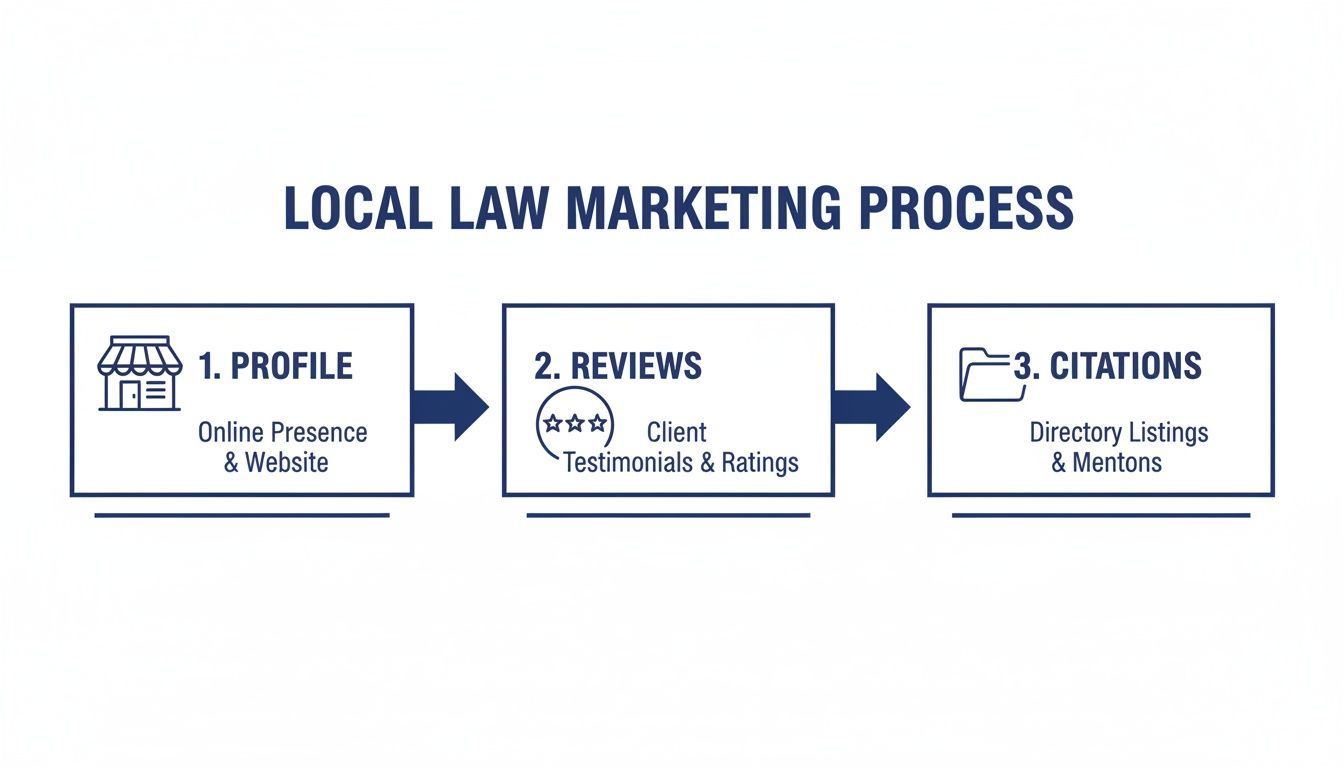
Think of it this way: a strong local foundation gives Google more signals that you're a legitimate, authoritative choice, which can actually help your ads perform better.
Re-Engage High-Intent Prospects with Remarketing
Let's be realistic: a potential client rarely hires the first lawyer they find. They’re overwhelmed, researching multiple firms, and simply not ready to pick up the phone on their first visit to your website.
Remarketing is the strategy that keeps your firm in front of them during this critical decision-making window.
By adding a tracking pixel to your website, you can show targeted, subtle ads to people who visited your site but didn't contact you. These ads follow them across other websites they visit and social media platforms, serving as a gentle reminder of your firm and its expertise. It's a simple but incredibly effective way to stay top-of-mind without being pushy.
By getting these pieces right, you can turn your paid advertising from an expensive gamble into a reliable, scalable system for acquiring new clients. If you're ready to put these strategies into motion, learn more about our dedicated services for AI-powered Google Ads and SEO.
Humanizing Your Firm with Social Media and Video

In family law, trust is everything. Before a prospective client ever looks at your credentials or case history, they’re searching for a human connection. They need to know you understand the emotional turmoil they’re facing.
This is exactly where social media and video marketing stop being optional and become a core part of your client acquisition strategy. These platforms give you a way to show the real people behind the law firm, building rapport at scale by offering a genuine look at your firm's personality and values.
Ultimately, it’s about creating a presence that feels supportive and approachable. You want to be the firm clients feel comfortable with when they’re at their most vulnerable.
Choosing Platforms With Purpose
Not every social media channel is the right fit for a family lawyer. A scattergun approach will just burn time and money. Instead, you need to focus your energy where you can build the most professional credibility and trust.
LinkedIn for Professional Authority: This is your digital handshake. Use it to share articles on emerging family law trends, connect with other local professionals (think therapists or financial planners who could be great referral sources), and post your own analysis on legal developments. This cements your position as a serious, knowledgeable expert.
Facebook for Community Connection: Think of your Facebook page as a local resource hub. Share genuinely helpful content—not just ads for your firm. Post links to co-parenting articles, guides for managing divorce-related stress, or simple explainers on local court procedures. You’ll position yourself as a helpful guide for the entire community.
Each channel has a different role, but they both work toward the same goal: building a brand that is both authoritative and empathetic.
Creating Video Content That Connects
Video is, without a doubt, the most powerful tool you have for humanizing your firm. It’s the next best thing to a face-to-face meeting, allowing potential clients to hear your voice and get a feel for your personality before they even pick up the phone.
The trick is to create content that showcases your expertise without ever giving specific legal advice or breaching client confidentiality. When you're thinking about your video strategy, it helps to understand the different formats, like those covered in this TikTok vs. YouTube Shorts comparison. Short-form video is fantastic for breaking down complex topics into quick, easy-to-understand clips.
Video marketing for attorneys isn't about going viral. It's about building familiarity and trust. A simple, well-lit video of you clearly explaining a legal concept can be far more powerful than a slick, high-budget commercial because it feels real.
Here are a few practical video ideas that build trust while respecting privacy:
- Process Explainer Videos: Shoot a 60-second video on "What to Expect at Your First Custody Mediation" or "The 3 Stages of a Collaborative Divorce." These demystify the process and ease anxiety.
- Attorney Q&A Sessions: Film your attorneys answering common, non-case-specific questions. Think "What's the difference between marital and separate property?" or "How is child support calculated in our state?"
- "Meet the Team" Shorts: Create short, personable intros for your paralegals and support staff. Making the entire team feel more approachable can be a huge differentiator.
By consistently sharing valuable, human-centric content, you turn your social media from a simple marketing channel into a powerful trust-building engine. This strategy doesn't just bring in more leads; it brings in the right leads—people who already feel a connection to your firm. For a deeper dive, check out our detailed guide on creating effective attorney marketing videos.
Turning Leads Into Clients and Proving Your ROI
Getting a steady stream of leads is only half the battle. Seriously. The most brilliant marketing campaign for a family lawyer falls completely flat if your firm can’t actually turn those calls and emails into retained clients.
This is where the rubber meets the road—where your process and your people transform a potential client's anxious click into a signed retainer agreement.
A clunky or slow intake process is one of the fastest ways to lose a high-value case. Think about it: when someone is facing a family crisis, their patience is paper-thin. They need reassurance and a clear path forward, and they need it now. Your internal systems become just as important as your legal chops.
Refining Your Client Intake System
The second a lead reaches out, a clock starts ticking. Your response time, professionalism, and ability to convey genuine empathy immediately set the tone for the entire relationship. A solid client intake system ensures no one ever falls through the cracks.
- Get a CRM. Now. A Client Relationship Management (CRM) tool is non-negotiable in 2024. It tracks every single interaction—from the initial phone call or form submission to every follow-up email—so you can deliver a seamless, professional experience.
- Train Your Team for Empathy, Not Just Information. The first person a lead speaks to is rarely an attorney. You absolutely have to train your intake specialists to handle sensitive, emotional calls with compassion. Their job is to gather the necessary details without sounding like a robot reading from a script.
- Automate the Small Stuff. Use simple automated emails to confirm you received an inquiry and let the person know exactly when they can expect a call back. This small step provides immediate reassurance and shows you're on top of things.
The quality of your client intake process is a direct reflection of the client experience you provide. A seamless, empathetic first contact builds the foundational trust necessary to win the case before you’ve even discussed its merits.
Proving Your Marketing ROI
“So, is this marketing stuff actually working?” It's the question every firm principal asks. The answer shouldn't be a gut feeling.
By tracking the right Key Performance Indicators (KPIs), you can stop just spending money on marketing and start making strategic investments with a clear, measurable return. Forget vanity metrics like clicks or website visitors. You need to drill down into the data that directly impacts your firm's bottom line.
Key Metrics That Actually Matter
| Metric | Why It Matters | How to Track It |
|---|---|---|
| Cost Per Qualified Lead | This shows you how much you're spending to get a viable potential client, not just a random tire-kicker. | Use your CRM and call tracking to tag the source of every lead that meets your ideal client criteria. |
| Client Acquisition Cost (CAC) | This is the ultimate number. It’s your total marketing spend divided by the number of new clients signed. No hiding from this one. | Add up all marketing costs (ad spend, agency fees, etc.) over a set period and divide by the new clients you signed. |
| Conversion Rate | This reveals the percentage of leads that become clients, putting a spotlight on the effectiveness of your intake process. | Track the number of leads vs. the number of signed retainers from each specific marketing channel (e.g., Google Ads, SEO). |
The global family law market is projected to hit an incredible $43.8 billion by 2025, and there's immense opportunity for firms that get this right. You can see more details about these market trends on KentleyInsights.com.
By tracking these KPIs, your firm can strategically capture its share of this growing market. Data-driven decisions allow you to double down on what’s working and cut what isn't, plain and simple. If you want to dive deeper, check out our guide on measuring advertising effectiveness for a more detailed analysis.
Common Marketing Questions I Hear from Family Lawyers
I talk to family law attorneys every day. Most know they need a better marketing plan, but they're getting hit with so much conflicting advice that it's tough to see the right path forward. It’s completely normal to have questions when you're making these kinds of decisions for your firm's future.
Let's cut through the noise and tackle the big questions I hear all the time.
How Much Should I Actually Be Spending on Ads?
There's no single magic number, but most healthy firms we see are investing somewhere in the ballpark of 7-12% of their gross revenue back into marketing.
But honestly, picking a percentage is the wrong way to look at it. The smart money works backward from the goal.
First, figure out how many new cases you need to hit your revenue targets. Then, determine what a single case is worth to your firm. This lets you calculate a target Client Acquisition Cost (CAC). If you know you can profitably acquire a new client for $1,500, you can set your Google Ads budget with confidence, knowing exactly what kind of return you're aiming for. It turns marketing from a guessing game into a predictable system.
Should I Focus on SEO or Paid Ads?
This is the classic question, and the answer is almost always: both. They just do different jobs.
- SEO is your long-term asset. Think of it like buying your office building instead of renting. It takes time and effort to build, but once you have that organic authority, it generates a consistent stream of high-quality leads at a much lower cost over time. It's the foundation.
- Paid Ads are your on-demand lead source. They get your phone ringing right now. This is perfect for filling your pipeline quickly, targeting a very specific high-value case type, or getting immediate traction while your SEO efforts are still building momentum.
My advice is always to build the SEO foundation from day one, then layer in paid ads to accelerate your growth and hit your short-term goals. Over time, as your SEO gets stronger, you can often pull back on ad spend without seeing a drop in leads.
I see too many attorneys view marketing as just another expense on the P&L. The ones who win treat it as a strategic investment. The entire game is knowing which levers to pull—SEO for sustainable authority and ads for immediate results—to generate a predictable return for the firm.
What Do I Do When I Get a Negative Online Review?
First, take a breath. Don't panic, and definitely don't ignore it. A bad review feels personal, but it’s actually a golden opportunity to show every future client how professional you are.
The key is to respond quickly, politely, and get the conversation offline immediately. Never get into a public back-and-forth.
Here’s a simple script that works every time: "Thank you for sharing your feedback. We take client concerns very seriously and would like to discuss this with you directly. Please contact our office at your convenience."
That's it. This response shows prospective clients that you're responsive and accountable without ever getting into specifics or violating confidentiality. A single negative review, handled with class, can actually build more trust than a page full of five-star ratings with no context.
At Case Quota, we build these kinds of comprehensive, results-driven marketing strategies for family law firms day in and day out. If you're ready for a plan that delivers predictable growth, learn more about how we can help.